Projects
Note: if you have lots of information, create a special page for it!
Note 2: images need to be uploaded somewhere and then linked here. I know this is inconvenient, so next time I'll find a little more friendly system. You can send me your info if you like and I'll update the wiki.

This Hack is a inverted surveillance system, a transparent camera that makes invisible the ones that pass through it’s field of view. It’s an anonymous spot in the public space, an island of freedom. The massive application of this concept in the streets will produce very interesting results. This new enviroment of anonymous freedom will make people behave in different and new ways as we are used to see. But we will not see them, because they are invisible...
More info on: Invisibility Surveillance Camera
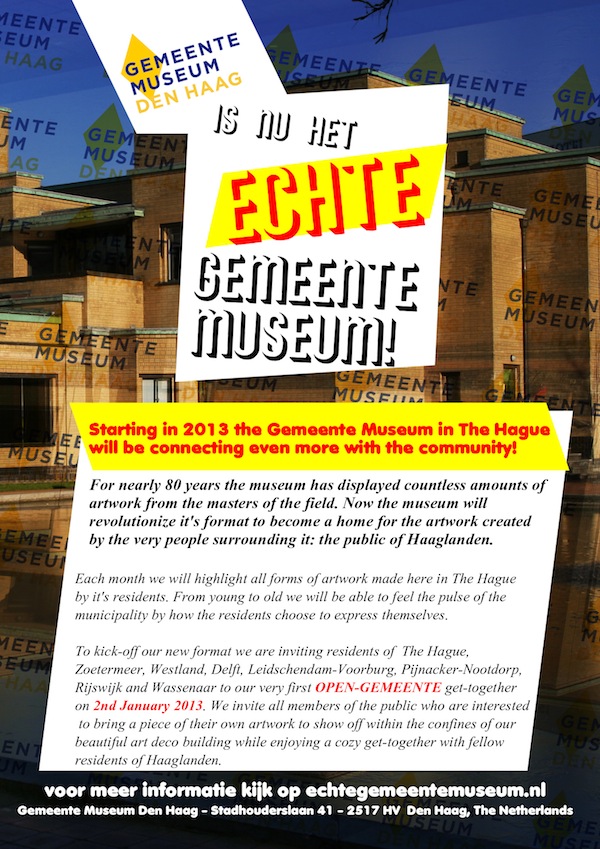
What if the Gemeente Museum (English: Municipal Museum)in Den Haag (the Netherlands) decided to change their format completely from that of showing works from various masters of art to that of showing artwork done by the actual people who live in the municipality of Haaglanden (which includes the Hague and a number of other small cities and towns)?. What if the way they introduced this concept was to invite the public to show up with their works and come together in a kind of town-meeting meets party meets art-exchange type event? Would this reduce the "quality" the museum strives for? Would this actually reflect the feeling and true "pulse" of the municipality? Would the public of the municipality have a renewed interest in the museum?
In class I presented a short slide show with a cultural hack that I did in Cardiff Wales. I posed as an artist participating in Experimentica 2012 performance festival, and was allowed to participate in a live radio show. Only when we were on air did I reveal that my proposal for the festival was rejected.

The posters show pictures of people anonymously shot from the neck down. They are holding paper sheets displaying their stories in few sentences in their hands. All the experiences are related to rumors about HIV/AIDS and their results. By addressing the problems to public space awareness in thinking and acting is supposed to be created. In this way an open discourse creating changes in attitudes can evolve. The reactions (public dicussion about rumors and young people went to HIV Tests) on the campaign show that it does have a certain impact. In another step we attempt to broaden the sphere of influence.
In the movie four women speak about their lives. Not all of them are infected but they made experiences with HIV/AIDS that changed their lives. Comprehensibly expressed HIV doesn't only appear in the form of a virus but in peoples fear as well. The rumors circulating in the area have negative effects on the society, Tabooing, stigmatisation and violence are the results the women got confronted with. Social workers speak about the experiences they made with their work. Despite positive tendencies the fear of people remains a strong opponent in the fight against HIV/AIDS.
We pursue a communication strategy based on changing attitudes towards a certain topic without being missionary. We believe that changes in thinking in a community can only originate from the very community and take time.
Trailer: http://vimeo.com/42765138 Website: http://www.whisperdownthelane.com
Hacking in progress, documentation follows.
On November 13, we went with some of the C(ultural) HACK(ing) ArtScience students to the Clioplein in The Hague.
What immediately jumped into my head was the philosophical architectonic principle described by the English philosopher Jeremy Bentham. A panoptic building consists of a tower with rings of cells around it. They have two windows: one on the outside and one to the tower. One supervisor in the tower is sufficient enough to monitor, identify and manage all the residents. The panopticon is part of an ordered society that makes everything visible and controlled. The model operates in institutions that people form and socialize. According to Bentham, it is useful "to know and master the overall living conditions of a certain number of people"
The whole complex in The Hague seemed built with safety in mind. Next to the clioplein there was a huge keyhole.
On the clioplein I found an indication for a parking place with HELICON on.
A plan for a cultural hack seemed clear.
For a simple unobserved Cultural Hack I had to remove the letters H, E and L, and instead add A, N, O, P, T.


So I did => two days later I was subtly scratching off the three letters.
Half of the letter H was loose, when suddenly a ferocious inhabitant of the clioplein came up to me:
- "WHAT ARE YOU DOING?!" He asked.
- "I like the texture, it's interesting." I responded.
- "IF ANYTHING HAPPENS TO THE DOOR I KNOW HOW I CAN FIND YOU, BELGIAN BOY"
- "THERE IS A CAMERA THERE AND THERE" he showed me in a brutal way.
Totally impressed I got out of the panopticon and realized that there is no central guard in a 21th century panoticon. The panopticon reversed so it seemed. All the inhabitants in the circle are controlling their neighbours and the central square now.
a choreographed space moving throughout the KABK building. Video coming soon. Please read more here.
In the Netherlands, all public phone booths have been removed in 2011. A private company is now exploiting some booths in bigger cities, but they go unnoticed because they double as advertising abris. Through a hack I want to draw attention to these kind of obsolete spaces of static vintage communication teleportals as opposed to the very much integrated ‘life is all dynamics’ style of mobile devices everywhere. The initial plan was to call the booth itself, and to play a sonic message to the curious passer-by who answers the phone. After contacting RBL Telecom, they stated that it is not possible to call their phones, because the machines have no ringer installed (and a top secret number). Unnoticed and silent – I figured adding the sound of a phone ringing would already have some effect… (to be continued, testing on December 6).