Find the red gaps in your detection coverage.
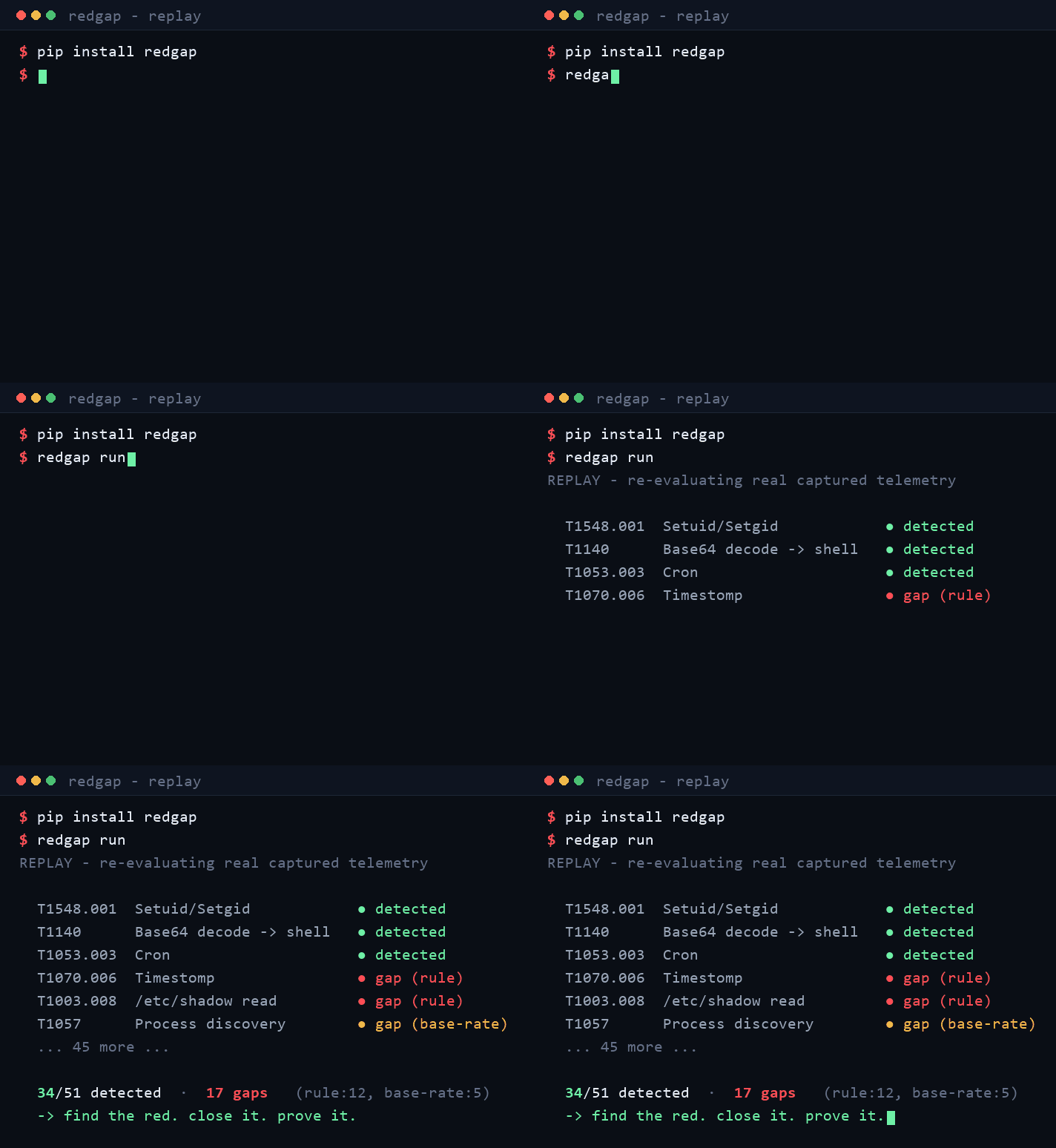
RedGap is an automated, MITRE ATT&CK-mapped offense↔detection coverage harness. It runs 51 benign ATT&CK techniques (across 11 tactics) against its own disposable local lab, collects real telemetry with an independent collector, and then deterministically - from logs and Sigma rules, with no AI in the loop - decides whether each technique was detected or is a gap. Point it at your own Sigma rules with redgap audit --rules and it grades them the same way. The output is a coverage report (technique → detected? → gap type) plus an ATT&CK Navigator layer and a per-rule health scorecard.
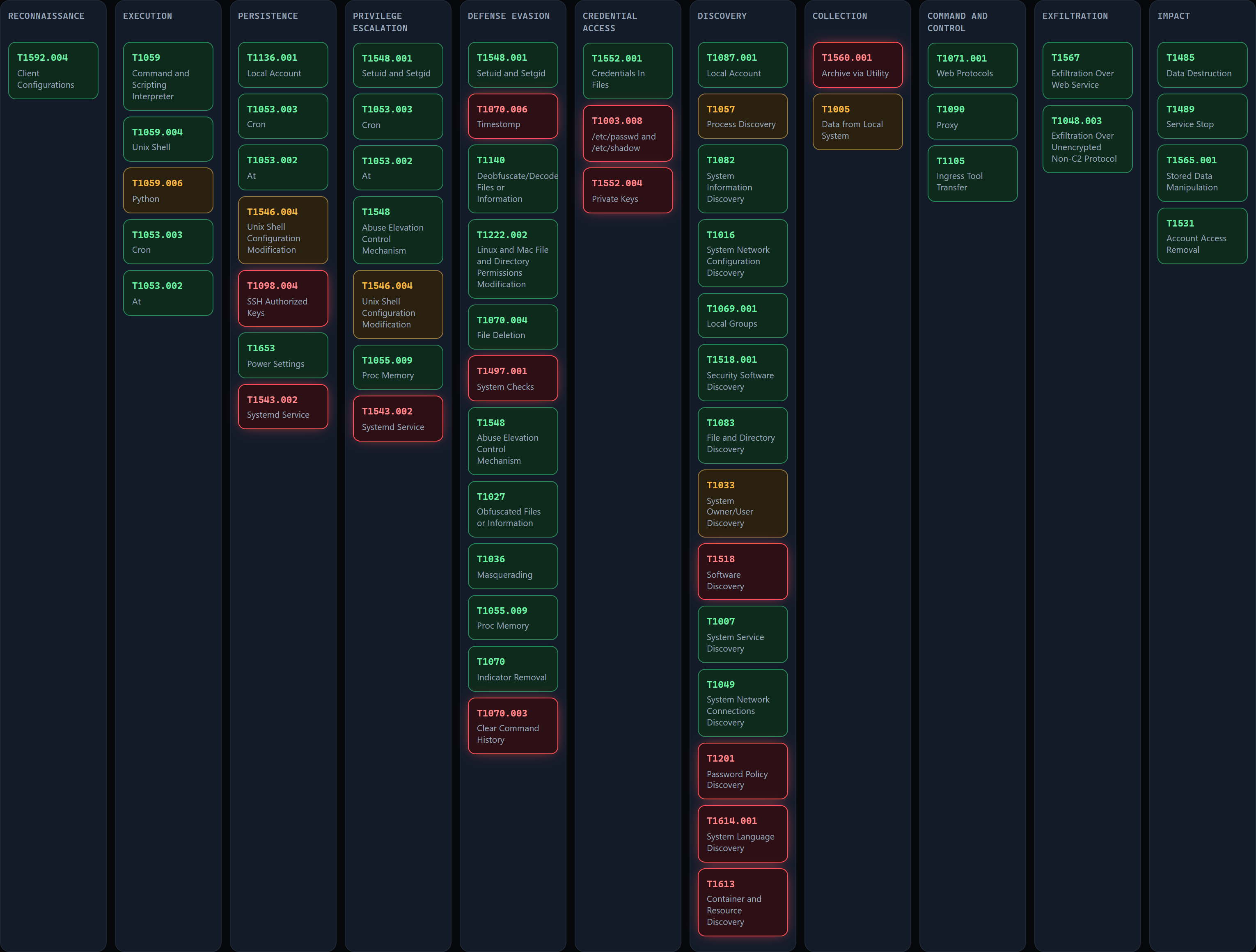
The name is the output: in the coverage grid, detected techniques are green and gaps are red. RedGap finds the red.


v1.0 - what this is and is not. RedGap is a deterministic harness over a fixed set of techniques. It is not an autonomous agent that continuously attacks and adapts. Adaptive, gap-driven technique chaining (the agent choosing its next attack from the last result) is the honest next step, tracked on the roadmap. Precise scope on purpose.
Status. RedGap's own parser + evaluator ingests all 122 real SigmaHQ linux/process_creation rules with zero parser errors and zero evaluator crashes - that ruleset is vendored under tests/corpus/ and checked by test_sigmahq_corpus.py, so the claim is reproducible, not asserted. 333 tests run fully offline in CI. Coverage is computed from 51 committed real-telemetry captures - one per technique, each with a raw log + parsed events + sha256 provenance - not authored logs; the default run detects 34/51 across 11 ATT&CK tactics. See docs/architecture.md · committed output in docs/samples/.
Every detected verdict is a pure function of (logs, rules), computed and written to disk before any language model is ever called. An optional LLM planner may (a) choose the order of techniques and decide when to stop, and (b) narrate the report. It cannot decide whether something was detected - both the deterministic and the LLM planner return the engine's coverage, never model text. A test asserts the coverage report is byte-identical with and without the LLM.
This is deliberate. LLMs hallucinate confident verdicts; a coverage tool whose ground truth an LLM can fabricate is worthless. RedGap draws the trust boundary in code.
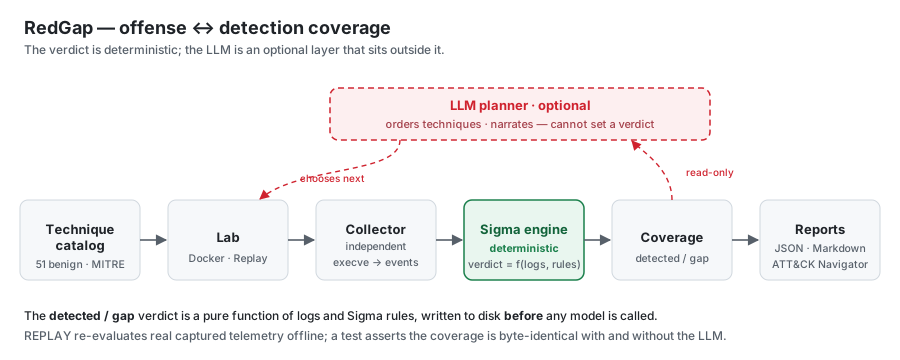
The verdict is a pure function of logs and rules, written to disk before any model runs. The LLM (dashed red) can only order techniques and narrate - it sits outside the verdict path.
The default path is REPLAY: it re-evaluates real telemetry captured from a prior live run (committed as fixtures with provenance) through the exact same engine used in LIVE mode. No Docker, no key, no network.
pip install redgap
redgap run            # REPLAY: prints the coverage table + writes out/coverage.{json,md} + navigator-layer.json
From source instead (or before the first PyPI release):
git clone https://github.com/befnoz/redgap && cd redgap
pip install -e .
redgap run
Live dashboard: the same coverage, as an interactive web page - https://befnoz.github.io/redgap/. Drop your own out/coverage.json on it to render your gap grid entirely in the browser (nothing is uploaded). See docs/DEPLOY.md to switch it on.
To run the real thing against the local Docker lab:
redgap run --live # brings up the disposable lab, executes techniques, captures fresh telemetryTo try the optional LLM planner (needs the llm extra and ANTHROPIC_API_KEY):
pip install -e ".[llm]"    # adds the optional anthropic SDK
redgap run --llm           # equivalently: COVERAGE_LLM=1 redgap run
The committed coverage.json is identical whichever planner ran - a test asserts it.
A run executes 51 benign techniques across 11 ATT&CK tactics and produces a real coverage grid: 34 detected · 17 gaps (12 rule, 5 base-rate). Every verdict is computed by the engine from captured telemetry against real SigmaHQ rules - see the live grid at the dashboard (click any technique for its real telemetry, the rule, and why) or docs/samples/. The original kill-chain below is the illustrative core, showing both kinds of gap and the remediation round-trip:
| # | ATT&CK | Tactic | Result |
|---|---|---|---|
| 1 | T1087.001 Account Discovery: Local | Discovery | detected |
| 2 | T1057 Process Discovery | Discovery | gap (base-rate) - too noisy for a single-event rule; needs correlation (roadmap) |
| 3 | T1136.001 Create Account: Local | Persistence | detected |
| 4 | T1548.001 Setuid/Setgid | Priv. Esc / Defense Evasion | detected (matches a shipped SigmaHQ rule) |
| 5 | T1070.006 Timestomp | Defense Evasion | gap (rule) → closed live in the remediation round-trip |
The remediation round-trip is the point: 12 of the 17 gaps are rule gaps - real telemetry, no rule firing. Write the missing rules, re-run, and every one flips red→green (redgap run --fix → 46/51, leaving only the 5 base-rate gaps that honestly need correlation, not a single-event rule). Both the before and after coverage reports are committed - RedGap finds real blind spots and closes them, not a status printer.
The same coverage as an interactive page - befnoz.github.io/redgap. The full ATT&CK grid, detected in green, rule-gaps in red, base-rate gaps in amber:
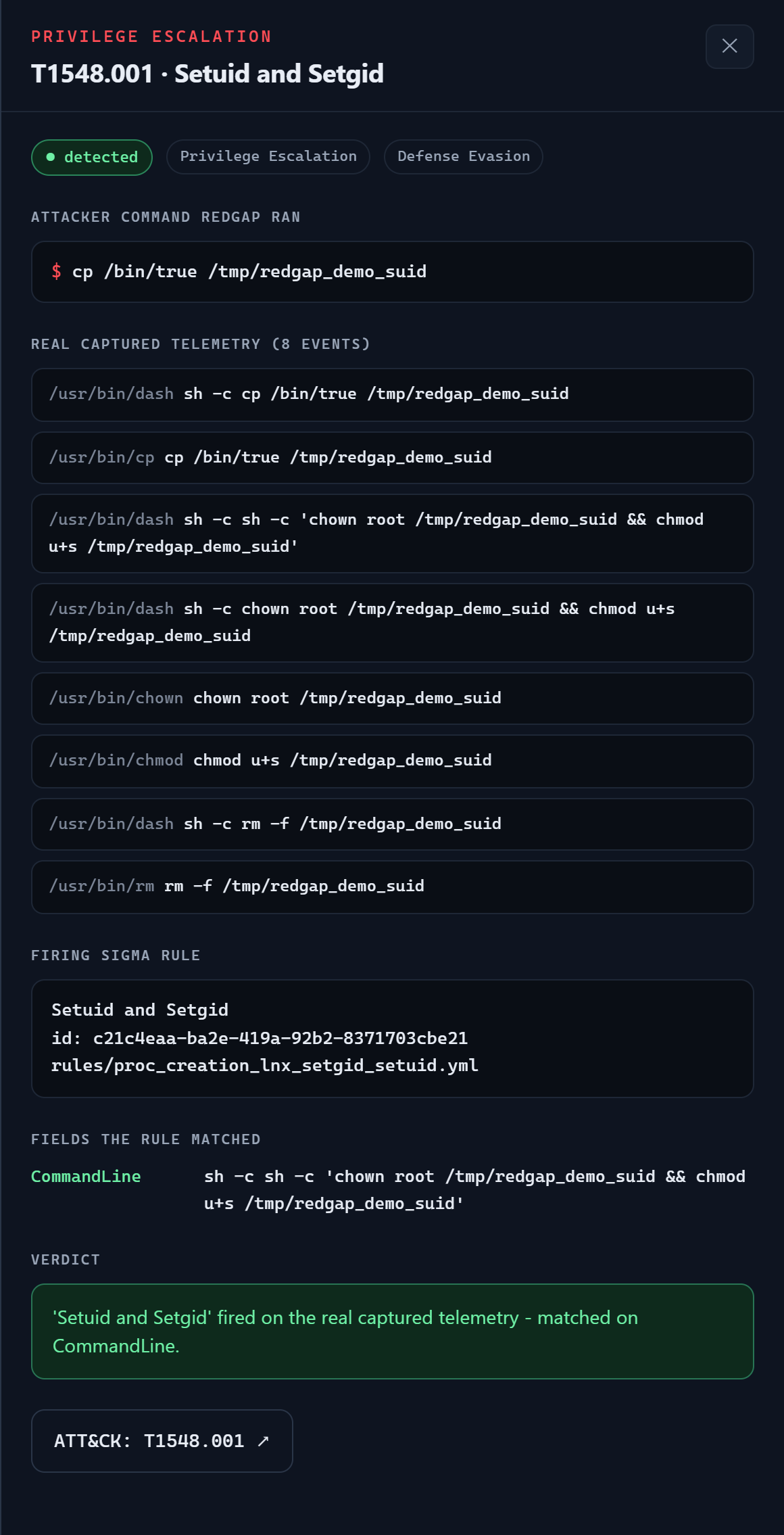
Click any technique and the Detection Playground opens the real evidence behind the verdict - the attacker command RedGap ran, the captured telemetry, the firing Sigma rule, and the exact fields it matched:
Drop your own out/coverage.json on the page to render your gap grid entirely in the browser - nothing is uploaded.
RedGap ships a demo rule set, but the real workflow is your rules. Point it at your own Sigma directory and it scores every one of RedGap's real-telemetry techniques against them, fully offline:
redgap audit --rules ./my-sigma/                    # your ATT&CK coverage + a rule-health scorecard
redgap audit --rules ./my-sigma/ --fail-under 20    # CI gate: fail the build if coverage drops below N
You get your own coverage grid (drops straight into ATT&CK Navigator) plus a per-rule scorecard that buckets every rule you own:
- firing - matched real captured telemetry, with the exact event and fields as evidence.
- SILENT - tagged to a technique but never fires on real exec data: false confidence. A rule can pass
sigma check(static validation lints the rule text and its tags) and even match a sample log its author wrote, yet still do nothing on real captured telemetry - and neither static validation nor an author-written test runs the rule against independently captured events, so neither can surface it. - out-of-corpus / unevaluable - reported honestly, never scored pass/fail.
Every classification is a boolean from the same deterministic (events, rules) engine - no model ever touches it.
See it catch a SILENT rule. examples/my-sigma/ ships three rules - one that fires, one tagged-but-silent, one out-of-corpus. Run it against RedGap's real telemetry:
redgap audit --rules examples/my-sigma(examples/ lives in the source tree, not the installed wheel - run this from a git clone of the repo, or pip install -e ..)
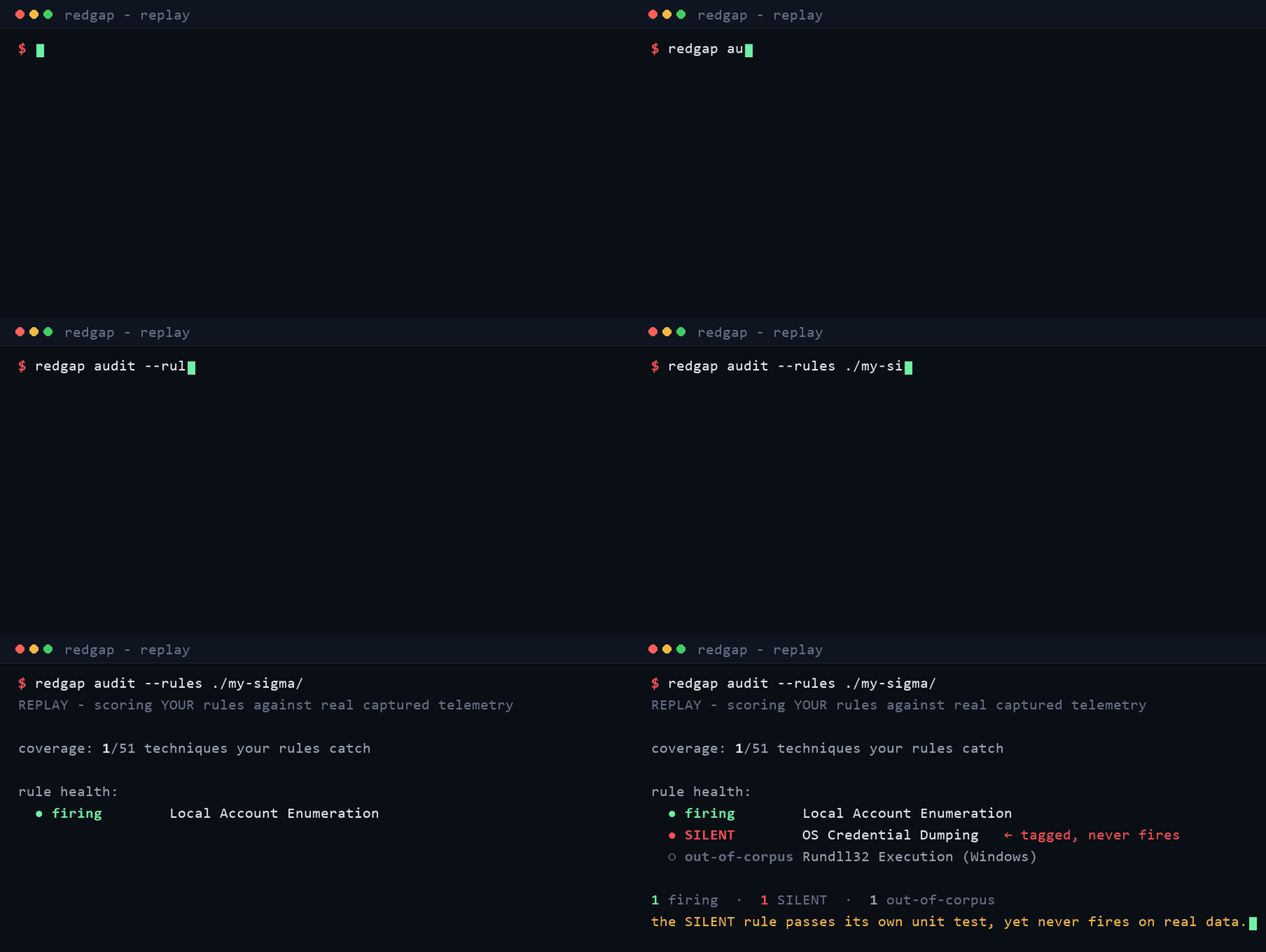
The OS Credential Dumping rule looks like coverage - it is tagged to the right technique and passes static validation - yet it never fires on real Linux telemetry (it only matches a Windows tool name). That is the SILENT bucket: false confidence that linting the rule text cannot surface, because it never runs the rule against real events.
RedGap does not replace the tools below - it closes a loop each of them leaves open, and because its rules are standard Sigma they run inside the detection tools unchanged. The honest picture:
| Capability | sigma-cli |
Atomic Red Team | Zircolite | RedGap |
|---|---|---|---|---|
| Executes benign ATT&CK techniques | - | ✅ (hundreds, cross-platform) | - | ✅ (51, local lab) |
| Captures telemetry with its own collector | - | - (your EDR does) | - (you supply logs) | ✅ |
| Runs Sigma rules against real events | - (lints / converts rule text) | - | ✅ | ✅ |
| Emits a detected-vs-gap coverage verdict | - | - | - | ✅ |
| Flags SILENT rules (pass validation, never fire) | - | - | - | ✅ |
| Gap taxonomy (rule vs base-rate) | - | - | - | ✅ |
They are complementary, not competitors. sigma-cli lints (sigma check) and converts
(sigma convert) your rules but never runs them against events; Atomic Red Team is a far
larger cross-platform attack
library that generates real telemetry for your own EDR to judge; Zircolite runs Sigma at
forensic speed over logs you already have - and since RedGap's rules are plain Sigma, they
run unchanged in Zircolite. RedGap's niche is closing the whole loop deterministically for
a fixed technique set, which is what lets it compute coverage and surface the SILENT rules
the others have no reason to look for.
assert_lab_only) that the test suite proves cannot be widened. Every technique is a benign, published Atomic-Red-Team-derived detection test with no exploit payload, no off-box action, and no runtime downloads. See ETHICS.md, SCOPE.md, and SECURITY.md.
Not shipped: weaponizable breadth, real exploits, credential material, or anything that runs against a system you do not own.
- Adaptive, gap-driven technique chaining (agent picks the next attack from the last verdict).
- Effect / syscall-level detection (e.g.
utimensatfor timestomp) via a higher-fidelity collector. - Correlation rules (turn the base-rate gap into a real detection).
- Portability: the rules are standard Sigma, so they already run unchanged in Zircolite or any SIEM.
MIT - see LICENSE. Third-party attributions in NOTICE. ATT&CK® is a registered trademark of The MITRE Corporation.