Architecture
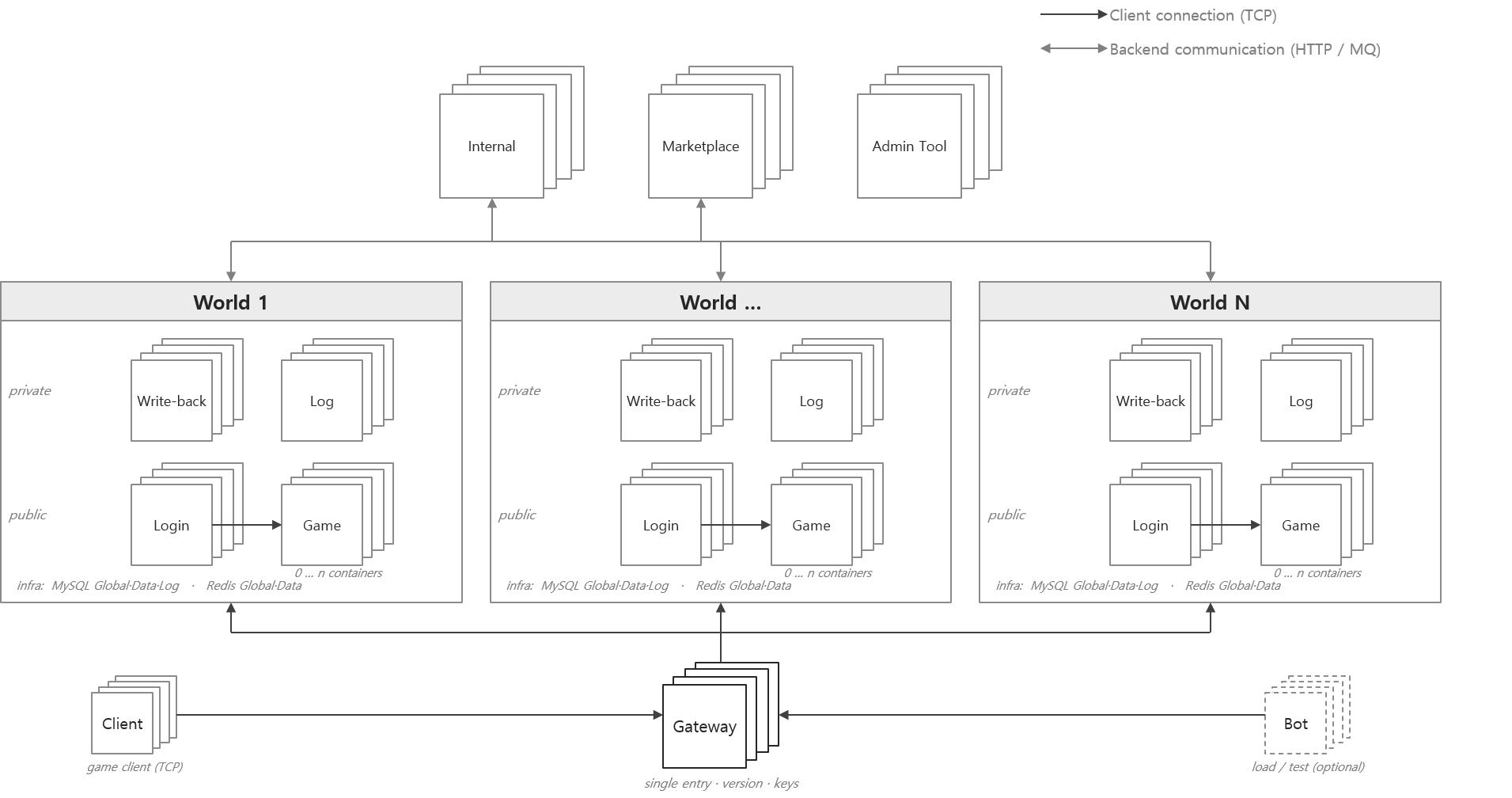
The server is organized around worlds: each world has its own data and services, while some services are shared across all worlds.
Legend (diagram): solid arrows are client TCP connections; double-headed arrows are backend communication (HTTP / RabbitMQ).
- Client / Bot → Gateway (TCP): version check, encryption keys, world and login server list.
- Gateway → Login (TCP, per world): account authentication and character management.
- Login → Game (TCP transfer): after Internal resolves the target game host, Login hands off the session to the correct Game container. The client then plays on Game directly.
Backend services use HTTP + FlatBuffer; events and write-back use RabbitMQ; hot data is cached in Redis.
- Gateway: Single entry point for clients and bots. Routes players to the chosen world's Login servers.
- Internal: Central HTTP service for accounts, characters, clans, parties, mail, bans, sessions, and cache. Publishes world-scoped notifications via RabbitMQ (Internal). Uses unified and per-world databases.
- Marketplace: Shared in-game marketplace for all worlds. Uses unified MySQL.
- Admin Tool: Blazor Server web UI for operators.
Unified infrastructure (shared, not shown as a separate box in the diagram): unified MySQL, unified Redis, and two RabbitMQ clusters — Internal (service events, write-back) and Log (structured logs).
Each world (World 1 … World N) has three layers, as shown in the diagram:
-
MySQL: Global, Data (sharded by
id % shard_count), and Log databases. - Redis: Global and Data shard caches. Internal reads/writes cache; Write-back persists to MySQL.
- Write-back: Consumes write-back messages from RabbitMQ, reads Redis, and writes to that world's MySQL (Global/Data).
- Log: Consumes log messages from RabbitMQ (Log) and writes to that world's MySQL (Log).
- Login: Account tasks (character creation, password changes). Communicates with Internal over HTTP; transfers clients to Game over TCP.
- Game: Game logic and sessions. Multiple containers (0 … n) per world, each identified by a host ID. A container loads only maps assigned to its host.