This project focuses on predicting tags for the XCodeval dataset using Modern BERT and GPT.
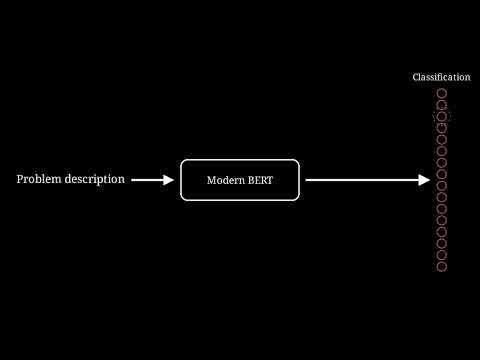
- Dataset: XCodeval
- Task: Multi-label tag classification
- Model Used: Modern BERT (Base) - GPT (open AI)
- Best Macro F1:
0.81Modern BERT
chmod +x install.sh

./install.sh

source venv/bin/activate

uvicorn server:app --host 0.0.0.0 --port 8000

curl http://localhost:8000/health

python predict.py --from-dataprep --n  10 --server http://localhost:8000
Now The link of mlflow in the predict.py file will change , it is tight to the dns of AWS EC2 instance , and also you should be an AWS user that have access to my S3 bucket. We can check this at anytime drop a message.
- Loads and cleans the XCodeval dataset.
- Saves the cleaned version as
my_data.csv.
-
Colab Stage:
Initial experiments and hyperparameter sweeps on Google Colab (T4 GPU). -
RunPod Stage:
When Colab hit usage limits, we migrated to RunPod.io — renting NVIDIA A5000 GPUs for full-scale fine-tuning.
A robust cloud-based architecture was implemented to manage and track all experiments using MLflow and AWS services.
-
Compute Layer:
- Training initiated from Google Colab or RunPod for scalable GPU usage.
- RunPod instances handle large-scale fine-tuning with A5000 GPUs.
-
Tracking & Storage:
- MLflow Server hosted on an AWS EC2 instance for centralized experiment tracking.
- PostgreSQL (RDS) acts as the MLflow backend to store metrics, hyperparameters, and model metadata.
- S3 Bucket used as the artifact store for model checkpoints and logs.
-
Connectivity & Access:
- MLflow server accessible at:
http://ec2-13-60-228-74.eu-north-1.compute.amazonaws.com:5000/
- MLflow server accessible at:
-
Pipeline Flow:
- Model training executed on RunPod with MLflow tracking enabled.
- MLflow server logs all metrics to PostgreSQL and uploads artifacts to S3.
The following diagram illustrates the system flow between RunPod, and AWS services:

The code for the Simulation is in the manim directory. You can do it on your own !