

$ kubectl get nodes -owide
NAME                   STATUS   ROLES                  AGE     VERSION               INTERNAL-IP     OS-IMAGE                         KERNEL-VERSION         CONTAINER-RUNTIME
k3s-server             Ready    control-plane,master   546d    v1.31.1+k3s1          192.168.0.103   Debian GNU/Linux 12 (bookworm)   6.12.34+rpt-rpi-2712   containerd://1.7.21-k3s2
clusterpi-worker1      Ready    <none>                 546d    v1.31.1+k3s1          192.168.0.188   Debian GNU/Linux 12 (bookworm)   6.12.34+rpt-rpi-v8     containerd://1.7.21-k3s2
esp-node-01-guenther   Ready    <none>                 4m53s   v1.31.1-picokubelet   192.168.0.111   picokubelet on bare metal        esp-rs-no_std          lies://0.1.0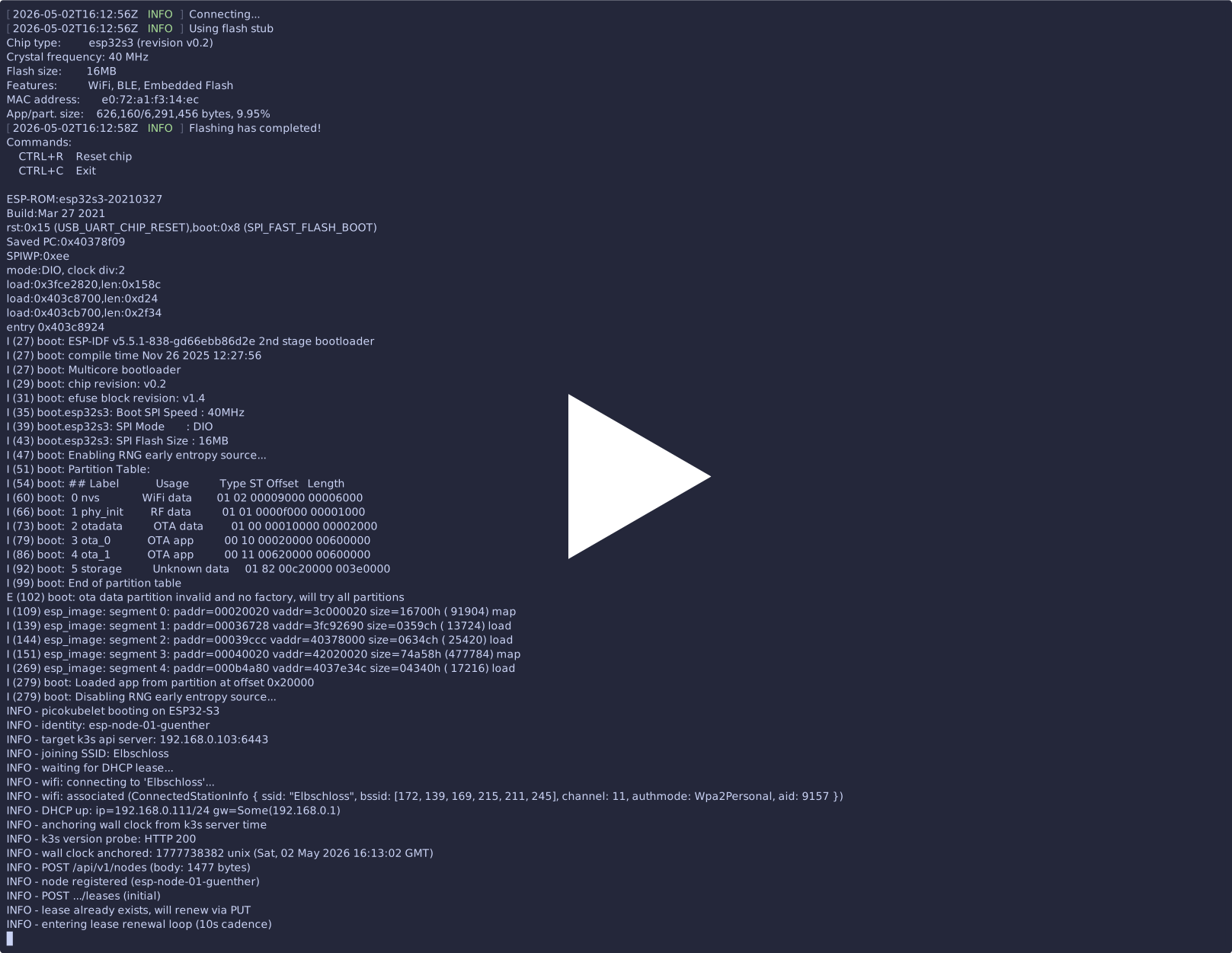

picokubelet is a Kubernetes kubelet, written in Rust, targeting the ESP32-S3. It boots, gets a DHCP lease over Wi-Fi, talks TLS to a real k3s API server, registers itself as a node, and renews its lease so the control plane keeps believing it. As far as the cluster is concerned, it is a worker.
The hardware is a Waveshare ESP32-S3-ETH: an ESP32-S3R8 with a W5500 Ethernet controller on SPI, optionally PoE-powered. The control plane is a k3s instance on a Raspberry Pi. Nothing about that combination is unusual on its own; the unusual part is what's at the other end of the SPI bus.
It exists because nobody had told the ESP32 it couldn't.
Real:
- Wi-Fi association, DHCP, and TLS to a real k3s API server. (PoE+Ethernet via the on-board W5500 is the intended production form factor; the code path isn't there yet, so dev currently runs over Wi-Fi.)
- Wall-clock anchoring from the
Dateheader on the first/versionresponse. The board has no RTC, only vibes. Noderegistration viaPOST /api/v1/nodes, with capacity advertised honestly:cpu: 240m,memory: 320Ki, archxtensa-lx7, OSno_std.- Lease creation in
kube-node-lease, plus renewal at a 10s cadence with a 40s lease duration. /statussubresource PATCH on a 5min cadence, or immediately whenever any tracked condition flips.MemoryPressuredriven by actual ESP heap free bytes; flips True below 20KB free.lastTransitionTimesemantics: only updated when a condition'sstatusfield actually flips, not on every heartbeat. Conflating the two is a real-kubelet anti-pattern that makes nodes look flappy in monitoring.- A
node.specht.dev/heap-bytes-freeannotation on the main resource that updates with each status push. - Five custom joke-but-honest conditions (
Vibes,Caffeinated,Existential,Peckish,Haunted) derived from real state (heap %, uptime, lifetime renewal count, Wi-Fi reconnects, BSSID changes, wall-vs-monotonic skew) and surfaced throughkubectl describe node. - WS2812 status LED on GPIO 21, driven via RMT from a dedicated task, with
SelfTest,Booting,Connecting,Healthy, andActivitypatterns.
Faked, by design:
- Pods. The kubelet does not yet watch
/api/v1/pods. Promtail has scheduled itself onto the node and sits inPending. That's the next phase of work. - Volumes,
exec, logs,kubectl exec, container runtime. None of these exist. The container runtime version is reported aslies://0.1.0. PIDPressureandDiskPressureare always reported as False. There are no PIDs, and there is no disk.
On the roadmap (in roughly this order):
- W5500 Ethernet swap. The board hardware is ready; the code path isn't.
- Pod theater: watching
/api/v1/pods?fieldSelector=spec.nodeName=…, accepting scheduled work, and walking pods through their status transitions on a timer without ever running anything. - OTA via OCI artifacts. The recursive joke being that the cluster deploys its own workers.
- The eight-node Tamagotchi rack. Boards on order.
At time of writing, esp-node-01-guenther has been Ready for consecutive lease renewals, including survival of a real BeaconTimeout event with RSSI -90 dBm. The reconciler architecture recovered without intervention; the lease counter continued unbroken through the reconnection.
- Wi-Fi disconnect and re-association: handled
- TLS connection reset mid-request: handled
- Routes vanishing while reconcilers fire: handled
- Waveshare ESP32-S3-ETH: ESP32-S3R8 plus a W5500, with an optional PoE module.
- A Raspberry Pi running k3s for the control plane. Any k3s install will do; the node doesn't care.
The ESP boots, brings up Wi-Fi via esp-radio, and lets embassy-net handle DHCP. Once it has an IP, kubelet::bootstrap walks through anchoring the wall clock from the /version Date header, registering the Node, creating the Lease, and pushing an initial status PATCH so every condition has a fresh lastHeartbeatTime out of the gate. The API server address, bearer token, and Wi-Fi credentials are baked in at compile time via env!, sourced from a .env file loaded by mise.
After bootstrap, two embassy tasks run the syncloop:
reconcilers::leasePATCHeskube-node-lease/<name>every 10s (against a 40s lease duration), recreates the Lease on 404, and drives the LED.reconcilers::statusPATCHes/api/v1/nodes/<name>/statusevery 5min (or immediately on any condition flip) and then PATCHes the heap-free annotation on the main resource.
Both tasks share a single ApiClient wrapped in an embassy_sync::Mutex, acquired briefly per request. The LED runs as its own independent task and listens on an embassy_sync::Signal, so it stays responsive even when the network code is mid-handshake. There is no CRI, no runtime, no network namespace; just JSON patches saying yes, this node is Ready, why do you ask.
Module map:
kubelet:NodeIdentityand the bootstrap sequence (anchor clock → register node → create lease → push initial status).k8s::{conditions, models}: per-condition tracker state, plus typed Kubernetes resource builders that own their own JSON serialisation (noserde; the bodies are short and fixed-shape).net::{wifi, http, client}: Wi-Fi controller task, the parsed HTTP response shape, and the TLS+HTTPApiClientbuilt onembedded-tls.reconcilers::{lease, status}: the two syncloop tasks.led: the WS2812 driver task.
The whole thing is built on embassy for async, embassy-net for the network stack, esp-radio for Wi-Fi, embedded-tls for TLS, and esp-hal for the chip.
This is shaped like a real kubelet's syncloop, smaller.
The Waveshare board has a single onboard WS2812 on GPIO 21. Firmware drives it from a dedicated embassy task over RMT channel 0, so the LED keeps animating even when the kubelet is mid-TLS handshake. Brightness is capped at ~15%; full power is genuinely painful indoors.
| Pattern | State |
|---|---|
| Red → green → blue → off, 200 ms each | Self-test at boot; confirms the LED is alive before anything else runs. |
| Solid dim white | Booting. Set after self-test, before network init. |
| Blue, ~1.5 Hz breathe | Connecting. Covers Wi-Fi association, DHCP, TLS handshake, node registration, and initial Lease creation. |
| Green, ~0.33 Hz breathe | Healthy. Set after the first successful Lease renewal; Lease creation alone isn't enough. |
| Yellow flash, 100 ms | Lease renewal heartbeat, every ~10 s, overlaid on the green breathe. |
Warning, Disconnected, and Panic exist as enum variants but currently render to off. They're reserved for phases when error handling is built out enough to drive them honestly; an LED that lies under stress is worse than one that goes dark.
You will need the Espressif Rust toolchain. The repo uses mise to pin everything (espup, espflash, the Xtensa-aware Rust toolchain) so you don't have to reason about it.
mise install
cp .env.example .env   # set K3S_API_HOST, K3S_API_PORT, K3S_TOKEN, WIFI_SSID, WIFI_PSK, NODE_NAME
cargo build --release
espflash flash --monitor target/xtensa-esp32s3-none-elf/release/picokubelet
The dev loop currently runs over Wi-Fi; PoE+Ethernet via the on-board W5500 is the intended production setup but the code path isn't there yet. If you're new to Rust on Espressif chips, the esp-rs book is the right starting point. The Xtensa toolchain situation is what it is; espup makes it bearable.
Should I use this in production? No.
Why? It seemed like the obvious next step.
Why Rust?
The embedded Rust ecosystem on ESP32 (esp-hal, embassy, the embedded-hal traits) is currently the most pleasant way to write firmware. C would also work, in the same sense that you could also walk to the moon.
Does it run Doom? No, but a pod scheduled to it can claim to.
This wouldn't exist without the esp-rs working group, the Embassy project, and the maintainers of embassy-net-wiznet. All the actually-hard work (async on no_std, a TCP/IP stack that fits, a W5500 driver that doesn't lie about its DMA) is theirs. The novelty here is just pointing it at a Kubernetes cluster.
A Specht Labs project.
Licensed under either of MIT or Apache 2.0, at your option.