Use a GitHub repository as a lightweight document database.
GitDb stores JSON documents as files in a Git repository and talks to the GitHub REST API (Contents API for single documents, Git Data API for batched commits). Every write is a commit, so you get a full audit trail, diffs, pull-request review and rollbacks for free — with no server to run.
It is a good fit for configuration, seed data, small catalogues, feature flags, CMS-like content and demos. It is not a replacement for a real database; see Limitations.
pip install gitdb-pyWith the asyncio client:
pip install "gitdb-py[async]"From source:
pip install -e ".[dev]"Requires Python 3.9+ and requests; the async client additionally needs httpx.
import os
from gitdb import GitDb

db = GitDb(repo="owner/name", token=os.environ["GITHUB_TOKEN"], branch="main", root="data")
users = db.collection("users")

user_id = users.insert({"name": "Ada", "email": "ada@example.com"})  # -> generated id
users.get(user_id)  # -> dict | None
users.update(user_id, {"email": "new@example.com"})  # partial merge
users.upsert("grace", {"name": "Grace Hopper"})
users.list(limit=100)  # -> list of ids
list(users.all())  # -> documents
users.find(lambda d: d["name"].startswith("A"))  # client-side filter
users.count()
users.delete(user_id)
Write many documents in a single commit:
with db.batch(message="seed users") as b:
    b.put("users", "1", {"name": "Ada"})
    b.put("users", "2", {"name": "Grace"})
    b.delete("users", "3")
Or asynchronously:
from gitdb import AsyncGitDb

async with AsyncGitDb(repo="owner/name", token=token, concurrency=8) as db:
    users = db.collection("users")
    await users.upsert("ada", {"name": "Ada"})
    async for user in users:
        print(user["name"])
A runnable script lives in examples/quickstart.py.
For complete client applications (CLI, bulk import, indexed queries, snapshots,
async, and a small web service), see the examples guide.
GitDb Server puts a browser UI in front of a GitDb repository: sign in with
a repository and token, browse the collections ("tables") it contains, and
query them. It is published to GitHub Pages at
https://charles2ke.github.io/GitDb/ and there is nothing to install: the
page is static and talks to the GitHub REST API from your browser. The token is
kept in memory for the tab only — it is never stored and never sent anywhere but
api.github.com — and a token is only needed for private repositories. The
source lives in site/ and is deployed by
.github/workflows/pages.yml (enable Pages with
the GitHub Actions source once, under Settings → Pages).
examples/server/ ships the same UI as a small FastAPI
application, for running it locally against a repository:
pip install -r examples/server/requirements.txt
uvicorn examples.server.main:app --reload
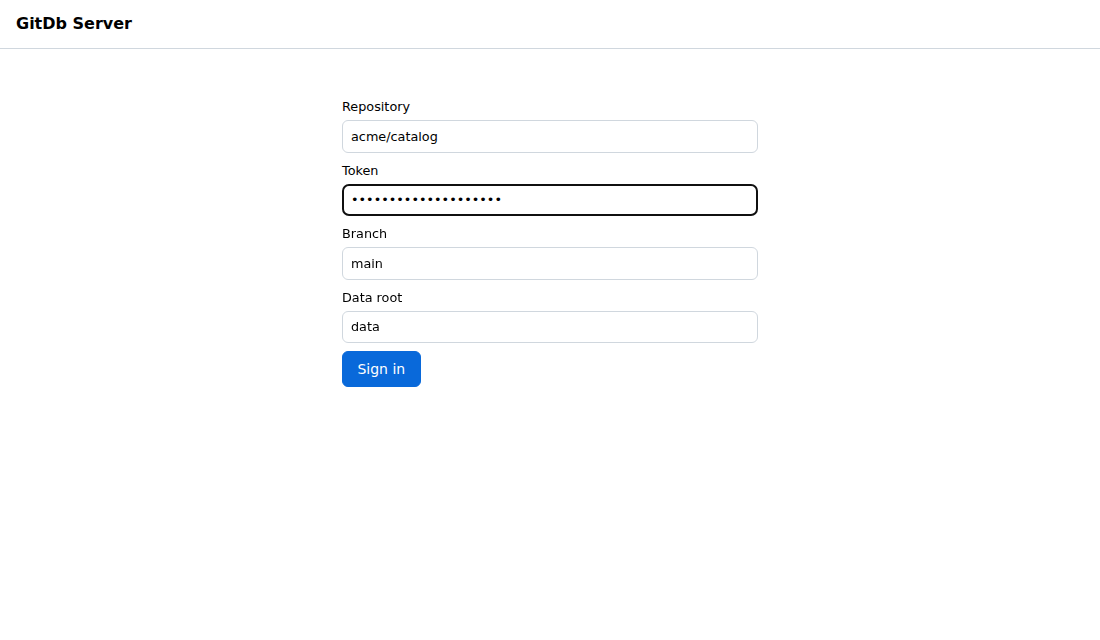
Then open http://127.0.0.1:8000 and sign in with the repository (owner/name),
a GitHub token with Contents: Read permission, the branch to read (main by
default) and the data root holding the collections (data by default).
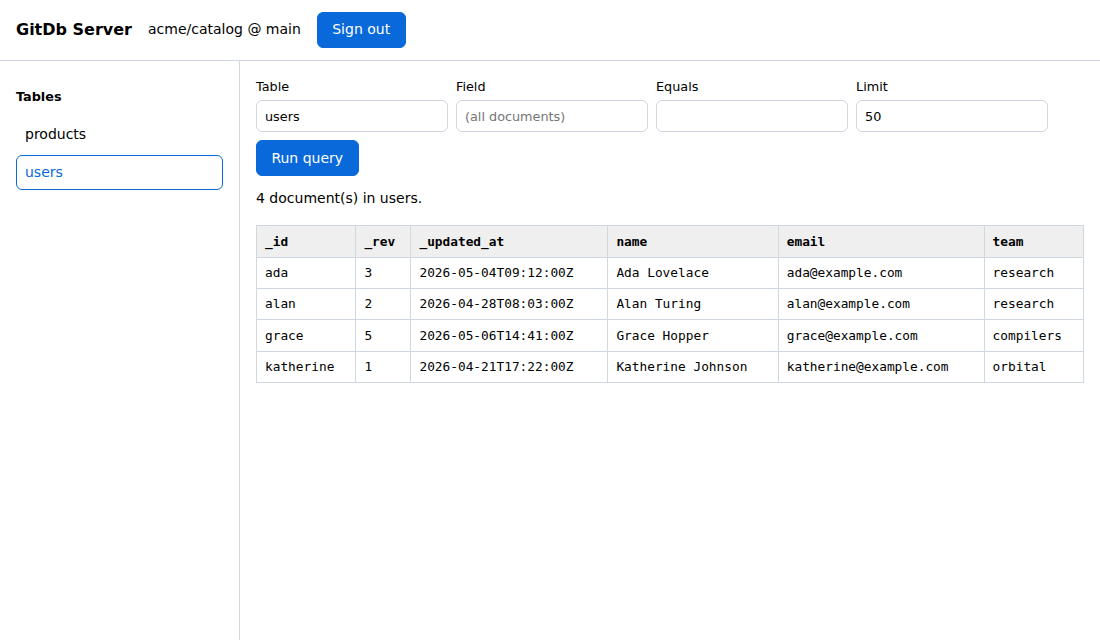
The sidebar lists every collection under the data root; the derived _index and
_manifest directories are hidden. Selecting one runs a query and renders the
documents as a table, with _id, _rev and _updated_at first.
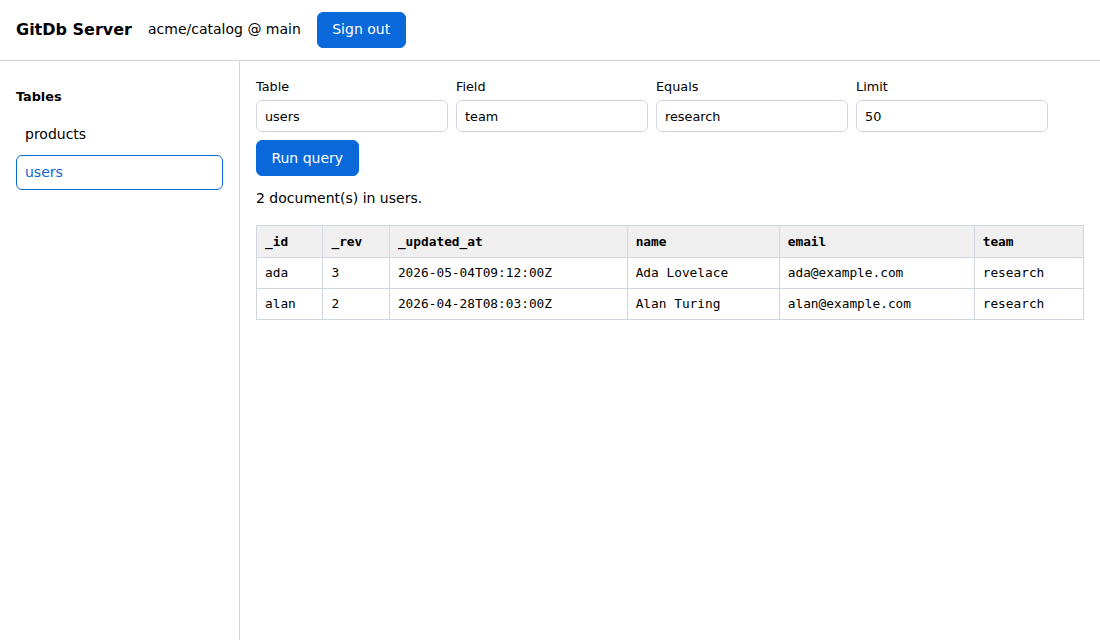
The query form filters by field value and caps how many documents come back (500 at most). Indexed fields are served from the index, any other field falls back to a client-side scan.
The token is exchanged for an opaque, HttpOnly session cookie and only ever
lives in the server process memory: sessions are per process and are dropped on
sign-out or restart. Run it locally next to the browser that uses it rather than
exposing it to a network. Besides the UI it exposes POST /api/login,
GET /api/collections, POST /api/query and POST /api/logout; see the
server README for the payloads. The hosted build has
no backend and therefore no HTTP API: it performs the same reads directly against
the GitHub REST API.
Documents are JSON files:
{root}/{collection}/{id}.json # data/users/01HZY6C1MRK1P2Q0F4X8ZC5V9T.json
With sharding enabled (shard_depth=2, shard_width=2) the leading characters of
the id become directories, which keeps individual directories small:
data/users/01/HZ/01HZY6C1MRK1P2Q0F4X8ZC5V9T.json
Optional indexes and manifests live alongside the collections and are written in the same commit as the documents they describe:
{root}/_index/{collection}/{field}.json    # {"values": {"ada@example.com": ["ada"]}, ...}
{root}/_manifest/{collection}.json         # {"count": N, "ids": [...], "documents": {...}}
Every document carries metadata written by GitDb:
| Field | Meaning |
|---|---|
_id |
Document id (also encoded in the file name) |
_created_at |
RFC 3339 UTC timestamp of the first write |
_updated_at |
RFC 3339 UTC timestamp of the latest write |
_rev |
Monotonic revision counter, starting at 1 |
Ids are generated as 26-character, ULID-style values: 10 characters of
millisecond timestamp plus 16 characters of randomness, so ids sort by creation
time. User-supplied ids are validated against [A-Za-z0-9._-] (must start
alphanumeric, max 128 characters) and path traversal (.., /, \) is
rejected.
| Option | Default | Description |
|---|---|---|
repo |
– | "owner/name" of the backing repository |
token |
None |
Personal access token with contents:write (optional in read-only mode) |
branch |
"main" |
Branch used for reads and writes |
root |
"data" |
Directory holding the collections ("" for repository root) |
api_url |
https://api.github.com |
Set to https://ghe.example.com/api/v3 for GitHub Enterprise |
raw_url |
https://raw.githubusercontent.com |
Base url used in read-only mode |
session |
None |
Injectable requests.Session (custom transport, proxies, auth) |
auth |
None |
Any requests auth object, e.g. for GitHub App flows |
max_retries |
3 |
Retries for rate limits and 5xx responses |
backoff_factor |
0.5 |
Base seconds for exponential backoff with jitter |
timeout |
30.0 |
Per-request timeout in seconds |
shard_depth |
0 |
Number of id-prefix directory levels (0 disables sharding) |
shard_width |
2 |
Characters per shard level |
conflict_retries |
2 |
Automatic retries after a sha conflict |
batch_retries |
2 |
Retries after a batch ref update loses a race |
cache |
True |
True/False, or any Cache implementation |
concurrency |
1 |
Bounded thread pool used by all(), find() and count() |
indexes |
None |
{"users": ["email"]} — secondary indexes |
manifests |
None |
["users"] or {"users": ["name"]} — per-collection manifests |
use_graphql |
False |
Fetch documents in bulk through the GraphQL API |
graphql_batch_size |
50 |
Aliased lookups per GraphQL request |
contents_max_bytes |
900_000 |
Above this, writes/reads route through the Git Data blob API |
pace_requests |
True |
Self-throttle from X-RateLimit-Remaining/Reset |
read_only |
False |
Fetch documents from raw.githubusercontent.com without a token |
ref |
None |
Read a fixed commit sha or tag (implies read_only=True) |
pin_ref |
True |
Resolve the branch to a commit sha for immutable raw reads |
committer / author |
None |
{"name": ..., "email": ...} used for the commits |
Methods:
db.collection(name)→Collectiondb.collections()→ sorted collection names stored underrootdb.batch(message=...)→Batch(context manager)db.writer(max_operations=100, max_seconds=5.0)→Writercoalescing writesdb.transaction(message=...)→Transactionover a temporary work branchdb.at(commit_sha)/db.snapshot()→ read-only view pinned to a commitdb.on_branch(branch)→ view of another branchdb.resolve_ref(refresh=False)→ commit sha the client currently reads fromdb.history(collection, id, limit=30)→ commit history for one documentdb.revert(commit_sha, message=None)→ forward commit undoing another commitdb.reindex(collection)→ rebuild index and manifest filesdb.compact(confirm=True)→ squash history into a single commit (destructive)db.rate_limit(resource="core")→ currentRateLimitwithout spending quotadb.invalidate(path=None)→ drop cached shas/ETags (all, or a single path)db.close()/with GitDb(...) as db:→ close the underlying session
| Method | Description |
|---|---|
insert(document, id=None, message=None) |
Create a document, return its id. Raises ConflictError if the id exists |
get(id) |
Return the document or None |
exists(id) |
True when the document exists |
update(id, patch, message=None) |
Shallow-merge patch, return the new document |
replace(id, document, message=None) |
Overwrite the document wholesale |
upsert(id, document, message=None) |
Update when present, otherwise insert |
delete(id, message=None) |
Delete, raising NotFoundError when missing |
list(limit=None, after=None) |
Sorted ids in the collection |
all(limit=None, after=None) |
Documents, fetched in bulk and in parallel |
find(predicate, limit=None) |
Client-side filter over all() |
find_by(field, value, limit=None) |
Index-backed lookup (1–2 requests when indexed) |
page(limit=100, after=None) |
One Page(documents, cursor); cursor is None at the end |
pages(size=100) |
Iterator over pages |
count() / len(collection) |
Number of documents |
history(id, limit=30) |
Commit history for one document |
restore(id, commit_sha) |
Restore an earlier version as a new commit |
reindex() |
Rebuild this collection's index/manifest files |
insert, get, update, replace, upsert and delete accept extra
keyword arguments: expected_rev= for explicit compare-and-set on
update/replace/delete, and fresh=True on get to bypass caches.
| Method | Description |
|---|---|
put(collection, id, document) |
Queue a create-or-replace |
insert(collection, document) |
Queue a document with a generated id, returns the id |
delete(collection, id) |
Queue a deletion |
expect(collection, id, rev=..., sha=...) |
Require a document version before committing |
commit() |
Flush as one commit, returns the commit sha (None when empty) |
operations / expectations |
Queued operation and precondition counts |
The context manager commits on a clean exit and discards the queue if the block
raises. Preconditions are checked against the base tree before any blob is
uploaded, and a lost ref-update race is retried up to batch_retries times
against the new head.
with db.writer(max_operations=50, max_seconds=5.0) as w:  # coalesce into commits
    for record in records:
        w.put("users", record["id"], record)

with db.transaction(message="migrate") as tx:  # work branch + fast-forward
    tx.collection("users").upsert("ada", {"name": "Ada"})
    with tx.batch() as b:
        b.put("users", "grace", {"name": "Grace"})
Writer flushes every max_operations writes or max_seconds seconds (and
on exit).
Transaction applies several commits to a temporary branch and then advances
the target branch in a single ref update, rolling back by deleting the work
branch if the block raises.
pip install "gitdb-py[async]"AsyncGitDb, AsyncCollection and AsyncBatch mirror the synchronous surface
on top of httpx.AsyncClient — same options, same method names, same errors,
with await in front and async with for the context managers:
from gitdb import AsyncGitDb

async with AsyncGitDb(repo="owner/name", token=token, concurrency=8) as db:
    users = db.collection("users")
    await users.insert({"name": "Ada"})
    documents = await users.all()
    async for page in users.pages(size=100):
        ...
    async with db.batch(message="seed") as b:
b.put("users", "grace", {"name": "Grace"})all(), find() and count() fan out with asyncio.gather, bounded by
concurrency. Writer and Transaction are synchronous-only for now.
GitDbError
├── NotFoundError    document/path missing (404)
├── ConflictError    blob sha mismatch or duplicate insert (409/422)
├── RateLimitError   rate limit exhausted after retries (403/429)
├── AuthError        bad credentials, missing scope, or write in read-only mode (401/403)
└── ValidationError  invalid id, collection name, repo or request body (422)
Single-document writes use optimistic concurrency: GitDb reads the blob sha
and sends it back on PUT/DELETE. If someone else committed in the meantime
GitHub rejects the write and GitDb raises ConflictError. update, replace,
upsert and delete automatically refetch the sha and retry up to
conflict_retries times (default 2); set conflict_retries=0 to surface
conflicts immediately.
update, replace and delete also take expected_rev=, which fails with
ConflictError unless the stored document is at that _rev — use it when a
blind overwrite would be wrong.
Batches are a single commit created through the Git Data API (blobs → tree →
commit → ref update), so all documents in a batch land atomically in one commit.
The ref update is not forced, so a concurrent push to the same branch cannot
silently overwrite history: GitDb rebuilds the tree on the new head and retries
up to batch_retries times, then raises ConflictError.
The precise guarantees are: read-committed at branch head, atomic per commit,
no isolation levels. Reads see whatever the branch (or pinned commit) contains
at the time of the request. Anything wider than one commit is not a transaction
— db.transaction() gets close by staging commits on a work branch and
fast-forwarding once, but the fast-forward itself is the only atomic step.
Undo is always a forward commit: collection.restore(id, commit_sha) brings an
old version back and db.revert(commit_sha) undoes a whole commit. Neither
rewrites history.
snap = db.snapshot()  # pin to the current branch head
old = db.at("abc123...")  # pin to a specific commit
Views are read-only, share the HTTP session, and keep their own cache. In
read-only mode GitDb resolves the branch to a commit sha once (pin_ref=True)
and reads raw.githubusercontent.com/{repo}/{sha}/{path}, which is immutable
and therefore safe to cache; pass pin_ref=False for the older
branch-name behaviour, or get(id, fresh=True) to force a revalidated read.
db = GitDb(
    repo="owner/name", token=token, indexes={"users": ["email"]}, manifests={"users": ["name"]}
)
db.collection("users").find_by("email", "ada@example.com")
Index files ({root}/_index/{collection}/{field}.json) map field values to ids
and are written in the same commit as the document, so they never disagree
with the data. Manifests ({root}/_manifest/{collection}.json) hold the id list
plus projected fields, making list() and count() a single request.
Both are opt-in per collection because they cause write amplification: every
write to an indexed collection also rewrites the index. Use reindex() to
rebuild them after direct pushes or configuration changes.
Authenticated requests get 5,000 requests/hour on github.com. GitDb inspects
X-RateLimit-Remaining, X-RateLimit-Reset and Retry-After, sleeps for the
indicated duration (or exponential backoff with full jitter), and retries up to
max_retries times before raising RateLimitError. Transient 5xx responses are
retried with the same policy.
With pace_requests=True (the default) the client also throttles before
sending, spreading the remaining quota over the time left until reset, and
db.rate_limit() reports the current budget without spending any of it.
RateLimitError carries .remaining, .reset and .reset_at.
To keep request counts low:
-
Prefer
db.batch(...)over many single writes — one commit instead of one per document — ordb.writer(...)to coalesce a stream of writes automatically. -
Keep the cache enabled: GitDb stores ETags next to blob shas and revalidates with
If-None-Match; GitHub does not charge 304 responses against the quota. Pass anyCacheimplementation (disk, Redis, …) to share it across processes. -
list()asks for the collection subtree only, andall()reads the document bodies straight from the Git blob shas returned by that listing. Raiseconcurrencyto fan those reads out, or setuse_graphql=Trueto collapse them into a handful of GraphQL requests. -
Index a collection and use
find_by()instead of scanning withfind(). -
For higher quotas, authenticate as a GitHub App installation:
from gitdb import GitDb, InstallationTokenAuth

db = GitDb(repo="owner/name", auth=InstallationTokenAuth(fetch_token))
fetch_tokenreturns a token or a(token, expires_at)pair and is called again shortly before expiry. Minting is left to you, so GitDb needs no JWT dependency.
db.reindex(collection)rebuilds index and manifest files after direct pushes.db.compact(confirm=True)replaces the branch with a single commit carrying the current tree. It discards history and force-updates the ref; use it only when history growth, rather than content size, is the problem.
These are properties of Git and GitHub, not of the client, so they can be mitigated but not removed:
- No true multi-commit ACID. One commit is atomic and reads are
read-committed at the branch head, but there are no isolation levels.
db.transaction()stages work on a branch and fast-forwards once, which is the closest achievable analogue;restore()/revert()undo by committing forward rather than rewriting history. - API rate limits. 5,000 requests/hour for a personal token caps throughput. ETag revalidation, caching, bulk blob reads, batching and proactive pacing all push against it, and GitHub App installation tokens raise the ceiling, but the ceiling exists.
- Repository size. Every write adds a commit, so a write-heavy repository
grows steadily; GitHub recommends staying below 1 GB. Keep data on a dedicated
branch or repository separate from code, enable
shard_depthfor large collections, split very large datasets across repositories, and usedb.compact()when history is the problem. - Single-branch write serialization. A branch ref is inherently serialized,
so concurrent writers to the same branch contend.
db.writer()coalescing andbatch_retriesabsorb bursts; genuine write scaling means sharding across branches or repositories and merging. - Queries run client-side. GitDb is not a query engine:
find()still evaluates a Python predicate over the documents. Secondary indexes make equality lookups cheap (find_by) and manifests make listing cheap, but there are no joins, aggregations or server-side sorting beyond id order.
pip install -e ".[dev]"
ruff check . && ruff format --check .
mypy
pytest -q
Tests mock every HTTP call with responses (and respx for the async client);
the suite never touches the network.
Apache-2.0. See LICENSE.