
weewx-skyfield 2.1
The almanac serves comets — any comet the Minor Planet Center tracks,
added to weewx.conf by designation, with Halley configured out of the
box — and rounds out the almanac's measure of time and distance: moon
perigee/apogee tags with a supermoon callout on the Sky page, solar
time and the equation of time, unit-aware AU distance tags, and an
illumination percent tag. Drop-in upgrade from 2.0 — install over
it, no configuration changes needed; the installer adds the
[[Comets]] entry and fetches the first elements.
What's new
-
Comet tags.
[Skyfield] [[Comets]]inweewx.confmaps tag
names to MPC designations — the installer writes the two comets
everybody knows,halley = 1Pandhale_bopp = C/1995 O1(the 1997
great comet, ~49 AU out and receding — a distance the almanac table
watches grow), and the README carries a ready-to-paste block of other
famous comets (Encke, the Rosetta comet, 2024's Tsuchinshan-ATLAS…).
Add the comet everyone is talking about as, say,
tsuchinshan_atlas = C/2023 A3, and each entry serves the almanac's
full planet-style surface:$almanac.halley.rise/.set/.transit
and the wholenext_/previous_family, alt/az and every ra/dec
flavor,distance/distance_from_sun(with the raw AU floats),
elongation,visible,illumination, the constellation it stands
in, andmag— the MPC total magnitude from the published g/k
parameters, with a documented caveat: comets are notorious for
deviating from it, so treat it as expectation, not measurement.
There is deliberately no pass machinery — a comet rises and sets
daily, like a planet — and comet tags never fall through to PyEphem,
which has no comets. Elements are the MPC's CometEls.txt, one small
file for every comet with a current orbit, cached beside the
satellite TLEs and refreshed about every two days on a worker thread
— atomically, the old file kept on any failure — with
comet_downloads = falseas the isolated-network switch, same story
as the satellites. A comet the MPC drops from the file (they retire
comets that have faded from observability) serves honest "N/A" tags
with a log warning naming it, never an error, and
$almanac.halley.elements_epoch/.elements_agestay live as
diagnostics.And none of it needs pandas. Skyfield's own comet loader is built on
pandas DataFrames, so this extension constructs the orbits against
Skyfield's core directly — comets, like the bundled 118,218-star
Hipparcos catalog, work with nothing extra installed. -
Comets everywhere they belong on the Sky page. A comet rides
every roster panel: a row in the almanac table, a brass-dotted chip
in the rail (whose eyebrow then reads "Sun, Planets & Comets"), a
brass bar on the rise & set ribbons, and —
$almanac.halley.perihelionbeing a tag now — a countdown chip in
the header whenever a configured comet's perihelion lies ahead
within a year: the news-cycle countdown. A comet without elements
is honestly absent from all of them. -
Comets on the dome — and the orrery. A configured comet above
the horizon plots on the dome as a labeled diamond with a small
anti-sunward tail — comet tails point away from the sun, so the
glyph is honest physics as well as iconography — always: the config
list is the filter. Solid brass when its magnitude says
plausibly naked-eye (6.0 or brighter), a hollow ring when fainter —
there, but not visible to the eye, the same visual language as a
satellite in Earth's shadow — with the magnitude in the tooltip and
the footer crediting the Minor Planet Center. And the Solar System
panel plots every configured comet at its current sun distance and
heliocentric longitude, horizon or no horizon — the panel that shows
a news-cycle comet falling sunward, inside Jupiter's ring, inside
Earth's, as the report cycles pass (marker only, no orbit ring: an
eccentric orbit does not draw as a circle). Halley, the shipped
default, is the hollow ring until the 2060s. For embedding skins,
$sky_page.comet_names()joinssatellite_names()as a public
contract, and the dome diamond'sdata-bright="1|0"joins
data-sunlitas a live-layer hook.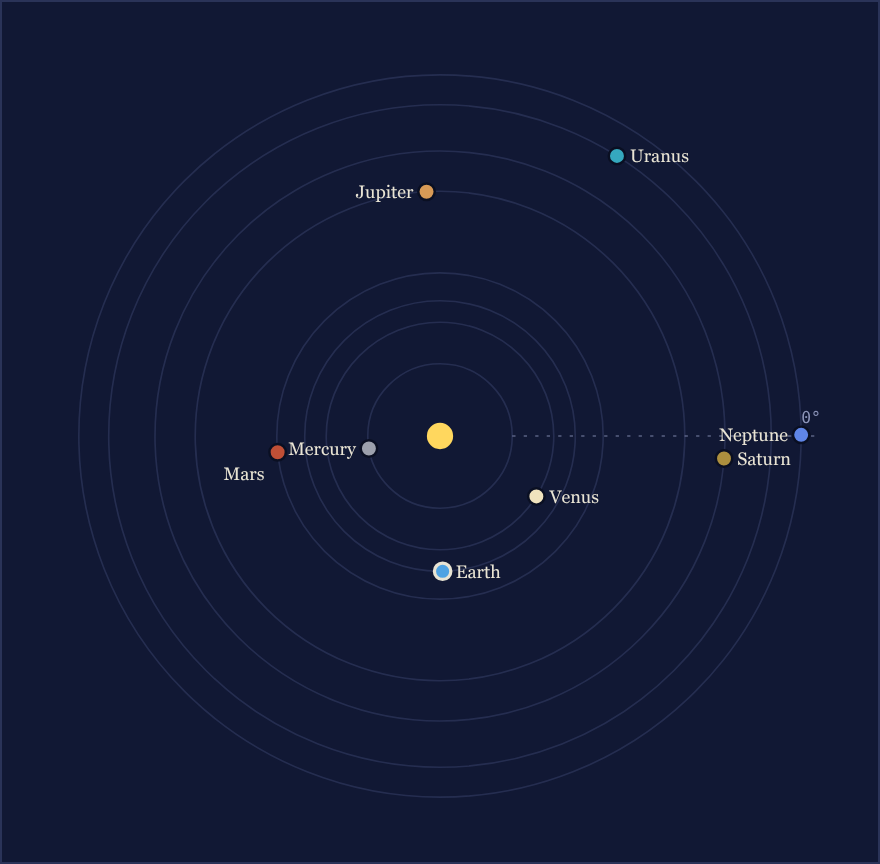
-
Meteor showers. The almanac knows the dozen major annual
showers of the IMO working list, each peak computed from the sun's
ecliptic longitude — the Perseids peak when the sun reaches 140.0°,
whatever the calendar says — so nothing is looked up and nothing
needs annual maintenance.$almanac.next_meteor_showerserves the
shower next ahead (name, translated label, peak time, ZHR, radiant
position with live alt/az, and the parent body — the Perseids are
comet 109P/Swift-Tuttle's trail), and
$almanac.active_meteor_showerslists what's active now. The Sky
page's countdown row always carries the next shower with the moon's
peak-night illumination as the honest interference judgment — this
year's Perseids peak, August 12, lands on a new moon: a dark-sky
year, and the chip says so — and during a shower's activity the dome
marks its radiant with a rayed glyph, ZHR and peak date in the
tooltip. Shower names are translated in all nine bundled languages. -
Earth's perihelion and aphelion.
$almanac.next_perihelionand
$almanac.next_aphelion(withprevious_twins) — Earth's closest
and farthest approach to the sun, early January and early July,
matching the published instants within a minute. Closest in the
depth of northern winter: the seasonal misconception-buster, now an
almanac fact. -
Moon perigee and apogee.
$almanac.moon.next_perigee,
.previous_perigee,.next_apogeeand.previous_apogee— the
times of the moon's closest and farthest approach, found on the
geometric center-to-center distance, the definition the published
apsis tables use, and reproducing them to the minute. A supermoon's
headline number is one time-travel away:
$almanac(almanac_time=$almanac.moon.next_perigee.raw).moon.distance.km. -
$almanac.next_supermoon. The supermoon rule as a tag: the
instant of the next full moon falling within a day of perigee,
searched forward full moon by full moon. One field for a live
page's supermoon countdown; the Sky page's callout reads it too. -
A supermoon callout on the Sky page. The lunation panel now ends
with the quiet next-perigee/next-apogee line — and, whenever the next
full moon falls within a day of perigee, a brass Supermoon
callout above it. Like the satellite pass cards, it is anticipation:
it appears ahead of the event and leaves with it. (The next one:
December 23, 2026 — full moon and perigee seven hours apart.)
-
Solar time and the equation of time.
$almanac.solar_timeis
local apparent solar time — what a sundial reads — as an angle like
sidereal_time(180° is solar noon), with$almanac.solar_angleits
unit-aware twin;$almanac.equation_of_timeis a signed duration
ValueHelper, apparent minus mean solar time per the USNO sign
convention (positive with the sundial ahead of the clock, about
+16 minutes in early November). Values agree with Meeus within a few
seconds across the year, and the sign convention is documented in
"Differences from PyEphem", since published sources disagree on it.
And the Sky page charts it: a new Equation of Time panel beside the
Solar Year chart — the classic double-humped curve, week by week at
the analemma's own noon instants, with today's value on the brass
point.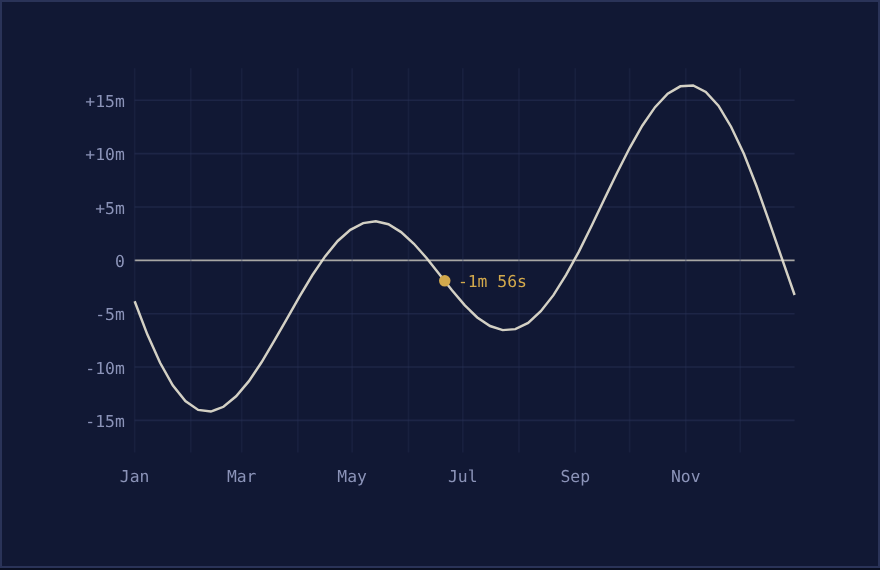
-
Unit-aware distances.
$almanac.mars.distance(from Earth,
mirroring the satellites'.distance) and
$almanac.mars.distance_from_sunare ValueHelper twins of the raw AU
floatsearth_distance/sun_distance: "1.8588 AU" by default in
every unit system, converting on ask ($almanac.moon.distance.km).
Theastronomical_unitunit registers with WeeWX in its own group,
group_distance_astronomical, so skins can restyle the whole family
through[Units]. Stars with a measured Hipparcos parallax serve
the twins too; a star without one honestly reads "N/A". -
illumination.$almanac.venus.illuminationis the ValueHelper
twin of the raw percent-illuminatedphasefloat (and of the moon's
moon_fullness), rendering with the report's percent formatting.
Requirements
- WeeWX 5.2 or later
- Python 3.9 or later
- Skyfield 1.47 or later, and NumPy — and still no pandas
- For live-updating pages (optional): weewx-loopdata 6.9 or later and
weewx-celestial 8.1 or later.
Installing/upgrading
Download weewx-skyfield.zip
and install with weectl, then restart WeeWX:
sudo -- bash -c ". /home/weewx/weewx-venv/bin/activate; weectl extension install weewx-skyfield.zip -y"
Upgrading from 2.0 (or any 1.x) is a drop-in: install over the old
version; no configuration changes are needed. The installer adds the
comet_downloads and [[Comets]] entries to [Skyfield] and fetches
the first comet elements; on an isolated network, set
comet_downloads = false (comet tags then read "N/A" unless you
maintain the one element file yourself — see the README).