Releases: codejeet/NVMatrixEngine
Release list
NVMatrixEngine 0.1.5 — Ocean swells and hull contact

Ocean Island now starts with broad, tall swells: a 1.8 m wave-height scale and a
48 m minimum initial wavelength, with a smooth taper between 48 and 72 m. The
retained spectral energy is normalized so selecting longer waves preserves their
height. Both elevation and velocity potential initialize the coupled simulation;
the boat, local water and rendered surface use that same evolving water state.
The initial spectrum can be adjusted with --wave-amplitude,
--wave-wind-speed and --wave-min-wavelength. The larger height allowance is
limited to wind spectra whose minimum wavelength is at least eight water depths.
The wave filter runs at initialization; it adds no per-frame simulation pass.
Particle contact now accounts for radius and the normal-sampling halo outside
baked mesh bounds. This corrects false contacts with empty parts of the tapered
boat hull's bounding box. Boundary seeding, detached water and secondary particles
use the same clearance rule; distant particles retain the fast rejection.
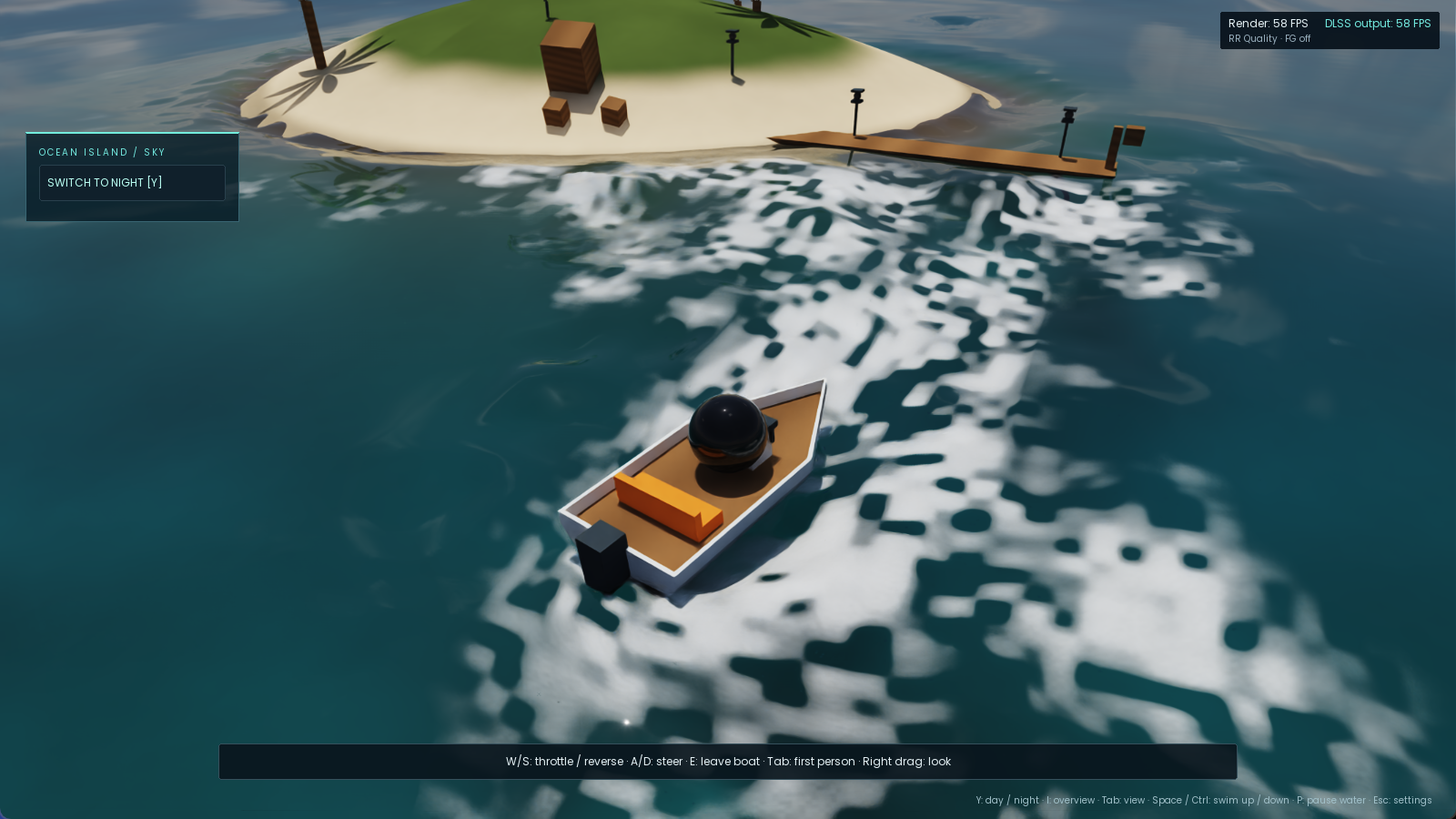
The README features a fresh ocean boat screenshot from the updated engine.
Engine-wide fast RIS path-tracing defaults, PBR glTF/GLB/OBJ imports, Neon Night,
DLSS controls, and the existing water and gameplay features are included.
Download NVMatrixEngine-0.1.5-preview-win64.zip, extract the entire folder, and
open Play Extra Large Water Lab.cmd for the ocean boat scene. Play Water
Lab.cmd, Play Large Water Lab.cmd, and Play Neon Night.cmd are also
included. The portable DX12 build bundles assets and runtime dependencies;
optional CUDA experiments remain in source builds.
The executable and affected shaders compiled successfully. A live ocean session
was captured for documentation. Release tests and package validation remain
skipped at the maintainer's request. The screenshot is not a benchmark or a
long-run stability, hull-artifact or shadow-flicker certification. The adjacent
verification JSON records skipped package validation. A source-commit manifest,
per-file hashes and archive SHA-256 checksum identify the exact payload.
Target: Windows 11 x64 and a compatible high-end NVIDIA RTX GPU/driver.
Development uses an RTX 5090; other hardware and frame-generation output were
not reverified for this release. Close and reopen an already-running lab to load
the new executable and shaders.
NVMatrixEngine 0.1.4-preview — Faster path tracing and Neon Night
NVMatrixEngine 0.1.4 — Faster path tracing and Neon Night
This preview brings the optimized renderer to every scene: GPU-local geometry and
material data, faster opaque traversal, and shared fast RIS direct-light sampling.
Defaults are one base camera path, two full light samples, four imported-light
candidates, four surface bounces, and Russian roulette. Esc → Path tracing exposes
the sampler, reference mode and budgets.
The release adds generic glTF, GLB and OBJ loading with PBR textures and the playable
Neon Night alley. Imported CC0 street props, wet materials, 4K signs, movable neon
blocks, bloom, rolling-ball controls, FPS counters and Esc settings are included.
Startup shows progress and keeps the window responsive during background loading.
Ocean terrain caustics receive denser sampling around the glass ball and short
motion history.
Download NVMatrixEngine-0.1.4-preview-win64.zip, extract the entire folder, and
open Play Water Lab.cmd, Play Large Water Lab.cmd, Play Extra Large Water
Lab.cmd, or Play Neon Night.cmd. The portable DX12 build bundles assets and
runtime dependencies. Optional CUDA experiments remain in source builds.
Tests and release validation were skipped at the maintainer's request. This
archive packages the existing optimized build; no fresh scene runs, benchmarks,
vendor-signature checks or relocated-extraction tests were performed. The adjacent
verification JSON explicitly records skipped validation. Earlier development
measurements in the included documentation are historical, not fresh verification
of this archive. A per-file manifest and archive SHA-256 checksum are included.
Target: Windows 11 x64, a compatible high-end NVIDIA RTX GPU and driver. Development
uses an RTX 5090; this preview does not certify other hardware. Frame generation
availability depends on the GPU, driver and OS, and generated presentations do not
increase simulation speed. Actual generated output was not reverified for this
release.
NVMatrixEngine 0.1.3-preview — Fixed-grid Ocean Island
NVMatrixEngine 0.1.3 — Hamiltonian water and Ocean Island
This release restores the working ocean simulation from before dynamic cell sizing around rigid bodies. The ocean uses fixed 1 m fluid cells and a 2 m wave grid. Hamiltonian waves handle calm regions, while body interactions and complex flow activate existing 3D simulation regions. The unstable local refinement solver and its feedback are removed.
The release includes the larger indoor lab and the 256 × 256 m ocean with 6 m offshore depth, a beach island, pier, day/night HDR environments and night lanterns. It retains the larger powered boat, simulated foam/bubbles/spray, underwater Space propulsion, filling controls and shared camera/player controls. Small Water Lab defaults to legacy DX12 water; Large and Ocean default to Hamiltonian water.
Download NVMatrixEngine-0.1.3-preview-win64.zip, extract the whole folder, and open Play Water Lab.cmd, Play Large Water Lab.cmd or Play Extra Large Water Lab.cmd. The portable DX12 build includes runtime dependencies. Optional CUDA and old deep-pool experiments remain in source builds and are excluded from this package.
Target: Windows 11 x64, high-end NVIDIA RTX GPU and compatible driver. Validation uses the RTX 5090 development PC; it does not certify other GPUs or a clean Windows installation. The source and shaders are rebuilt, with native numerical tests, nine ocean/indoor render cases and portable tests after extracting the ZIP to a different directory. The adjacent verification JSON records the checks and checksum for this exact archive.
DLSS frame generation initialization and app-local DLL loading are checked. Additional generated presentations may remain unverified on this machine; consult frameGenerationOutputVerified in the verification report. Generated frames do not increase simulation speed. Wakes and hull contact remain limited by the fixed grid; this is a hybrid engine integration, not a reproduction of the paper's complete rendering pipeline.
Release verification completed: 9 package checks passed; SHA-256 e6c9560543c83f12fb2f465200aa90ca119f224d8654dd350561b7ad353b545a. This machine reported 0 additional generated presentations, so frame-generation output remains unverified despite successful initialization. The check does not affect the restored fluid simulation.
NVMatrixEngine 0.1.2 — Fisheye DLSS and lighting improvements
NVMatrixEngine 0.1.2 — Fisheye DLSS and lighting improvements
NVMatrixEngine is a C++20 / DirectX 12 game engine with GPU liquid simulation, path-traced lighting and spectral caustics. Water Lab is the playable demo: a pool with a wall inlet, sinking glass ball, powered boat and underwater views.
Changes in 0.1.2
- Fisheye frame generation: both normal and fisheye cameras support DLSS FG. A cached bidirectional lens-distortion map supplies the fisheye projection to DLSS while preserving the separate HUD composition.
- Separate FPS counters: the HUD shows Render FPS and DLSS output FPS using actual presented-frame counts, plus RR/FG status.
- DLSS presets in Esc: switch Ray Reconstruction upscaling between Quality, Balanced and Performance without resetting the water. The settings display the actual input/output resolution.
- Cheaper diffuse lighting: contribution-weighted Lambertian visibility sampling reduces shadow-ray work with probability compensation. Water shadow intersections can stop once a surface crossing is established; camera and photon intersections retain refined roots. See the implementation and earlier measurements.
- Camera and launcher: 90° default diagonal FOV, shared forward/inverse fisheye mapping, and a development launcher that handles WSL UNC paths and locates the available CUDA build.
- Game-engine branding: updated README, bundled instructions and software citation metadata.
Run
Download NVMatrixEngine-0.1.2-preview-win64.zip, extract the entire folder, and open Play Water Lab.cmd. The portable build includes its runtime dependencies; no installer, administrator access or CUDA Toolkit is required. GitHub's source-code ZIP does not contain the executable.
Target: Windows 11 x64, a high-end NVIDIA RTX GPU and compatible driver. The default launcher uses DX12 water simulation, Balanced DLSS and automatic frame generation where supported. Both lens modes are available in Esc. See START-HERE.txt for controls.
Packaging and scope
Release validation was skipped for this update. This archive packages the existing executable and updated shaders without a new build, relocated-extraction test or runtime-validation run. The adjacent .verification.json explicitly records validationStatus: "skipped"; earlier development results are not fresh validation of this ZIP.
The ZIP includes dependency notices, a per-file manifest and the custom soundtrack. Its source commit and SHA-256 checksum identify the package. Development has used an RTX 5090; this release does not certify other hardware or a clean Windows installation.
Frame generation adds presentation frames; it does not accelerate simulation or raw rendering. Performance varies with resolution, active particles, fluid depth and lighting. CUDA/adaptive modes remain experimental, and ReSTIR PT currently covers opaque-primary diffuse indirect paths. Full ReSTIR BDPT remains future work.
NVMatrixEngine 0.1.1 — Sinking-ball default and research discoverability
NVMatrixEngine 0.1.1 — Sinking-ball default and research discoverability
Patch release of the native DX12/DXR GPU liquid simulation and path-traced caustics engine. Water Lab remains the main demo: a room-scale pool with a wall inlet, sinking glass ball, powered boat and underwater views.
Changes in 0.1.1
- Solid glass / Sink is now the physics-object default, not only a UI setting applied after construction. New room/deep-pool sessions use 2,500 kg/m³; Float remains selectable and persists through chamber resets.
- Native tests verify sinking without any UI/setter call, fresh-session defaults and existing float/boat behavior. Portable checks inspect actual ball density/mass in each packaged rendered scenario.
- Research-oriented README, algorithm/source entry points, GitHub topics and software citation metadata. No new performance or BDPT claims.
- Fresh rebuilt portable executable, per-file manifest, archive checksum and verification report. The previous release is preserved.
Included
- Native DX12/DXR camera path tracing and light-side spectral photon caustics.
- GPU APIC / FLIP-PIC liquid, continuous anisotropic scalar-field reconstruction and procedural DXR water geometry.
- Dielectric reflection/refraction, depth-dependent absorption, lasers, surface foam and secondary bubbles/spray.
- DLSS Ray Reconstruction / super resolution, optional frame generation and Reflex.
- RmlUi settings for lighting, camera, flashlight, sink/float density, simulation quality and audio.
- Optional CUDA graph-replay solver, deep-pool narrow-band ownership and ReSTIR PT modes.
Run
Download NVMatrixEngine-0.1.1-preview-win64.zip, extract everything, and open Play Water Lab.cmd. Do not download GitHub's source-code ZIP expecting an executable. No installer, administrator access or CUDA Toolkit is needed for the portable build.
Target: Windows 11 x64, high-end NVIDIA RTX GPU and compatible current driver. Tested on RTX 5090 / driver 616.64. The executable is unsigned. Fisheye projection pauses frame generation; the default launcher uses the normal lens. See START-HERE.txt for controls.
Known FG limitation: the release machine reported FG enabled with no SDK error, but zero extra presented frames. The predecessor build reproduced this. The feature remains selectable, but generated output is not verified in this preview; the download's verification report records this explicitly. Raw rendering and DLSS Ray Reconstruction are separate checks.
Scope
This is a research preview, not production middleware or a blanket 60 FPS claim. CUDA/adaptive modes are experimental and not demonstrated faster than the default DX12 solver. ReSTIR PT covers opaque-primary diffuse indirect paths; ReSTIR BDPT is not implemented. Camera + photon transport is not a claim of general unbiased BDPT.
The ZIP includes dependency notices, a per-file manifest and the custom soundtrack. The adjacent .sha256 and .verification.json describe the exact archive and relocated-extraction smoke checks. Testing on the development RTX 5090 is not a clean-OS, other-GPU or D3D12 debug-layer certification.
Future work focuses on raw path-tracing latency, stable refractive reuse, and reducing dense/synchronization costs in adaptive water simulation. See the repository roadmap.
NVMatrixEngine 0.1.0 — Water Lab preview
NVMatrixEngine 0.1.0 — Water Lab preview
First public engine-only portfolio release. The main demo is a playable room-scale pool with a wall inlet, glass ball, powered boat, underwater views and spectral illumination.
Included
- Native DX12/DXR camera path tracing and light-side spectral photon caustics.
- GPU APIC / FLIP-PIC liquid, continuous anisotropic scalar-field reconstruction and procedural DXR water geometry.
- Dielectric reflection/refraction, depth-dependent absorption, lasers, surface foam and secondary bubbles/spray.
- DLSS Ray Reconstruction / super resolution, optional frame generation and Reflex.
- RmlUi settings for lighting, camera, flashlight, sink/float density, simulation quality and audio.
- Optional CUDA graph-replay solver, deep-pool narrow-band ownership and ReSTIR PT modes.
Run
Download NVMatrixEngine-0.1.0-preview-win64.zip, extract everything, and open Play Water Lab.cmd. Do not download GitHub's source-code ZIP expecting an executable. No installer, administrator access or CUDA Toolkit is needed for the portable build.
Target: Windows 11 x64, high-end NVIDIA RTX GPU and compatible current driver. Tested on RTX 5090 / driver 616.64. The executable is unsigned. Fisheye projection pauses frame generation; the default launcher uses the normal lens. See START-HERE.txt for controls.
Known FG limitation: the release machine reported FG enabled with no SDK error, but zero extra presented frames. The predecessor build reproduced this. The feature remains selectable, but generated output is not verified in this preview; the download's verification report records this explicitly. Raw rendering and DLSS Ray Reconstruction are separate checks.
Scope
This is a research preview, not production middleware or a blanket 60 FPS claim. CUDA/adaptive modes are experimental and not demonstrated faster than the default DX12 solver. ReSTIR PT covers opaque-primary diffuse indirect paths; ReSTIR BDPT is not implemented. Camera + photon transport is not a claim of general unbiased BDPT.
The ZIP includes dependency notices, a per-file manifest and the custom soundtrack. The adjacent .sha256 and .verification.json describe the exact archive and relocated-extraction smoke checks. Testing on the development RTX 5090 is not a clean-OS, other-GPU or D3D12 debug-layer certification.
Future work focuses on raw path-tracing latency, stable refractive reuse, and reducing dense/synchronization costs in adaptive water simulation. See the repository roadmap.