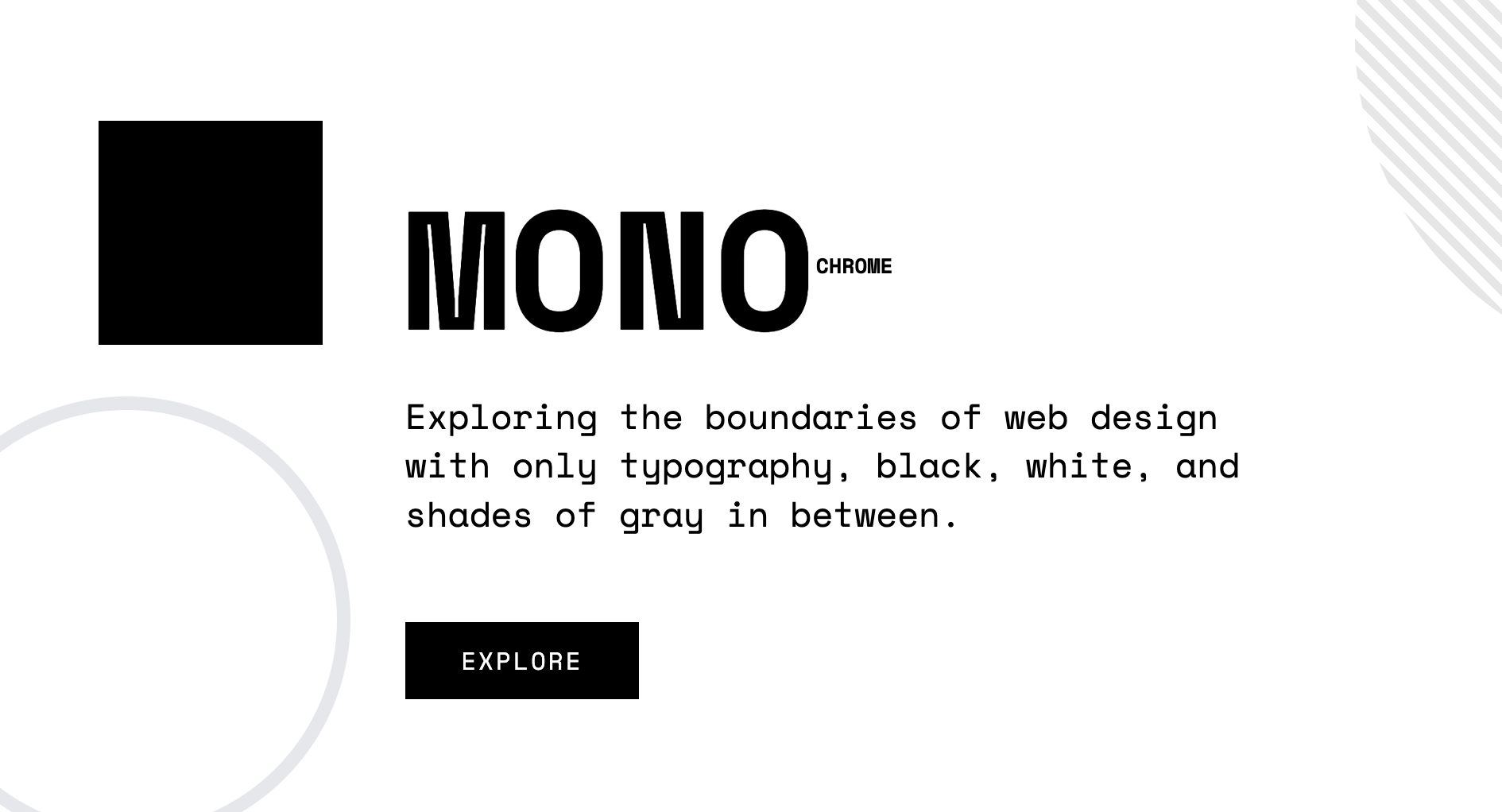
MONO is a stripped-down design system that embraces the power of black, white, and the shades between. It's about removing color as a distraction to focus on what really matters: solid design fundamentals.
Think of it as design on hard mode—if it works in monochrome, it'll work anywhere.
"Perfection is achieved not when there is nothing more to add, but when there is nothing left to take away." - Antoine de Saint-Exupéry
Strip away the non-essential. Color, decoration, complexity-gone.
Perfect what remains: typography, spacing, and proportion.
Create patterns and relationships with limited elements.
Test how users respond. Does it communicate? Does it connect?
- Design tokens — one stylesheet of CSS custom properties (
css/mono.css): ink/paper, layered surfaces, a nine-step gray ramp, a modular type scale, spacing rhythm, rule weights, corner radius, and measure - Components — buttons, inputs, selects, checkboxes, radios, switches, ranges, file inputs, validation patterns, tables (scrolling and stacked), tabs, accordions, modals, dropdowns, tooltips, toasts, panels, a phone tab bar, and bottom sheets — all monochrome, all accessible
- The TUNE layer — a global customizer on every page (slide-over on desktop, bottom sheet on phones): theme, structure, corners, typeface, scale, weight, rhythm, and icon set. Everything applies live, persists in localStorage, and exports as plain CSS
- Dark mode — layered grays, not flat black: the page, raised surfaces, and overlays each get their own tier.
data-theme="dark", persisted, with an AUTO option that follows the system - Structure axis —
data-structure="outlined | soft | minimal": boxes drawn in ink, surfaces built from shades (the default), or pure negative space - Corner radius — one
--radiustoken, 0–16px; 0 keeps the brutalist default and everything from checkboxes to sheets follows proportionally - Icons — one canonical vocabulary rendered by your choice of Lucide, Tabler, Phosphor, or Material Symbols:
<i class="icon" data-icon="settings"></i> - Typography — six curated monospace faces, switchable live
- Phone navigation — an app-style bottom tab bar with icons plus a mega-menu sheet; the site itself runs on it
- Examples — four complete pages (login, article, dashboard, pricing) built with zero page-local CSS
index.html— Home: the system at a glancecomponents.html— Every component, live, with copyable codetypography.html— The specimen book: roster, scale, weight, tracking, leading, measurelayout.html— The twelve-column grid as a spec sheetgallery.html— Typographic compositions from the system's own tokenscustomizer.html— The TUNE layer, documented control by controlexamples.html— Index of real-world example pages (examples/)about.html— Manifesto, process, FAQ, colophon
All monospace, all on Google Fonts. Space Mono is the default; switch faces in the TUNE panel or by changing --font-mono.
| Face | Weights | Character |
|---|---|---|
| Space Mono | 400, 700 + ital | Geometric, a little spacey |
| JetBrains Mono | 100–800 + ital | Tall x-height, engineered |
| IBM Plex Mono | 400, 700 + ital | Corporate, warm |
| Fragment Mono | 400 + ital | A Helvetica for code |
| Courier Prime | 400, 700 + ital | The screenplay face |
| Spline Sans Mono | 300–700 + ital | Grotesque, compact |
git clone https://github.com/layogtima/mono.git
cd mono
# Open any HTML file in your browser — no build step needed to *use* the site
Tailwind is precompiled into the repo (css/base.css + css/utilities.css), so the site has no runtime CDN dependency. If you change utility classes in the markup, regenerate them once:
npm install
npm run build:css<!DOCTYPE html>
<html lang="en">
<head>
<meta charset="UTF-8" />
<meta name="viewport" content="width=device-width, initial-scale=1.0" />
<title>MONO Project</title>
<!-- 1. Typeface -->
<link rel="preconnect" href="https://fonts.googleapis.com" />
<link rel="preconnect" href="https://fonts.gstatic.com" crossorigin />
<link
href="https://fonts.googleapis.com/css2?family=Space+Mono:ital,wght@0,400;0,700;1,400;1,700&display=swap"
rel="stylesheet"
/>
<!-- 2. Theme engine (synchronous, before the stylesheets: applies saved
theme/structure/type/radius/icons before first paint) -->
<script src="js/mono-theme.js"></script>
<!-- 3. Styles: preflight, MONO tokens + components, utilities -->
<link rel="stylesheet" href="css/base.css" />
<link rel="stylesheet" href="css/mono.css" />
<link rel="stylesheet" href="css/utilities.css" />
<!-- 4. Behaviors: icons, components, and the TUNE layer -->
<script src="js/mono-icons.js" defer></script>
<script src="js/mono.js" defer></script>
<script src="js/customizer.js" defer></script>
</head>
<body class="bg-paper text-ink min-h-screen">
<!-- Your design genius goes here -->
<button class="btn">Hello, ink</button>
<i class="icon" data-icon="check" aria-hidden="true"></i>
</body>
</html>Don't want the whole system? Open the TUNE panel on the site, dial in a theme, and COPY CSS — you get a fonts link and a resolved :root token block that works anywhere.
- Use the token utilities —
bg-paper,text-ink,border-divider,bg-surface-1,text-gray-500— neverbg-whiteortext-black. That's what lets one attribute restyle the whole site. - Type sizes are scale steps:
text-step--2throughtext-step-7(plustext-step-displayfor big fluid numbers). Nothing in between. - Tailwind slash-opacity (
bg-ink/50) does not work withvar()colors; the translucent things in the system (backdrops, the tab bar blur) live inmono.css. - Borders:
borderfollows the structure axis (--divider-w),border-2is the fixed 2px rule,border-hairlineis 1px. - Wide tables get a
.table-scrollwrapper; phone-first tables use.table-stackwithdata-labelon each cell.
Everything hangs off CSS custom properties in css/mono.css:
| Token | Default | Role |
|---|---|---|
--ink / --paper |
#0f0f0f / #ffffff |
Text and the page |
--surface-1 / --surface-2 |
#f5f5f5 / #ebebeb |
Raised tiers — cards, menus, sheets |
--ink-muted / --ink-faint |
#5f5f5f / #979797 |
Secondary and tertiary text |
--edge / --divider |
hairline grays | Implied structure; follows data-structure |
--gray-100 … --gray-900 |
neutral ramp | Everything between ink and paper |
--font-mono |
Space Mono | The face, everywhere |
--step--2 … --step-7 |
1rem base, 1.25 ratio | The modular type scale |
--step-display |
fluid clamp | Stat numbers that never overflow a phone |
--leading / --tracking |
1.6 / 0em | Body rhythm |
--weight-bold |
700 | Every bold on the site |
--radius |
0px | Corners, from checkboxes to sheets |
--border-w / --border-w-hairline |
2px / 1px | The two rule weights |
--space-1 … --space-8 |
4px … 96px | Spacing rhythm |
--measure |
65ch | Maximum prose width |
Dark mode (data-theme="dark") re-points the whole set at layered grays — page #161616, surfaces #1f1f1f / #2a2a2a — never flat black.
Generate your own set with the TUNE panel.
Check out these projects already embracing the monochromatic revolution:
Amit's portfolio showcasing UI/UX design, hardware consulting, and flow artistry. Minimal and focused, just like its creator's attention span.
Shreshth's corner of the internet-web development, visualizations, and philosophical musings, all without the distraction of color.
A personal guide to growing food in Bengaluru. Proving that even plants, which literally exist to provide color in nature, can be documented in black and white.
A landing page for our small Xonotic community in India, focused on trying to get arena shooter games back in style! You like Quake/Unreal Tournament? You're in for a treat :)
Do you like drums? Interactive drumset where you can drop a beat!
Got MONOCHROME magic to share?
- Fork the repository
- Create your feature branch (
git checkout -b feature/monochrome-magic) - Commit your changes (
git commit -m 'Add my B&W brilliance') - Push to the branch (
git push origin feature/monochrome-magic) - Open a Pull Request
GPL v3. Share it, improve it, build with it.
- Created by Amit
- Inspired by minimalism and constraint-driven design
- Built with Tailwind CSS (precompiled — no runtime CDN)
- Icons by Lucide, Tabler, Phosphor, and Material Symbols