

An XrmToolBox tool that documents your Dataverse plugin step registrations in your C# source.
It reads the steps and images registered in the connected environment and writes them
back into your plugin classes as Xrm Tools
compatible [Plugin], [Step] and [Image] attributes.
Your registration stops living only in an environment you have to go look at, and starts living in the code review, the diff and the git history.
Registration lives in the environment, source lives in git, and nothing keeps them
honest. The only existing tool that closes the gap is spkl instrument, a CLI buried in
the largely dormant SparkleXrm framework. This does the same job from inside XrmToolBox,
against the modern attribute model.
Tool Library in XrmToolBox → search for Plugin Step Codegen → Install. Nothing else to set up, and nothing to configure.
The Tool Library installs it from nuget, where it lives as
Comentality.PluginStepCodegen.
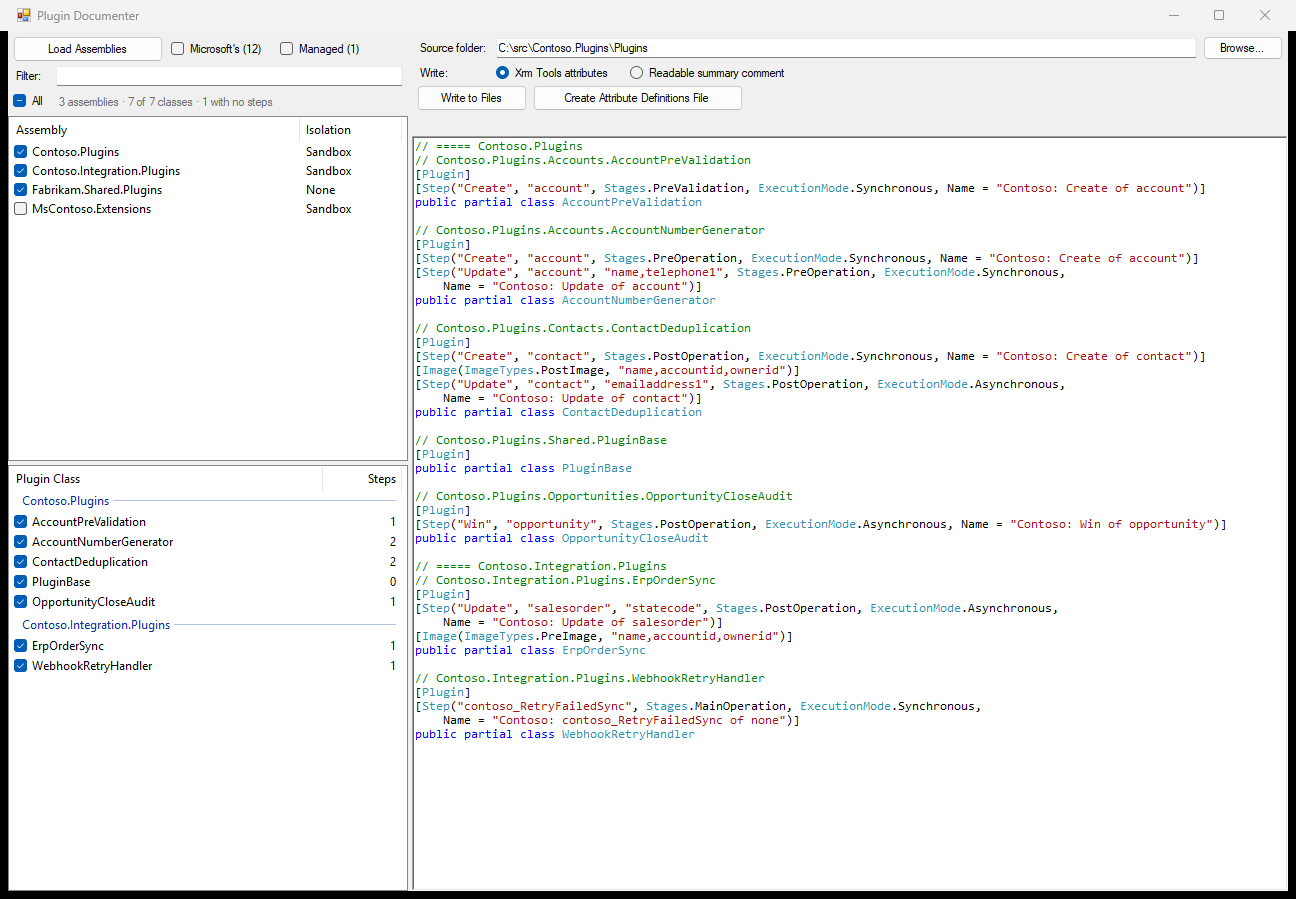
- Load Assemblies lists the unmanaged plugin assemblies in the connected environment — the ones somebody is writing. Microsoft's and everything else shipped in a solution are a switch away.
- Ticking one — or All of them, for a project that ships an assembly per plugin — loads every plugin type that has at least one registered step, grouped by assembly.
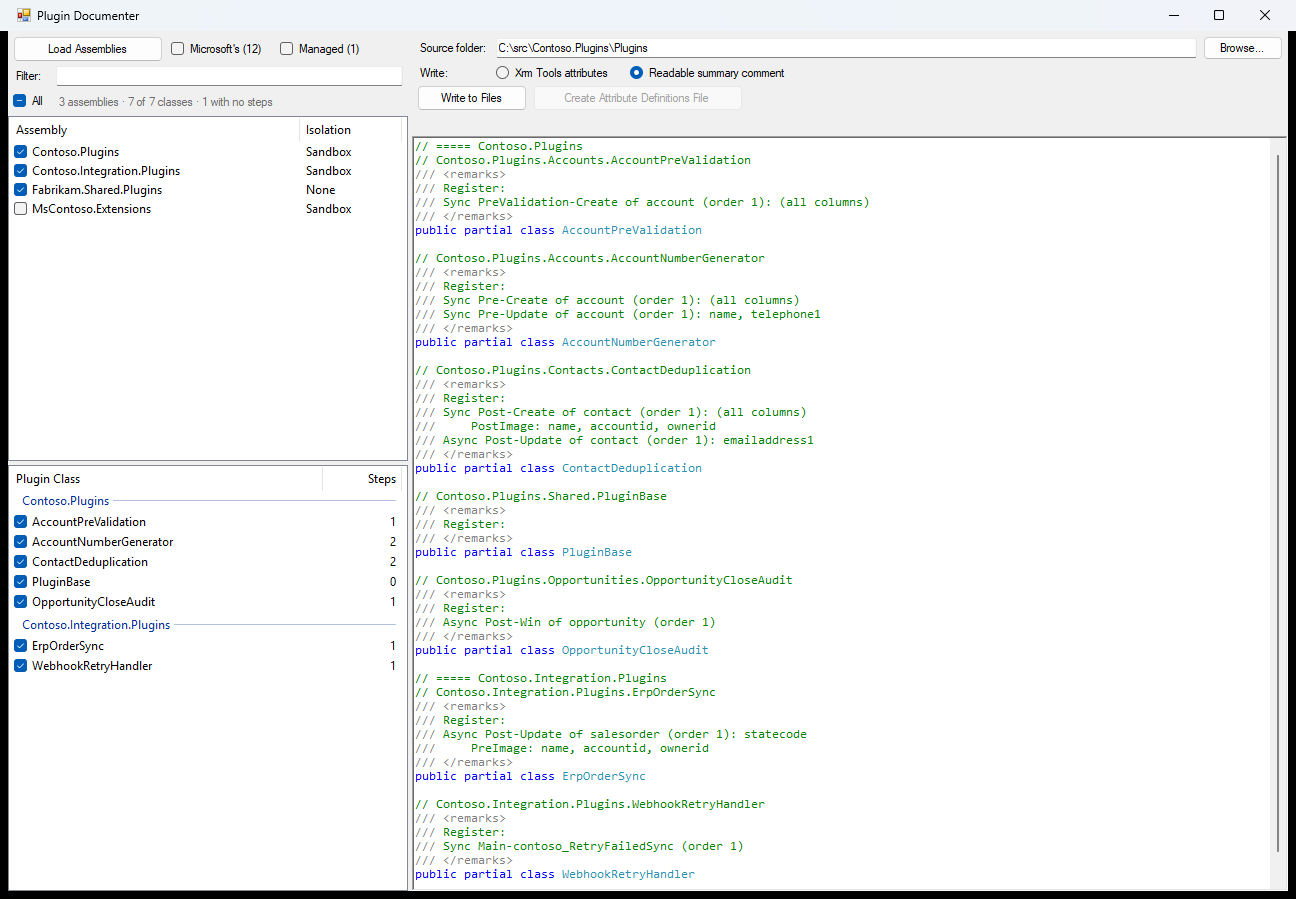
- Write chooses the output: Xrm Tools attributes or a readable summary comment.
- The preview pane shows exactly what would be written, and follows the ticks and the mode as you change them.
- Write to Files finds the
.csfile declaring each class and splices the output in above the class declaration. - Create Attribute Definitions File drops a dependency-free
XrmToolsMetaAttributes.csinto your project so the emitted attributes compile without the NuGet package or the Visual Studio extension.
Every file that changes gets a timestamped .bak copy beside it, and nothing is ever
written to the environment.
Two shapes, chosen with the Write toggle. They are independent: each replaces only its own block, so switching modes never deletes the other one's work, and a class can carry both.
/// <summary>Handles account writes.</summary>
[Obsolete("your own attributes are left alone")]
[Plugin(Description = "Keeps account data consistent.")]
[Step("Create", "account", Stages.PreOperation, ExecutionMode.Synchronous)]
[Image(ImageTypes.PostImage, "name")]
[Step("Update", "account", "name,address1_line1", Stages.PostOperation, ExecutionMode.Asynchronous,
    Name = "Recalculate rollups",
    ExecutionOrder = 25,
    Description = "Runs after the write completes.",
    AsyncAutoDelete = true)]
[Image(ImageTypes.PreImage, "name", Name = "Before", EntityAlias = "Before")]
[Step("Associate", Stages.PreValidation, ExecutionMode.Synchronous)]
public partial class AccountManager : IPlugin
Style follows the XrmTools.Meta.Attributes README: the widest positional constructor
the step's data supports, remaining facts as named properties, wrapping one argument per
line only when the line gets long. Attribute order is load bearing — [Image] binds
to the nearest preceding [Step], so steps are written in execution order with their own
images following them.
The same registration as prose, for the reader rather than the compiler:
/// <summary>Handles course history.</summary>
/// <remarks>
/// Register:
/// Sync Pre-Delete of ilac_class (order 1, disabled, As SYSTEM)
///     PreImage: (all columns)
/// Sync Post-Create of mshied_coursehistory (order 3): ilac_suggestedesllevel
///     PreImage:
///         mshied_academicperioddetailsid, ilac_class, mshied_courseid, ilac_currentlevel,
///         ilac_enddate, ilac_exitlevel, ilac_isstudentleaving, ilac_sessiontype
/// Sync Post-Update of mshied_coursehistory (order 1):
///     ilac_enddate, mshied_enrollmentstatus, ilac_startdate, ilac_suggestedesllevel
/// </remarks>
public partial class CourseHistoryHandler : IPlugin
Because nothing here has to compile, the comment carries two facts no attribute can
express: a disabled step, and the user a step impersonates, as As <name>.
| Getting started | Install it, connect, and do a first run. |
| Choosing assemblies | Why the list starts short, what the two switches hold, and how the filter behaves. |
| What gets written | Both output modes in full: what is emitted, what is suppressed, and in what order. |
| Writing to files | How a class is matched to a file, what is replaced, the backups, and the report. |
| Attribute definitions file | Making the emitted attributes compile, with or without the NuGet package. |
| Limits and troubleshooting | What the tool cannot express, and what to do when a run does not go as expected. |
.\build.ps1     # build Debug and copy the DLL into your local XrmToolBox Plugins folder
.\deploy.ps1    # copy the existing Debug DLL without rebuilding
.\publish.ps1 # build Release, pack, and push to NuGet.orgtests/ holds an end to end suite: six assemblies of empty plugin classes, under two
publishers, registered every way this tool has to describe — four in managed solutions and
two by hand, the way a plugin you are writing is registered — driven entirely by pac.
Several assemblies rather than one because that is where the interesting failures live:
a class name that is not unique across a source tree, an assembly whose source is missing,
an assembly named Microsoft that is nothing of the sort.
cd tests
.\register.ps1      # build the assemblies, pack three solutions, import them
.\verify.ps1        # confirm the environment matches the test matrix
.\unregister.ps1    # take it all away again
.\xtb.ps1           # build the tool and open it in an XrmToolBox of its own
.\ui.ps1            # screenshot the layout without XrmToolBox or a connection
xtb.ps1 puts a private XrmToolBox in tests\.xtb holding nothing but this tool, connects
it to the same environment and opens it, so testing a change is one command and cannot
disturb the XrmToolBox you work in.
Then compare what the tool writes with the expected output in tests/README.md, which spells out, class by class, exactly what both output modes should produce.
MIT