BC250 FSR4 v4.0.0-rc9 — retained shader checkpoint and chart refresh
Pre-release
Start here: beginner guide and corrected downloads
The illustrated beginner walkthrough covers the pinned OptiScaler download, exact game folders, Steam/Heroic choices, a real RC9/INT8 watermark reference, first-use shader compilation and undo steps.
Use the documentation refresh 2 downloads:
- RC9 docs2 ZIP · ZIP checksum
- RC9 docs2 tar.xz · tar.xz checksum
- Matching documentation/tooling source · source checksum
The -docs2 archives correct watermark removal: close the game, set Fsr4EnableWatermark=auto, remove any explicit MLSR-WATERMARK launch variable, and restart. In the pinned OptiScaler build, false sets the variable to 0; its presence still enables the SDK banner.
The original RC9 archive README footer mistakenly listed RC8's size and checksum; -docs1 corrected that footer. All three package revisions contain the same 111,815,680-byte DLL, SHA256 eefcac03ab17b04a29a5bb16e3f3e9c3181ba9ea46b05a61cb49a5003e1516ef. Existing assets and the RC9 tag are retained. This refresh comes from commit 6df385a and changes documentation only.
The watermark illustration is SDK-rendered over the standalone probe's synthetic pattern, not a game screenshot. Windows and other GPUs remain unqualified. Read the first-launch guidance before treating an initial compilation pause as a failed installation.
RC9 publishes the retained FSR 4.1.1 INT8 shader checkpoint as one Windows x64 DLL, labeled 4.1.1r9. Replace the compatible upscaler DLL in a native FidelityFX game or a working upstream OptiScaler installation. The ZIP and tar.xz contain the same DLL, instructions, checksums and notices.
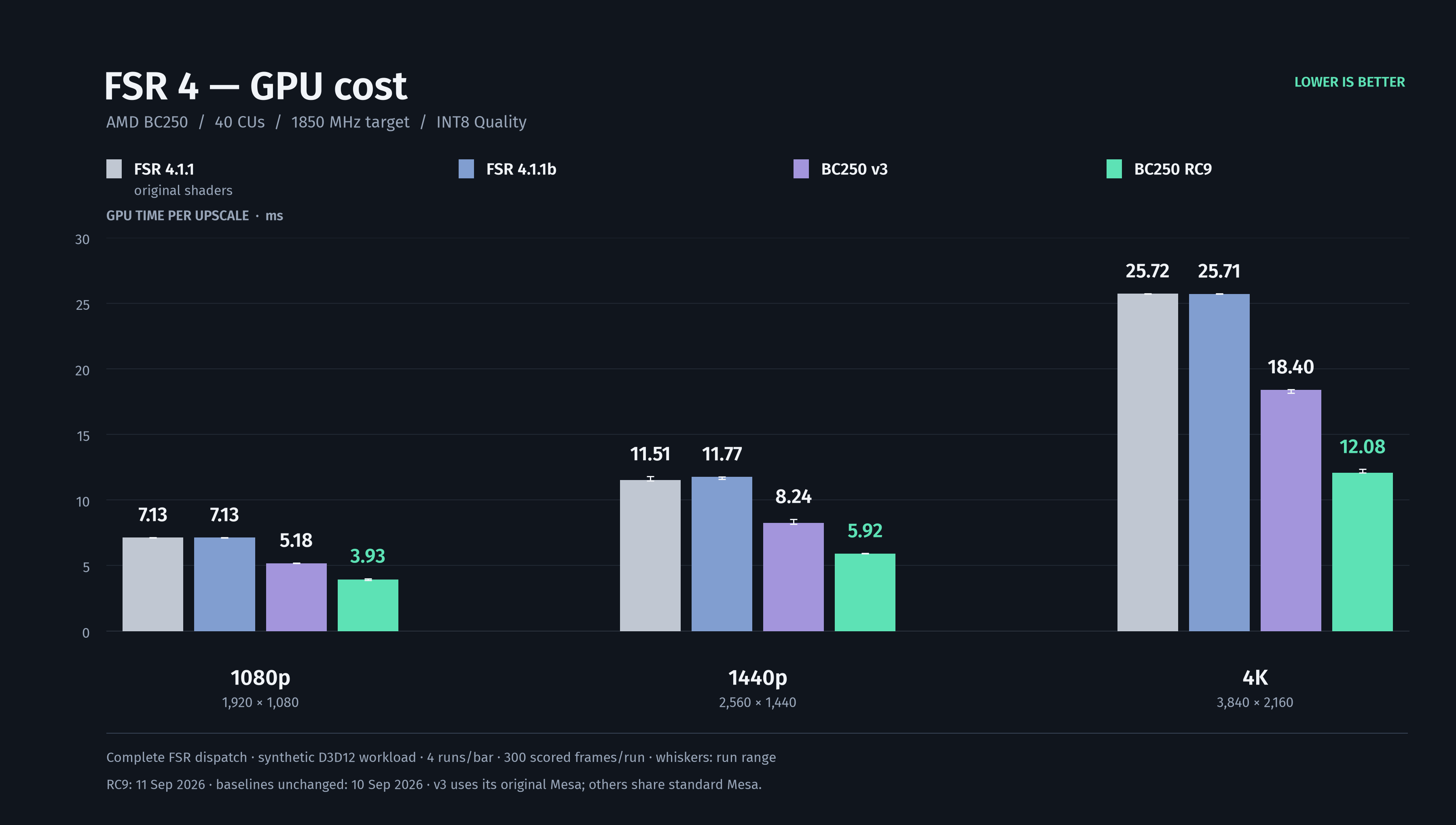
| Quality output | Final RC9 GPU cost | Range of four run medians |
|---|---|---|
| 1080p | 3.92825 ms | 3.87222–3.99682 ms |
| 1440p | 5.91826 ms | 5.90224–5.92666 ms |
| 4K | 12.08447 ms | 12.05920–12.33966 ms |
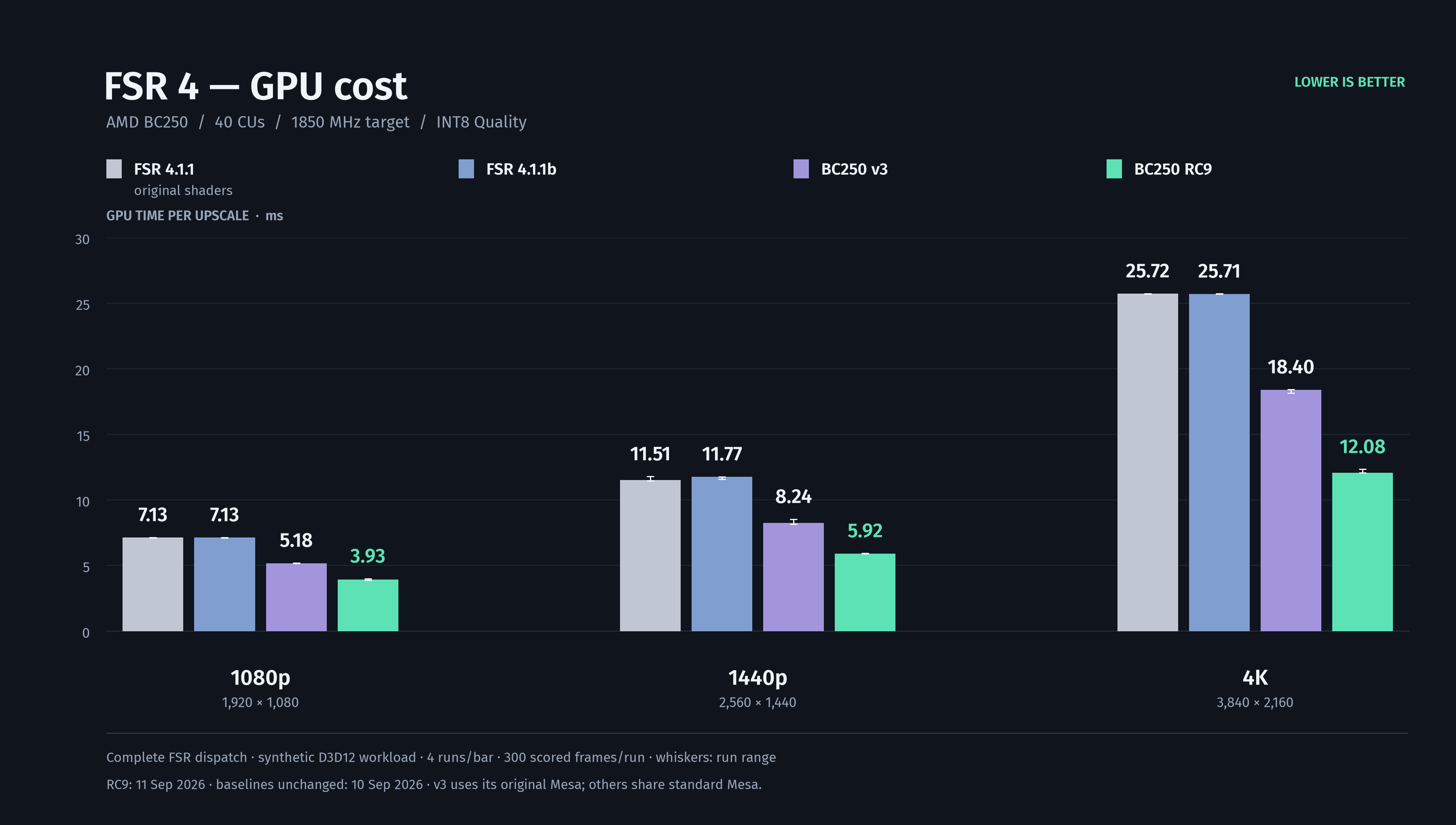
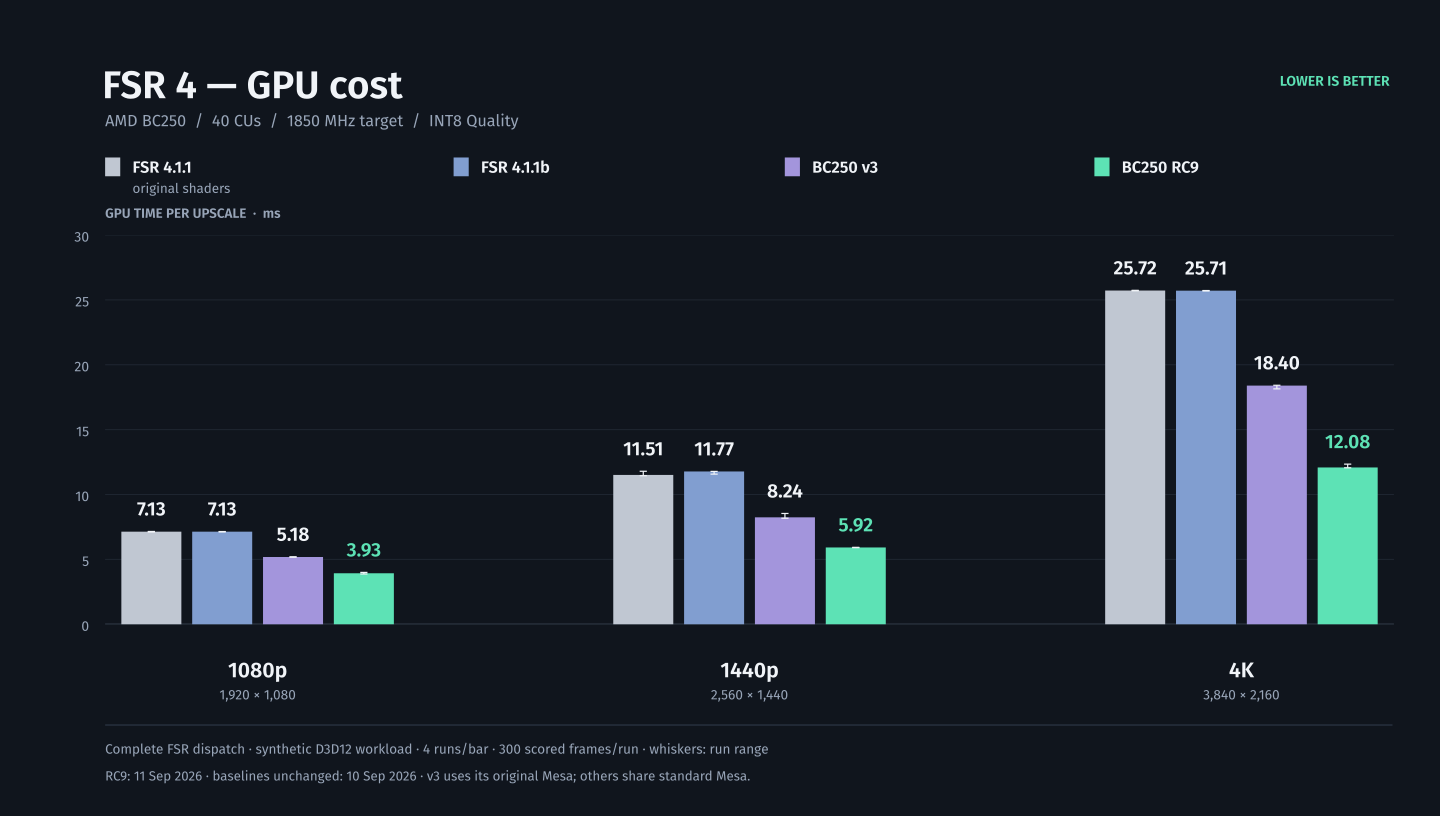
Only RC9 was remeasured on September 11. The chart retains all 36 original September 10 baseline runs for FSR 4.1.1, the supplied 4.1.1b DLL and upstream v3. Each bar is the median of four independent 600-frame runs, scoring the last 300 frames. These are synthetic whole-upscaler GPU costs on BC250 with ordinary GE-Proton and standard Mesa, not whole-game FPS. Relative to the historical RC7 chart, the 1440p and 4K values are lower and 1080p is slightly higher; those comparisons span two dates.
RC9 changes twelve shader slots from RC8 and nineteen from RC7. It adds exact Winograd convolution and bounded packed arithmetic, while retaining dynamic model-weight fallbacks, the scalar integer-cast compatibility repair and SDK synchronization fix. All 348 shaders exactly match the retained qualified development DLL; only its provider label and PE checksum differ.
All twelve scored images, three resolution preflights and seven additional 1440p image cases match their verified references. Every sampled scoring clock is 1850 MHz. The complete exported source rebuilds every shader and reproduces the exact distributed DLL; all 220 tests and the required CI jobs pass.
RC9 has no new game rendering or endurance checks. RC7's seven game checks retain their original identity and scope. Native Windows, other GPUs and frame generation remain unqualified. No RC9-specific driver or Proton tool is needed.
Install and undo · RC9 evidence and scope · Chart method and all timestamps · Chart PNG · Chart SVG
DLL: 111,815,680 bytes. SHA256:
eefcac03ab17b04a29a5bb16e3f3e9c3181ba9ea46b05a61cb49a5003e1516ef
The complete source archive and adjacent checksums are attached. The retained RC6 runtime/driver assets and prior RC7/RC8 releases remain available for recovery.