Repository navigation
Basel vs CRR


📌 Guide, not policy. The regime differences of docs/methodology/README.md govern; the repository defines the implementation specification. Applicable law and official regulatory texts prevail over both the repository and this guide.
K-SACCR calculates every netting set under one of two regimes: CRR, the EU
baseline and default, or BCBS, Basel CRE52. Where the texts agree the engine
has one implementation; where they differ, the difference is recorded with
locators in both texts before any code depends on it, and a test case shows it.
This page distinguishes recorded implementation differences, regulatory input requirements, adopted interpretations and unsupported treatments. A shared VBA formula does not establish that the two regimes prescribe identical inputs or eligibility conditions.
Version scope: the eight numbered rows and their test catalogue describe v1.0.2; the badge counts that recorded inventory, not every possible legal difference. Release 1.0.2 adds no recorded difference: its trade exposures to a CCP and settled-to-market trades follow the same rules in both regimes, and only the QCCP definition follows each regime's text (below). Additional input requirements and limitations are discussed below. Version 1.0.2 was
released on 2026-10-23 (GitHub Release). The CRR
side of each row is implemented but, like every CRR rule in v1.0.2, not
validated against published or independent numerical expected values under the project evidence policy (see Regulatory Basis). This does not mean there are no CRR tests or source checks. The clearing coverage records every clearing arrangement and its treatment in both regimes.
The toolkit calculates SA-CCR under two regimes: CRR (Regulation (EU) No 575/2013 and its delegated acts) and BCBS (Basel Framework, CRE52). CRR is the default.
For an EU institution the CRR is the binding rule set, and regulatory figures must be produced under it. The BCBS regime does not replace it. It sits alongside it for the following uses.
-
Seeing the effect of EU-specific rules. The CRR transposes CRE52 with a number of deviations: one-way margin agreements, the margin period of risk floor for client-cleared trades, the other-risks asset class, the lambda shift for options on negative rates or prices, and the offset across interest-rate maturity buckets. Running the same portfolio under both regimes isolates the effect of each deviation. The
Basel_vs_CRRsheet lists them with their legal references. Digital options are also treated differently, but the toolkit supports them in neither regime. -
Tracing a figure to the international standard. Model reviewers, auditors and supervisors often start from CRE52. The
BCBSresult lets them reconcile a CRR figure with the standard it derives from, step by step. - Monitoring exercises and peer comparison. Basel III monitoring exercises, and comparisons with institutions outside the EU, use the Basel rules rather than the CRR.
- Groups with entities outside the EU. Subsidiaries outside the EU follow national rules that implement the Basel Framework; CRE52 is a closer starting point for them than the CRR, though not a substitute for those national rules.
Results under BCBS are not CRR figures, nor any jurisdiction's regulatory figures, and must not be used for EU regulatory reporting.
| # | Topic |
CRR (locator) |
BCBS (locator) |
Effect on numbers |
|---|---|---|---|---|
| 1 | Interest-rate aggregation across maturity buckets | Only the formula with offsets (Art. 280a(3)) | The formula with offsets, or the sum of absolute bucket values at the bank's choice (CRE52.57(5)) |
IRBucketOffset = FALSE is valid only under Basel |
| 2 | Asset classes | Six, with other risks (Art. 277(1)(f), 280f: factor 8%) | Five (CRE52.72) | Other-risk trades are rejected under Basel |
| 3 | Commodity hedging sets | Energy, metals, agricultural goods, other commodities and climatic conditions (Art. 277a(1)(e)); climatic conditions take 18% (Art. 280e(5)) | Energy, metals, agricultural and other commodities (CRE52.45, CRE52.70 step 2); CRE52.72 sets factors by commodity type, not by hedging set | Climatic trades form their own hedging set under CRR only |
| 4 | Single-name credit factor | By credit quality step 1–6 (Art. 280c(5), Table 3) | By rating AAA to CCC (CRE52.72) | Same factors on a different scale |
| 5 | Supervisory delta of interest-rate and commodity options | Shifted by the regulatory lambda (CRR-RTS Art. 5) |
CRE52.40 FAQ2: an IR shift with currency-wide consistency and supervisory guidance; see the qualification below for commodity options | Delta differs when a price or strike is near or below zero |
| 6 | Interest-rate maturity bucket 1 | End date > 0 and ≤ 1 year (Art. 280a(3), Table 2) | Less than one year (CRE52.57(3)) | An end date of exactly 1 year is in bucket 1 under CRR, bucket 2 under Basel |
| 7 | MPOR floor of a client facing its clearing member | 5 business days: the client, like the clearing member, replaces the 10-day minimum of Art. 285(2)(b) (Art. 279c(1)(b)) | Engine: 10 business days, an adopted conservative interpretation. CRE54.2 footnote 2 also refers to CRE54.12 for the exchange-traded member–client leg under a bilateral agreement. Under CRE54.14–.17, if the conditions of CRE54.15 are met, the client takes the clearing member's treatment towards a CCP (CRE54.14), minimum MPOR 10 days for OTC derivatives (CRE54.8(2)); CRE54.16 changes only the risk weight, to 4%; if CRE54.14–.16 are not met, a bilateral trade (CRE54.17; CRE52.50). CRE54.12 expressly grants the 5-day floor to the clearing member; the CRE54.2 footnote prevents presenting this as an unqualified prohibition for every client arrangement | With daily remargining and no higher floor or override, the engine gives a CRR CLIENT a lower MF; CM has a base floor of 5 in both. Final EAD also depends on RC, multiplier and the cap |
| 8 | Variation margin posted under a one-way margin agreement (the bank posts, the counterparty does not) | A one-way agreement is a margin agreement (Art. 272(7), (7a)), so the netting set is margined (Art. 275(2)); entered as unmargined with VM posted, it is rejected | The netting set is unmargined (CRE52.2) and C includes the posted VM with a negative sign (CRE52.10, footnote 2) | Unmargined with posted VM: INVALID under CRR, VALID under Basel, where the posted VM raises RC |
| # | Workbook treatment | Covered by |
|---|---|---|
| 1 | Params IRBucketOffset: TRUE (default) is the formula with offsets; FALSE is the sum of absolutes for Basel netting sets, and makes a CRR netting set with interest-rate trades INVALID with its EAD withheld |
illustrative-ir-sum-of-absolutes (Basel); TEST_InputValidation params-ir-sum-of-absolutes-crr, -bcbs; relation in TEST_Invariants
|
| 2 | Asset class OT, allowed only in CRR netting sets; one hedging set per identical risk factor; rejected under Basel, which makes the netting set INCOMPLETE
|
T24, T25 (CRR), T26 (Basel), fixture illustrative-other-risks
|
| 3 | Commodity sub-class CLIMATIC: a CRR-only factor-table row with its own hedging set CLIMATIC, 18% |
T27 (CRR only), fixture illustrative-climatic-commodity
|
| 4 | Sub-classes AAA–CCC and CQS1–CQS6 side by side in the factor table; unrated names entered as CQS3, CQS5 or the mapped step |
T28 (CRR only), fixture illustrative-credit-quality-step
|
| 5 | CRR: λ computed per option, an entered λ ignored with a warning. Basel: λ from the Lambda shift column, with compliance and currency consistency checked by the user; acceptance of a commodity shift is not proof of regulatory permission. A trade with P + λ or K + λ ≤ 0 is rejected | T20, T21 (CRR), T22 (Basel), fixture illustrative-negative-ir-forward; T23 (CRR only), illustrative-negative-commodity-price
|
| 6 | The bucket follows the netting set's regime; its key stays <1Y in both |
TEST_InputValidation ir-bucket-boundaries-crr, -bcbs; the add-on effect in ir-bucket-offset-crr, -bcbs
|
| 7 | Client clearing role on NettingSets: CM takes MPORFloorCleared (5) in both regimes, CLIENT under CRR only; a Basel client keeps MPORFloorBilateral (10). From 1.0.2 every CM and CLIENT set gets an INFO line naming its role, floor and rule, the Basel client's marked as a conservative interpretation |
TEST_InputValidation netting-set-clearing-client-crr, -bcbs, netting-set-clearing-client-disputes-crr, -bcbs; for CM, netting-set-clearing-member-crr, -bcbs; illustrative-clearing-client-listed (weekly remargining: MPOR 9 under CRR, 14 under Basel) |
| 8 | Basel: Margined = N with negative VM is accepted, with an INFO line. CRR: rejected. Classification follows the actual agreement, not the current sign of VM; a one-way agreement must be represented with its real terms, not an invented receive-side threshold |
TEST_InputValidation netting-set-unmargined-vm-posted-crr, -bcbs (Basel RC 1,030) |
Every regime difference has a case that shows it, as the completeness policy requires; for rows 3 and 4 only the CRR side has a catalogue case. A rejection test confirms an input guard, not a fully supported calculation for the rejected product. All these cases are illustrative.
| # | Example | CRR |
BCBS |
|---|---|---|---|
| 1 | CRE99 Example 1 inputs with IRBucketOffset = FALSE |
INVALID, EAD withheld |
IR add-on 625,153.16, EAD 959,214.42 USD (illustrative), against 346,764.39 with offsets |
| 2 | Three other-risks swaps (illustrative-other-risks) |
Other-risks add-on 880, EAD 1,232 (T24, T25) | Every trade EXCLUDED, netting set INCOMPLETE: 3 of 3 trade(s) rejected (T26) |
| 3 | Heating-degree-day swap (illustrative-climatic-commodity) |
Hedging set CO|CLIMATIC|STD, factor 18% (T27) |
Row CO_CLIMATIC is CRR-only: the trade is rejected |
| 4 | Single-name CDS on a name of credit quality step 2 | Factor 0.42% (T28) | The same factor for rating A
|
| 5 | Receiver swaption, forward −0.20%, strike 0.10% (illustrative-negative-ir-forward) |
λ = 0.10% − (−0.20%) = 0.30% (T20), δ = −0.994175 (T21) | No λ entered: rejected (T22) |
| 5 | Commodity call, price −5, strike −4 (illustrative-negative-commodity-price) |
λ = −(1 + 0.1) × (−5) = 5.5 (T23) | Engine accepts λ as entered, subject to positive shifted price and strike; regulatory scope requires separate assessment |
| 6 | Interest-rate swap ending exactly one year after the reporting date | Bucket 1 | Bucket 2 |
| 7 | Margined netting set, daily remargining, role CLIENT
|
MPOR 5, MF 0.212132 | MPOR 10, MF 0.3 |
| 8 | Unmargined swap worth 30 with 1,000 of VM posted | INVALID |
RC = 30 − (−1,000) = 1,030 |
For the supported single-margin-agreement case, both regimes cap the EAD of a margined netting set at its EAD without margin, and both calculate that unmargined EAD with C = NICA:
- CRR. Art. 274(3) caps at the exposure "not subject to any form of margin agreement"; its RC follows Art. 275(1), whose NICA "does not include the variation margin posted or received" (EBA Q&A 2023_6962, final, 15/03/2024).
- Basel. CRE52.2 caps at the EAD "calculated on an unmargined basis"; CRE52.10 takes C from the NICA methodology of CRE52.17 and adds posted VM only for a one-way agreement where the bank alone posts (footnote 2), a netting set CRE52.2 already treats as unmargined.
The hypothetical unmargined calculation recomputes RC, the multiplier and the add-ons with unmargined maturity factors; it is not just a substitution of C in the ordinary margined result.
So illustrative-posted-vm-cap gives 40,774,849.35 EUR under both regimes (T16,
T17), although the fixture has category regime. The prototype workbook used
VM + NICA for the Basel cap and gave a different Basel figure; v1.0.0 corrected
it (#39). Details
and the worked numbers are on
Replacement Cost and Collateral.
The template's Basel_vs_CRR sheet compares 28 areas. Those marked same in substance run through one implementation:
| Area | Both texts | Locators |
|---|---|---|
| EAD and alpha | EAD = 1.4 × (RC + PFE); the consolidated CRR has no alpha exception by counterparty type | CRE52.1; CRR Art. 274(2) |
| Cap of a margined EAD | At the unmargined EAD, with C = NICA | CRE52.2, .10; CRR Art. 274(3), 275(1) |
| Margined RC | max(V − C, TH + MTA − NICA, 0) | CRE52.18; CRR Art. 275(2) |
| Multiplier | Floor 5%, the same exponential | CRE52.23; CRR Art. 278(3) |
| Supervisory duration | (exp(−0.05 S) − exp(−0.05 E)) / 0.05, floored at 10 business days | CRE52.34; CRR Art. 279b(1)(a) |
| FX adjusted notional | The foreign leg, or the larger converted leg | CRE52.35; CRR Art. 279b(1)(b) |
| Basis and volatility coefficients | SF × 0.5 and × 5; hedging-set eligibility and construction must also be checked (see below) | CRE52.46–.47; CRR Art. 277a(2), 280 |
| Inflation | Interest rate, own hedging set per currency, 0.5% | Basel FAQ; CRR Art. 277(4)(a), 277a(1) |
| Supervisory option volatilities | The same table, with 150% for other risks under CRR | CRE52.72; CRR Art. 279a Table 1; CRR-RTS Art. 5(3) |
| Maturity factor | sqrt(min(max(M, 10 / OneBusinessYear), 1)) unmargined; 1.5 × sqrt(MPOR / OneBusinessYear) margined. The engine uses 250 business days per year; applicable horizons and floors still matter | CRE52.48–.52; CRR Art. 279c |
| Settled-to-market trades (from 1.0.2) | Remaining maturity is the time to the next reset date, floored at 10 business days; E and T keep their roles | CRE52.37(5), CRE52.48, Basel FAQ to CRE52.31–.32; CRR Art. 279b(1)(a), 279c(1)(a), 279c(2) |
| Trade exposure to a CCP (from 1.0.2) | MPOR floor of 10 business days; where the CCP retains VM and the collateral is not protected, each trade's horizon is the lower of one year and its remaining maturity, at least 10 business days; risk weight 2% for a QCCP (stated on Checks, not applied) | CRE54.7, CRE54.8(2)–(3); CRR Art. 304(3)(b), (d), 306(1)(a) |
| Sold options and sold protection | Optional reductions in both, with conditions that must be distinguished; not applied by K-SACCR, which gives an EAD not lower than with them (see below) | CRE52.1 FAQ1–2; CRR Art. 274(5), (7) |
| Area | Regulatory distinction or scope | Workbook treatment |
|---|---|---|
| Risk-driver mapping | CRR Art. 277(2)–(3) and RTS Articles 1–4 prescribe identification and materiality methods; Basel CRE52.26–.28 permits multi-class allocation in the stated circumstances | User prepares the risk-category legs and uses the same Economic trade ID. Different allocation can change PFE. This is not permission to split ordinary linear products arbitrarily |
| Option combinations and digitals | CRR Art. 274(6) and CRE52.42–.43 prescribe decomposition; digital options require the specific collar treatment, with the Basel effective-notional cap also considered | Option legs share an Economic trade ID. Entering two option legs alone does not establish correct digital treatment or implementation of its cap |
| Several margin agreements; one agreement over several netting sets | Similar rules (CRE52.74–.75; CRR Art. 274(4), 275(3), 278(2)) | Not implemented: declared MIXED or SHARED and rejected |
| Proportional alternatives | EU only: simplified SA-CCR and the original exposure method (CRR Art. 273a, 281, 282) | Not implemented |
| Collateral eligibility and haircuts | Different rule sets (Basel credit risk mitigation; CRR Art. 276, 223) | Collateral is an input after haircuts |
| MPOR after qualifying disputes | Basel doubles F + N − 1 (CRE52.51(3)); the CRR minimum is 2F + N − 1 under the documented reading of Art. 285(4)–(5). The trigger and subsequent application period must also be met | The engine uses 2 × (F + N − 1) in both regimes: a recorded decision, higher than the CRR minimum when N > 1; see Margining and MPOR |
| QCCP status (from 1.0.2) | CRR: a CCP authorised or recognised under Regulation (EU) No 648/2012 (Art. 4(1)(88)); Basel: a QCCP as defined in CRE50.3, so a CCP outside the EU can qualify for a Basel netting set | NettingSets column R, read under the netting set's regime; the user's attestation. It sets only the risk-weight rule stated on Checks, not the EAD |
| Trade-count floor for trade exposures to a CCP | Does not apply (CRR Art. 285(3)(a); CRE54.8(1)) | The one large-or-illiquid flag still sets 20 days for a CCP netting set: a conservative limitation in both regimes |
| Settled-to-market trades in a margined netting set | CRE52.74 and CRR Art. 274(4) treat a mixed netting set | Not implemented: the netting set is INVALID, a limitation of the engine, not a regulatory prohibition |
These items can affect exposure through the inputs, the eligible netting or hedging sets, or a treatment outside the supported scope. They are not numerically irrelevant merely because the engine has no regime switch for them.
| Topic | CRR | Basel / consequence for the workbook |
|---|---|---|
| Equity and commodity adjusted notional | Art. 279b(1)(c): market unit price × units, with a specific rule for transactions contractually expressed as a notional amount | CRE52.36 uses current unit price × units; its volatility FAQ substitutes underlying volatility or variance and contractual notional. Prepare the appropriate adjusted amount before entry; an arbitrary historical notional is not interchangeable with current exposure units |
| Variable notional or quantity | Art. 279b(2)(a) covers deterministic amounts or quantities through time weights, and stochastic amounts through current market values | CRE52.37(1)–(2) covers market-value formulas and time-weighted variable IR/credit notionals. The workbook does not derive a schedule of amounts from the contract |
| Multiple exchanges and leverage | Art. 279b(2)(b) refers to remaining payments for contracts with multiple notional exchanges; (c) adjusts for multiplied cash flows or underlying | CRE52.37(3)–(4) addresses equivalent unleveraged notional and multiple principal exchanges. Apply the relevant contractual rule before entry; do not mechanically count every coupon as a principal exchange |
| Unrated single-name credit | Art. 280c(5)(a): IRB mapping; under the standardised approach 0.54%, or 1.6% where the specified Art. 128 condition applies | A matching numeric factor does not make rating assignment a free choice. The user must substantiate the applicable classification rather than simply select a convenient CQS |
| Credit indices and other multi-name positions | Art. 280c(5)(b): qualifying indices listed on a recognised exchange use majority constituent credit quality; other positions use the notional-weighted constituent factors | CRE52.72 provides IG/SG index factors. The engine's fixed index/CQS rows do not calculate constituent-weighted factors. An arbitrary basket must not be relabelled as an IG/SG index or rounded to the nearest CQS to imply compliance |
| Basis hedging-set eligibility | Art. 277a(2) requires the identical pair and positive correlation, with the specified fallback otherwise | CRE52.46 requires separate sets per specific basis in a single currency. Matching coefficients do not establish eligibility; the engine relies on user labels and does not prove correlation. Cross-currency floating legs do not receive basis treatment under the Basel footnote |
See Potential Future Exposure for the input contract, aggregation boundaries and the limits on supported credit baskets.
-
Basel client clearing: the 10-day
CLIENTfloor is the project's conservative interpretation of CRE54.2, .8 and .12–.17, documented in Clearing coverage. It must not be described as an unconditional Basel prohibition of five days for all client arrangements. A floor is not necessarily the final MPOR. - Basel λ: CRE52.40 FAQ2 requires the same parameter for IR options in the same currency and discusses supervisory recommendations. The engine accepts a per-trade input and does not enforce that currency-wide consistency. The FAQ's IR wording is not an explicit counterpart to the EU commodity rule. Under the amended RTS Art. 5, CRR computes λ per option: for IR, max(0.001 − min(P, K), 0); for commodities, max(−1.1 × min(P, K), 0).
- Disputes: with F = 10 and N = 5 business days, the documented CRR minimum is 24 days; the engine applies 28 days in both regimes. The corresponding MFs are approximately 0.464758 and 0.501996. This conservative implementation choice can affect PFE; the EAD cap may limit the final effect.
- Sold options: CRR Art. 274(5) permits zero EAD for a netting set composed solely of sold options, always negative in market value, with all premiums received upfront and no margin agreement. CRE52.1 FAQ1 describes sold options outside netting and margin agreements. These eligibility descriptions should not be collapsed into an identical rule. Neither relief is implemented.
- Sold protection: CRR Art. 274(7) and CRE52.1 FAQ2 permit an unpaid-premium cap subject to their standalone/unmargined conditions. This optional cap is not implemented; its absence does not mean every result must be strictly greater than a result with relief.
-
Clearing scope: the
CMrole represents the clearing member facing its client, not the member facing a CCP. From 1.0.2 the member's trade exposure to a CCP has its own role,CCP, with its QCCP status and retained VM; the protection of posted collateral stays the user's, multi-level client structures are rejected when declared with roleMULTI, and a CCP entered with roleNis calculated as bilateral. The combined large/illiquid flag does not implement every clearing exemption. See Margining and MPOR and the clearing coverage matrix. Risk weights and default-fund capital must not be confused with the SA-CCR exposure value.
Implemented, illustrative test passed, source checked, and validated against a published or independent expected value describe different evidence.
An illustrative case can verify a branch or rejection without establishing an
independent regulatory numerical benchmark. Identical results under both
regime flags do not by themselves validate either regulatory interpretation.
The v1.0.2 examples above retain their catalogue status; the clearing, CCP and
settled-to-market cases added in 1.0.2 are illustrative, and no independent
validation is claimed by this documentation update.
Primary references: Basel CRE52, Basel CRE54, CRR consolidated 26 June 2026, and Delegated Regulation 2021/931, consolidated 25 May 2025. The source register identifies the archived texts and their status; future amendments require a fresh comparison.
The workbook carries the comparison on its Basel_vs_CRR sheet: for each area, the Basel and EU rule, whether they are the same, the effect on numbers, the workbook treatment, the tests and the status of the source check.
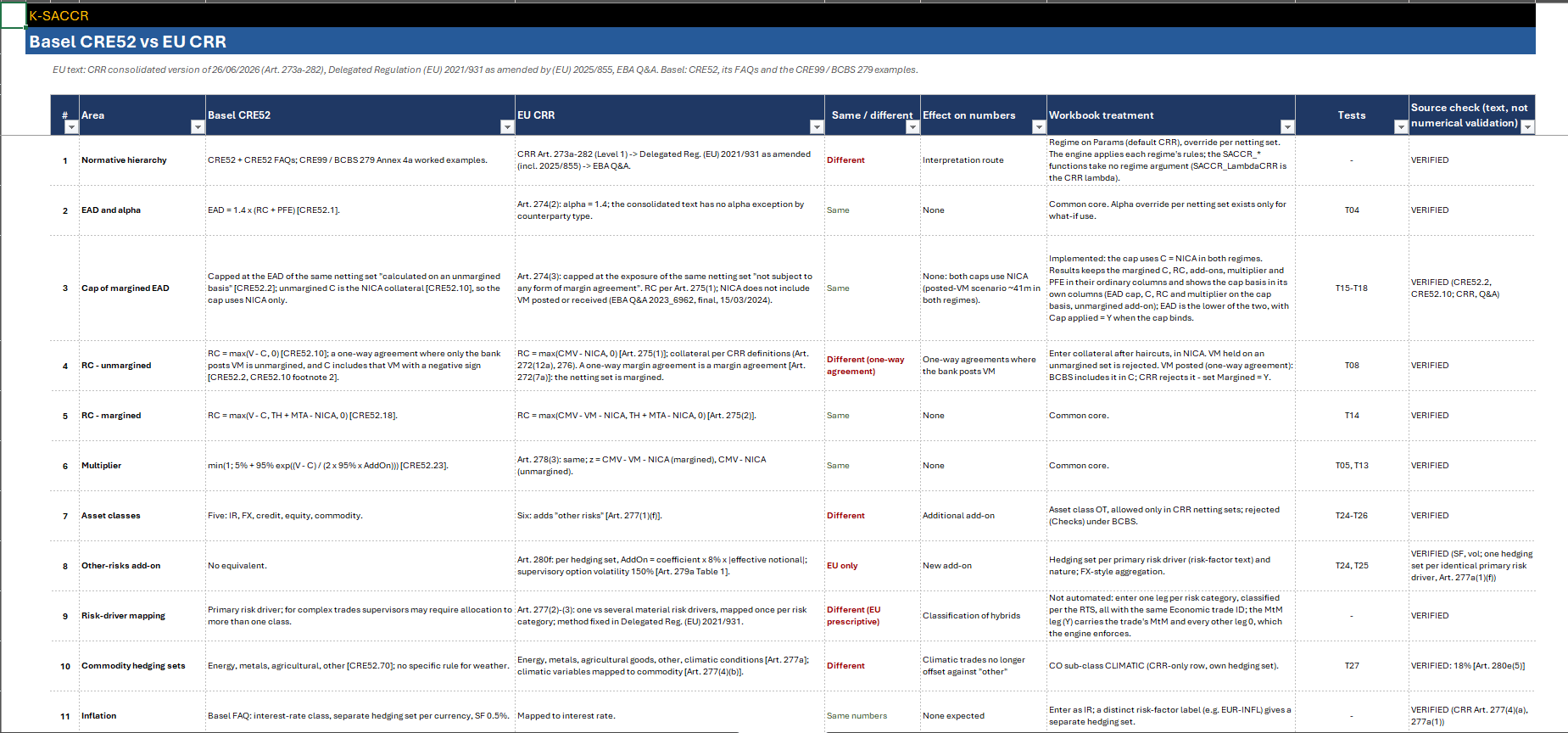
It has 28 numbered rows. In 1.0.2 (#389) eight rows were completed or qualified (among them the Basel lambda, listed credit indices and multi-name positions, the Basel client's 10 days, the CRR basis conditions, the sold-option and sold-protection reductions and the cap columns) and three added: equity and commodity adjusted notional, variable notional or quantity, and multiple exchanges and leverage. The column K header reads Source check (text, not numerical validation); the screenshot was retaken after that revision.
Column G (same or different) is green when it starts with "Same" and red bold
otherwise; column K (source check) is black for VERIFIED and red bold
otherwise (conditional formatting,
#296). The sheet
is a summary in the workbook; the methodology's regime-differences table is
implementation record. A VERIFIED source-check cell is not a numerical-validation certificate, and the screenshot is a static illustration rather than evidence that a downloaded workbook contains the latest wording.