Repository navigation
Worksheet Functions


📌 Guide, not policy. docs/PUBLIC_API.txt and the headers of
SACCR_Formulas.basgovern; where this page differs, the repository wins.
The module SACCR_Formulas is the only supported API of K-SACCR: ten
SACCR_* functions that compute the SA-CCR building blocks. The engine calls
them for every regulatory formula, and you can type them in any cell to check
an intermediate figure on your own inputs. They depend on the VBA runtime
only (no WorksheetFunction), so results do not depend on the Excel version
or locale. Their names, arguments, defaults and results are a contract:
changing one is a public API change.
Each function checks the domain of its inputs and returns an Excel error value instead of raising a VBA error or returning a misleading number:
| Error | Returned when |
|---|---|
#NUM! |
A number is outside its domain, or a result overflows the range of a Double
|
#VALUE! |
A value that is not a number where one is needed: a text Threshold in SACCR_LambdaCRR; a text, Boolean or other non-number element in SACCR_FactorAggregation
|
#REF! |
SACCR_FactorAggregation gets ranges or arrays of different sizes or shapes |
| The error itself | An error value inside an input range (SACCR_FactorAggregation) or as Threshold (SACCR_LambdaCRR) is passed on |
Nine functions return a Variant, so they can carry the error value; a
VBA caller tests it with IsError. SACCR_NormCDF returns a Double: it
accepts any real number and has no error result. The documented floors (S
below 0, M below the minimum, SD below its floor) are applied, not
rejected.
| Function | Returns | Reference |
|---|---|---|
SACCR_SupervisoryDuration(S, E, [FloorYears]) |
Supervisory duration | CRE52.34; CRR Art. 279b |
SACCR_MaturityFactor(M, [Margined], [MPOR_BD], [MinBD], [BDPerYear]) |
Maturity factor | CRE52.48, 52.52; CRR Art. 279c |
SACCR_OptionDelta(P, K, T, Vol, IsCall, IsBought, [Lambda]) |
Supervisory delta of an option | CRE52.40; CRR Art. 279a |
SACCR_LambdaCRR(P, K, IsInterestRate, [Threshold]) |
CRR lambda shift | Del. Reg. (EU) 2021/931 Art. 5, as amended by 2025/855 |
SACCR_CDODelta(A, D, IsLong) |
Supervisory delta of a CDO tranche | CRE52.41 |
SACCR_IREffectiveNotional(D1, D2, D3, [Rho12], [Rho23], [Rho13]) |
IR effective notional across buckets | CRE52.57 |
SACCR_FactorAggregation(AddOns, Rhos) |
Single-factor aggregation | CRE52.61, .66, .70 |
SACCR_Multiplier(VminusC, AddOn, [FloorPct]) |
PFE multiplier | CRE52.23; CRR Art. 278(3) |
SACCR_ReplacementCost(V, C, [Margined], [TH], [MTA], [NICA]) |
Replacement cost | CRE52.10, .18; CRR Art. 275 |
SACCR_NormCDF(x) |
Standard normal distribution N(x) | — |
Function SACCR_SupervisoryDuration(S As Double, E As Double, Optional FloorYears As Double = 0) As VariantSD = (exp(−0.05 S) − exp(−0.05 E)) / 0.05, in years. S and E are years from
the reporting date; a negative S (already started) is floored at 0. The
result is at least FloorYears (ten business days is 10/250).
#NUM! when E is before S after the floor, or FloorYears is negative.
=SACCR_SupervisoryDuration(0, 10)           → 7.8693868057…
=SACCR_SupervisoryDuration(0, 0.01, 10/250) → 0.04
Function SACCR_MaturityFactor(M As Double, Optional Margined As Boolean = False, Optional MPOR_BD As Double = 10, Optional MinBD As Double = 10, Optional BDPerYear As Double = 250) As VariantUnmargined: √min(max(M, MinBD / BDPerYear), 1). Margined:
1.5 × √(MPOR_BD / BDPerYear); M is then ignored. #NUM! when
BDPerYear ≤ 0, or (margined) MPOR_BD ≤ 0, or (unmargined) MinBD < 0.
=SACCR_MaturityFactor(0.75)       → 0.8660254…
=SACCR_MaturityFactor(3/365)      → 0.2          (floored at 10 business days)
=SACCR_MaturityFactor(0, TRUE, 10) → 0.3
Function SACCR_OptionDelta(P As Double, K As Double, T As Double, Vol As Double, IsCall As Boolean, IsBought As Boolean, Optional Lambda As Double = 0) As Variantd1 = (ln((P + λ)/(K + λ)) + ½ Vol² T) / (Vol √T); bought call +N(d1), sold
call −N(d1), bought put −N(−d1), sold put +N(−d1). Result between −1 and 1.
#NUM! when T ≤ 0, Vol ≤ 0, P + λ ≤ 0 or K + λ ≤ 0.
=SACCR_OptionDelta(0.06, 0.05, 1, 0.5, FALSE, TRUE) → -0.2693952… (CRE99 Example 1 swaption)
Function SACCR_LambdaCRR(P As Double, K As Double, IsInterestRate As Boolean, Optional Threshold As Variant) As VariantInterest rate: λ = max(threshold − min(P, K), 0), default threshold 0.001
(0.10%). Commodity: λ = max(−(1 + threshold) × min(P, K), 0), default 0.1.
Result 0 or positive. Under Basel the shift is left to judgement (CRE52.40
FAQ) and is entered on the trade instead. #VALUE! when Threshold is
not a number, #NUM! when it is negative, the error itself when it is an
error value.
=SACCR_LambdaCRR(-0.002, 0.001, TRUE) → 0.003
=SACCR_LambdaCRR(-5, -4, FALSE)       → 5.5
Function SACCR_CDODelta(A As Double, D As Double, IsLong As Boolean) As Variantδ = ±15 / ((1 + 14A)(1 + 14D)), positive for purchased protection.
#NUM! unless 0 ≤ A < D ≤ 1.
=SACCR_CDODelta(0.03, 0.06, TRUE) → 5.7409675…
Function SACCR_IREffectiveNotional(D1 As Double, D2 As Double, D3 As Double, Optional Rho12 As Double = 0.7, Optional Rho23 As Double = 0.7, Optional Rho13 As Double = 0.3) As VariantEN = √(D1² + D2² + D3² + 2ρ12 D1D2 + 2ρ23 D2D3 + 2ρ13 D1D3); the defaults
give the regulatory cross terms 1.4, 1.4 and 0.6. #NUM! when a
correlation is outside 0 to 1 or the three do not form a valid correlation
matrix (the same test the engine applies to IRCorrBucket*).
Function SACCR_FactorAggregation(AddOns As Variant, Rhos As Variant) As VariantAddOn = √((Σ ρk Ak)² + Σ (1 − ρk²) Ak²). AddOns is a range, an array or a
single number (any sign; blank counts as 0); Rhos the matching correlations
0 to 1 (a blank correlation only beside a blank add-on). Two vectors are paired
in order whatever their orientation; anything else must have the same rows and
columns. #REF! for different sizes or shapes, #VALUE! for a
non-number element, #NUM! for a correlation outside 0 to 1, and the
first error value found in either input.
=SACCR_FactorAggregation(E18:G18, H18:J18) → 282.1288… (FormulaTest row 18, CRE99 Example 2)
Function SACCR_Multiplier(VminusC As Double, AddOn As Double, Optional FloorPct As Double = 0.05) As Variantm = min(1, F + (1 − F) exp((V − C) / (2 (1 − F) AddOn))); 1 when AddOn is 0.
Result between F and 1. #NUM! when AddOn < 0 or F is not in [0, 1).
=SACCR_Multiplier(-20, 282) → 0.9651926…
=SACCR_Multiplier(10, 282)  → 1
Function SACCR_ReplacementCost(V As Double, C As Double, Optional Margined As Boolean = False, Optional TH As Double = 0, Optional MTA As Double = 0, Optional NICA As Double = 0) As VariantUnmargined: max(V − C, 0). Margined: max(V − C, TH + MTA − NICA, 0); TH, MTA
and NICA are used only when margined. #NUM! when a margined set has a
negative TH or MTA.
=SACCR_ReplacementCost(5, 10, TRUE, 0, 10, 2) → 8
Function SACCR_NormCDF(x As Double) As DoubleN(x) by the Hart (1968) double-precision algorithm as published by West (2005), absolute error below 1E-14; N(−|x|) is taken as 0 beyond |x| = 37. Any real number; no error result.
=SACCR_NormCDF(1.96) → 0.9750021…
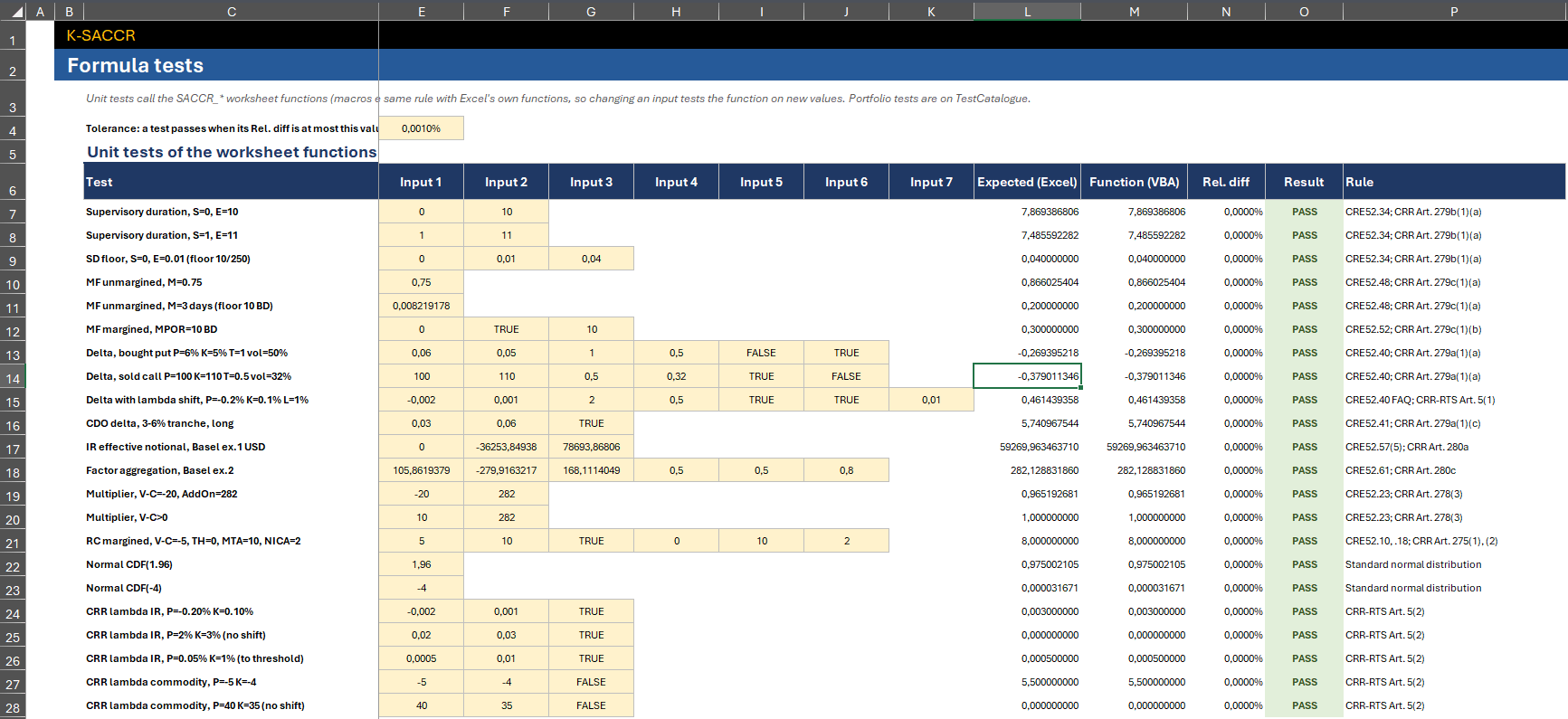
FormulaTest unit-tests the ten functions on the workbook's yellow inputs. Each row computes the same rule with Excel's own functions (column L) and with the VBA function (column M), so changing an input tests the function on new values. Portfolio-level tests are on TestCatalogue (see Test Catalogue).
| Position | Content |
|---|---|
| E4 | Tolerance, workbook name FormulaTest_Tolerance; template value 0.00001 (0.001%); data validation > 0 and ≤ 0.01 |
| Row 6 | Headers |
| Rows 7–28 | 22 tests |
| C | Test name |
| D | Arguments (what Inputs 1–7 mean on that row) |
| E–K | Input 1 … Input 7 (yellow, editable) |
| L | Expected (Excel) |
| M | Function (VBA) |
| N | Rel. diff |
| O | Result: PASS / FAIL
|
| P | Rule (CRE52 / CRR reference) |
| Rows | Function | Tests |
|---|---|---|
| 7–9 | SACCR_SupervisoryDuration |
S=0 E=10; S=1 E=11; floor 10/250 |
| 10–12 | SACCR_MaturityFactor |
M = 0.75; M = 3 days (floor); margined, MPOR 10 |
| 13–15 | SACCR_OptionDelta |
Bought put; sold call; with lambda shift |
| 16 | SACCR_CDODelta |
3–6% tranche, protection bought |
| 17 | SACCR_IREffectiveNotional |
CRE99 Example 1, USD |
| 18 | SACCR_FactorAggregation |
CRE99 Example 2 |
| 19–20 | SACCR_Multiplier |
V − C = −20; V − C > 0 |
| 21 | SACCR_ReplacementCost |
Margined, TH 0, MTA 10, NICA 2 |
| 22–23 | SACCR_NormCDF |
x = 1.96; x = −4 |
| 24–28 | SACCR_LambdaCRR |
Three interest-rate and two commodity cases |
Column N is labelled Rel. diff but is a normalized difference:
Rel. diff = |Function − Expected| / max(1, |Expected|)
=IFERROR(ABS(M7-L7)/MAX(1,ABS(L7)),"")
It is a relative error only when |Expected| ≥ 1; below 1 it is an absolute
difference. A row PASSes when Rel. diff ≤ E4
(=IF(ISNUMBER(N7),IF(N7<=FormulaTest_Tolerance,"PASS","FAIL"),"FAIL")); an
error value fails. Below about 1E-16 (double precision) only an exact match
passes.
The Expected formulas apply the same boundaries as the functions: a negative duration start is floored at zero, a non-positive add-on or a positive V − C gives a multiplier of 1. Agreement between Excel and VBA is a regression check of the implementation, not an independent regulatory validation. Randomised inputs are planned in #165 (v1.3.0).
Screenshot: FormulaTest
The domain and error contract itself is tested by the TEST_Formulas suite
(9 cases, 82 checks on 64-bit; 80 on 32-bit, which skips two LongLong
checks), which also writes the formulas on a temporary sheet to check that the
same results reach worksheet cells.
- How It Works — where the engine calls each function
- Test Catalogue — TEST_Formulas and TEST_Harness
- Regulation: Potential Future Exposure · Replacement Cost and Collateral · Margining and MPOR
- Workbook Guide · Home