Repository navigation
SA CCR Overview


📌 Guide, not policy. docs/methodology/README.md governs; where this page differs, the repository wins.
This page explains what the standardised approach for counterparty credit risk (SA-CCR) measures, how its parts fit together and how K-SACCR applies the EU and Basel versions of it. The formulas are on the pages linked below; the regulatory sources and their versions are on Regulatory Sources.
Status at v1.0.2: version 1.0.2 was released on 2026-10-23; see the
GitHub Release.
SA-CCR is the standardised, non-modelled method that banks use to measure the exposure at default (EAD) of their derivative netting sets for counterparty credit risk. It does not need an internal exposure model: it combines the current exposure with a supervisory estimate of how far the exposure could grow, using supervisory factors, correlations and option volatilities that the regulation prints.
| Text | Where SA-CCR is | Role in K-SACCR |
|---|---|---|
| Basel Framework, chapter CRE52 | Standardised approach to counterparty credit risk, effective 1 January 2023 | Regime BCBS, supported per netting set |
| EU CRR, Regulation (EU) No 575/2013 | Part Three, Title II, Chapter 6, Section 3 (Articles 274–280f), as amended by Regulations (EU) 2019/876 and 2024/1623 | Regime CRR, the baseline and default |
| Delegated Regulation (EU) 2021/931, as amended by (EU) 2025/855 | Supervisory delta and lambda shift of interest-rate and commodity options (Article 5) | Applied to CRR netting sets |
SA-CCR gives an exposure value. It is not a capital calculation: the EAD is an input to the wider prudential framework, and risk-weighted assets and CVA are outside v1.0.2 (see Regulatory Basis).
CRE52.1 covers OTC derivatives, exchange-traded derivatives and long-settlement transactions. Under the CRR, long-settlement transactions are addressed by Article 273(8). Regulatory applicability and the workbook's supported inputs are separate questions: v1.0.2 calculates supported derivative legs, including linear futures and listed options, settled-to-market trades and, from 1.0.2, a clearing member's trade exposures to a CCP, but does not implement the complete CCP capital framework (risk weights, default-fund contributions) or claim a dedicated long-settlement workflow. See the methodology support matrix before representing a transaction in the workbook.
SA-CCR is the standardised exposure method; IMM is the internal exposure model method and requires supervisory permission. This choice is distinct from the standardised or IRB approach used subsequently to calculate credit risk-weighted assets. The CRR also permits smaller derivative businesses to use simplified methods, subject to Article 273a:
| Method | Derivative-business thresholds | K-SACCR v1.0.2 |
|---|---|---|
| Full SA-CCR (Articles 274–280f) | No small-business threshold required | Supported within the documented instrument and netting-set scope |
| Simplified SA-CCR (Article 281) | Both ≤ 10% of total assets and ≤ EUR 300 million | Not implemented; planned in v1.5.0 |
| Original exposure method (Article 282) | Both ≤ 5% of total assets and ≤ EUR 100 million | Not implemented; planned in v1.6.0 |
| IMM (Section 6) | Supervisory permission under Article 283 | Not implemented |
The Article 273a thresholds concern the size of on- and off-balance-sheet derivative business under its prescribed valuation and aggregation rules, assessed monthly at month-end; they are not thresholds on SA-CCR EAD. Notification and loss-of-eligibility rules also apply (Articles 273a–273b).
SA-CCR exposure values feed several parts of the EU prudential framework. Counterparty credit risk, CCP trade exposures, large exposures and certain CVA approaches use Chapter 6 exposure measures, subject to their own rules. The leverage ratio and the output floor involve distinct calculation contexts and adjustments (dashed in the picture); the risk-based EAD cannot simply be reused unchanged in every framework.
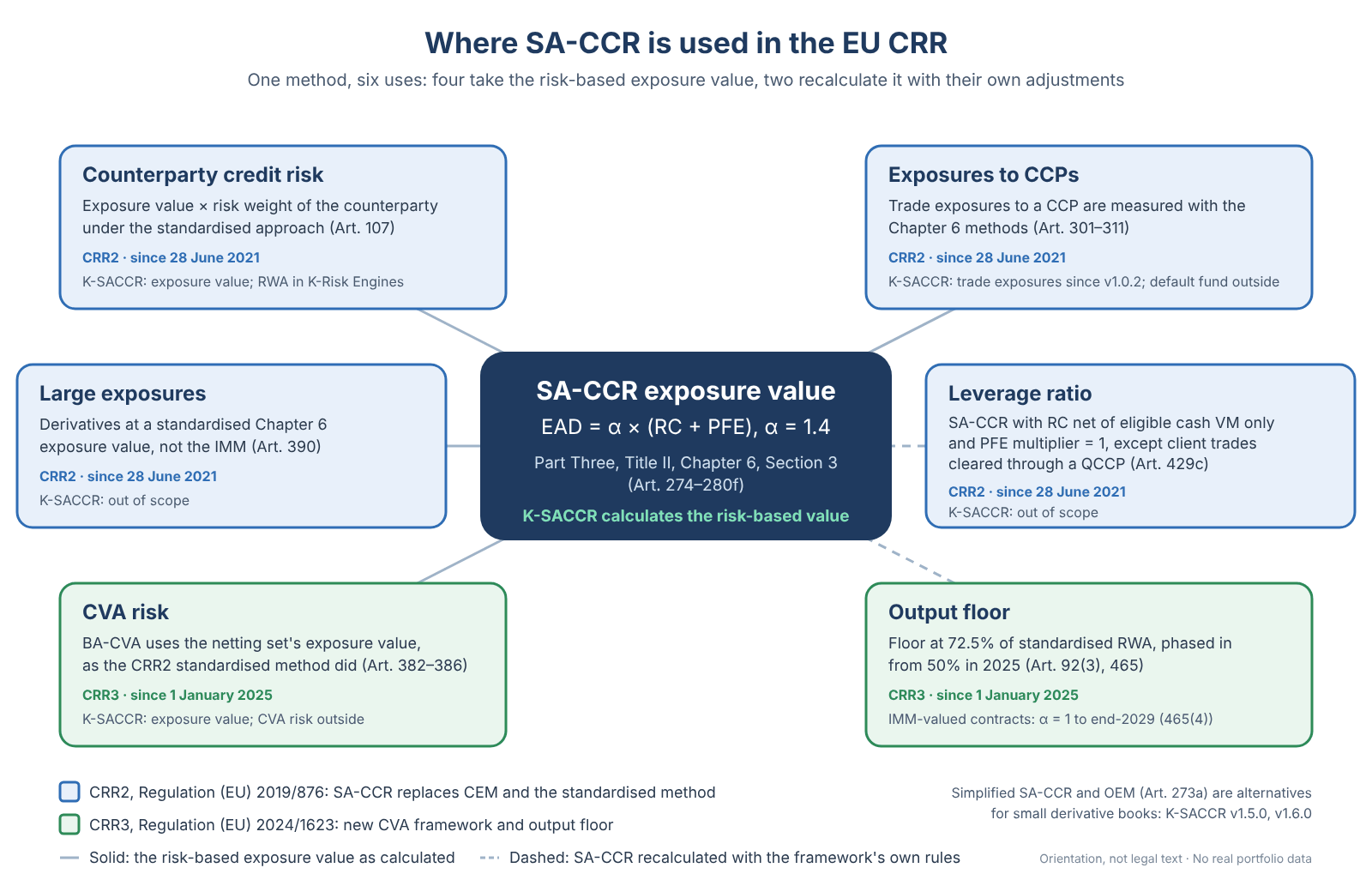
| Use | CRR | SA-CCR application / reform | How the SA-CCR value enters | K-SACCR |
|---|---|---|---|---|
| Counterparty credit risk | Art. 107 | CRR2, 28 June 2021 | Exposure value times the counterparty's risk weight under the standardised approach | Exposure value; RWA in K-Risk Engines |
| Exposures to CCPs | Art. 301–311 | CRR2, 28 June 2021 | Trade exposures to a CCP are measured with the Chapter 6 methods | A clearing member's trade exposures calculated from v1.0.2 (role CCP), risk weight stated, not applied; default-fund contributions outside K-SACCR, in K-Risk Engines
|
| Large exposures | Art. 390 | CRR2, 28 June 2021 | Derivatives enter at a standardised Chapter 6 exposure value; the internal model method is not used | Out of scope |
| Leverage ratio | Art. 429c | CRR2, 28 June 2021 | SA-CCR with specific collateral rules for RC and a PFE multiplier of 1; qualifying QCCP client clearing has exceptions under Art. 429c(4a) and (5) | Out of scope |
| CVA risk | Art. 382–386 | CRR2; CRR3, 1 January 2025 | The CRR2 standardised method and the CRR3 basic approach (BA-CVA) take the netting set's exposure value; the standardised approach (SA-CVA) does not | Exposure value; CVA risk outside K-SACCR |
| Output floor | Art. 92(3), 465 | CRR3, 1 January 2025 | Risk-weighted assets may not fall below 72.5% of the standardised amount, phased in from 50% in 2025; until 31 December 2029, institutions must use α = 1 in the SA-CCR floor calculation for Annex II contracts whose exposure values are calculated using IMM in the un-floored risk exposure amount (Art. 465(4)) | Out of scope |
The dates above identify SA-CCR application or the relevant reform, not the first introduction of each prudential framework. K-SACCR v1.0.2 calculates the supported risk-based exposure value at the centre of the picture, including the exposure value of a clearing member's trade exposures to a CCP.
For the leverage ratio, α remains 1.4. Article 429c(3) restricts recognition of collateral received for RC to eligible cash variation margin; paragraph (4a) permits wider collateral recognition for qualifying QCCP client clearing. Paragraph (5) sets the PFE multiplier to 1 except for derivative contracts with clients cleared by a QCCP.
For the output floor, Article 465(4) requires, rather than merely permits, α = 1 until 31 December 2029 where its conditions are met. Any wording in the figure suggesting an optional election must be read subject to this requirement. This transition does not change α for the ordinary risk-based SA-CCR or the leverage ratio. The sources are recorded in docs/assets/README.md.
For the ordinary risk-based calculation, both texts use the following formula (CRE52.1; CRR Art. 274(2)):
| Term | Meaning | Page |
|---|---|---|
| RC, replacement cost | What the bank would lose if the counterparty defaulted today and the trades had to be replaced, after collateral; for a margined netting set, also the largest exposure the margin agreement lets build up without a call | Replacement Cost and Collateral |
| PFE, potential future exposure | A supervisory estimate of potential exposure growth: over the prescribed horizon for unmargined trades, or during the margin period of risk for margined trades | Potential Future Exposure |
| multiplier | Ranges from 5% to 1 and recognises negative net value or excess collateral; PFE is therefore at least 5% of the aggregate add-on before any margined EAD cap (CRE52.23; CRR Art. 278(3)) | Potential Future Exposure |
| AddOn aggregate | The sum of the asset-class add-ons, with no diversification across classes (CRE52.25; CRR Art. 278(1)) | Potential Future Exposure |
| α | 1.4 in both texts; the workbook lets a netting set override it only for what-if runs | Regulatory Basis |
The PFE of a margined netting set uses a maturity factor driven by the margin period of risk instead of the trades' remaining maturity; that is on Margining and MPOR.
Every input of the formula, down to the trade (select it to open the full-size version):

The final SA-CCR EAD is calculated per netting set. Trades with the same counterparty can be grouped where a legally enforceable netting arrangement is recognised for prudential purposes. A transaction without such recognised netting must be treated as its own netting set (CRE52.1; CRR Articles 272 and 295–298). One counterparty may therefore have several netting sets.
The NettingSets sheet has one row per netting set. The workbook accepts that grouping as entered and does not determine legal enforceability or regulatory recognition: the user must establish those conditions before combining trades.
| Kind | Definition | How K-SACCR treats it |
|---|---|---|
| Unmargined | Under CRR, no margin agreement. Under Basel, no agreement obliging the counterparty to post variation margin; this includes a one-way agreement where only the bank posts (CRE52.2) |
Margined = N; RC from V and C; maturity factor from each trade's remaining maturity |
| Margined | Under Basel, an agreement obliging the counterparty to post variation margin. Under CRR, any margin agreement, including a one-way agreement where only the bank posts (Art. 272(7), (7a)) |
Margined = Y; RC also covers threshold and MTA; maturity factor from the MPOR; EAD capped at the unmargined EAD of the same netting set |
| Not supported | Several margin agreements in one netting set, or one agreement over several netting sets (CRE52.74–.75; CRR Art. 274(4), 275(3)) | Declared as MIXED or SHARED; the netting set is rejected. A settled-to-market trade in a margined netting set is rejected too (from 1.0.2) |
The client-clearing role on NettingSets (N, CM, CLIENT, and from 1.0.2
CCP and MULTI) sets the MPOR floor of a margined netting set; a trade
exposure to a CCP is its own netting set, with the CCP as counterparty. See
Margining and MPOR.
Every Results row has a status: only a VALID netting set reports an EAD. A
netting set with a rejected trade is INCOMPLETE and its EAD is withheld
rather than calculated on part of the portfolio; see
Outputs and Statuses.
The calculation runs from trade to netting set. Each step is visible on a sheet of the workbook, so a difference in EAD can be traced to the step that caused it.
Trade        adjusted notional d  x  supervisory delta  x  maturity factor MF
             = effective notional (CRR: "risk position", Art. 279)          -> TradeCalc
Bucket       sum of effective notionals per IR maturity bucket,
             credit or equity entity, or commodity type                     -> Buckets
Hedging set  IR: combine maturity buckets, then apply SF
             FX, other risks: SF x absolute net effective notional
             credit, equity, commodity: correlate entity/type add-ons       -> HedgingSets
Asset class  sum the hedging-set add-ons; no offset across hedging sets
Netting set  aggregate add-on, multiplier, PFE, RC, EAD, cap                -> Results
The same path as a picture: each trade is assigned top-down to its netting set, asset class and hedging set, then the figures are aggregated bottom-up to the exposure value (select it to open the full-size version):

| Block | What it does | Where defined |
|---|---|---|
| Adjusted notional d | Interest rate and credit: notional in the calculation currency × supervisory duration. FX: converted foreign-leg notional, taking the larger converted leg if both are foreign. Equity and commodity: current unit price × quantity, converted to the calculation currency. Other risks: the most appropriate method under Art. 279b(1)(d) | CRE52.34–.36; CRR Art. 279b |
| Supervisory delta δ | +1 or −1 for linear trades; a simplified supervisory Black–Scholes-type delta for options; a tranche formula for CDO tranches | CRE52.38–.41; CRR Art. 279a; CRR-RTS Art. 5 |
| Maturity factor MF | Unmargined: sqrt(min(max(M, 10/250), 1)), with M in years; margined: 1.5 × sqrt(MPOR / 250), with MPOR in business days. The workbook uses 250 business days per year | CRE52.48–.53; CRR Art. 279c |
| Supervisory factor SF | A regulatory scaling factor calibrated to exposure volatility. Base factors range from 0.38% (top-rated credit) to 40% (electricity); basis and volatility hedging sets apply coefficients of 0.5 and 5 respectively | CRE52.44, .72–.73; CRR Art. 280–280f |
| Hedging sets | Groups within which permitted offsets are calculated: currency for IR, currency pair for FX, credit or equity entities within their class, commodity types within a commodity group; basis and volatility transactions form separate hedging sets | CRE52.45–.47; CRR Art. 277a |
| Correlations | Between interest-rate maturity buckets, and between entities or commodity types and their common factor | CRE52.57, .61, .66, .70; CRR Art. 280a–280e |
| Multiplier | Recognises negative value and excess collateral; the multiplier is floored at 5%, so PFE ≥ 5% × aggregate add-on before any margined EAD cap | CRE52.23; CRR Art. 278(3) |
| Cap | A margined netting set's EAD is at most its EAD without margin | CRE52.2; CRR Art. 274(3) |
A transaction with more than one material risk driver may contribute to more than one risk category (CRR Art. 277; CRE52.26–.28). In K-SACCR the user enters it as legs sharing an Economic trade ID, with one leg per relevant category. Each leg carries the inputs required for its risk contribution, while the economic transaction's market value is entered once, on one leg, to avoid double-counting V and RC. The workbook does not determine material risk drivers or decompose complex payoffs automatically; see Inputs.
The Basel Framework is the international standard agreed by the Basel Committee; the CRR is the EU regulation that implements it, with an EU delegated regulation for the option delta. The two texts agree on almost every formula and parameter, but not on all of them.
-
CRR is the baseline. The Params sheet sets the regime,
CRRby default, and each netting set can override it withBCBS(#8). -
One implementation where the texts agree. The engine has one code path
per rule, tagged with both rule identifiers, such as
CRE52.10andCRR.275.1. - Every difference is recorded first. A difference changes a result only after it has been compared in both texts and recorded in the methodology's regime differences; eight are recorded, listed on Basel vs CRR.
-
Every result names its regime. Results has a total per regime,
TOTAL CRRandTOTAL BCBS, and never adds a CRR and a Basel EAD together: for the same portfolio they are alternatives, not parts.
The recorded differences are other risks (CRR only), the climatic-conditions commodity hedging set (CRR only), the credit-quality-step scale for credit factors, the lambda shift of interest-rate and commodity options, the sum of absolute interest-rate bucket values (Basel only), the boundary of interest-rate maturity bucket 1, the MPOR floor of a client facing its clearing member, and variation margin posted under a one-way agreement. The cap of a margined netting set is not a difference: both texts use NICA as the collateral of the cap.
The EAD reference card collects the formulas and supervisory parameters as K-SACCR implements them: netting-set exposure, trade-level inputs, asset-class parameters and aggregation, with the points where CRR and Basel differ. Select it to open the full-size version.

The card summarises the methodology and is not a source. The illustrations
use shortened labels: the adjusted-notional definitions above govern the
meaning of "notional", and the methodology records the workbook's conservative
MPOR treatment for CRR dispute/remargining combinations. It gives S, E, M and
T in years of 365 days, the default of the DaysPerYear parameter; its values
were checked against the methodology's parameter table on 2026-10-15
(docs/assets/README.md).
The workbook shows the same card as a picture at the foot of its README sheet
(#283).
| Does | Does not |
|---|---|
| Calculate SA-CCR EAD under CRR or Basel CRE52 for supported instruments and netting-set structures | Price trades or source market data: values, prices, FX rates and collateral after haircuts are inputs |
| Show every trade, bucket, hedging-set and netting-set quantity | Calculate risk-weighted assets (a CCP's risk weight is stated on Checks, not applied), CVA, CCP default-fund exposures or securities financing transactions |
| Reject inputs it cannot calculate correctly, and withhold the EAD of the affected netting set | Calculate the simplified SA-CCR or the original exposure method (CRR Art. 281, 282) |
Classify every run as REGULATORY or WHAT-IF against the parameter set CRE52-CRR-2026-10-09
|
Decide eligibility, legal enforceability or the mapping of complex trades to risk drivers; those are the user's |
| Reconcile its figures with a bank's own, per netting set and per trade leg | Certify a bank's figures or replace a regulatory approval |
🏷️
REGULATORYis a parameter classification. It means that the run matches the workbook's reference supervisory parameter set. It does not certify legal eligibility, complete regulatory coverage, input correctness or numerical validation.WHAT-IFidentifies departures from that set; see Regulatory Basis.
Scope boundaries: v1.0.2 does not support digital options, the
MIXED/SHARED margin-agreement structures above, multi-level client
structures (role MULTI is rejected) or settled-to-market trades in a
margined netting set. Automatic decomposition
of option combinations and risk-driver mapping are not implemented; the user
must supply supported legs. The optional special exposure reductions for
sold options and sold credit protection under CRR Art. 274(5) and (7) are not
applied, so the exposure is not lower than with them. See the
methodology support matrix
for the full list of supported, user-prepared and excluded treatments.
Under the evidence policy of v1.0.0, kept in v1.0.1 and v1.0.2 (#44), only the values printed in the Basel worked examples of CRE99, tests T01–T14, count as validation. They are Basel examples, so CRR rules are implemented but not numerically validated in v1.0.2. The client-clearing, CCP and settled-to-market rules added in 1.0.2 are implemented and tested on illustrative values in both regimes. Every other case is illustrative: it shows a behaviour and validates nothing. A cross-check against a second source is planned in #100. See Worked Examples and Validation Approach.
| If you want to | Read |
|---|---|
| Know which official texts, in which versions, the methodology was checked against | Regulatory Sources |
| Know the regimes, the scope of v1.0.2, the parameter set and what is validated | Regulatory Basis |
| Understand RC, collateral, VM, NICA, threshold, MTA and the cap | Replacement Cost and Collateral |
| Understand the margin period of risk and the maturity factor | Margining and MPOR |
| Follow the add-ons asset class by asset class | Potential Future Exposure |
| See every point where CRR and Basel give different numbers | Basel vs CRR |
| Reproduce the CRE99 examples and the illustrative cases | Worked Examples |
| Enter a portfolio | Getting Started, Inputs |
| Read the results and their statuses | Outputs and Statuses |
| Compare the results with a bank's own figures | Reconciliation and Evidence |
- Regulatory Sources · Regulatory Basis · Basel vs CRR
- Replacement Cost and Collateral · Margining and MPOR · Potential Future Exposure
- Worked Examples · How It Works · Home
- Official texts: Basel CRE52 · Consolidated CRR, 26 June 2026
- Repository: methodology · EAD reference card