Evolutions of a Middleware
A Middleware is unlikely to be removed (though it still may be replaced) once it is built into a system. There are few evolutions as a Middleware is a third-party product and is unlikely to be messed with:
- If the Middleware in use does not fit the preferred mode of communication between some of your services, there is an option to deploy a second specialized Middleware.
- If several existing systems need to be merged, that is accomplished by adding yet another layer of Middleware, resulting in a Bottom-Up Hierarchy (Bus of Buses).
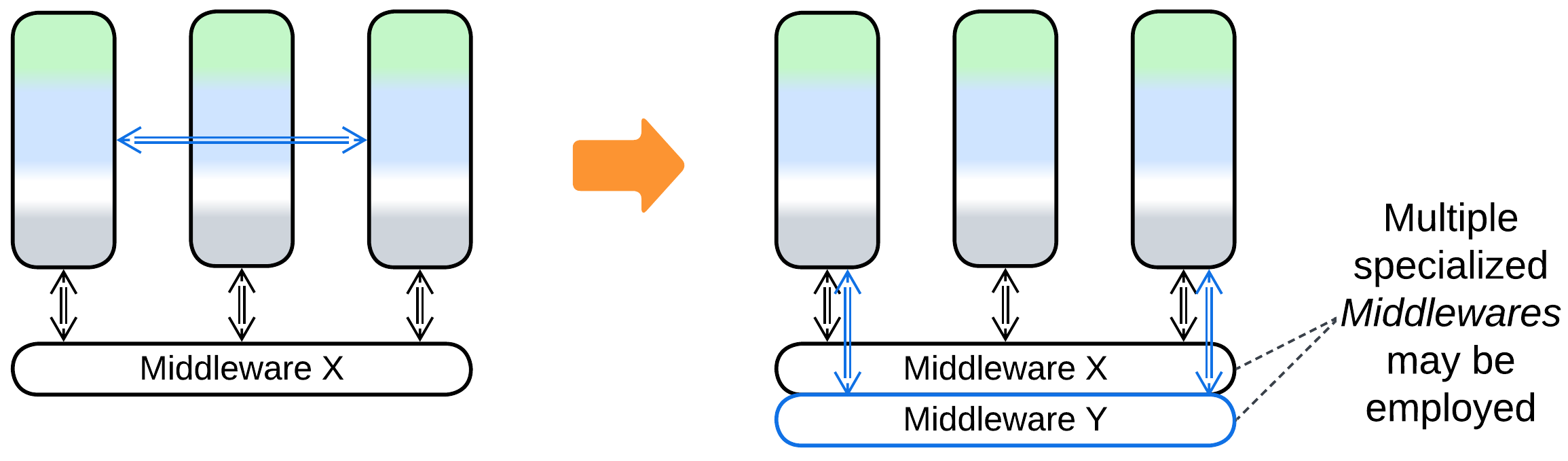
Patterns: Middleware.
Goal: support specialized communication between scaled services.
Prerequisite: the system relies on a Middleware for scaling.
If the current Middleware is too generic for the system’s needs, you can add another one for specialized communication. The new Middleware does not manage the instances of the services.
Pros:
- Supports specialized communication with no need to write code for tracking the instances of services.
Cons:
- You still need to notify the new Middleware when an instance of a service is created or dies.
- There is an extra component to administer.
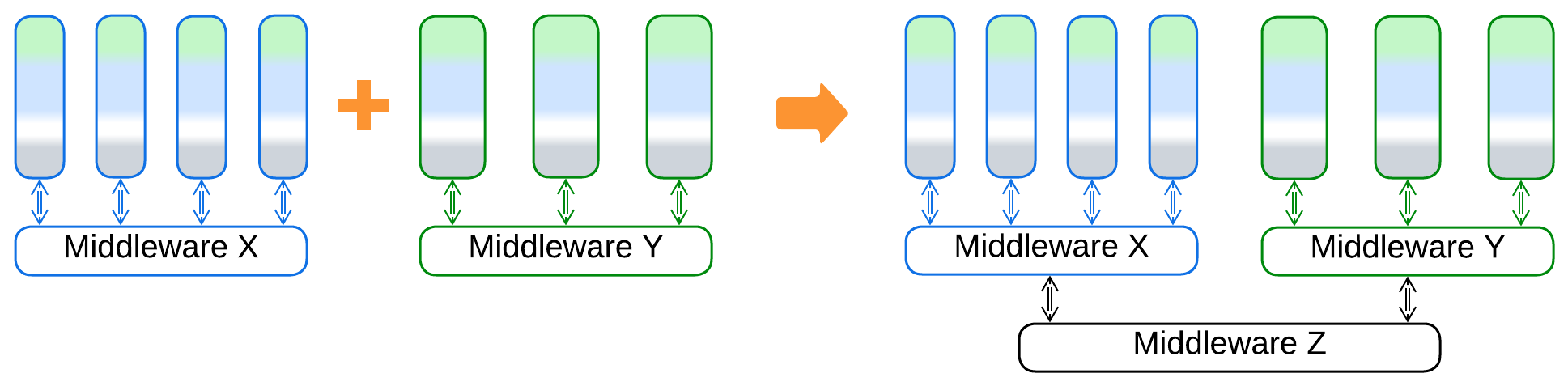
Patterns: Bottom-up Hierarchy (Hierarchy, Middleware).
Goal: integrate two systems without a heavy refactoring.
Prerequisite: both systems use Middlewares.
If we cannot change the way each subsystem’s services use its Middleware, we should add a new Middleware to connect the existing Middlewares.
Pros:
- No need to touch anything in the existing services.
Cons:
- Performance suffers from the double conversion between protocols.
- There is a new component to fail (miserably).
| << Evolutions of a Pipeline | ^ Evolutions of architectures ^ | Evolutions of a Shared Repository >> |
|---|
Analytics
Appendices
- Acknowledgements
- Books referenced
- Copyright
- Disclaimer
-
Evolutions of architectures
- Evolutions of a Monolith that lead to Shards
- Evolutions of a Monolith that result in Layers
- Evolutions of a Monolith that make Services
- Evolutions of a Monolith that rely on Plugins
- Evolutions of Shards that share data
- Evolutions of Shards that share logic
- Evolutions of Layers that make more layers
- Evolutions of Layers that help large projects
- Evolutions of Layers to improve performance
- Evolutions of Layers to gain flexibility
- Evolutions of Services that restructure services
- Evolutions of Services that add layers
- Evolutions of a Pipeline
- Evolutions of a Middleware
- Evolutions of a Shared Repository
- Evolutions of a Proxy
- Evolutions of an Orchestrator
- Evolutions of a Sandwich
- Format of a metapattern
- Glossary
- History of changes
- Index of patterns
- Martin Fowler's Bliki
- Software Architecture Chronicles
- Patterns and Principles
- UI and UX Patterns
- Enterprise Integration Patterns
- Microservices Patterns
- Gang of Four Design Patterns
- Game Programming Patterns
- PLoP Archive
- Metapatterns website
