Streaming Integrity Monitor & Universal Regeneration Guard
Catch LLM decoding corruption while the answer is still being generated and cut the stream mid-flight: corruption that starts in the hold window never reaches the user, and mid-stream corruption is aborted within a few hundred characters of onset, so the host regenerates the answer.





| throughput | detection latency | false-alarm budget | footprint | setup |
|---|---|---|---|---|
| 197,632 chars/sec on a laptop CPU | ~590 chars past corruption onset | configurable, conformal-calibrated | numpy only, no model, no GPU | 3 lines, zero training |
The guard runs hundreds of times faster than a typical LLM produces text, so it is never the bottleneck: a model streaming at 50 tokens/sec writes ~250 chars/sec, and SIMURG reads 197,000.
Table of contents
When you run an LLM in production, especially a quantized, small, or self-hosted model, it sometimes derails mid-generation. The decoded stream stops doing the task and collapses into one of a handful of pathologies:
| failure mode | what it looks like |
|---|---|
| repetition collapse | the same phrase, list, or token repeated until the token budget runs out |
| cross-lingual drift | an English answer that quietly slides into Chinese, Arabic, or Cyrillic |
| regurgitation | the model dumps a README, boilerplate, or training text |
| structural breakdown | #REF! -0.00 -0.00 ... 0.00: number and symbol garbage |
| template leakage | `< |
This is not factual hallucination. A fluent-but-wrong sentence (see What SIMURG is NOT) has no statistical scar. What is shown above is decoding corruption, and it leaves a statistical signature in the token stream: repetition rate, lexical variety, script distribution, compressibility, and predictive surprise all move in measurable ways.
SIMURG watches that signature character by character, decides in real time whether the stream has gone bad, tells you where it started, and lets you abort and retry before the user ever sees the corruption.
The full technical report, with the complete evaluation, per-class analysis, onset-localization study, and the zero-leak protocol specification:
SIMURG: Zero-Leak Online Detection of LLM Decoding Corruption in Production Streams, F. Aghayev, E. Ahmadbayli, HAL-X AI, 2026. Read the paper (PDF, 13 pages)
| SIMURG | post-hoc linter | LLM-as-judge | perplexity threshold | |
|---|---|---|---|---|
| when it fires | mid-generation, ~590 chars past onset | after the full answer | after the full answer | post-hoc, or needs logprob access |
| what the user sees | zero bad tokens when onset is in the hold window; otherwise the clean prefix plus a bad tail of at most ~900 chars, replaced by the retry | the whole corrupt answer | the whole corrupt answer | varies |
| why it fired | a named, human-readable reason on every alarm | a pattern list | the judge's opinion, if any | one number |
| model-agnostic | any OpenAI-compatible endpoint, or any stream you feed | any | any | needs a logprob-capable backend |
| overhead | numpy-only, ~197k chars/sec on one CPU core | trivial | one extra LLM call per answer | per-token logprobs |
The zero-leak property is the point: post-hoc checks can only tell you that the answer was bad after the user read it. SIMURG holds the opening of every stream in a buffer, releases it only once it is verified clean, keeps re-checking, and cuts the stream the moment it crosses the calibrated threshold.
SIMURG makes one O(1)-per-character pass over the stream, maintaining a set of incremental features (digit fraction, foreign-script fraction, repetition rate, compressibility, type-token ratio, script-switch rate, structural-artifact density, ...), and feeds a pluggable detector ensemble on top of them:
flowchart TD
    A["token stream"] --> B["stream features<br/>one O(1) per character incremental pass"]
    B --> C1["char n-gram surprise<br/>self-calibrating, no reference corpus"]
    B --> C2["Count-Min repetition sketch<br/>constant memory, 8k counters"]
    B --> C3["rolling SimHash drift<br/>topic collapse detection"]
    B --> C4["robust-z self-calibration<br/>baselines frozen on the clean prefix"]
    B --> C5["rule tier<br/>interpretable thresholds, zero training"]
    C1 --> D["conformal fusion<br/>finite-sample false-alarm budget"]
    C2 --> D
    C3 --> D
    C4 --> D
    C5 --> D
    L["learned tier<br/>15-weight online logistic model"] --> D
    D --> E["CLEAN / SUSPECT / CORRUPT<br/>plus Page-Hinkley onset localization"]
    E --> F["zero-leak protocol<br/>HOLD first 350 chars, RELEASE if clean,<br/>re-check every 400, ABORT on corrupt"]
    F --> G["bad tokens never reach the UI"]
| detector | what it measures | why it catches corruption |
|---|---|---|
| char n-gram surprise | predictive surprise of each char against an in-stream 3-gram model | loops and garbage drive surprise toward zero |
| Count-Min repetition | n-gram repetition rate in a constant-memory sketch | repetition collapse is the most common production failure |
| rolling SimHash drift | distance of a 48-token fingerprint from the clean-prefix baseline | topic collapse and regurgitation move the fingerprint |
| robust-z self-calibration | every feature z-scored against its own frozen clean-prefix baseline | no hand-tuned magic numbers, adapts to any domain |
| rules | interpretable thresholds (digit fraction, script switch, template markers, ...) | day-one coverage, every alarm is a sentence a human can read |
- Rule tier. Interpretable thresholds on the stream features. Works on day one
with zero training, and every alarm is explainable:
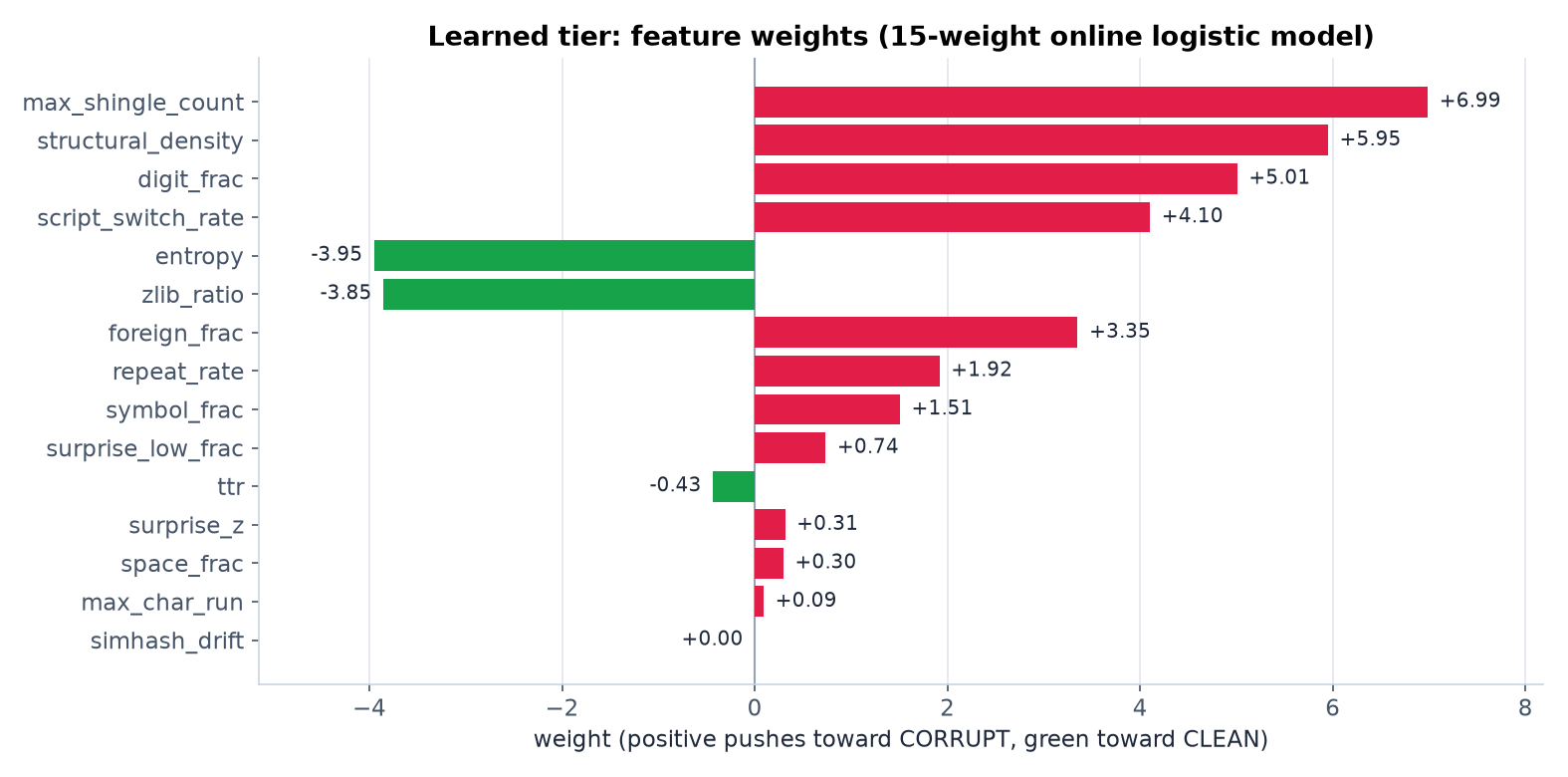
"repetition loop rate=0.71","digit fraction 0.57","script switch en to zh". - Learned tier. A small online logistic regression (15 weights, a few KB)
that adds robustness and keeps learning in production via
partial_fit.
The fusion layer sets its thresholds from the score distribution on clean streams, which gives a finite-sample guarantee on the false-alarm rate. "Flag at most 2% of clean outputs" is a knob you set and the calibration enforces, not a threshold you hope holds.
- HOLD the first 350 characters. A stream that is corrupt from the start is killed before a single character reaches the UI.
- RELEASE the prefix if it scores clean, and freeze the self-calibrated baselines on it.
- Re-check every 400 characters for the rest of the stream.
- ABORT on a calibrated threshold crossing (with a 2-hit or hard-rule hysteresis so a single noisy checkpoint does not kill a good answer).
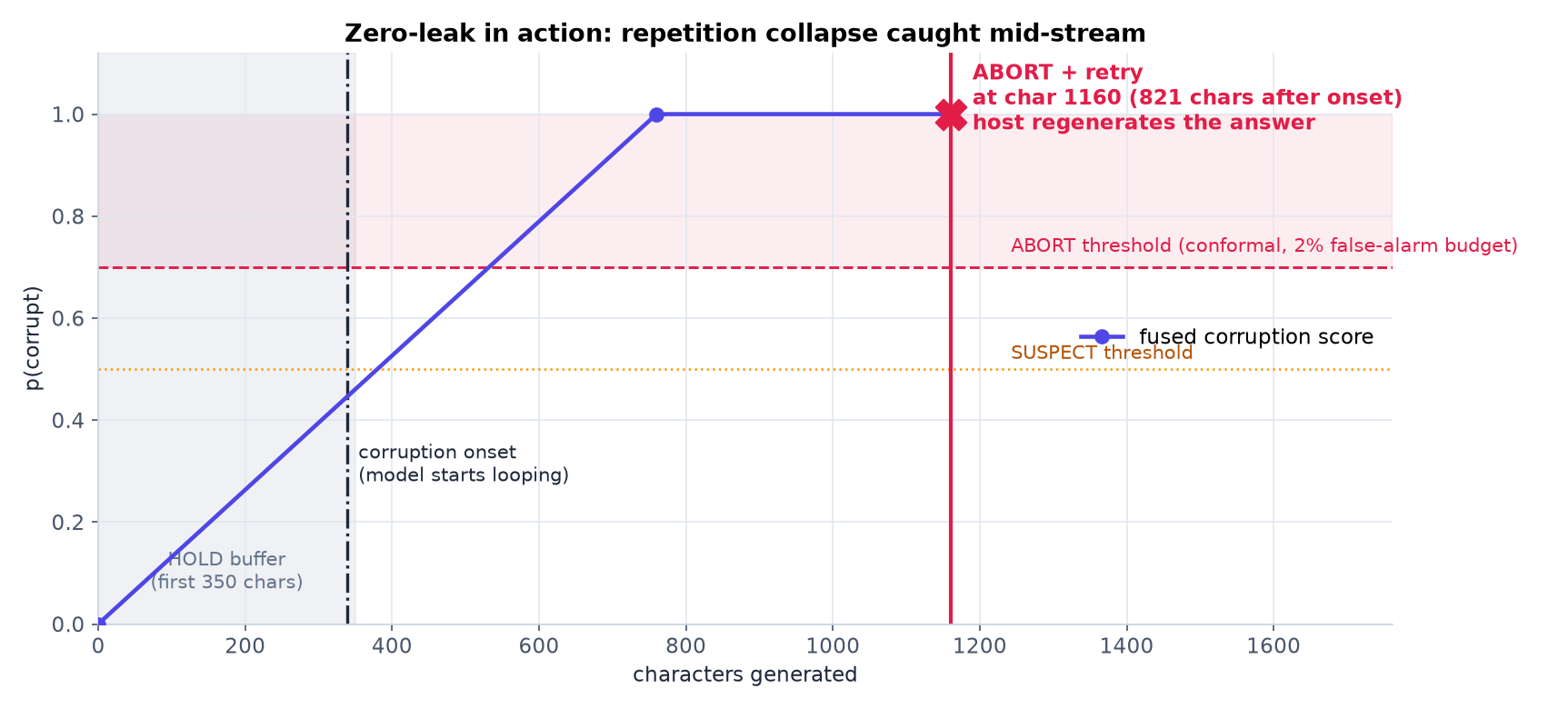
A synthetic stream that is clean prose and then collapses into a repetition loop
at character 339. SIMURG holds the opening, verifies the clean prefix, scores
the stream at every 400-char checkpoint, and aborts 821 characters after the
loop starts. Corrupt streams that are already bad at the 350-char checkpoint
are blocked fully (12 of 21 in the benchmark, see below); for this mid-stream
onset the user sees the clean prefix plus a short bad tail, and the guard's
contract with the host is a retry: GuardedLLM regenerates the answer and
the host replaces the shown text, so the bad tail never becomes the final
output:
Every alarm carries the reasons that fired it. For the stream above:
repetition loop rate=0.66 zlib=0.10
vocabulary collapse ttr=0.09
surprise collapse low_frac=1.00
Reproducible end-to-end benchmark: builds the CorruptBench synthetic set (243 streams, 4 failure classes), trains the learned tier, calibrates the conformal thresholds, and reports the full table:
pip install -e .
python3 -m simurg.data.evaluate          # seed 7, deterministic dataset
Test split (81 streams), seed 7:
| metric | value |
|---|---|
| stream-level TPR | 78/80 = 0.975 |
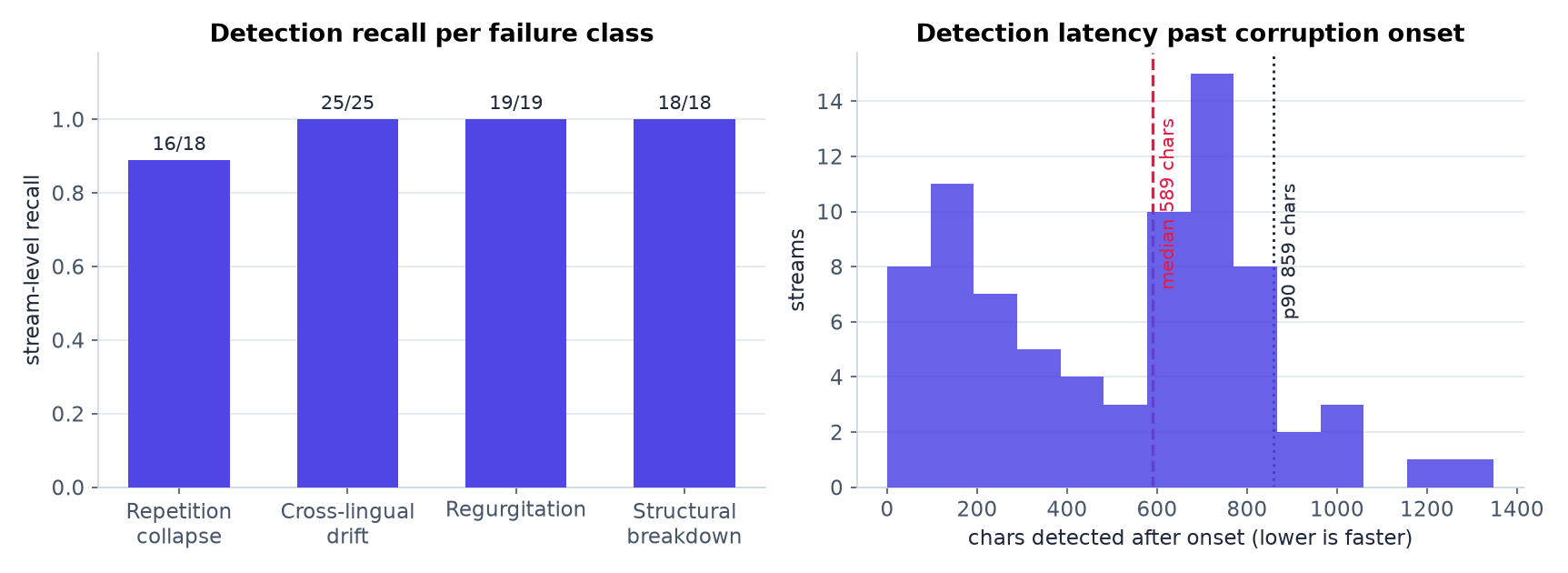
| recall, repetition collapse | 16/18 = 0.89 |
| recall, cross-lingual drift | 25/25 = 1.00 |
| recall, regurgitation | 19/19 = 1.00 |
| recall, structural breakdown | 18/18 = 1.00 |
| detection latency past onset | median 590, p90 868 chars |
| onset localization error | median 532 chars |
| zero-leak (onset inside hold window) | 12/21 blocked fully |
| throughput | 197,632 chars/sec |
| stream-level AUROC (final score) | 0.55, dragged down by ties at p=1.0 and a 1-stream clean test split; TPR/FPR at the calibrated threshold is the operating metric |
In addition, the shipped detector flagged 0 false alarms on 121 real production texts from a self-hosted reasoning-model deployment.
Those numbers describe the bundled domain. The detector is only as good as the clean corpus it calibrates against, so retrain on your own traffic before you trust it in production. It takes seconds, see below.
pip install simurg        # numpy only
pip install simurg[figures]   # + matplotlib, for the paper plots
pip install simurg[test]      # + pytest
From source:
git clone https://github.com/doofzoff/SIMURG.git
cd SIMURG
pip install -e .Works with vLLM, llama.cpp server, TGI, Ollama, SGLang, OpenAI, OpenRouter: anything
that speaks /v1/chat/completions. Batteries included: the zero-leak protocol
plus an abort, retry, fallback-model ladder.
from simurg import GuardedLLM

llm = GuardedLLM(
    "http://localhost:8000/v1", model="my-model",
    retries=1,
    fallback=GuardedLLM("https://openrouter.ai/api/v1",
                        model="qwen/qwen3", api_key="sk-..."),   # optional
)

result = llm.chat(
    [{"role": "user", "content": "Explain how oil prices affect a small economy."}],
    on_token=lambda t: print(t, end="", flush=True),             # only CLEAN text is ever forwarded
)

print(result.ok)        # True if a clean answer was produced
print(result.verdict)   # "clean" | "suspect" | "corrupt"
print(result.attempts)  # the full ladder: what each attempt did and why
If an attempt corrupts, nothing from it reaches on_token. A corrupt attempt
is retried; if all retries fail, the fallback model is tried.
Not on an OpenAI-style API? Wrap your own token loop:
from simurg import Simurg

s = Simurg()                          # rule tier works with zero setup
for token in my_llm_stream():
    v = s.feed(token)
    if v.state == "corrupt":
        abort_and_retry(reason=v.reasons, onset=v.onset_char)
        break
    ui.write(v.released)              # text cleared for display (may lag while holding)
final = s.finish()
ui.write(final.released)from simurg import Simurg
s = Simurg()
s.feed(whole_text)
print(s.finish().state) # "clean" / "suspect" / "corrupt"Feed the calibration step your good outputs so the thresholds fit your domain:
# bring your own clean corpus (.jsonl with a "text" field per line)
SIMURG_CORPUS_JSONL=/path/to/my_clean_outputs.jsonl python3 -m simurg.data.evaluate --save
Full guide, including the quick path, the live dashboard, and the production flywheel: docs/TRAINING.md.
Give SIMURG examples of your model's bad outputs. It tells you whether that failure is even catchable in stream statistics, and hands you a fitted detector if it is:
from simurg import fit_custom_detector

report, detector = fit_custom_detector(
    "template_leak",
    clean_texts   = my_good_outputs,     # 50+
    corrupt_texts = my_bad_outputs,      # 20+
)
print(report)
#  verdict: DETECTABLE   held-out AUROC: 0.98   -> auto-registered into every Simurg()
The gate is the point: fluent factual lies come back NOT DETECTABLE instead
of a false promise. Details, plus the zero-training LexiconDetector for known
bad markers like <|im_start|>: docs/CUSTOM.md.
python3 -m simurg.training.train_live # writes metrics for the bundled dashboardA real-time web dashboard: log-loss, accuracy, AUROC, all 15 weights animating per epoch, memory, and the final held-out TPR/FPR verdict.
A second web page for runtime: connect it to any OpenAI-compatible endpoint, send a prompt, and watch the answer get guarded while it is generated. The dashboard renders in real time:
- the released stream text (what the user would actually see),
- the fused corruption score with the calibrated SUSPECT/ABORT thresholds and the 350-char hold zone,
- the corruption onset marker and the human-readable reasons,
- all 15 stream features as sparklines, sampled at every checkpoint.
Every run is recorded as a session (timestamped frames with score, state, released text, features and reasons). The sessions panel lists them, deletes them, and replays any session at up to 128x for postmortem analysis, so a corrupt answer from Tuesday can be re-watched the way a crash log is read.
python3 -m simurg.guard_dashboard --port 8321
# open http://127.0.0.1:8321, point it at your endpoint, guard a stream
Pasted texts can also be analyzed at full speed in the same UI. Same self-contained dark style as the training dashboard, zero new dependencies: the server is stdlib-only and acts as a CORS-free proxy to your endpoint.
SIMURG can be your agent's free internet. The TinyFish
Search API gives every SIMURG install a web-search layer — structured
{title, snippet, url, site_name} results at 30 requests/min, $0, no card,
no wallet draw — so a local or small model can re-check a fact on the web
before it commits to an answer: fetch the evidence, feed it into the model's
context, or let the grounding verdict decide abstention. It works out of the
box: the package ships a free-tier TinyFish key (Search is $0 at any wallet
balance — the key carries no billing relationship), so no setup is needed.
For dedicated 30 req/min limits set your own free key
(export TINYFISH_API_KEY=..., agent.tinyfish.ai/api-keys), or
export TINYFISH_API_KEY="" to disable web search entirely:
from simurg import websearch

if websearch.available():                       # True out of the box
    hits  = websearch.search("when was the Y2K bug")
    check = websearch.ground("Y2K bug")
    # check["verdict"]: "attested" | "thin" | "no_record"
    # attested   → subject is echoed in the evidence → feed check["evidence"]
    #              into the model's context
    # thin       → weak or generic hits that never mention the subject → caution
    # no_record  → nothing anywhere → likely fabricated → abstain
Or from any shell / agent pipeline — right after pip install simurg:
python3 -m simurg.websearch "when was the Y2K bug" --json
python3 -m simurg.websearch "Y2K bug" --ground    # verdict + evidence
The same engine powers Monolith's L4 grounded verification (below): with a key,
the web evidence is TinyFish's structured results; without one, a keyless
DuckDuckGo scrape. ground() also cross-checks the keyless Wikipedia hit-count
and requires the subject itself to be echoed in the evidence (generic "treaty
of 1874" hits do not attest a "Zorbachian treaty"). Stdlib HTTP only — zero new
dependencies.
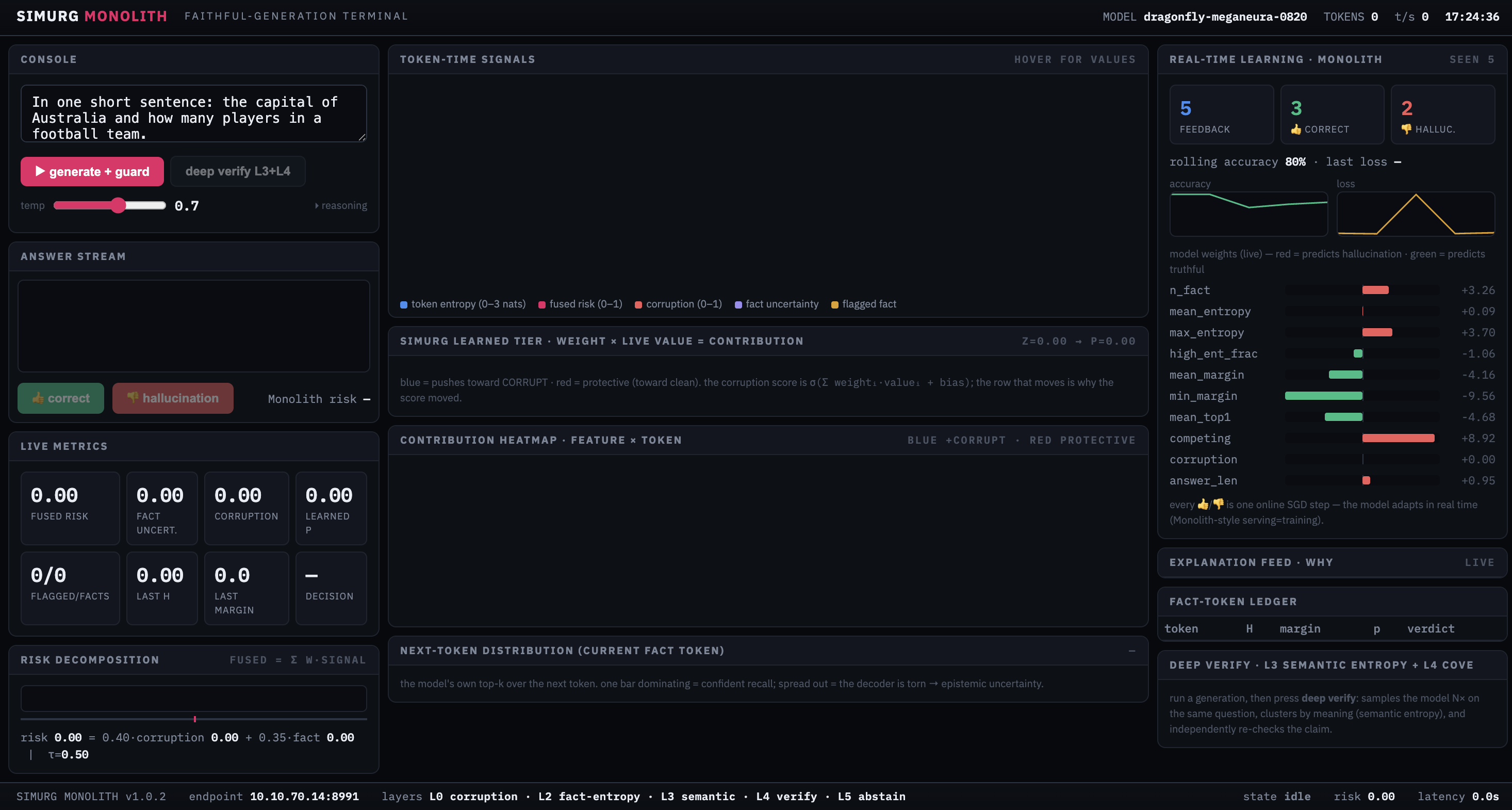
The base guard watches the decode. SIMURG Monolith adds the layer that watches the facts — and, in the spirit of the Monolith recommender, keeps learning while it serves: every 👍 / 👎 a user gives an answer is one online SGD step, so the hallucination model adapts in real time, with no batch-retrain gap (serving loop == training loop).
It stacks five layers on top of the base guard:
- L2 · white-box fact-uncertainty — reads the decoder's own top-k logprobs on fact-bearing tokens (numbers, entities, dates). A fact the model is torn about (high entropy, competing alternatives) is flagged. This is a signal a black-box guard structurally cannot have — you get it because you host the model.
- L3 · self-consistency — resamples a claim and measures semantic entropy.
- L4 · grounded verification — checks the claim against real evidence
(Wikipedia + the free web — TinyFish Search when
TINYFISH_API_KEYis set, keyless DuckDuckGo otherwise), not against the model itself. It catches BOTH a fabricated subject (no record anywhere → abstain) AND a wrong detail on a real subject (e.g. the answer's date contradicts the sources → abstain, and it surfaces the correct date). A model cannot detect its own confident lie; external grounding can. - L5 · conformal abstention — where the answer cannot be trusted, Monolith abstains instead of asserting.
- Online model — a small logistic model over the logprob features that predicts per-answer hallucination risk and trains live from your feedback (bootstrapped multilingual EN/RU/AZ, then adapted by real 👍/👎).
python3 -m simurg.veritas_dashboard --port 8330 \
    --url http://your-endpoint:PORT/v1/chat/completions \
    --model your-model
# open http://127.0.0.1:8330
The endpoint must return logprobs (vLLM, SGLang, TGI, llama.cpp all can). The
terminal shows, live: the token stream coloured by uncertainty, per-token entropy
and margin, the learned-tier weight × value contribution, a feature×token
contribution heatmap, the grounded verdict (confident / hedge / abstain), and a
real-time learning panel where the model's weights, rolling accuracy and loss
move on every piece of feedback.
If you integrate SIMURG into your own AI product, connect your existing like / dislike buttons and the guard learns from real usage:
from simurg.veritas.monolith import MonolithModel, aggregate

mono = MonolithModel.load("monolith_model.json")   # or MonolithModel() to start fresh

# ── at serving time: featurize the answer's fact tokens, predict risk ──
vec  = aggregate(fact_rows, corruption=corr, answer_len=len(answer))
risk = mono.predict(vec)            # 0..1 — surface it as a warning badge

# ── when the user reacts, that is your label — one online SGD step ──
mono.learn(vec, label=0)            # 👍 correct   → truthful
mono.learn(vec, label=1)            # 👎 wrong     → hallucination
mono.save("monolith_model.json")    # persist; it keeps adapting to YOUR traffic
fact_rows are the per-fact-token features the guard already computes while
streaming (entropy, margin, top-1 prob, competing alternatives). The dashboard
does exactly this over HTTP — see veritas_dashboard.py (/api/feedback).
L4's web evidence runs on the same free engine described in
Free web search for your agents:
with a key resolved (bundled free key by default, or your own
TINYFISH_API_KEY), the grounded verdict reports its source as
tinyfish+wiki instead of web+wiki; with web search opted out
(TINYFISH_API_KEY=""), the keyless DuckDuckGo scrape runs exactly as before.
# generate the multilingual answer-level dataset from any logprobs endpoint
SIMURG_GEN_URL=http://your-endpoint/v1/chat/completions SIMURG_GEN_MODEL=your-model \
    python3 -m simurg.veritas.monolith_data.generate
python3 -m simurg.veritas.monolith_data.train     # held-out AUROC + saves the model
The shipped bootstrap model was trained on 300 EN/RU/AZ answers (held-out AUROC
1.0); replace it by training on your own traffic, then let live feedback refine
it. The token-level FactPulse dataset (simurg/veritas/factpulse/) documents
the honest limit that motivates L3–L5: ~78% of fabricated numbers are produced
confidently, so single-generation logprobs alone cannot catch them — grounding
can.
SIMURG detects corrupt or degenerate decoding, not factual wrongness. A fluent, well-formed sentence that is simply false ("the capital of Australia is Sydney") has no stream-statistical signature: it looks exactly like a true sentence. For that you need grounding (constrain the model to retrieved facts and make it quote them), retrieval verification, or a factuality checker.
SIMURG guards the delivery; grounding guards the content. Use both.
fit_custom_detector will explicitly refuse to pretend it can catch this class.
src/simurg/
├── core.py              taxonomy, detector protocol, registry
├── features.py          the single O(1)/char stream-feature pass
├── websearch.py         free web-search layer for agents (TinyFish) + ground()
│                        verdict; CLI: python3 -m simurg.websearch "query"
├── signals/             the raw estimators: n-gram surprise, Count-Min sketch,
│                        rolling SimHash, robust-z calibration, Page-Hinkley
├── detection/           rules, detectors, conformal fusion, sentinel (protocol)
├── learning/            online logistic model, custom-failure-mode training (BYOC)
├── integrations/        GuardedLLM, the OpenAI-compatible drop-in guard
├── data/                CorruptBench synth, dataset builder, benchmark, generator
├── training/            live-training run + real-time web dashboard
├── guard_dashboard.py   live guard dashboard server (stdlib-only, SSE, sessions)
├── guard_ui/            live guard dashboard front-end + recorded sessions
├── veritas/             SIMURG Monolith: fact-entropy, grounding, abstention,
│   ├── monolith.py      the online hallucination-risk model (serving = training)
│   ├── monolith_data/   multilingual bootstrap dataset + trainer + shipped model
│   └── factpulse/       token-level fabrication dataset (the confident-lie limit)
├── veritas_dashboard.py Monolith terminal server (stdlib-only, SSE, feedback API)
├── veritas_ui/          Monolith terminal front-end (real-time learning panel)
└── weights/             shipped model + conformal thresholds (use as a pair)
docs/                    TRAINING.md, CUSTOM.md
examples/                runnable quickstart
tests/                   sentinel + websearch regressions + dashboard e2e tests
figures/                 benchmark figures referenced by this README
paper/                   the full technical report (PDF)
.github/workflows/       CI: test matrix on 3.10 / 3.12 / 3.13 + build check
CHANGELOG.md             release history
Ideas under active consideration, in rough priority order:
- Engine-level abort. Ship integrations that stop generation inside the inference engine (a vLLM streaming hook and a generic SSE middleware proxy), so an abort frees GPU time instead of just saving the UI. The guard already exposes everything a host needs; what is missing is the wiring.
- Fleet telemetry. Export
p(corrupt), verdict transitions, and onset positions as Prometheus metrics or OpenTelemetry spans, so a Grafana panel can show a corruption rate per model and endpoint and alert when a quantization or a prompt change starts producing bad streams. - Zero-dependency runtime. Export the guard core (features, sketches, fusion) to ONNX or a small C library that runs inside the inference server with no Python, for hosts that cannot take a numpy dependency on the hot path.
- CI regression suite. A golden corpus of labeled clean and corrupt streams with fixed expected verdicts, plus latency and throughput budgets, run as a GitHub Action on every pull request: the build fails when a threshold tweak quietly degrades detection.
- Multi-stream fleet mode. Guard N parallel live streams in one process, with per-stream sessions and a single dashboard that compares corruption rates across endpoints, so a bad quantization shows up as one lane going red while the others stay green.
Will it catch factual hallucinations? No, and it will tell you so. Factual errors have no stream-statistical signature. Use grounding or a factuality checker for content, SIMURG for delivery.
What is the overhead? One O(1) pass per character, ~197k chars/sec on a laptop CPU. A 50 tok/s model writes ~250 chars/sec, so the guard is hundreds of times faster than the model it guards. Memory is bounded per stream: 8,192 sketch counters, a 48-token SimHash window, and an n-gram table capped at 60k contexts.
Does it only work with English?
No. Script features are language-agnostic (per-script fractions, switch rates),
and you can declare your expected scripts at construction time
(Simurg(expected_scripts=("cyrillic",))). Retrain on your traffic for best
results.
What is the SUSPECT state for? It is a non-blocking warning tier between CLEAN and CORRUPT. Your host can use it to slow the UI down, show a subtle indicator, or pre-stage a retry, without discarding a stream that may still turn out clean.
How do I retrain on my own domain?
SIMURG_CORPUS_JSONL=... python3 -m simurg.data.evaluate --save over your clean
outputs. It rebuilds the weights and the conformal thresholds in seconds. Full
guide: docs/TRAINING.md.
@techreport{aghayev2026simurg,
  title       = {SIMURG: Zero-Leak Online Detection of LLM Decoding Corruption in Production Streams},
  author      = {Aghayev, Farid and Ahmadbayli, Elturan},
  institution = {HAL-X AI},
  year        = {2026},
  url         = {https://github.com/doofzoff/SIMURG},
  note        = {technical report, see paper/simurg_paper.pdf}
}Apache-2.0. See LICENSE. Developed by doofZ (Farid Aghayev), HAL-X AI.