Worked Example
Want to see what qiime2-its produces before installing anything? This page walks through a real,
production-scale run on public data -- 53 soil-fungi samples from NCBI BioProject
PRJNA767765 -- and publishes everything:
the scripts, the metadata, and the resulting report.
Open the full PDF report (37 pages) · all the files
 |
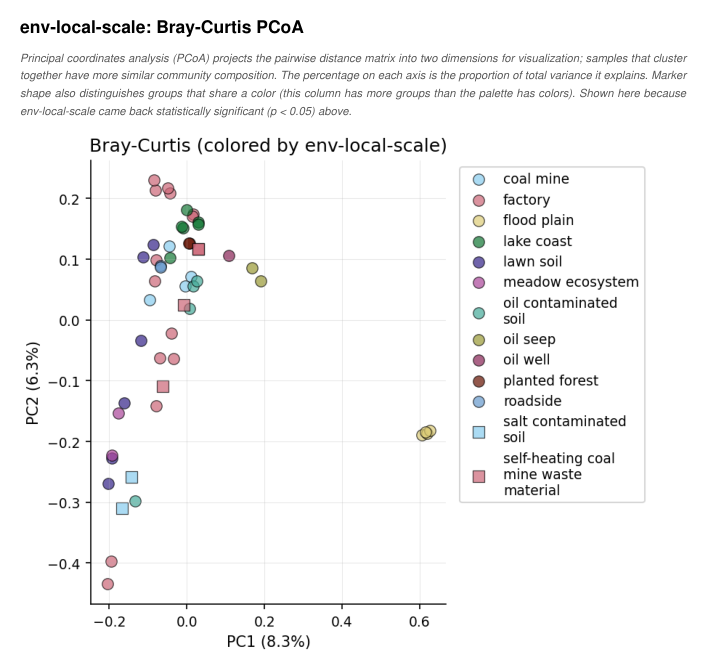 |
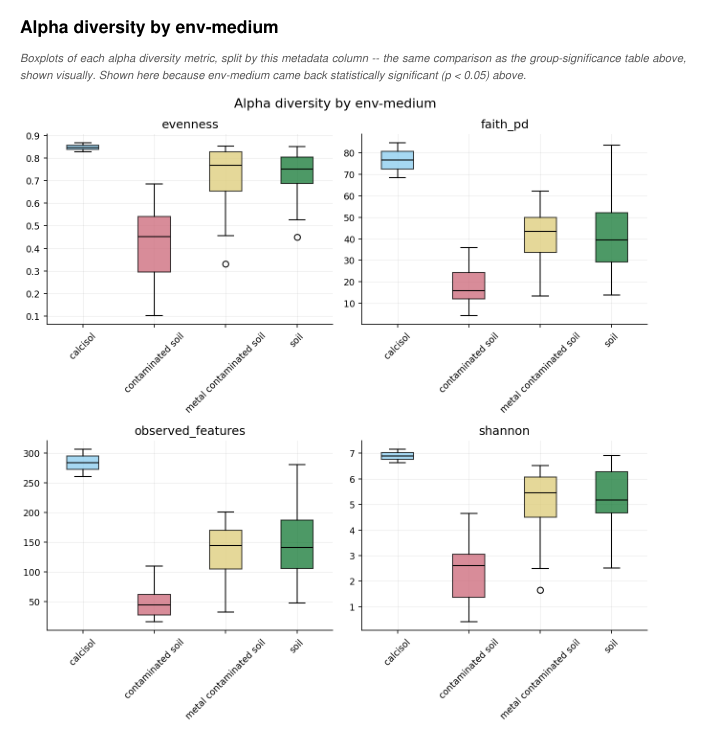
| Alpha diversity per group, one page for each metadata column that tested significant. | PCoA for Bray-Curtis and unweighted UniFrac. Colorblind-safe colors, plus marker shapes when a column has more groups than the palette has colors. |
 |
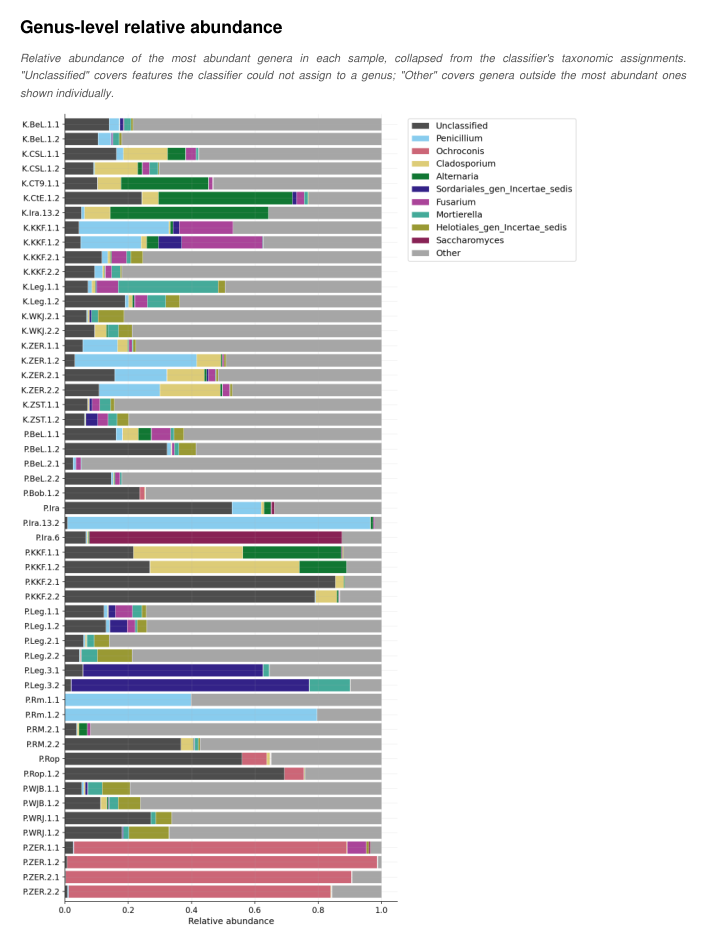 |
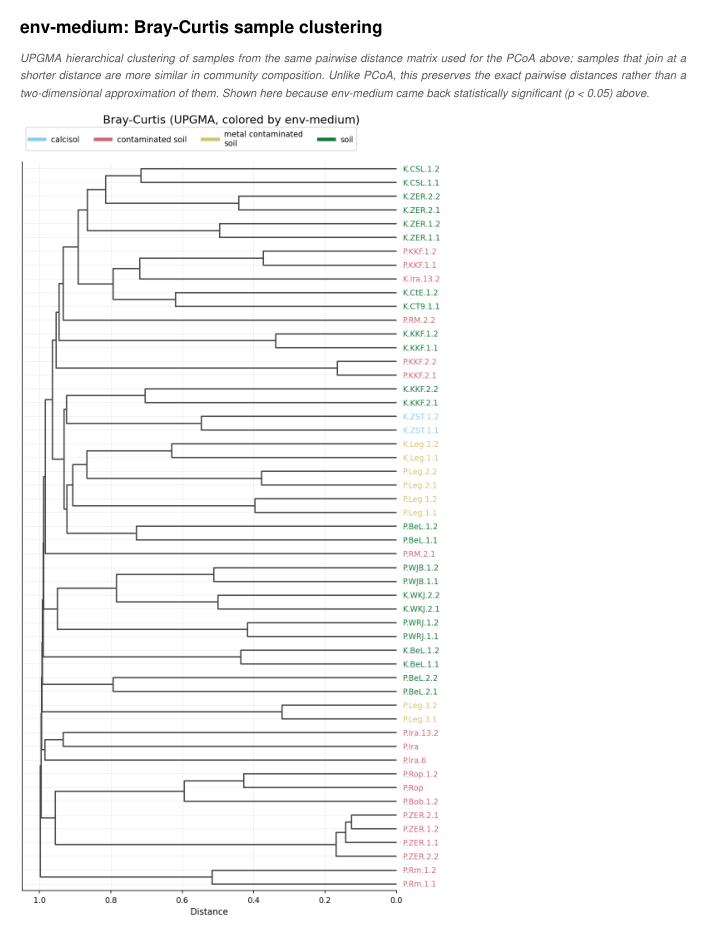
| UPGMA sample clustering from the same distance matrix, leaves colored like the PCoA. | Genus-level composition of every sample. |
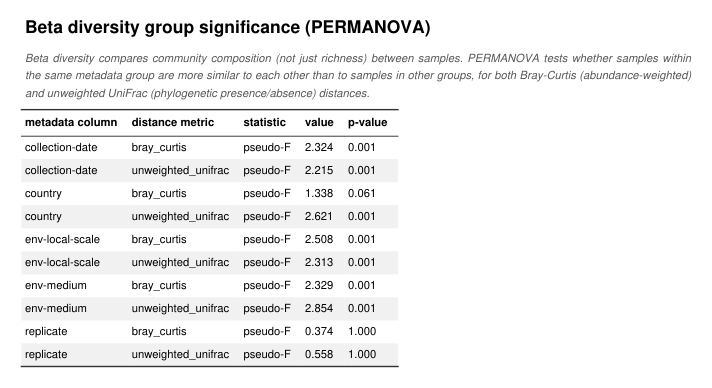
The report also carries the run's full provenance (exact command, parameters, tool and plugin versions, input files), DADA2 read retention per sample, sequence-length and classification-confidence distributions, rarefaction curves and the sample-classifier results -- see Advanced stats and the PDF report for what each page means.
| Source | BioProject PRJNA767765 -- fungal ITS amplicons, Illumina MiSeq, paired-end |
| Samples | the 53 field samples from Poland and Iran (the BioProject's laboratory microcosm samples are left out) |
| Size | 106 fastq files, 3.3 GB |
| Metadata | country, environmental medium, local environment, collection date, elevation, replicate -- built from the samples' public BioSample records |
| Classifier | UNITE 2025-02-19, fungi, 99% clusters, no singletons |
Inside an activated QIIME2 environment with qiime2-its installed (pip install qiime2-its, see
Installation) and a clone of the repository for the scripts, from an empty working
folder with ~15 GB free:
EX=/path/to/QIIME2_ITS/examples/PRJNA767765

python3 $EX/01_fetch_metadata.py .   # optional: rebuilds metadata.tsv + download_manifest.tsv
bash $EX/02_download_reads.sh        # 3.3 GB from ENA into ./raw_reads, MD5-verified, resumable
bash $EX/03_train_classifier.sh      # UNITE classifier into ./classifier (slow; skip if you have one)
THREADS=40 PARALLEL=10 bash $EX/04_run_pipeline.sh   # -> ./output/report.pdf
The analysis itself is a single command, everything else left at its default:
qiime2-its -q rachis-qiime2-2026.7 \
    -i raw_reads -o output -m metadata.tsv -c classifier/unite-classifier.qza \
    -pe --extract-its2 --taxa Fungi -t 40 -p 10
The published run used qiime2-its 0.3.2 on QIIME2 2026.7 and took 3 h 28 min with 40 threads
on a 64-core workstation. Expect small numerical differences if you re-run it (rarefaction and
PERMANOVA permutations are random), not different conclusions.
| Script | What it does |
|---|---|
01_fetch_metadata.py |
Builds the QIIME2 metadata file and the download manifest from two public APIs (ENA file report, NCBI BioSample); standard library only. Its output is committed, so this step is optional -- it exists so nothing in the example is hand-made. |
02_download_reads.sh |
Downloads each run's fastq pair from ENA under the Casava-style names QIIME2 requires, checking every file against ENA's MD5. |
03_train_classifier.sh |
Fetches UNITE with QIIME2's rescript plugin and trains the naive-Bayes classifier -- about 1 h 40 min, single-threaded (see also Building a classifier). |
04_run_pipeline.sh |
The qiime2-its command above. |
metadata.tsv is also a realistic template for your own metadata file.
Before publishing, the user name, host name and the home-directory part of the program path were
blanked in the run's run_metadata.json, and the PDF was rebuilt from the same output folder
(qiime2_its.report.build_report()), so "Run by" reads "(not recorded)". Nothing else was changed.
You can do the same before sharing your own reports.
The sequencing data belongs to its authors; the repository only holds scripts and metadata derived from the public archive records. If you use it, cite the study registered on the BioProject:
Okrasińska A. et al. (2022). Marginal lands and fungi -- linking the type of soil contamination with fungal community composition. Environmental Microbiology. https://doi.org/10.1111/1462-2920.16007
UNITE is distributed under CC BY-SA 4.0 -- see https://unite.ut.ee/cite.php.