Repository navigation
Limitations
insilicoPCR applies sequence rules only. Nothing in it models melting or annealing temperature, primer dimers, hairpins or other secondary structure, amplification efficiency or product yield, or competition between the assays of a multiplex. A product is reported when its primers bind the template within the mismatch budget and the 3'-end rules, face each other on one sequence, lie within the size limits and, for a qPCR assay, have the probe between them (Amplicon Calling). Whether the reaction then works at your annealing temperature is for a primer design tool, such as Primer3, and for the bench.
Within those rules, a few cases make the report say less than a real PCR would. Each is named in the output, so a negative can be told apart from "could not tell".
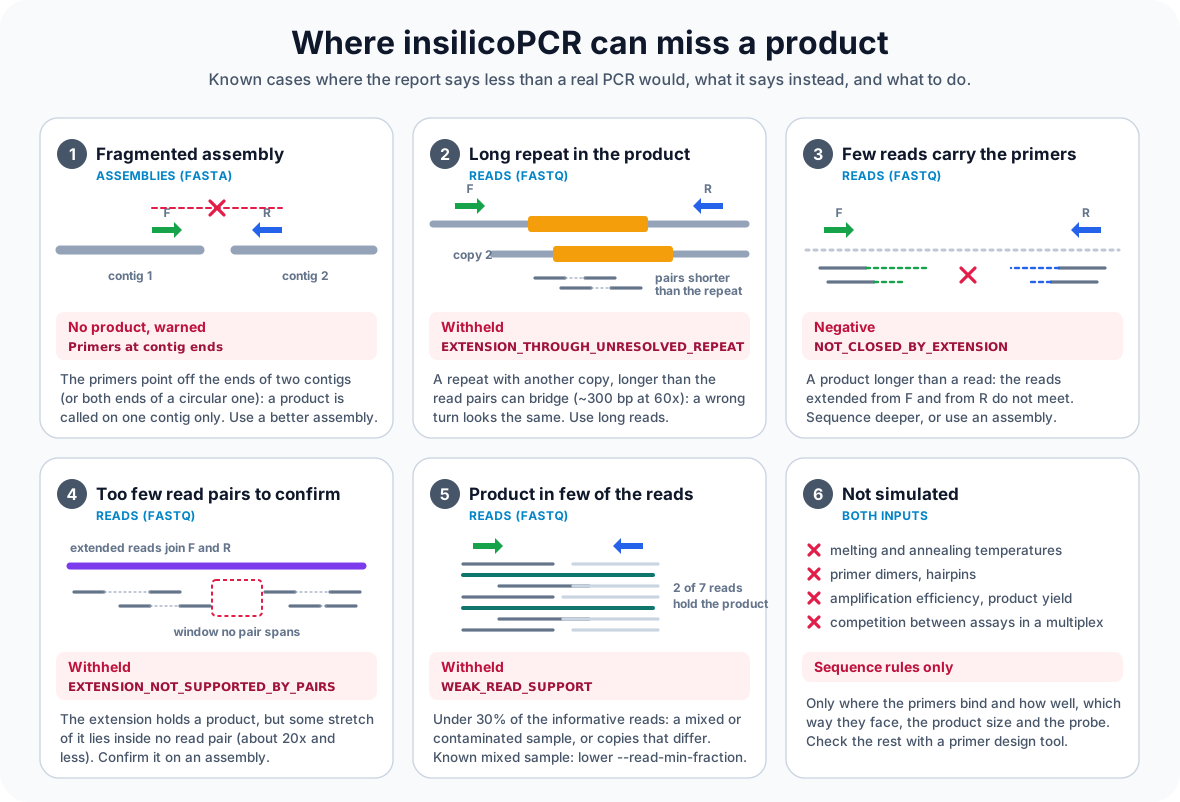
1. Fragmented assembly (Primers at contig ends). A product is called on one contig only. When the assembly breaks between the two primers, they bind on different contigs and no product is reported. A circular sequence is searched as a circle since 0.15.3, a product across its origin reported (see Reports): a FASTA record whose header says circular=true (as Unicycler, Flye and Bakta write it) or [topology=circular], and a contig of the FASTQ-mode mini-assembly that closes on itself. Mark the circles of an assembly whose headers do not say so. A break inside a primer's site counts too, since 0.15.3: a primer whose 3' end runs off a contig is not a site a product is called from, but it is named as pointing off that end. Since 0.15.4 it is named only when at least 12 of its bases (or half the primer, if that is more) are aligned on the contig: a few bases at a contig's end match some primer by chance. A primer of 12 bases or fewer is therefore never named so. Since 0.15.0, when an assay has no product but its primers point off the ends of two contigs, or off both ends of one linear sequence (a circular plasmid or chromosome not marked as one), and joining them would give a product within --max-length, the run says so: a Warning: line in the log, a Primers at contig ends: line in QAlog.txt, each with the smallest such product, and the sample's cell marked in the HTML report. That size (a product of at least N bp) is the bases of the two contigs from each primer's 5' end to the contig's end, or the longer primer's length if that is more (since 1.0; 0.15.4 added the primer bases past the contig ends, which may lie on the other contig where contigs overlap, and could overstate it). Use a more complete assembly, or run the reads.
The reads are baited and mini-assembled; an assay the mini-assembly misses is called from the reads themselves, and a product longer than a read is looked for by extending the reads (FASTQ mode and false negatives). What remains is listed, with the reason, in report_fastq_diagnostics.tsv:
2. Long repeat in the product (EXTENSION_THROUGH_UNRESOLVED_REPEAT). The product passes through a repeat that has another copy in the sample and is longer than the read pairs can bridge (about 300 to 350 bp at 60x, 200 to 250 bp at 20x). A real product and a wrong turn into the other copy look the same there, so the product is withheld, real or not. An assembly of long reads settles it.
3. The extended reads do not meet (NOT_CLOSED_BY_EXTENSION). The product is longer than a read, and the reads extended from each side do not meet within the maximum product length: too few reads carry the primers, or the extension stops (a gap in coverage, a branch it cannot follow). A negative, weaker than one on an assembly. Sequence deeper, or run the assay on an assembly. Before 0.15.3 the extension reached only about a fragment past the reads that carry the primers, and a product longer than 1.5 to 2 kb ended here whatever the depth; it now baits more reads in rounds (see Reports). A product through a tandem repeat longer than about 30 bases ((AT)n, (CAG)n, a VNTR) is not joined either: the extended reads loop in the repeat, and the assay is EXTENSION_IN_TANDEM_REPEAT, inconclusive, since 0.15.3.
4. Too few read pairs to confirm (EXTENSION_NOT_SUPPORTED_BY_PAIRS). The extended reads hold a product, but some stretch of it lies inside no read pair, or the pairs are too few (about 20x and less). Withheld; confirm it on an assembly.
5. Product in few of the reads (WEAK_READ_SUPPORT). Complete products are in the reads, but in fewer than 2 or under --read-min-fraction (default 30%) of the informative reads (reads carrying a primer at the product's locus): contamination, index hopping, a mixed sample, or a locus of which only some copies match the assay. Withheld and warned about; lower --read-min-fraction if the sample is known to be mixed.
With --read-extension off, products longer than a read or merged pair (about 580 bp for 2 x 300 bp reads) are not looked for, and such an assay shows as NOT_IN_READS.
6. Not simulated. As above: no temperatures, no dimers or hairpins, no efficiency or yield, no multiplex competition. A product the rules accept may still fail in the tube, and the synthetic gel is drawn from the report, not from a simulated reaction (Synthetic Gel Visualizer).
One case makes the report miss a product that a real PCR would give. Unlike the six above, nothing in the output names it: the assay simply shows no product. It is known and will be revisited; until then, keep it in mind when a negative matters. (Products of one primer alone, and of the primers of two assays in one reaction, are reported since 0.15.3: see Amplicon Calling.)
FASTQ: a primer site with many differences may bait no read. Since 0.15.3 the reads are baited with BBDuk on k-mers shorter than the shortest primer by --5p-truncation (so a primer whose 5' bases do not match still baits, as a hit on an assembly is still accepted), but at least 16 plus -m bases long (and, when -m allows indels, one base shorter than the shortest primer, so that a deletion can be matched), allowing -m substitutions (hdist, at most 3, the most BBDuk allows) and -m insertions or deletions (edist, at most 2, the most BBDuk allows; none at -m 0). A site with more indels than that, or more 5' mismatches than the k-mer leaves out, may still bait no read: the same sample then gives the product as an assembly and none as reads, and because no read carries the primer, report_fastq_diagnostics.tsv does not list the assay either; when only one primer's site is missed, it lists the assay as PARTIAL_BAIT, which is then this gap, not a true negative. Before 0.15.3 the k-mers were as long as the shortest primer and substitutions only, so any indel, or 5' mismatches beyond -m, kept a site from baiting. When such sites are expected (divergent strains, degenerate or tailed primers), run the assay on an assembly of the reads as well.
See also Why is an amplicon I expected missing from the report? for products the rules reject on purpose (size limit, 3'-end mismatches, orientation, probe).
Gap characters in an assembly shift the locations. BLAST drops - (and other characters that are not bases) from a sequence it reads, and positions are counted on what it keeps: in a FASTA file holding - characters, as an aligned FASTA does, GenomeLocation is off by their number before the product from a position counted with them. Sizes and mismatches are not affected.