Convolutional and Transformer
Convolution and self-attention solve different structure problems. A convolution reuses a local detector at every position; self-attention lets each token combine information from selected tokens in its context. nuNN keeps both implementations deliberately small: a 1D convolutional stack and a decoder-only mini transformer.
| Model | Structural bias | Public entry point | Runnable example |
|---|---|---|---|
| 1D CNN | locality and shared filters | nu_convnet.h |
cnn_seq |
| Decoder-only transformer | content-dependent token interaction with a causal mask | nu_transformer.h |
transformer_char |
A filter of width K slides across a channel-major input:
y_o(t) = activation(
    b_o + sum_c sum_k W(o,c,k) * x_c(t+k)
)
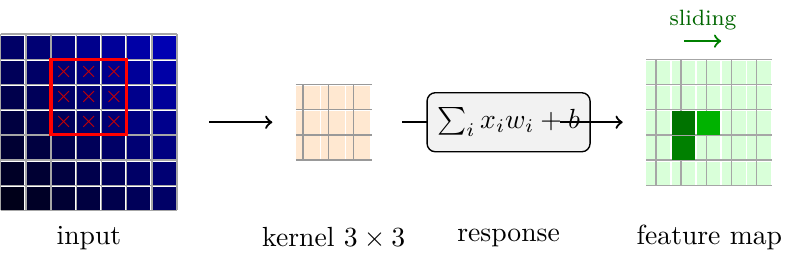
Conv1DLayer uses valid padding and stride 1:
output_length = input_length - kernel_size + 1
Its public contract and tensor layout are explicit in nu_conv.h:
nu::Conv1DLayer conv(
    1,                         // input channels
    16,                        // input length
    8,                         // output channels / filters
    5,                         // kernel width
    nu::Activation::Tanh,
    0.005
);

const auto& features = conv.forward(input);
Flat inputs and outputs are channel-major: all positions for channel 0, followed by all positions for channel 1, and so on. The implementation uses an im2col matrix so all windows become columns and the filter bank becomes one Eigen product. Read the construction and reverse col2im path in nu_conv.cc.
MaxPool1DLayer uses non-overlapping windows:
output_length = floor(input_length / pool_size)
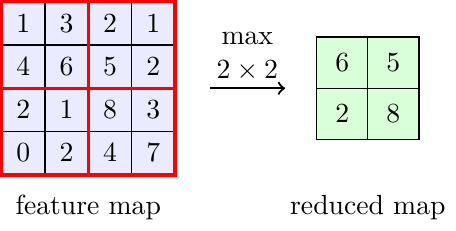
During forward() it stores the winning input index for every output. During backward() only that index receives the upstream gradient. Any remainder shorter than a complete pool window is discarded.
MaxPool1DLayer has no trainable parameters; the learning-rate argument on the common backward() interface is ignored.
ConvNet owns the convolution/pooling stack and an MlpMatrixNN head. This is the exact architecture in cnn_seq.cc:
using LC = nu::MlpMatrixNN::LayerConfig;

nu::ConvNet cnn(1, 16);
cnn.addConv1D(8, 5, nu::Activation::Tanh, 0.005);
cnn.addMaxPool1D(4);

const size_t flatSize = cnn.flatFeatureSize(); // 8 * 3 = 24
cnn.setFCHead({
    LC(flatSize),
    LC(16, nu::Activation::Tanh),
    LC(2, nu::Activation::Sigmoid)
}, 0.005);

double loss = cnn.train(sample, oneHotTarget);
auto output = cnn.predict(sample);
The size calculation is worth checking manually:
input:             1 x 16
valid conv K=5:    8 x 12
pool size 4:       8 x 3
flattened head:       24
setFCHead() rejects a first layer size that differs from flatFeatureSize(). During training, the head exposes dLoss/dInput; nu_convnet.cc passes it backward through the stack in reverse order.
Tests isolate each responsibility:
-
test_cnn.ccchecks convolution dimensions, pooling, gradients, and end-to-end learning; -
test_mlpmatrixnn.ccchecks the fully connected head and its input gradient.
Run cnn_seq [epochs] [learning_rate] to classify noisy one-cycle versus two-cycle signals.
For token representations X, learned projections form queries, keys, and values:
Q = X W_Q
K = X W_K
V = X W_V

Attention(Q,K,V) = softmax(Q K^T / sqrt(d_k)) V
Each attention head uses its own projections. The head results are concatenated and projected back to the model dimension.
Unlike convolution, the mixing weights are recomputed from the current content. Unlike a recurrent network, every allowed token pair can interact within one attention layer.
Next-token training must not leak future tokens. A causal mask sets attention scores above the diagonal to negative infinity before softmax:
token t can attend to positions 0 ... t
token t cannot attend to positions t+1 ... T-1
The SelfAttentionLayer::forward implementation accepts the causal flag. MiniTransformer uses it for decoder-only language modeling.
MiniTransformer is Pre-LN:
token ids
  -> token embedding + fixed sinusoidal position
  -> N * (
       LayerNorm -> causal multi-head attention -> residual
       LayerNorm -> feed-forward ReLU          -> residual
     )
  -> output projection
  -> logits [sequence_length x vocabulary_size]
The source is divided into four inspectable types:
| Type | Responsibility |
|---|---|
LayerNorm |
row-wise normalization plus learned scale and shift |
SelfAttentionLayer |
per-head Q/K/V projections, causal softmax, output projection |
TransformerBlock |
Pre-LN attention and feed-forward residual paths |
MiniTransformer |
embeddings, positions, blocks, logits, loss, generation |
All declarations are together in nu_transformer.h, their forward and backward paths are in nu_transformer.cc, and numerical behavior is covered by test_transformer.cc.
transformer_char.cc uses:
constexpr size_t sequenceLength = 32;
constexpr size_t modelDimension = 64;
constexpr size_t heads = 4;
constexpr size_t feedForwardDimension = 128;
constexpr size_t layers = 2;

nu::MiniTransformer model(
    vocabulary.size(),
    sequenceLength,
    modelDimension,
    heads,
    feedForwardDimension,
    layers,
    0.005
);

double loss = model.train(inputTokens, nextTokens);

std::mt19937 rng(42);
auto continuation = model.generate(
    prompt,
    80,
    0.8,                       // temperature
    &rng
);
Constraints follow directly from the implementation:
-
modelDimensionmust be divisible byheads; -
forward()andtrain()use the fixed context length passed to the constructor; - token IDs must be in
[0, vocabularySize); -
train()returns mean cross-entropy over the sequence; -
generate()is autoregressive and repeatedly uses the most recent context window.
Run:
transformer_char
transformer_char 1500 0.003 120
Positional arguments are epochs learning_rate generated_length.
Given logits z, generation samples from softmax(z / temperature):
- below 1 sharpens the distribution and favors high-probability characters;
- above 1 flattens it and increases variety;
- extremely small values approach greedy selection;
- high values expose weakly learned alternatives and noise.
Always compare generation with training loss. A plausible short sample is not a substitute for held-out evaluation.
Use ConvNet when local patterns and translation matter, especially for fixed-size 1D signals. Use MiniTransformer when relationships depend on token content and direct long-range interaction is useful. For sequential state carried one step at a time, compare with Recurrent Networks.
Use Theory Notes for the mathematical bridge and Training and Diagnostics for gradient, shape, and evaluation checks.