Releases: emazaheri/ios-agent
Release list
v0.1.1

A packaging release. No behaviour changes: ios-mcp on PyPI moves from 0.1.0 to 0.1.1 so the package can prove it belongs to this server.
Why the bump exists
The official MCP registry will not accept a manifest whose package it cannot tie to the server name. It requires mcp-name: io.github.emazaheri/ios-agent to appear in the README that PyPI publishes as the project description, which is a sensible anti-hijacking rule. PyPI never accepts a re-upload of an existing version, so proving ownership cost a version.
Now installable and discoverable
- PyPI:
ios-mcp—uvx ios-mcpruns the server over stdio. - MCP registry:
io.github.emazaheri/ios-agent, active.
Also in this release
The source distribution is an allow-list rather than the default "everything in the directory", which had been sweeping in private notes, 2.6 MB of images, and scripts that are not part of the package. 3.0 MB down to 131 KB.
Packaging metadata a listing needs and did not have: author, keywords, project URLs, and classifiers. The classifiers name macOS explicitly, because an install that succeeds on Linux and then cannot do anything is a worse first impression than a platform stated up front.
Full changelog: v0.1.0...v0.1.1
v0.1.0
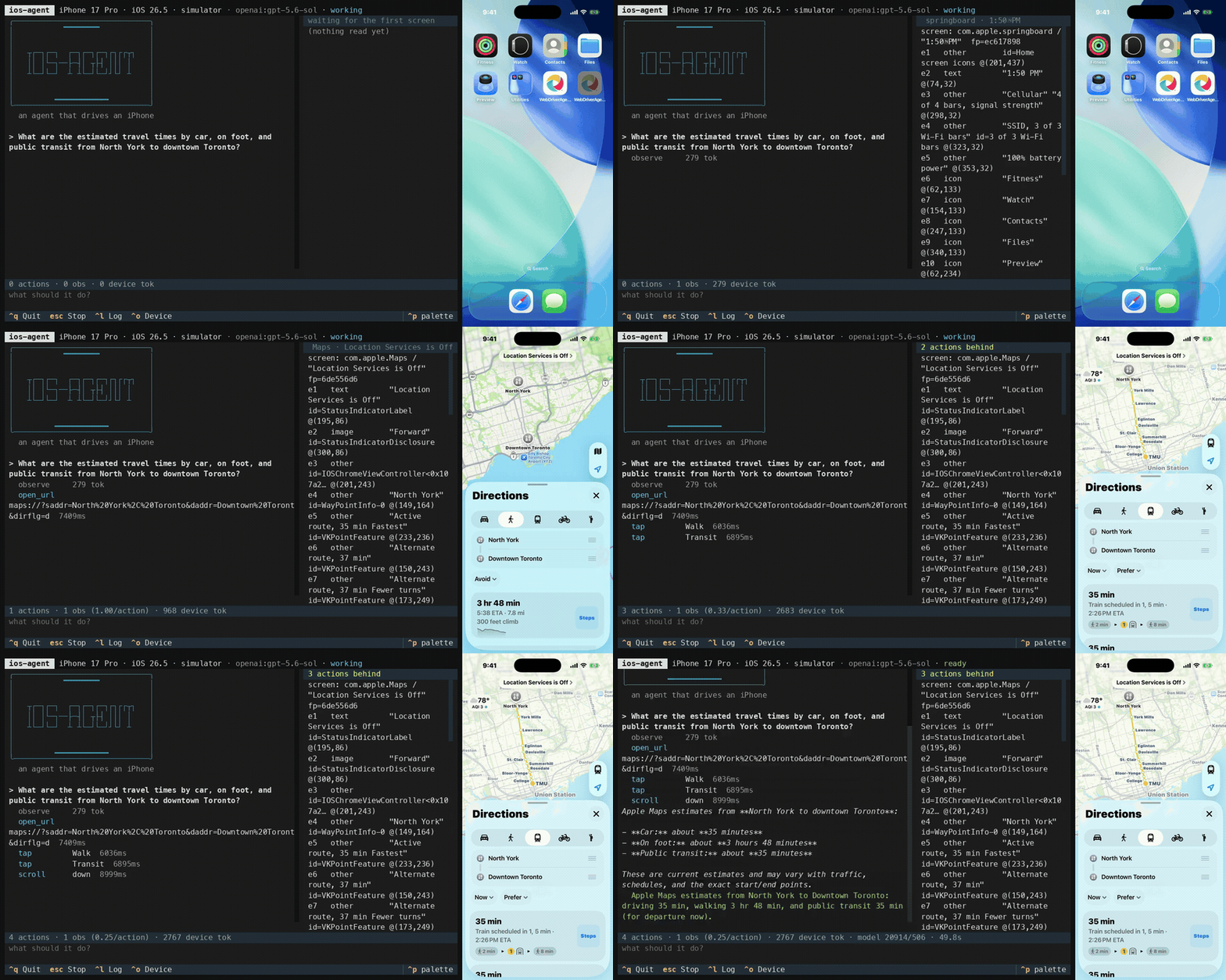
Drive an iPhone or an iOS Simulator with an AI agent.
What is in it
- An MCP server, ~30 semantic tools over XCUIAutomation via WebDriverAgent, so any MCP client can drive a simulator or a tethered iPhone.
- A terminal app (
ios-agent), which streams the model's reasoning beside the digest it is reading and keeps the cost on screen. - The library beneath both (
IosSession), with no MCP dependency, so an agent framework can import it directly.
Why it is not a test library
Screens reach the model as a compact digest rather than raw accessibility XML: 251 raw nodes to 12 elements on a third-party screen, 37,000 tokens to 329 on a long list. Resolution runs server-side through six tiers, so a retry costs zero model tokens. Every action returns the screen it produced, which halves round trips and is why the bundled agent spends exactly one observation per run, the same number a hand-written oracle needs. Anything irreversible is classified before it runs and asks first.
Measured, including the parts that were rejected
The eval harness was built before the agent so it could overturn the design, and it did. Of the four "deep agent" pillars, three were rejected on their own numbers and one was kept:
| pillar | outcome | evidence |
|---|---|---|
| Verification | kept | actions 85 → 53 (−38%), cost $1.21 → $0.74 |
| Planning | rejected | already at a hand-written oracle's floor on 8 of 10 tasks |
| Subagents | rejected | 5,864 prompt tokens per run against a 1M window |
| Memory | rejected | hedged, measured worse than none |
Each rejection is an ADR in docs/adr/.
Verified
618 offline tests, 13 simulator integration tests, 11 golden flows, and a goal-directed agent measured over 13 tasks. Driven against an iPhone 17 Pro Max on iOS 26.6 over both USB and Wi-Fi, and against apps Apple did not write.
Requirements
macOS with Xcode. The simulator path needs no code signing; a physical device does. See docs/real-device-setup.md.
uv sync && ./scripts/prepare_wda.sh simulator
uv run ios-agent "turn on bold text"