Repository navigation
Sampling
sample writes a subset of the records to standard output, and gives the same subset every time it sees the same input and seed. That makes a sample something you can rerun, share, and compare, rather than a one-off.
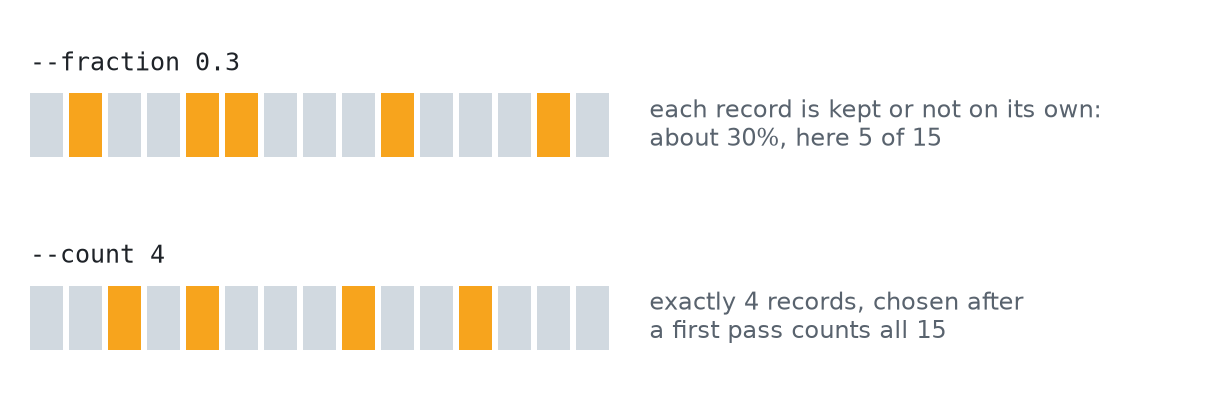
Figure 1. The two ways to sample. A fraction decides each record on its own, so the total varies a little; a count keeps exactly K records.
z-fastq sample --fraction 0.1 --seed 42 reads.fastq.gz > sample.fastq
z-fastq sample --count 1000 --seed 42 reads.fastq > sample.fastq
--fraction P decides for each record on its own, in a single pass, so it works on pipes. You get about a share P of the records. A fraction is written 0, 1, 0. and digits, or 1. and zeros; percentages and scientific notation are refused.
--count K keeps exactly K records, or every record when there are fewer. It reads the file twice, once to count and once to write, so it needs a regular file rather than a pipe.
--fraction 0 and --count 0 write nothing; they only validate the input.
The seed is 11 unless you set it. The same seed, input, and options always select the same records:
z-fastq sample --fraction 0.01 --seed 2025 reads.fastq > a.fastq
z-fastq sample --fraction 0.01 --seed 2025 reads.fastq > b.fastq
cmp a.fastq b.fastq
This holds within a version of z-fastq; pin the version when exact records must stay the same across upgrades.
z-fastq sample --paired --fraction 0.1 --seed 42 R1.fastq R2.fastq > sample.fastq
z-fastq sample --interleaved --count 1000 --seed 42 interleaved.fastq > sample.fastq
The pair is the unit: both mates are kept or neither. The output is one interleaved stream, mate 1 then mate 2, which deinterleave splits back into two files.
An exact count remembers a small entry for each chosen record, never the reads themselves, so its memory follows K rather than the size of the file:
Past --count 10000000 holds about 40 MB.
Because the file is read twice, it must not change in between. z-fastq compares its inode, size, and modification time across the two passes and stops with input changed during exact sampling if any differs; a rewrite that keeps all three is not detected.
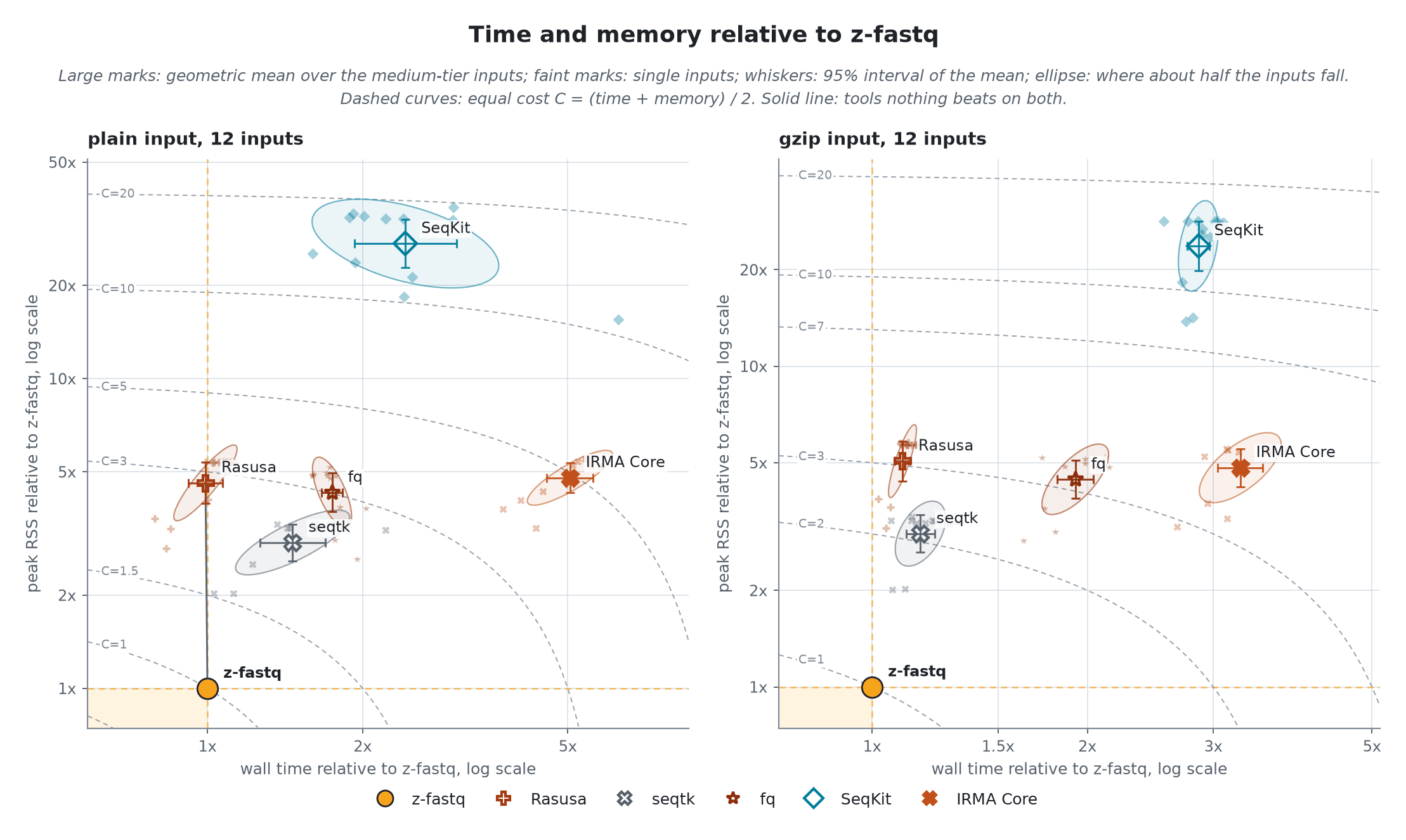
Figure 2. Fraction sampling: time and peak memory relative to z-fastq. The tools faster than z-fastq here check less of each record; the sample benchmark shows where, and how exact counts compare.
The output is plain FASTQ; pipe it to gzip for compression. With --fraction, records are written as they are chosen, so a malformed record late in the input fails the run after earlier records were written. With --count, the first pass reads the whole input, so a malformed record fails the run before anything is written. Write to a temporary file and keep it only on success (Automation).
- Paired reads: how mates are matched before a pair is kept.
- Interleaving: splitting a paired sample back into R1 and R2.
- Recipes: a paired subset as two files in one line.