Repository navigation
Validation
check answers one question: can this file be trusted as FASTQ? It reads every record, stops at the first problem, and says exactly where the problem is.
z-fastq check reads.fastq.gzA valid file prints nothing and exits with status 0, so check works as a plain pass or fail step in a script.

Figure 1. The four lines of a FASTQ record. The quality line holds one byte per base, so it is exactly as long as the sequence.
-
Header. Starts with
@, and the identifier follows at once, with no space or tab in between. - Sequence. One line of letters; wrapped sequences are not joined into one.
-
Plus line. Starts with
+; anything may follow it. -
Quality. One byte per base, Phred+33, from ASCII 33 (
!) to 126 (~).
An empty sequence with an empty quality line is a valid record. Lines may end in LF or CRLF, even mixed in one file, and the last line may lack its final line break. A carriage return counts as part of a line ending only when a line feed follows it, so a last quality line ending in a lone CR keeps the CR and is one byte too long.
The default, --alphabet iupac, accepts the IUPAC nucleotide letters in either case. --alphabet acgtn accepts only A, C, G, T, and N. The choice only decides what passes: z-fastq never changes letters or their case.
check reports the first failure with a code, the record number and the byte offset in the decompressed stream (both counted from 0), and the line within the record (counted from 1). A line over the --max-line-bytes limit is reported with the file name only.
| Code | Problem |
|---|---|
S001 |
the plus line does not start with +
|
S002 |
a sequence letter is outside the alphabet |
S003 |
the header does not start with @ and an identifier |
S004 |
the file ends inside a record |
S005 |
the sequence and quality lengths differ |
S006 |
a quality byte is outside Phred+33 |
Pair checks add two more codes, P001 and P002, described in Paired reads.
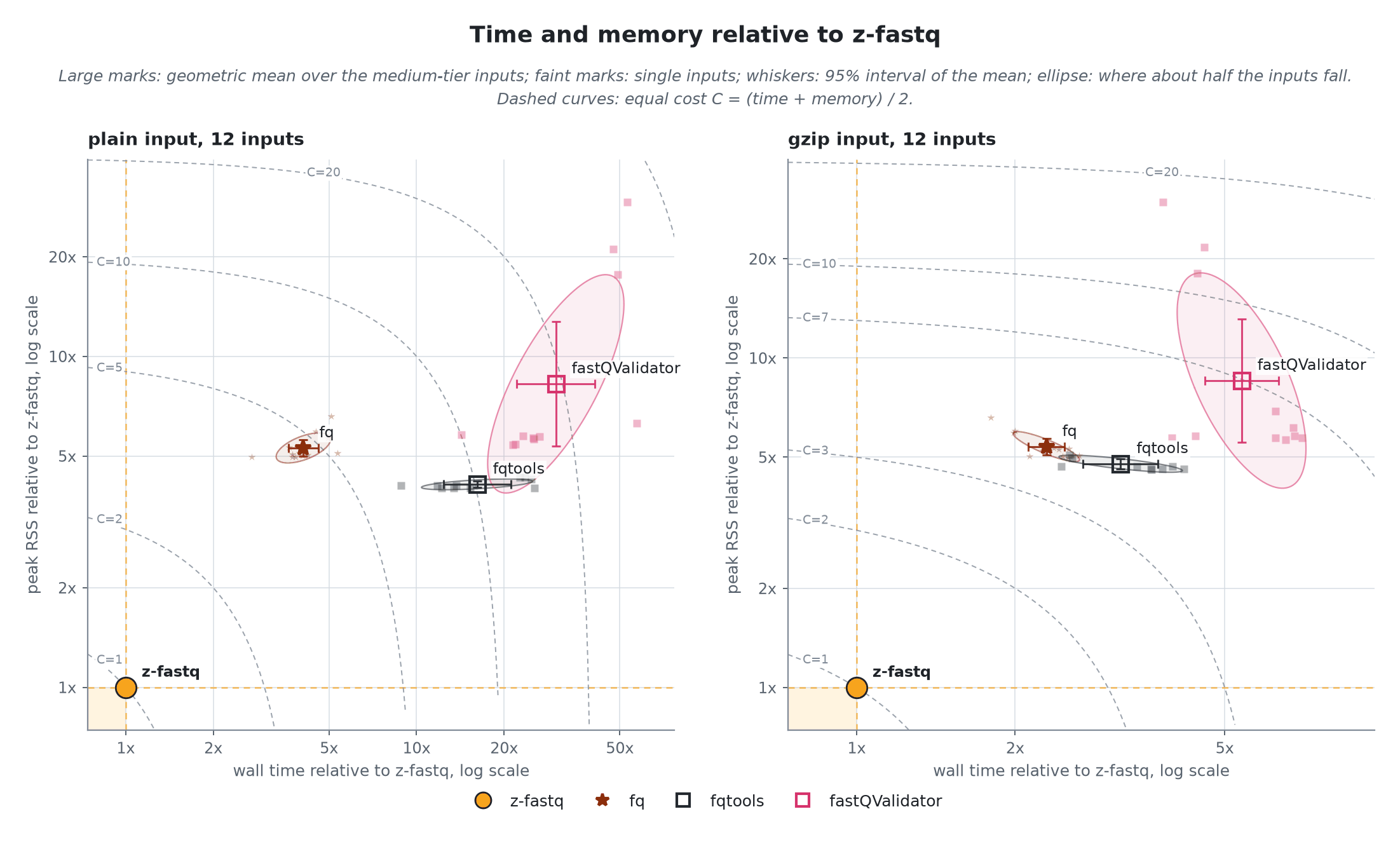
Figure 2. Time and peak memory of other validators relative to z-fastq, on 1 GiB inputs and one CPU. The check benchmark also shows which malformed files each tool lets through.
check does not skip bad records, fix qualities, or write a cleaned file. A broken record usually means a broken transfer or a broken tool upstream, and I would rather you find out than have it smoothed over.
- Paired reads: checking that two files, or one interleaved file, hold matching pairs.
-
Automation: exit statuses, and
check --jsonfor scripts. - Limits and supported formats: line length and the formats z-fastq reads.