
Replies: 2 comments 5 replies

-
|
Thanks I'm not very experienced with footnotes, but what I understand is that in Now you could technically replace the default See how to replace the default li component here: https://docusaurus.io/docs/markdown-features/react#mdx-component-scope This requires using some tricks because you don't want to change ALL the markdown FYI this is what a footnote JSX tree looks like after being compiled by MDX 1: <ol parentName="div">
<li
parentName="ol"
{...{
id: "fn-8",
}}
>
{`Note eight.`}
<a
parentName="li"
{...{
href: "#fnref-8",
className: "footnote-backref",
}}
>{`↩`}</a>
</li>
<li
parentName="ol"
{...{
id: "fn-9",
}}
>
{`Note nine.`}
<a
parentName="li"
{...{
href: "#fnref-9",
className: "footnote-backref",
}}
>{`↩`}</a>
</li>
<li
parentName="ol"
{...{
id: "fn-10",
}}
>
{`Note ten.`}
<a
parentName="li"
{...{
href: "#fnref-10",
className: "footnote-backref",
}}
>{`↩`}</a>
</li>
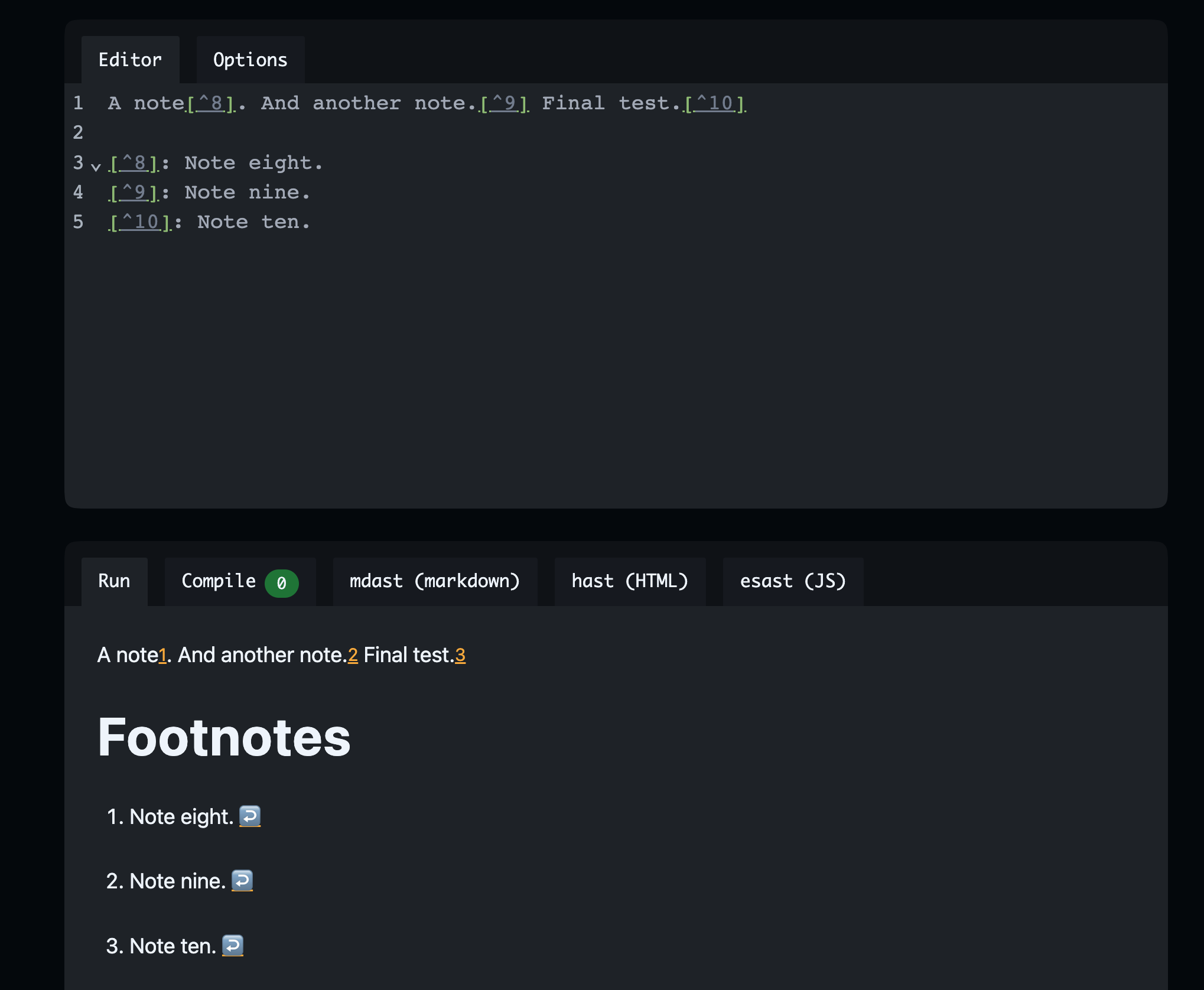
</ol>;https://mdx-git-renovate-babel-monorepo-mdx.vercel.app/playground/ I guess This is what GitHub renders for A note[^8]. And another note.[^9] Final test.[^10]
[^8]: Note eight.
[^9]: Note nine.
[^10]: Note ten.A note1. And another note.2 Final test.3 As you can see, it looks consistent with Docusaurus Footnotes |
Beta Was this translation helpful? Give feedback.

-
|
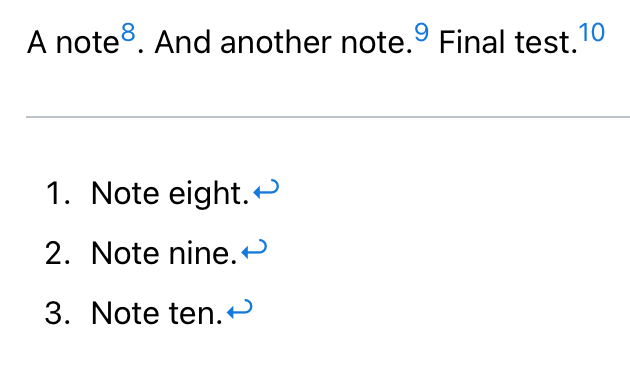
@slorber Docusaurus and GitHub renderings are not the same. Docusaurus shows:
Unlike GitHub, Docusaurus number of the handles (8, 9, 10 in this case) in the text do not match the numbers in the footnote list. |
Beta Was this translation helpful? Give feedback.

-
|
Yes, good catch. Seems fixed for MDX 2 with remark-gfm, see #7848 (reply in thread) |
Beta Was this translation helpful? Give feedback.

-
|
Here is how it works. You can have any text in your footnote ref, so (as @slorber mentioned) It would be nicer if the footnotes were not placed in an ordered list, but in a table (without lines within or around them), where the first column would have the ref (e.g. |
Beta Was this translation helpful? Give feedback.
-
Makes sense to me. At the same time it's MDX (v1) that choose to use an ordered list and not display the footnote ref, so I suggest opening an issue on MDX instead and see what they say, this might also be fixed in newer versions? cc https://github.com/wooorm https://mdx-git-renovate-babel-monorepo-mdx.vercel.app/playground/ Edit: Now using the v2 MDX playground with remark-gfm plugin enabled, it seems to render the footnotes like GitHub properly.
So I guess we should just upgrade to MDX 2 (asap) and this would be good enough |
Beta Was this translation helpful? Give feedback.

-
|
Thanks for responding. I'm not a very tech oriented user of docusaurus, so could you provide me with pointers that enable me to update to MDX 2? |
Beta Was this translation helpful? Give feedback.
-
|
@RieksJ you don't upgrade to MDX 2, we will do this as part of #4029 as soon as we have time, it's in the todolist In the meantime you can try https://github.com/pomber/docusaurus-mdx-2 but it's not maintained by us, may not work or be fragile. If you are not technical I'd recommend to just wait |
Beta Was this translation helpful? Give feedback.


Uh oh!
There was an error while loading. Please reload this page.
-
Intro
Thanks for the great project! It has made getting started very easy for a non-developer like me. I've run into just one problem I can't seem to find a solution for.
I am in the early stages of converting large technical document from Word (the format in which it is published by a state government) to a Docusaurus static website for use within my organization. The source document is split into volumes, numbered sections, and numbered sub-sections. As I've been converting this, I've broken out each subsection into its own markdown document.
Problem
The problem I've encountered is that the number sequence used for the footnotes in the original document are continuous for each volume. So, ideally I would be able to have a distinct page in the rendered webpage start with, say, footnote 14 rather than 1.
This seemed to be the behavior I was getting for a few days, but now my footnote lists (at the bottom of the document) are always ordered from 1. Based on what I've read online, this appears to be expected behavior. Is that correct?
The other thing I've discovered is that the inline references are NOT auto numbered. So
// A note[^8]. And another note.[^9] Final test.[^10]
// [^8]: Note eight.
// [^9]: Note nine.
// [^10]: Note ten.
gets rendered as
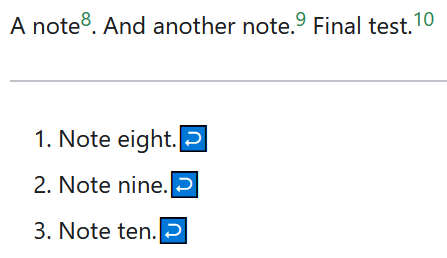
Is having the mismatch between footnote numbering expected unless they are matched manually?
Desired Outcome
Thank you in advance for any insight you might offer!
Beta Was this translation helpful? Give feedback.
All reactions