Dashboard
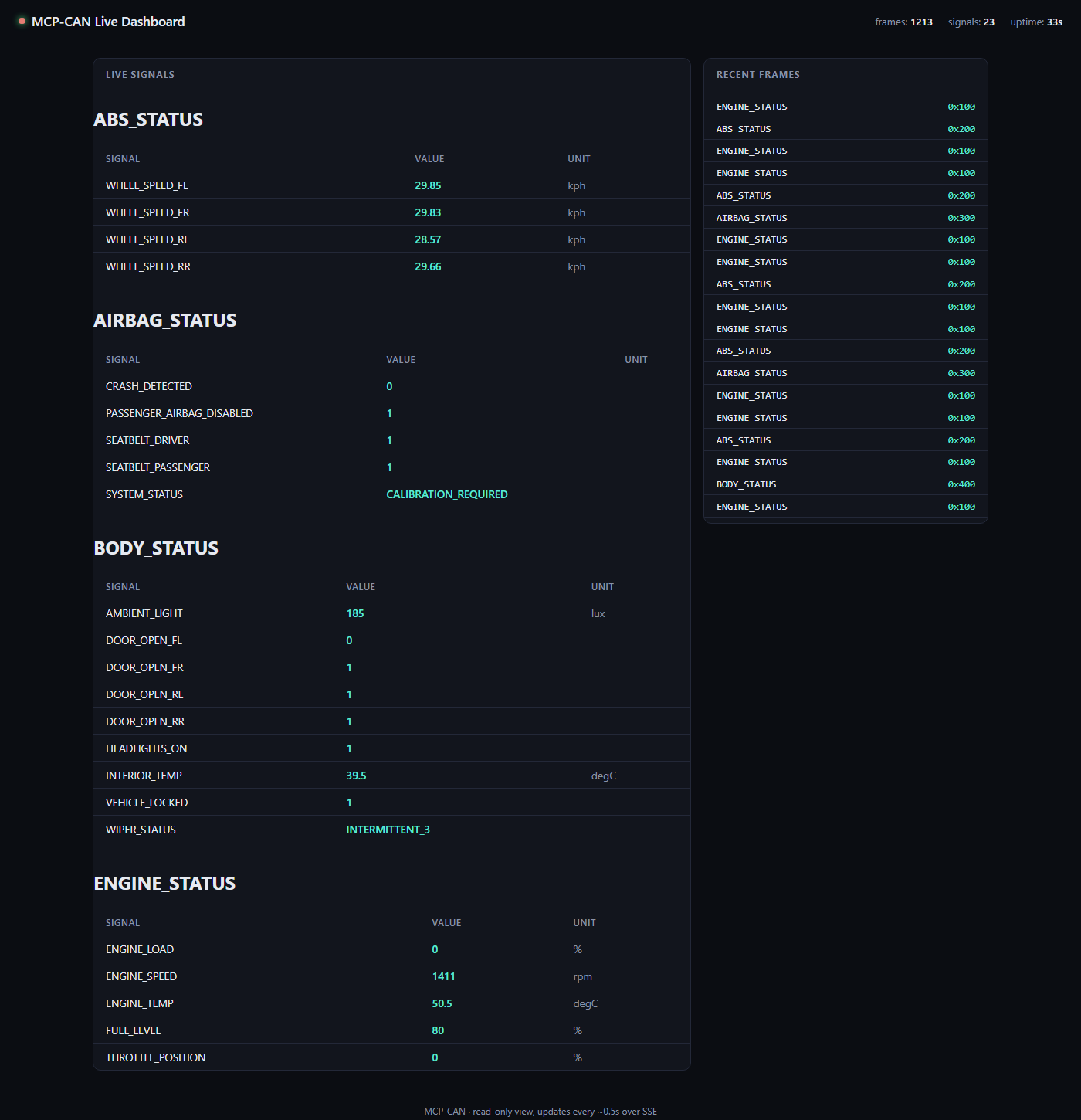
A read-only live web view at http://localhost:6278/dashboard (with mcp-can demo or server running) — signal values grouped by ECU message, and a scrolling feed of recent frames, updating roughly twice a second over Server-Sent Events.
-
Live Signals — every signal grouped under its ECU message (
ABS_STATUS,AIRBAG_STATUS,BODY_STATUS,ENGINE_STATUS), with current value and unit. Choice-decoded signals show the human-readable name (FAULT_PRESENT, not1). - Recent Frames — a scrolling feed of the latest raw frames by message name and arbitration ID.
- Header stats: total frame count, distinct signal count, server uptime.
-
GET /dashboardserves a single self-contained HTML page (server/templates/dashboard.html) — no build step, no external assets, works offline. -
GET /dashboard/streamis the SSE endpoint the page subscribes to; it pollsLiveState.snapshot()every 0.5s and pushes the result as a JSON event. - Backed by the same
LiveStatebackground listener that servesread_can_frames/filter_frames/monitor_signal/get_vehicle_snapshot— see Architecture. There's no separate polling loop for the dashboard.
No controls to send frames — it's an observation surface only.
Like every other bus-round-trip feature in this project, the dashboard only shows data when a simulator shares this server process's virtual bus — i.e. mcp-can demo. Pointed at a bare mcp-can server with no simulator (or a simulator running as a separate process, on a platform where the virtual backend doesn't share cross-process), it just shows "waiting for CAN traffic." See Troubleshooting.
Signal values are rounded to 3 decimal places for display (live_state.py::_display_value) — a raw scale/offset conversion (e.g. 58 * 0.4) routinely lands on an IEEE-754 neighbor like 23.200000000000003; harmless but not worth showing a human, and this doesn't pretend to more precision than the signal's scale factor actually carries.