Repository navigation
Building content with Claude
Five ways to work. They differ in where the files live and how much you watch, and they all end at the same place: a branch, a passing gate, and a pull request somebody reviews.
Everything on this page was checked against the official Claude Code documentation on 10 September 2026. Where a version or a command matters, the source is linked.
flowchart TB
    S["What are you about to do?"]
    S --> A{"Is it a whole<br/>day pack?"}
    A -->|yes| W["<b>Claude Code on the web</b><br/>a long run you check on"]
    A -->|no| B{"Are you arguing about<br/>shape, or writing files?"}
    B -->|arguing| P["<b>Claude Project only</b><br/>think first, no files yet"]
    B -->|writing| C{"Do you want to watch<br/>the diff as it happens?"}
    C -->|yes| D["<b>Desktop or terminal</b><br/>fast loop, local files"]
    C -->|no| W
    P --> BL["<b>The blended workflow</b><br/>settle the spine, then build"]
| Lane | Where files live | Watch it? | Best for |
|---|---|---|---|
| Claude Code on the web | A cloud VM, pushed to a branch | Check back | A full day pack, the default |
| Claude Code on desktop | Your machine | Yes, continuously | Fixing one artifact, a tight loop, anything visual |
| Claude Project only | Nowhere, it is a conversation | Yes | Shaping a week, arguing about a spine, drafting before commitment |
| The blended workflow | Both, in sequence | Both | What most real work turns out to be |
| Manual steps and checks | Your eyes | Always | The things no tool does for you |
Four things do not change, and they are the reason a session written by somebody else still lands.
flowchart LR
    A["<b>CLAUDE.md</b><br/>loaded at the start<br/>of every session"] --> B["<b>the spine gate</b><br/>a one-screen plan<br/>you approve or reject"]
    B --> C["<b>passes, one family<br/>at a time</b><br/>deck, notebook, exercises"]
    C --> D["<b>verify.py</b><br/>the six proofs,<br/>one command"]
    D --> E["<b>a branch and a PR</b><br/>never main"]
-
CLAUDE.mdis read at the start of every session, on every surface. It is the file that carries the naming rules, the folder layout, the banned words and the ground truth order. If a session is producing the wrong shape of thing, the fix usually belongs inCLAUDE.mdrather than in the prompt. - The spine gate is not optional. A session states the envelope, the continuity and a one-screen spine, then stops. You approve or you reject. Nothing past the spine gets built without an explicit yes, because rejecting a spine costs a minute and rejecting a finished pack costs an afternoon.
- One artifact family per pass. Decks, then notebooks, then the activity, then exercises with solutions, then the take-home, then the Kahoot pack, then study notes with the cheat sheet and the pre-read.
-
python3 scripts/verify.py content/W01/D3is the gate. One command runs all six proofs. A pack that has not passed is not done, and it is not reviewable.
One session per day pack. Do not continue yesterday's session for today's pack.
The reason is drift. A long session carries yesterday's decisions as context, and the second pack
starts inheriting the first pack's shape without anybody choosing that. Start fresh from
prompts/day_pack_prompt.md.
If you ask a session to build two days at once it should refuse and say why. That refusal is correct behaviour, not a malfunction.
The worst opening is "build Week 4 Day 2". It gives the session nothing to check itself against. A good opening does four things:
Build the day pack for W04/D2.

Envelope: who this is for, what slot it fills, how much of their
effort it can absorb, what runs before it and what runs after.

Sources: the links I have already verified are below. Use these as
the lock rather than as a starting point.
  - <link>  checked <date>
  - <link>  checked <date>

Continuity: what landed on D1 that this day builds on, and what
D3 needs this day to leave behind.

Stop at the spine. I will approve it before you build anything.
The fourth line is the one people drop, and it is the one that saves the afternoon.
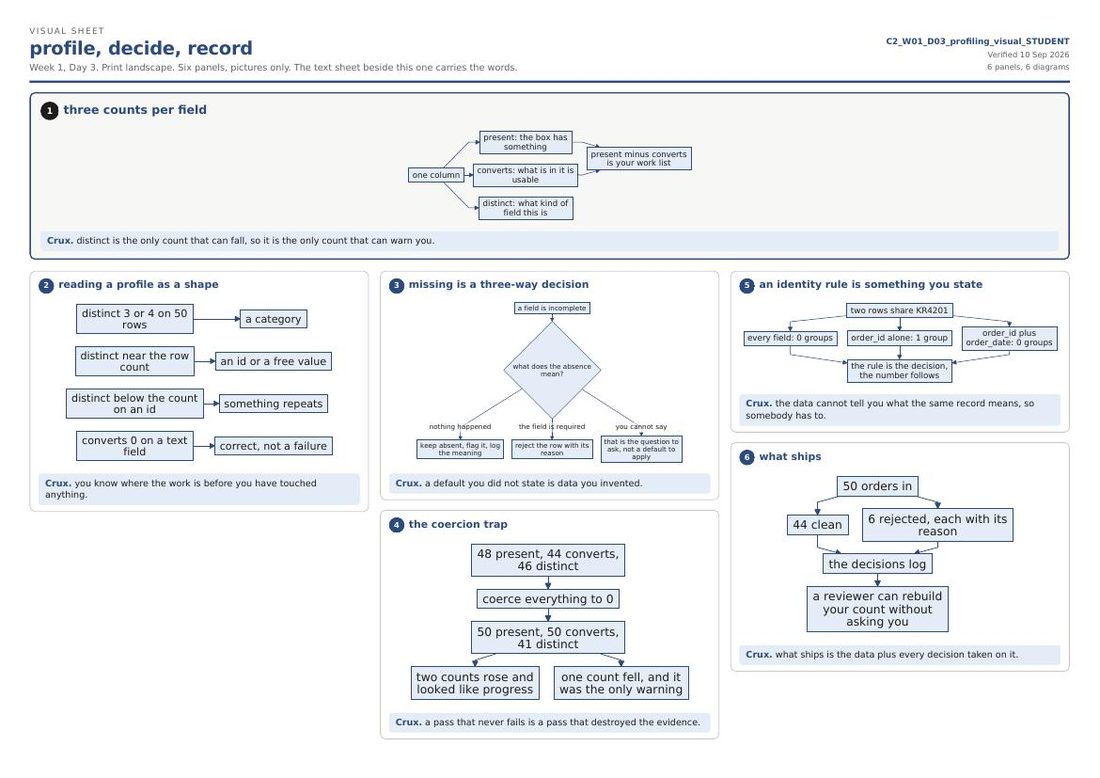 |
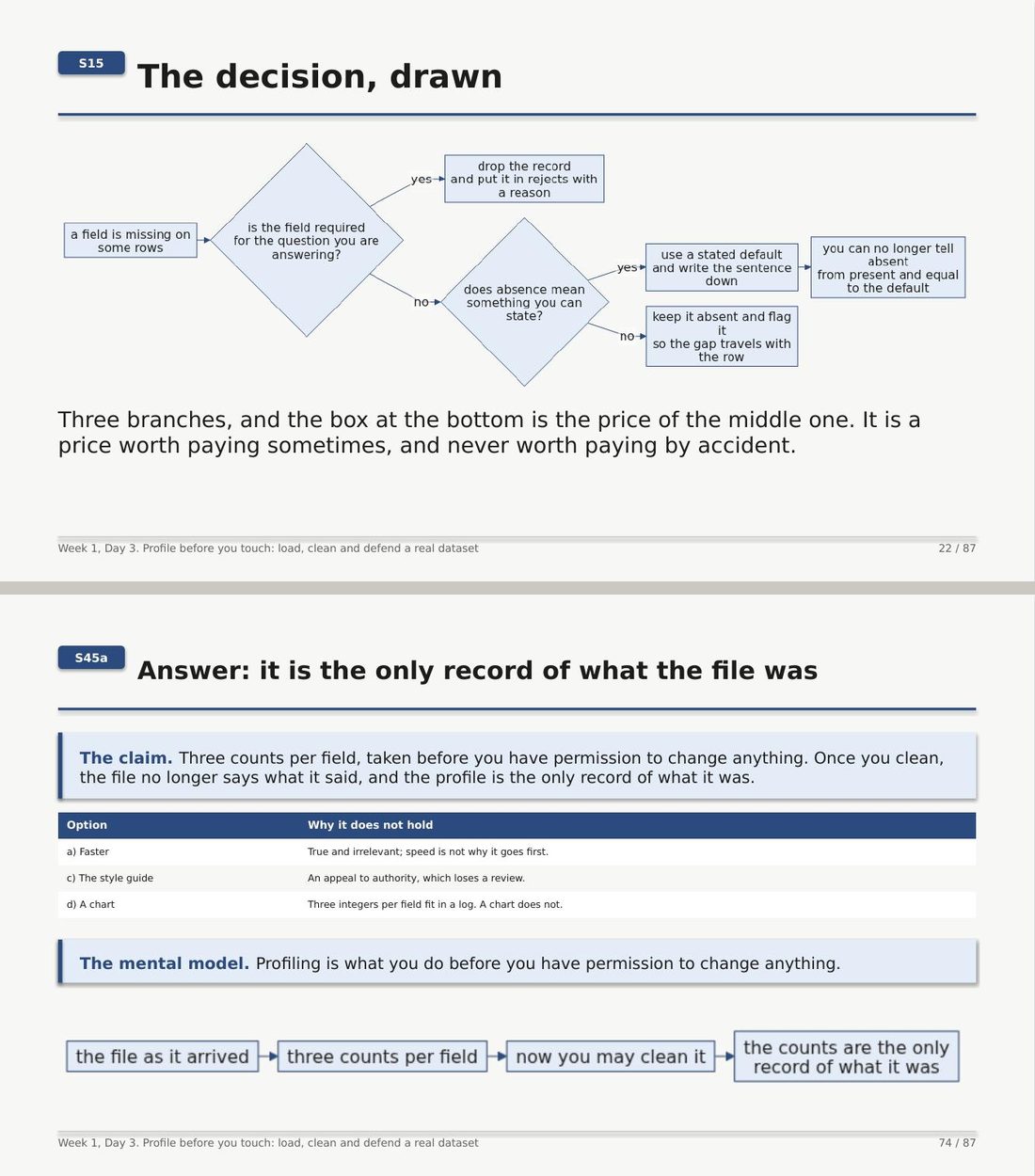 |
A cheat sheet, authored as markdown and printed by scripts/build_cheatsheet.py. Panel one is the anchor and carries the day's picture. |
A slide, authored as markdown and built by scripts/build_deck.py through the shared layout in scripts/deck_layout.py. |
Both are built from markdown by a script. Neither is edited by hand in its final form, because a
.pptx older than its markdown is stale, and the gate fails it.
| You want to | Read |
|---|---|
| Run a full day pack from a browser | Claude Code on the web |
| Fix one artifact quickly on your own machine | Claude Code on desktop |
| Think about a week before anything is a file | Claude Project only |
| Do both, in the order that works | The blended workflow |
| Know what you still have to do yourself | Manual steps and checks |