Home
jevos is a small local LLM that answers yes/no questions about a text. You send the text and the question, and it sends back P(yes), the probability that the answer is yes. It runs on a laptop CPU, in 26 ms for a short request and 112 ms for a 190-token one, and it generates no text, so there is nothing to parse.
That narrow job is the point. A router, a filter, a policy check, a judge in an evaluation loop: most decisions an application asks a language model for are yes/no questions with a threshold on top, and they do not need a chat model on a GPU or a call to a hosted API.
This wiki is the long version of the README: how to use the server, how to turn other kinds of decisions into yes/no questions, what we measured about the model, including where it is wrong, and how it compares with the alternatives.
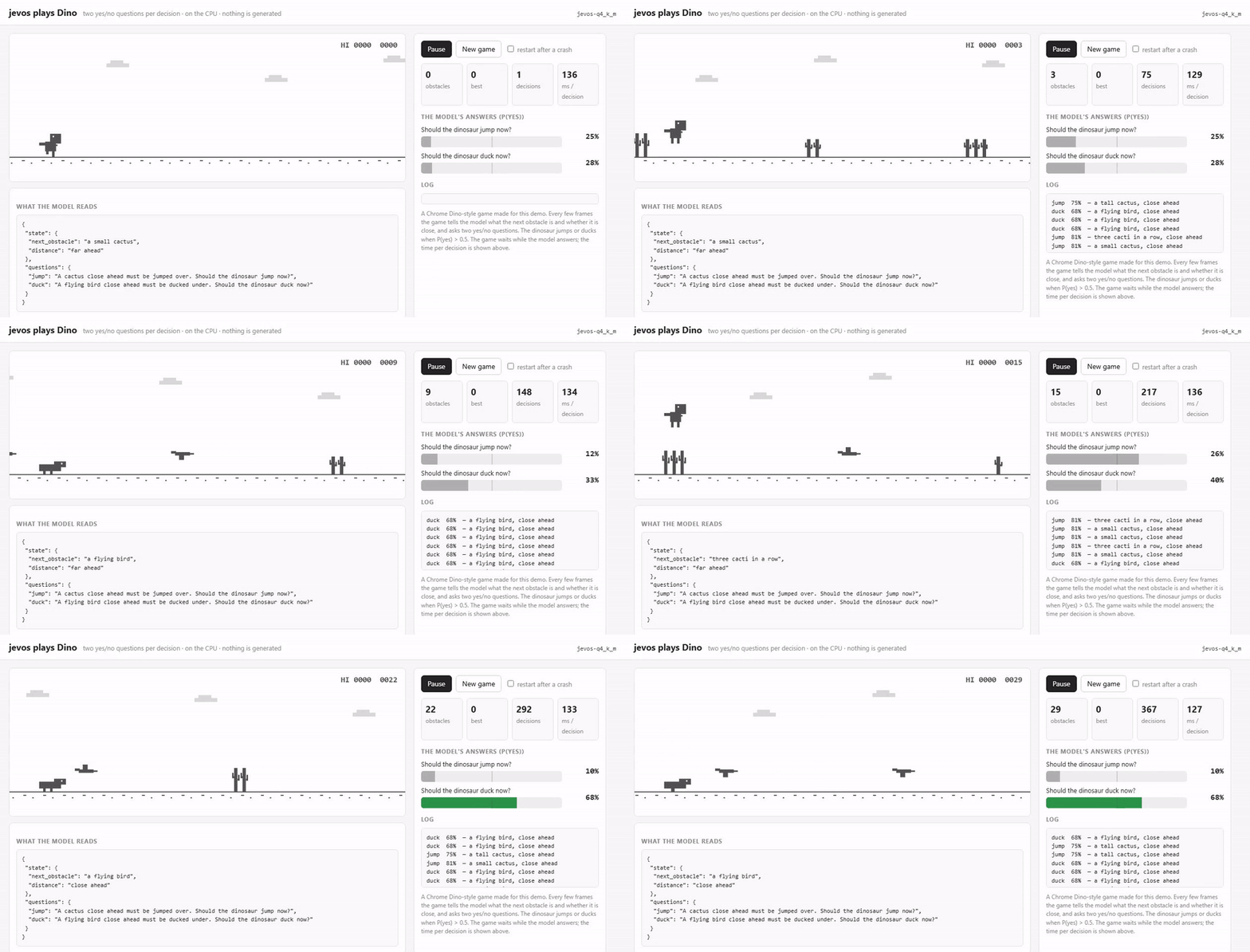
- Ask a local LLM a yes/no question and get P(yes): the request, the answer, Python, the command line, and what to do with the number.
- Zero-shot text classification with yes/no questions: routing a ticket to one of several labels with one question per label.
- LLM policy decisions: put the rule in the question: refunds, access rules and thresholds, and why rules are the model's hardest case.
- LLM as a judge on a CPU: evaluation criteria as yes/no questions, scored locally.
- Why a small LLM says yes when the answer is no: 152 wrong yeses against 91 wrong noes on 999 new questions, and why calibration does not fix it.
- Small LLMs and arithmetic in yes/no questions: 0.58 on questions that need a sum, against 0.95 on questions that only need reading.
- Our held-out benchmark said 0.855, new questions said 0.757: why a test split built like the training data is not held out enough.
- jevos vs Jev vs Laya for yes/no decisions: speed, accuracy, context, cost and what each one can answer.
- Speed: where LLM latency comes from, and why a model that generates nothing is fast.
- Probability and thresholds: what P(yes) means, calibration, and how to turn a probability into a decision.
- Question design: how to write questions a small model answers well.
- Use cases: moderation, triage, routing, screening, documents.
- Evaluation: grading RAG pipelines, judges, CI checks and test sets.
- Agents and routing: routers, cascades, tool gating and guardrails.
- Integrations: Python, JavaScript, curl, n8n, Slack, CI and more.
- Local and private AI: self-hosted, offline and on-premise decisions.
- llama.cpp and GGUF: the runtime and the file format of the release's GGUF builds, and the tokenizer jev takes from llama.cpp.
jevos answers yes/no questions, and multiple-choice questions asked as one yes/no question per option, in English only. Scores, asked as one yes/no question per level, are early (54% on held-out score questions, 82% within one level). On rules it has never seen it is right about four times in five (0.810 on 2,000 such questions), which is good for a first pass and not good enough to be the last word on a refund, and the measurement pages say exactly where it fails.
jevos is built by feder-cr with Loris Salsi (@LosaLosSantos). The code is MIT, the model is on the release page.