Structured, context-rich error handling for Rust — define your error type once,
attach it to any Result with .context(...), and render colorized diagnostic
reports with automatic backtraces and span traces.




cargo add oopsieuse oopsie::prelude::*;
#[oopsie::oopsie(traced)]
pub enum AppError {
#[oopsie("Connection to {host} failed")]
Connect { host: String, source: std::io::Error },
}
fn connect(host: &str) -> Result<(), AppError> {
std::net::TcpStream::connect(host)
.context(app_oopsies::Connect { host })?;
Ok(())
}
fn main() -> oopsie::Report<AppError> {
oopsie::Report::run(|| connect("127.0.0.1:5432"))
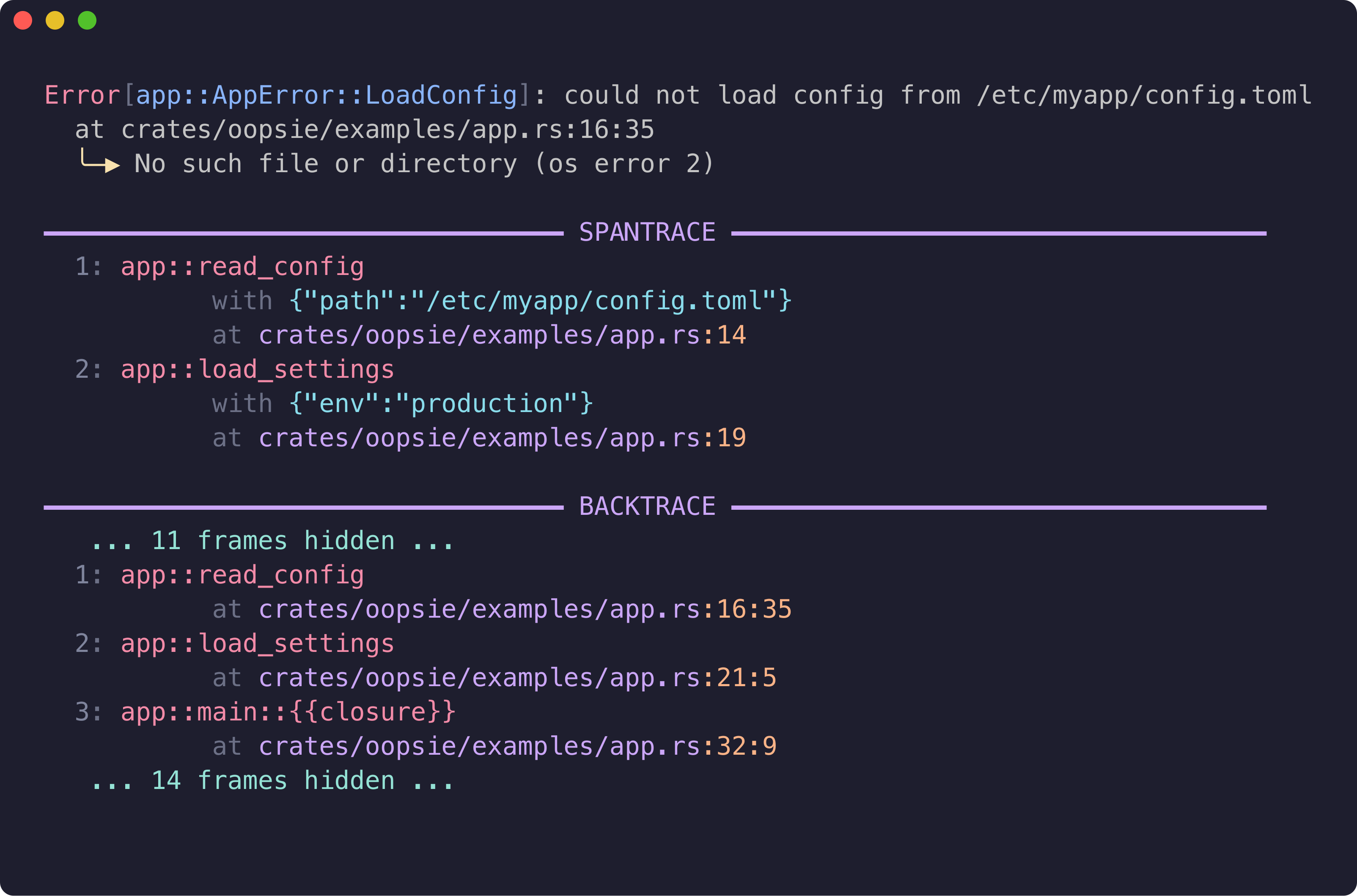
}#[oopsie] generates a context selector per variant — here app_oopsies::Connect,
in a module named after the type (AppError → app_oopsies) — alongside Display,
Debug, and Error impls. .context(selector) attaches your typed error to any
Result or Option. traced adds a captured backtrace (and a span trace with the
tracing feature) plus an automatic error code, and Report renders the result —
including panics, via its hook — as the colorized output shown above.
When one traced error wraps another, you can annotate the source field with
#[oopsie(forward)] to forward the inner error's backtrace and span trace instead of
capturing a redundant outer layer:
#[oopsie::oopsie(traced)]
pub enum GatewayError {
    #[oopsie("gateway rejected request")]
    Rejected {
        #[oopsie(forward)]
        source: AppError,
    },
}
Unlike thiserror, the attachment points and the renderer come built in; unlike
anyhow / eyre, your errors stay strongly typed.
| Crate | What it is |
|---|---|
oopsie |
The facade — #[oopsie], Report, panic hook, prelude. Start here. |
oopsie-core |
Lower-level types (Backtrace, SpanTrace, Diagnostic, Welp), used through the facade. |
oopsie-macros |
The #[oopsie] attribute and Oopsie derive. |
Feature flags are documented in the crate docs.
std is on by default. Build with default-features = false for no_std +
alloc targets — the crate always needs an allocator, so bring your own
(extern crate alloc plus a global allocator) in the consumer. fancy
enables std (colorized Report rendering needs it), so it is unavailable on
no_std targets.
| Feature | no_std? |
|---|---|
serde |
yes (alloc-based erased module) |
extras |
implies std |
tracing |
implies std |
chrono |
implies std |
jiff |
implies std |
test-utils |
implies std |
fancy |
implies std |
Under no_std, #[oopsie]/#[derive(Oopsie)], Welp, error chains, and
Diagnostic/Display rendering all work unchanged; backtraces are always
empty, and Report — which is fancy-only — is unavailable. See
crates/nostd-smoke for a bare-metal (thumbv7em-none-eabihf) smoke test,
and just nostd to run it locally.
The MSRV is 1.89. A nightly toolchain is pinned in rust-toolchain.toml for the
snapshot tests and the unstable-feature lanes — you don't need it to use the crate.
just test    # snapshot-bearing combos (stable + nightly) plus doctests
just clippy  # lint both channels with -D warnings
cargo fmt    # format
Snapshot tests only match on the blessed feature combos; run just test-bless
after a change that legitimately shifts one.
oopsie builds on ideas from the Rust error-handling ecosystem:
- snafu — the context-selector pattern
behind
#[oopsie]: a selector per variant, attached to aResultwith.context(...). - color-eyre — the rich, colorized rendering of the error chain, span trace, and backtrace, and the matching panic hook.
Licensed under either of MIT or Apache-2.0 at your option.