Configuration
FreeCAD AI stores all settings in a single JSON file and provides a GUI dialog for editing them. No environment variables or .env files are needed.
Open the settings dialog in any of these ways:
- Menu: FreeCAD AI > AI Settings
- Toolbar: click the "AI Settings" button in the FreeCAD AI toolbar
- Chat panel footer: click the gear icon at the bottom of the chat dock widget
The dialog has six sections: LLM Provider, Parameters, Behavior, MCP Servers, User Tools, and a Test Connection button.
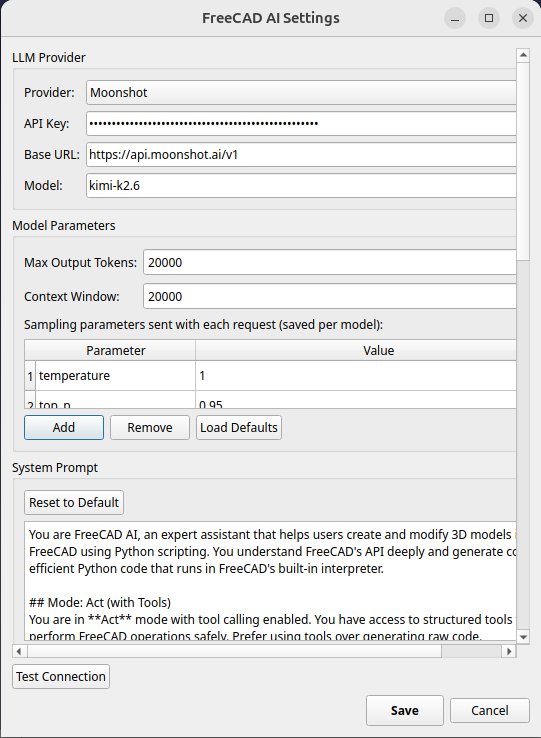
| Field | Description |
|---|---|
| Provider | Dropdown to select the LLM backend. Changing this auto-fills Base URL and Model with defaults. |
| API Key | Your provider's API key. Stored in plaintext in the config file. Leave empty for Ollama. |
| Base URL | The API endpoint. Auto-filled from provider presets but can be overridden. |
| Model | The model name to use. Auto-filled with the provider's recommended default. |
| Field | Description | Default |
|---|---|---|
| Max Output Tokens | Maximum number of tokens the LLM can generate per response. Range: 256--262,144. This controls output length only, not the context window. | 4096 |
| Context Window | Context window size in tokens. Older messages are automatically compacted when the conversation exceeds this limit. Set to your model's context limit, or lower to control API costs (e.g., 200,000 for Claude to avoid the expensive >200k tier). Range: 4,000--1,000,000. | 20,000 |
| Temperature | Controls randomness. Lower values (0.1--0.3) produce more deterministic output; higher values (0.7--1.0) produce more creative output. Range: 0.0--2.0. | 0.3 |
| Field | Description | Default |
|---|---|---|
| Auto-execute code in Act mode | When checked, the assistant executes tool calls immediately without asking for confirmation. When unchecked, each tool call shows a confirmation dialog. | Off |
| Thinking | Controls LLM reasoning chains. See the Thinking Mode section below. | Off |
| Viewport capture | Automatically attach viewport screenshots to chat messages. Off = disabled, Every Message = always, After Changes = only when tools modify the document. |
Off |
| Capture resolution | Resolution preset for viewport screenshots: Low (400x300), Medium (800x600), High (1600x1200). |
Medium |
| Model supports vision | Whether the LLM can process images natively. Auto-detected via Test Connection probe, or set manually. See Vision Routing below. | Not tested |
A list of configured Model Context Protocol servers. See MCP Integration for details.
- Add... -- opens a dialog to add a new MCP server (name, command, args, deferred, enabled).
- Remove -- removes the selected server from the list.
Each server in the list shows its status tags (e.g., (deferred), (disabled)).
Register your own Python functions as LLM-callable tools. Files in ~/.config/FreeCAD/FreeCADAI/tools/ are automatically discovered and validated.
-
Tool list -- shows all discovered tool files with status indicators:
-
✓valid (green) -- tool loaded successfully -
⚠warning (yellow) -- loaded with warnings (e.g., missing docstring) -
✗error (red) -- validation failed (e.g., syntax error, no typed functions)
-
-
Add... -- opens a file picker to copy a
.pyor.FCMacrofile into the tools directory. - Remove -- deletes the selected file from the tools directory.
- Reload -- re-scans and re-validates all tool files.
-
Also scan FreeCAD macro directory -- when checked, also scans
~/.config/FreeCAD/Macro/for compatible tool functions.
See Creating Custom Tools for the function convention and examples.
Click Test Connection to verify your provider settings. The workbench sends a small test request to the configured endpoint and displays the result:
- Green text -- connection successful, shows a snippet of the response.
- Red text -- connection failed, shows the error message.
After a successful connection test, a vision probe runs automatically. A small image containing a random 3-digit number is sent to the LLM. If the LLM reads the number correctly, vision is marked as supported. The result appears below the connection status:
- "Vision: supported" (green) -- the model can process images natively.
-
"Vision: not supported" (gray) -- the model cannot process images. If an MCP server provides a
describe_imagetool, images will be auto-described via that tool instead.
The test temporarily applies whatever values are currently in the dialog (you do not need to save first).
After verifying, click Save to persist settings or Cancel to discard changes.
| Provider | API Key Required | API Style | Default Model | Tool Calling | Notes |
|---|---|---|---|---|---|
| Ollama | No | OpenAI-compatible | llama3 |
Yes | Local, free, no data leaves your machine |
| Anthropic | Yes | Native Anthropic | claude-sonnet-4-20250514 |
Yes | Best tool calling quality |
| OpenAI | Yes | OpenAI | gpt-4o |
Yes | Wide model selection |
| Gemini | Yes | OpenAI-compatible | gemini-2.0-flash |
Yes | Google AI, generous free tier |
| OpenRouter | Yes | OpenAI-compatible | anthropic/claude-sonnet-4-20250514 |
Yes | Multi-provider gateway, pay-per-token |
| Custom | Varies | OpenAI-compatible | (none) | No* | Any OpenAI-compatible endpoint |
* Custom providers have tool calling disabled by default. If your custom endpoint supports tool calling, the assistant will fall back to code generation.
No API key needed. Install Ollama and pull a model (see Installation#Ollama Setup (Local Models)).
- Set Provider to Ollama.
- Leave API Key empty.
-
Base URL:
http://localhost:11434/v1(default). -
Model: enter the model name you pulled, e.g.,
qwen3,llama3,qwen2.5-coder. - Click Test Connection, then Save.
Recommended models for FreeCAD AI:
-
qwen3-- good tool calling, 8B parameters, runs on most hardware -
qwen2.5-coder-- strong at code generation, 7B parameters -
llama3-- fast general-purpose model, 8B parameters
- Go to console.anthropic.com and create an account.
- Navigate to API Keys and create a new key.
- In FreeCAD AI settings:
- Provider: Anthropic
-
API Key: paste your key (starts with
sk-ant-) -
Base URL:
https://api.anthropic.com(default) -
Model:
claude-sonnet-4-20250514(default, recommended)
- Click Test Connection, then Save.
Anthropic uses its own native API format (not OpenAI-compatible). The workbench handles this automatically.
Available models: claude-sonnet-4-20250514, claude-haiku-3-20250414, claude-opus-4-20250514
- Go to platform.openai.com and create an account.
- Navigate to API Keys and create a new key.
- In FreeCAD AI settings:
- Provider: OpenAI
-
API Key: paste your key (starts with
sk-) -
Base URL:
https://api.openai.com/v1(default) -
Model:
gpt-4o(default, recommended)
- Click Test Connection, then Save.
Available models: gpt-4o, gpt-4o-mini, gpt-4-turbo, o1, o1-mini
- Go to aistudio.google.dev and sign in with your Google account.
- Click Get API Key and create a new key.
- In FreeCAD AI settings:
- Provider: Gemini
- API Key: paste your key
-
Base URL:
https://generativelanguage.googleapis.com/v1beta/openai(default) -
Model:
gemini-2.0-flash(default, recommended)
- Click Test Connection, then Save.
Gemini uses an OpenAI-compatible endpoint provided by Google, so no special handling is needed.
Available models: gemini-2.0-flash, gemini-2.0-flash-lite, gemini-1.5-pro
OpenRouter is a gateway that routes requests to many providers (Anthropic, OpenAI, Google, Meta, Mistral, and more). You get a single API key and pay per token.
- Go to openrouter.ai and create an account.
- Navigate to Keys and create a new key.
- In FreeCAD AI settings:
- Provider: OpenRouter
- API Key: paste your key
-
Base URL:
https://openrouter.ai/api/v1(default) -
Model:
anthropic/claude-sonnet-4-20250514(default) or any model from the OpenRouter catalog
- Click Test Connection, then Save.
Model names on OpenRouter use the provider/model format. Browse the model list to find alternatives.
Use this for self-hosted models (vLLM, text-generation-inference, LM Studio, etc.) or any endpoint that implements the OpenAI /chat/completions API.
- Set Provider to Custom.
- Enter the Base URL of your endpoint (e.g.,
http://localhost:8000/v1). - Enter an API Key if your endpoint requires one, or leave it empty.
- Enter the Model name your endpoint expects.
- Click Test Connection, then Save.
Note: tool calling is disabled for custom providers by default. The assistant will fall back to generating Python code directly instead of using structured tool calls.
Settings are stored at:
~/.config/FreeCAD/FreeCADAI/config.json
This file is created automatically on first launch. You can edit it by hand, but using the settings dialog is recommended.
{
  "provider": {
    "name": "anthropic",
    "api_key": "sk-ant-...",
    "base_url": "https://api.anthropic.com",
    "model": "claude-sonnet-4-20250514"
  },
  "mode": "plan",
  "max_tokens": 4096,
  "context_window": 20000,
  "temperature": 0.3,
  "auto_execute": false,
  "max_retries": 3,
  "enable_tools": true,
  "thinking": "off",
  "viewport_capture": "off",
  "viewport_resolution": "medium",
  "mcp_servers": [],
  "user_tools_disabled": [],
  "scan_freecad_macros": false,
  "hooks_disabled": [],
  "vision_detected": null,
  "vision_override": null
}| Field | Type | Default | Description |
|---|---|---|---|
provider.name |
string | "anthropic" |
Provider identifier. One of: anthropic, openai, ollama, gemini, openrouter, custom. |
provider.api_key |
string | "" |
API key for the provider. Stored in plaintext. Leave empty for Ollama. |
provider.base_url |
string | "https://api.anthropic.com" |
API endpoint URL. Auto-filled from provider presets. |
provider.model |
string | "claude-sonnet-4-20250514" |
Model name to use for completions. |
mode |
string | "plan" |
Operating mode. "plan" shows generated code for review before execution. "act" executes tool calls directly (with optional confirmation dialog). |
max_tokens |
integer | 4096 |
Maximum output tokens per LLM response. Does not affect context window size. Range: 256--262,144. |
context_window |
integer | 20000 |
Context window size in tokens. Conversation is automatically compacted when it exceeds this limit. Set to model's limit or lower to control costs. Range: 4,000--1,000,000. |
temperature |
float | 0.3 |
Sampling temperature. Lower = more deterministic, higher = more creative. Range: 0.0--2.0. |
auto_execute |
boolean | false |
When true and mode is "act", tool calls execute without a confirmation dialog. |
max_retries |
integer | 3 |
Number of times to retry a failed tool call before giving up. |
enable_tools |
boolean | true |
When true, the assistant uses structured tool calls. When false, it falls back to generating raw Python code. |
thinking |
string | "off" |
LLM reasoning mode. "off" = no reasoning (fastest). "on" = standard thinking. "extended" = extended thinking with higher token budget. See Thinking Mode below. |
viewport_capture |
string | "off" |
Auto-capture viewport screenshots. "off" = disabled. "every_message" = attach screenshot with every message. "after_changes" = attach after tool calls modify the document. Can be overridden per-session via the Capture button. |
viewport_resolution |
string | "medium" |
Resolution preset for viewport screenshots. "low" = 400x300. "medium" = 800x600. "high" = 1600x1200. |
mcp_servers |
array | [] |
List of MCP server configurations. See MCP Servers below. |
user_tools_disabled |
array of strings | [] |
Filenames of user tool files to skip when loading (e.g., ["broken_tool.py"]). |
scan_freecad_macros |
boolean | false |
Also scan FreeCAD's macro directory (~/.config/FreeCAD/Macro/) for compatible tool functions. |
hooks_disabled |
array of strings | [] |
Hook directory names to skip when loading (e.g., ["log-tool-calls"]). |
vision_detected |
boolean or null | null |
Result of the vision probe. null = not tested, true = vision supported, false = vision not supported. Set automatically by Test Connection. |
vision_override |
boolean or null | null |
Manual override for vision support. When set, takes precedence over vision_detected. Set via the "Model supports vision" checkbox in Settings. |
Each entry in the mcp_servers array has this structure:
{
  "name": "filesystem",
  "command": "npx",
  "args": ["-y", "@modelcontextprotocol/server-filesystem", "/tmp"],
  "env": {},
  "enabled": true,
  "deferred": true
}| Field | Type | Default | Description |
|---|---|---|---|
name |
string | Display name for the server. | |
command |
string | Executable to launch (e.g., npx, python3, node). |
|
args |
array of strings | [] |
Command-line arguments. |
env |
object | {} |
Additional environment variables to set when spawning the process. |
enabled |
boolean | true |
Whether to connect to this server on startup. |
deferred |
boolean | true |
Load tool schemas lazily on first use. Set to false to load all schemas eagerly on connect. |
See MCP Integration for full documentation on MCP support.
Thinking mode enables the LLM to show its reasoning process before producing a final answer. This is useful for complex multi-step modeling tasks.
| Setting | Behavior |
|---|---|
| Off | No reasoning output. Fastest response time. Recommended for simple tasks. |
| On | Standard thinking/reasoning. The LLM produces a reasoning chain before its response. |
| Extended | Extended thinking with a higher token budget. Best for complex multi-step tasks but slower and more expensive. |
How thinking is implemented depends on the provider:
-
Anthropic: uses the
thinkingblock withbudget_tokensand the beta header. -
OpenAI: uses the
reasoning_effortparameter. -
Ollama (qwen3): uses
/thinkand/no_thinktags in the system prompt.
Not all models support thinking. If your model does not support it, the setting is silently ignored.
FreeCAD AI can attach images (viewport screenshots, pasted images, drag-and-drop) to chat messages. How these images are handled depends on whether the LLM supports vision:
Vision support is detected automatically when you click Test Connection in Settings. After a successful connection test, a small image containing a random 3-digit number is sent to the LLM. If the LLM reads the number correctly, vision is marked as supported.
You can also manually set vision support via the "Model supports vision" checkbox in the Behavior section of Settings. A Reset button appears when you have set a manual override, allowing you to return to the auto-detected value.
Vision detection resets when you change the provider or model (since different models have different capabilities). The manual override is preserved across provider/model changes.
| Scenario | Behavior |
|---|---|
| Vision supported | Images are sent inline to the LLM as base64 content blocks (native vision). |
| Vision not supported, MCP fallback available | Images are automatically described by an MCP tool (e.g., describe_image from llm-vision-mcp) and the text description is sent to the LLM instead. A note appears in the chat for each described image. |
| Vision not supported, no MCP fallback | Image controls (Capture, Attach, drag-drop, paste) are disabled. A tooltip explains how to enable vision. |
| Vision not tested | Image controls remain enabled (optimistic). On first image use, a hint suggests running Test Connection to enable auto-detection. |
If your LLM does not support vision, you can configure an MCP server that provides a describe_image tool. The workbench automatically searches registered MCP tools for one with describe_image in the name. When found, images are routed through that tool transparently — you do not need to invoke it manually.
A compatible MCP vision server is available at ghbalf/llm-vision-mcp. It routes images to a vision-capable model (OpenAI, Anthropic, Google, Ollama, or any OpenAI-compatible endpoint) and returns text descriptions.
git clone https://github.com/ghbalf/llm-vision-mcp.git
cd llm-vision-mcp
npm install
npm run buildOpen Settings > MCP Servers and click Add.... Fill in:
| Field | Value |
|---|---|
| Name | llm-vision-mcp |
| Command | node |
| Args | dist/index.js --provider openai --openai-api-key sk-... |
| Deferred | checked (recommended) |
Adjust the args for your vision provider. Examples:
# OpenAI (default model: gpt-4o)
dist/index.js --provider openai --openai-api-key sk-...

# Anthropic (default model: claude-sonnet-4-latest)
dist/index.js --provider anthropic --anthropic-api-key sk-ant-...

# Google Gemini (default model: gemini-2.0-flash)
dist/index.js --provider google --google-api-key AIza...

# Ollama local (default model: llava)
dist/index.js --provider ollama
The --provider and API key can also be set via environment variables (VISION_DEFAULT_PROVIDER, OPENAI_API_KEY, etc.) or a .env file in the llm-vision-mcp directory.
Important: The dist/index.js path must be absolute (e.g., /home/you/llm-vision-mcp/dist/index.js) or relative to your working directory.
After adding the server, click Test Connection. If the vision probe detects that your main LLM does not support vision, the workbench will automatically find the describe_image tool from the MCP server and use it to describe images before sending them to the LLM.
See MCP Integration for general MCP server documentation.
The /optimize-skill command automatically improves a skill's SKILL.md instructions by iteratively running test cases, scoring results, and using the LLM to fix errors.
- Type
/optimize-skillin the chat (Act mode) - Select a skill from the dropdown and add test cases (e.g.,
100x60x40mm, 2mm walls, snap-fit lid) - Configure iterations, runs per test, and strategy
- Click Start Optimization
The optimizer runs all iterations automatically inside a single tool call. Each iteration:
- Evaluates the SKILL.md against all test cases
- Scores: completion, error rate, geometric correctness, efficiency
- Asks the LLM to fix errors in the SKILL.md
- Keeps improved versions, discards regressions
| Field | Default | Description |
|---|---|---|
| Skill | -- | Skill to optimize |
| Test cases | -- | Arguments to test with (at least one required) |
| Iterations | 10 | Number of evaluate-modify cycles |
| Runs per test | 2 | Runs per test case (averaged for noise reduction) |
| Strategy | Balanced | Conservative (targeted fixes only), Balanced (+ periodic restructuring), Aggressive (frequent restructuring) |
Advanced settings:
| Field | Default | Description |
|---|---|---|
| Tool call budget | 30 | Max tool calls per evaluation run |
| Run timeout | 300s | Max seconds per evaluation run |
| Keep tolerance | 0.05 | Score margin for keeping lateral moves |
| Network retries | 2 | Extra retry attempts on network/timeout errors (exponential backoff: 5s, 10s, 20s...) |
The optimizer saves all versions under ~/.config/FreeCAD/FreeCADAI/skills/<name>/.optimize/:
-
SKILL.md.original-- backup of the original (never overwritten) -
v1.md,v2.md, ... -- each iteration's SKILL.md -
history.json-- score progression, kept/discarded status, model info
The best version is automatically written to SKILL.md. You can always restore the original from SKILL.md.original.
Hooks are user-defined Python scripts that fire on lifecycle events. They can block dangerous operations, modify user input, or log activity.
Each hook is a named directory under ~/.config/FreeCAD/FreeCADAI/hooks/ containing a hook.py file:
~/.config/FreeCAD/FreeCADAI/hooks/
├── safety-guard/
│   └── hook.py
└── my-logger/
    └── hook.py
Built-in hooks ship with the workbench (in the repo's hooks/ directory) and are discovered automatically.
Define functions named on_<event> in hook.py:
def on_pre_tool_use(context):
    """Block dangerous operations."""
    if context["tool_name"] == "execute_code":
        code = context["arguments"].get("code", "")
        if "removeObject" in code:
            return {"block": True, "reason": "Blocked: removeObject is dangerous"}
    return {}

def on_post_tool_use(context):
    """Log every tool call."""
    with open("/tmp/tool_log.txt", "a") as f:
f.write(f"{context['tool_name']}: {context['success']}\n")| Event | When | Can block? | Thread |
|---|---|---|---|
| pre_tool_use | Before a tool executes | Yes | Worker |
| post_tool_use | After a tool completes | No | Worker |
| user_prompt_submit | Before user message sent to LLM | Yes (block or modify) | Main |
| post_response | After LLM response processed | No | Main |
Worker thread hooks (pre_tool_use, post_tool_use) must NOT call FreeCAD GUI APIs (App.ActiveDocument, FreeCADGui). They can read/write files, log, or make HTTP requests.
Main thread hooks (user_prompt_submit, post_response) can safely access the FreeCAD API.
| Return | Effect | Events |
|---|---|---|
{"block": True, "reason": "..."} |
Block the action |
pre_tool_use, user_prompt_submit
|
{"modify": "new text"} |
Replace the user's message text | user_prompt_submit |
{} or None
|
No effect | All |
Multiple hooks on the same event run in alphabetical order by directory name. If any hook blocks, the action is blocked. Modifications chain (each hook sees the previous hook's output).
pre_tool_use: tool_name (str), arguments (dict), turn (int)
post_tool_use: tool_name, arguments, success (bool), output (str), error (str), turn
user_prompt_submit: text (str), images (list), mode ("plan"/"act")
post_response: response_text (str), tool_calls_count (int), mode
In Settings > Hooks:
-
Add -- copy a
hook.pyfile into a new hook directory -
Edit -- open
hook.pyin your system editor - Remove -- delete the hook directory (built-in hooks can only be disabled)
- Reload -- re-scan and reload all hooks without restarting FreeCAD
Disable a hook by adding its name to hooks_disabled in config.json, or by unchecking it in Settings.
| Hook | Event | Description |
|---|---|---|
log-tool-calls |
post_tool_use |
Logs tool calls to the FreeCAD Report View |
FreeCAD AI creates several directories under ~/.config/FreeCAD/FreeCADAI/:
| Directory | Purpose |
|---|---|
~/.config/FreeCAD/FreeCADAI/ |
Root config directory. Contains config.json. |
~/.config/FreeCAD/FreeCADAI/conversations/ |
Auto-saved chat sessions. The last 20 sessions are available for reload via the "Load" button in the chat footer. |
~/.config/FreeCAD/FreeCADAI/skills/ |
User-created skills. Each skill is a subdirectory containing a SKILL.md file. See Skills. |
~/.config/FreeCAD/FreeCADAI/tools/ |
User extension tools. .py and .FCMacro files with typed functions. See Creating Custom Tools. |
~/.config/FreeCAD/FreeCADAI/hooks/ |
User-defined hooks. Each hook is a subdirectory containing a hook.py file. See Hooks section above. |
~/.config/FreeCAD/FreeCADAI/logs/ |
Session logs. latest_session.json contains the most recent session's tool call log. |
-
API keys are stored in plaintext in
config.json. Protect this file with appropriate file permissions (chmod 600). - Auto-execute mode lets the LLM run arbitrary Python code in your FreeCAD session without confirmation. Use with caution, especially with cloud providers.
- MCP servers are spawned as child processes. Only configure servers you trust.
To verify your configuration is working:
- Open FreeCAD AI > AI Settings.
- Fill in your provider details.
- Click Test Connection.
- If successful, you will see a green "Connected!" message with a snippet of the LLM's response.
- If it fails, the red error message will indicate the problem:
- Connection refused -- the server is not running (common with Ollama).
- 401 Unauthorized -- invalid or missing API key.
- 404 Not Found -- wrong base URL or model name.
- Timeout -- the server took too long to respond. For Ollama, this can happen on first request while the model loads into memory; try again.
After configuring your provider, proceed to Getting Started to learn how to use the chat interface, switch between Plan and Act modes, and build your first 3D model.