Guardrails and Safety
The non-negotiable rules are enforced in code, not just in prompts. This page maps each guardrail to where it's enforced, so you can verify it's real rather than take it on faith.
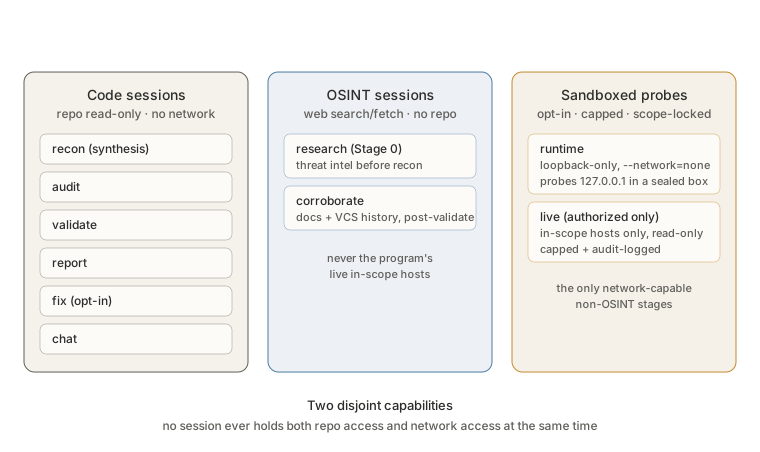
The capability map shows the core invariant visually — Argo's sessions fall into three disjoint zones, and no session ever holds both repo access and network access at once:
Stage 5 stops at DRAFT bundles; submission is a manual human action. There is no submission code
path anywhere in the tree — the only HTTP client is the gated live-probe executor (off by
default, see below). Report/draft artifacts carry a "Produced by Argo" footer (default on,
--no-attribution to opt out) — attribution only, never a claim of authorship over the target
code. The CLI exposes no submit command.
Every stage of the default pipeline is fully offline against the program's hosts. config.NETWORK_TOOLS
lists every network/sub-agent tool; the runner strips them from any session's allowlist before it
launches, and asserts no network tool is present as a hard stop right before launch. This is
backend-neutral: enforced via the tool allow/deny list for Claude, and via the OS sandbox
(-s workspace-write) for Codex — see Multi-Backend.
-
2a —
research+corroborate(opt-out, on by default): the only two stages allowed any network access, and only the OSINT subset (WebSearch/WebFetch) — never a shell, never the repo. Neither ever touches the program's live in-scope hosts (injected as an explicit forbidden denylist). See Threat-Informed Audit and Docs & History Corroboration. -
2b —
runtime(opt-in, default off): builds the OSS target from the cloned source into an egress-blocked container (--network=none) and probes only127.0.0.1inside that sealed namespace — never the program's real host. See Runtime Verification. -
2c —
live(opt-in, default off,⚠️ authorized use only): the one capability that deliberately contacts the program's real in-scope host, for authorized bug-bounty engagements whose RoE permit it. Heavily gated: RoE-authorization check, in-scope-only scope-lock (out-of-scope, unknown, and loopback hosts all hard-blocked), read-only-by-default + anti-DoS caps, a second opt-in for non-destructive writes (DELETE never allowed), full audit logging. See Live Verification.
The session's cwd is a separate writable scratch dir, never the repo — the repo is exposed only via
a read-only mount. Ingest additionally strips write bits from every copied repo file (defense in
depth). Mutation tools (Edit, MultiEdit, NotebookEdit) are always disallowed. There is no code
path that writes into repo/.
If a rendered prompt is missing a prohibited technique from the scope (e.g. "no DoS"), rendering fails — and an empty prohibited-techniques list is itself rejected, since a real program always has hard limits. Enforced at recon, audit, and validate — on the actual prompt that drives each session, not just the template.
Scope and findings are Draft-07 schema-validated at every gate. Every LLM call is logged (prompt sha256, model, tokens, cost) even when the session errors — cost logging is never skipped.
-
Scope filter, independent of the LLM verdict — drops any finding whose affected reference
falls under an explicit
out_of_scopetoken, before validation even sees it. -
Conservative ingest defaults — a silent brief defaults
automation_allowedto false and injects a conservative default prohibited-techniques set. -
Budget is a hard guard —
--budgetaborts remaining sessions once real spend hits the ceiling; the abort is logged, never silent.
They do not vouch for finding quality — that's the job of the audit and validation prompts (see
Adversarial Validation and
Benchmarks & Costs). For the adjacent question — how the pipeline
keeps a hallucinating, non-deterministic model trustworthy (mechanical diffs, ground-truth build
verification, physical caps, commit-pin reproducibility) — see
Determinism & Anti-Hallucination. They guarantee the pipeline stays inside the
authorized envelope: source-static only, read-only, no submission, and no live contact unless you
explicitly opt into the gated live stage — which itself stays scope-locked, read-only-by-default,
capped, and audit-logged.