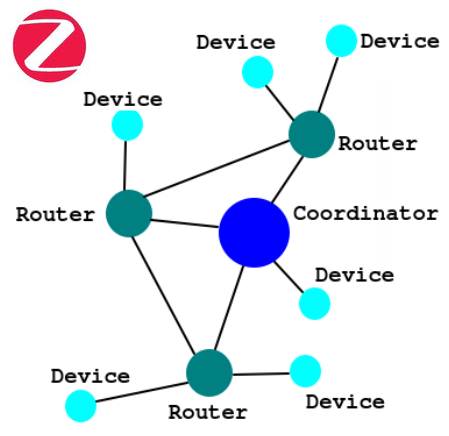
The Zigbee Coordinator (ZC) is the most critical device in a Zigbee network. It plays several key roles:
The ZC is the device that starts and organizes the Zigbee network. When powered on, it scans the radio environment for a suitable channel to avoid interference with other wireless systems (such as Wi-Fi or Bluetooth). Once it selects a channel, the ZC establishes a unique Personal Area Network Identifier (PAN ID) for the network. The PAN ID acts like a unique identifier for the network, distinguishing it from other Zigbee networks in the same area.
Every device in the Zigbee network needs a unique address. The ZC assigns a 16-bit network address to each new device joining the network. The network uses a combination of these short addresses for communication, while the 64-bit IEEE address is used globally to identify the device.
While the ZC doesn't handle all routing on its own (routers and end devices also participate in routing), it plays an essential role in maintaining the overall structure of the network. The ZC keeps track of the routing tables, node associations, and the overall topology of the network. It also ensures that the network's integrity is maintained over time, such as when nodes join or leave the network, or when the topology changes due to mobility or failures.
Zigbee supports encryption and secure key exchange to protect communication. The ZC is responsible for generating and distributing the network-wide encryption keys. This key is shared among devices in the network to encrypt the data they exchange. It can also authenticate devices that request to join the network to ensure that only authorized devices can participate.
The ZC can store a backup of the network settings, such as device addresses and routing information. If the ZC goes down or is replaced, it can restore the network from the backup. This prevents the entire network from being disrupted in case of failure.
The architecture allows only one ZC per Zigbee network, and it acts as the root of the network tree. It can communicate with both routers and end devices. While ZC is critical for forming the network, once the network is formed, other routers can take over routing duties, and the ZC is not required for day-to-day operation (although it must remain active for certain management tasks).
A Zigbee Router (ZR) enhances network scalability, extends coverage, and provides resilience through its role in routing data across the network.
ZR devices allow Zigbee to support mesh networking, where devices can forward messages on behalf of others. This means that even if two devices are too far apart to communicate directly, routers can relay the data, ensuring the entire network stays connected.
By relaying messages, ZRs effectively extend the range of the Zigbee network. This allows devices that are physically far apart to communicate by using intermediate routers. For instance, in a large home, routers can be placed at various points to ensure that all Zigbee devices (such as smart lights or sensors) can connect, even if they're not in direct range of the coordinator.
ZRs are typically always powered on (non-sleeping), as they need to be available to forward messages from other devices. Unlike end devices, which can enter sleep modes to save energy, routers need a stable power source. This makes ZRs ideal for fixed infrastructure devices, such as smart plugs, which can function continuously without needing battery replacements.
Each ZR maintains a routing table, which contains information about the best paths to different devices in the network. Zigbee uses an algorithm similar to Ad-hoc On-demand Distance Vector (AODV) to dynamically determine routes, minimizing delays and avoiding congestion.
Since routers relay messages, the network is resilient to single-point failures. If one router goes offline, the mesh network can automatically reroute messages through other available routers. This decentralized routing system improves the overall reliability of the Zigbee network, especially in large or complex environments.
When new Zigbee devices want to join the network, they can associate through either the ZC or a ZR. The router can help manage new devices by assigning them a network address and forwarding this information back to the coordinator. This decentralized joining process ensures that new devices can join the network without overwhelming the coordinator.
The Zigbee End Device (ZED) is designed for simplicity and power efficiency, fulfilling its role by performing specialized tasks without participating in routing or relaying data for other devices.
ZEDs are typically low-power devices designed to operate for extended periods on batteries. Examples of ZEDs include sensors, actuators, and remote controls. To conserve energy, these devices can enter sleep mode when not actively transmitting or receiving data. When in sleep mode, ZEDs do not participate in network routing.
Since ZEDs do not relay messages, they depend on nearby routers or the ZC for communication. When a ZED needs to send or receive data, it first communicates with a router or the coordinator, which then handles relaying the message. For example, a Zigbee temperature sensor (ZED) might wake up periodically, send a temperature reading to a nearby router (ZR), and then go back to sleep.
Since ZEDs sleep to conserve power, they need a mechanism to check for incoming messages. This is achieved through a polling mechanism, where the ZED wakes up at intervals and asks the parent device (a ZR or ZC) if any messages are waiting for it. This minimizes energy consumption while ensuring that important data is not missed.
ZEDs are often small and low-cost, and they serve specific roles such as:
- Sensors: Devices that collect environmental data (e.g., temperature, humidity, motion).
- Controllers: Devices like remote controls that send commands (e.g., turning on lights).
- Actuators: Devices that perform an action (e.g., locking a door or turning on a fan) when commanded.
When a ZED joins the network, it typically associates with a nearby router or the ZC. Once connected, it receives a unique network address. ZEDs do not need to maintain a routing table or perform complex network management tasks, which reduces their complexity and power needs.
When the ZC powers up, it scans the 2.4 GHz ISM band (or other frequency bands such as 868 MHz and 915 MHz depending on regional regulations) to find the best available channel. This is crucial in environments where multiple wireless protocols coexist, such as Wi-Fi, Bluetooth, or other Zigbee networks. Interference from these protocols can degrade performance, so the ZC performs energy detection (ED) scans to measure the noise levels on each channel.
Once a suitable channel is selected, the ZC assigns itself a unique PAN ID. This 16-bit identifier is crucial for ensuring devices can distinguish between different Zigbee networks operating in the same vicinity. The PAN ID is analogous to a Wi-Fi SSID in that it identifies the specific network the ZC is managing.
The network initialization process also involves setting up network parameters, such as beacon intervals, security settings (e.g., encryption keys), and addressing methods. Once the network is initialized, it enters a "discoverable" mode, allowing other devices to join.
Zigbee networks use two types of addresses: a 16-bit network address for local communication within the network and a 64-bit IEEE address for unique identification globally. The ZC allocates these 16-bit network addresses dynamically when a new device joins the network. This dynamic nature allows the ZC to manage the address space efficiently, avoiding conflicts and ensuring that every device has a unique identifier within the PAN.
The ZC also maintains a list of all active devices in the network and their associated network addresses. This list is referred to as the Device Address Table and is essential for managing communication within the network, especially when devices are mobile or when nodes leave and rejoin the network. The ZC's ability to handle devices joining and leaving dynamically is part of what makes Zigbee suitable for scalable and resilient networks.
For larger networks, the ZC can delegate addressing authority to Zigbee Routers (ZR), allowing them to handle the local assignment of addresses to their own child devices, reducing the load on the ZC and enabling larger networks to scale without performance degradation.
Zigbee is built on a mesh networking architecture, which means that the ZC is not a central point of failure for communication after the network is established. However, the ZC plays a pivotal role in network topology management. It maintains a routing table and keeps track of the network map, which includes knowing which devices are connected to which routers and the optimal paths for communication.
Zigbee uses an algorithm based on Ad-hoc On-demand Distance Vector (AODV) routing, which allows devices to dynamically discover routes to other devices as needed. The ZC helps initiate this process and maintains routing information for efficient data transfer. If the network topology changes (e.g., a router goes offline), the ZC can help manage route updates to ensure continued communication.
The ZC also monitors node associations, keeping track of which devices are currently active in the network. This allows the ZC to handle power management more effectively, ensuring that sleeping devices (Zigbee End Devices, ZEDs) can still communicate when they wake up.
Security in Zigbee networks is based on the Advanced Encryption Standard (AES-128), ensuring secure communication between devices. The ZC is responsible for generating and distributing two critical types of keys:
- Network Key: A shared key used for encrypting all messages at the network layer. This key is distributed to all devices in the network when they join. The ZC can update this key periodically to enhance security.
- Link Keys: Used for encrypting communication between two devices at the application layer. These keys are not shared network-wide but are specific to the communicating devices. The ZC can help with key establishment protocols (such as using certificates or pre-shared keys) when devices authenticate each other.
The ZC acts as a Trust Center (TC), which manages the distribution of these keys and enforces policies such as device authentication and message integrity checking. When a new device tries to join the network, the ZC verifies its credentials before granting access and distributing the necessary keys.
Additionally, Zigbee allows for key refreshes, where the network key can be updated without needing to rejoin devices, which enhances the overall security posture of the network.
Since the ZC is the only device responsible for forming and initializing the network, it becomes critical to plan for failure scenarios. Zigbee networks can support backup and restore functionality, where the ZC stores essential network information such as:
- Device Address Table
- Routing Information
- Security Keys
- Network Parameters (e.g., PAN ID, channel)
If the ZC goes offline or is replaced (e.g., due to a hardware failure), a backup of this data can be used to restore the network without requiring all devices to rejoin. This is particularly useful for large networks where manually re-pairing each device would be impractical.
However, in some cases, restoring the ZC might not be immediate. Zigbee's mesh architecture ensures that communication can continue between devices through routers, even in the absence of the ZC. This decentralized routing helps avoid network failure due to a single point of failure.
In a large Zigbee network, the ZC can become a bottleneck if too many devices attempt to communicate through it. To address this, Zigbee networks can be designed to offload tasks to Zigbee Routers. For instance, routers can handle local device joining, routing, and some network management, significantly reducing the workload on the ZC.
For very large networks, Zigbee Pro introduces network segmentation, where the network is broken into smaller, manageable segments. The ZC coordinates communication between these segments, optimizing network performance and scalability.
Network scalability is a critical feature in Zigbee systems, where hundreds or even thousands of devices may need to coexist. The ZC facilitates this by:
- Optimizing routing to avoid congestion
- Managing security at scale
- Supporting multi-hop communication via routers
In energy-constrained environments, such as where devices are powered by energy harvesting (e.g., solar), Zigbee introduced the Green Power feature. The ZC supports Green Power Devices (GPDs), which operate with extremely low power and may not be able to handle the full Zigbee stack. The ZC and routers help integrate these GPDs into the network by handling communication for them.
Zigbee operates using a mesh networking architecture, which is highly scalable and fault-tolerant. The Zigbee Router (ZR) is central to this, as it facilitates multi-hop communication between devices. Here’s how ZRs contribute:
-
Message Forwarding: In a Zigbee mesh, devices do not need to communicate directly with the Zigbee Coordinator (ZC) or with each other. Instead, they can use routers to forward messages. ZRs relay these messages from one device to another, which allows communication over long distances and through obstacles like walls or floors.
-
Path Discovery: Zigbee uses an Ad-hoc On-demand Distance Vector (AODV)-based routing protocol. ZRs play an active role in discovering paths between devices. When a device wants to send a message to another device that isn’t in direct range, the ZR helps by finding the most efficient route based on the network topology. ZRs maintain routing tables with information about available paths, ensuring that the best route is chosen dynamically.
-
Dynamic Routing: If the physical layout of the network changes—such as when devices are moved or a router goes offline—the ZR updates its routing table and helps discover new routes. This dynamic nature ensures the network remains operational without requiring manual intervention.
In small Zigbee networks, devices can communicate directly with the coordinator. However, as the network grows in size—both in terms of the number of devices and physical coverage—direct communication becomes impractical.
-
Extending Range: By introducing Zigbee Routers throughout a large area, such as a home or industrial facility, the network range can be extended significantly. Routers can be placed in strategic locations to ensure that all devices, regardless of distance, are connected. In scenarios where devices are physically far apart (such as between rooms or floors), ZRs ensure communication by relaying data between distant devices.
-
Supporting Dense Networks: ZRs allow Zigbee to scale to hundreds or thousands of devices by distributing the communication load. Without routers, all devices would need to communicate directly with the ZC, which could create a bottleneck. ZRs distribute the load, enabling more devices to join the network without overwhelming the coordinator.
A key difference between Zigbee End Devices (ZEDs) and Zigbee Routers (ZRs) lies in their power requirements.
-
Non-Sleeping Devices: Zigbee Routers must remain powered on at all times to forward messages. This means that ZRs are not energy-constrained devices and typically need a stable, reliable power source (e.g., being plugged into the mains). Devices like smart plugs, light bulbs, or security systems often serve as ZRs because they are always connected to power and can support continuous operation.
-
Energy Trade-Off: In contrast, ZEDs can go into sleep mode to save power, especially in battery-operated devices like sensors. However, ZEDs depend on nearby routers to relay their messages, as they don’t have the capability to forward messages or stay active for long periods. The presence of always-on routers ensures that these low-power devices can still communicate efficiently while conserving energy.
Zigbee Routers maintain routing tables that store information about the best paths to other devices in the network. Routing tables help routers quickly determine the next hop for a message to reach its destination, thus optimizing communication.
-
AODV Routing Algorithm: The Ad-hoc On-demand Distance Vector (AODV) routing algorithm used by Zigbee dynamically determines routes based on distance and network topology. When a message needs to be sent, the router checks its routing table for the most efficient path. If no path is found, the router will initiate a route discovery process to find one.
-
Route Discovery Process: During route discovery, a ZR broadcasts route request (RREQ) packets to neighboring devices. These neighbors pass the request further until it reaches the destination. Once the route is found, a route reply (RREP) packet is sent back along the reverse path to confirm the route. After the path is established, ZRs maintain route freshness to ensure optimal performance.
-
Congestion and Delay Minimization: The routing table also helps minimize network congestion by distributing data across multiple routes. If a particular route becomes congested, the router can reroute data via a less congested path, minimizing delays and ensuring smooth communication.
One of the key benefits of Zigbee’s mesh architecture is fault tolerance, largely enabled by ZRs.
-
Automatic Rerouting: If a router goes offline (e.g., due to a power failure), the Zigbee network automatically finds an alternative path through other ZRs. This self-healing feature makes Zigbee networks highly reliable, especially in environments where devices may frequently join and leave the network.
-
Single-Point Failure Resilience: Unlike star-topology networks, where the failure of a central hub can lead to a network-wide outage, the Zigbee mesh network avoids this by distributing communication among many devices. The network remains functional even when one or more routers fail, as the remaining routers reroute the data.
-
Distributed Load: By distributing the task of message forwarding across multiple routers, the network avoids overloading any single point. This distributed nature also improves data throughput and network robustness, as traffic can be dynamically balanced across the network.
Zigbee Routers play a key role in allowing new devices to join the network, a process known as device association.
-
Association via ZR: When a new device (like a sensor or light) tries to join the network, it does not need to communicate directly with the coordinator. It can join through the nearest ZR. The router will assign a 16-bit network address to the new device and forward this information to the coordinator. This decentralized process lightens the load on the ZC, allowing it to handle more devices without becoming a bottleneck.
-
Parent-Child Relationship: Once a ZR allows a new device to join the network, it acts as the device’s parent. This parent-child relationship is crucial for low-power devices (ZEDs), which need to conserve energy. The ZR will store messages for these devices while they are in sleep mode and deliver them when they wake up. This mechanism ensures that energy-constrained devices can function efficiently without draining their batteries.
Zigbee Routers assist in network maintenance through the use of beacons and other network maintenance messages.
-
Beaconing: Zigbee Routers periodically transmit beacon frames, which serve to synchronize devices in the network, inform devices about the network structure, and assist in keeping routing tables up to date. Beacons contain important network parameters, such as the PAN ID and the network addresses of nearby devices.
-
Network Health Monitoring: By sending and receiving beacons, ZRs can monitor the health of the network, identify network changes (e.g., new routers joining or leaving), and update their routing tables accordingly. This ongoing maintenance ensures that the mesh network remains stable and efficient.
Zigbee End Devices (ZEDs) are intentionally designed to be as simple and energy-efficient as possible. This is because many ZEDs are battery-operated, and minimizing power consumption is critical to extending their battery life.
-
Low-Power Operation: ZEDs are typically configured to operate in sleep mode most of the time, only waking up when they need to transmit or receive data. For example, a Zigbee motion sensor may remain inactive until it detects motion. Upon detecting motion, it wakes up, sends a message to its parent (usually a Zigbee Router, ZR), and then returns to sleep. This ability to remain in sleep mode for extended periods significantly reduces power consumption, allowing devices to operate for months or even years on a single battery.
-
Event-Driven Communication: ZEDs are often designed to respond to specific events or conditions, such as environmental changes (e.g., temperature or humidity), user actions (e.g., pressing a button on a remote), or other sensor readings. When such events occur, the ZED wakes up, performs its task (e.g., sending data or performing an action), and then returns to sleep. This event-driven nature further optimizes energy consumption.
-
Duty Cycling: A technique used to reduce power consumption is duty cycling, where a ZED wakes up periodically (e.g., every few seconds or minutes) to check for new tasks or messages. If there are no new messages, it quickly returns to sleep. The frequency of these wake-up cycles is a trade-off between responsiveness and power efficiency.
Since ZEDs do not participate in message relaying or routing, they are entirely dependent on nearby Zigbee Coordinators (ZCs) or Routers (ZRs) for their communication.
-
Parent-Child Relationship: Each ZED must associate with a parent device, which is either a ZC or a ZR. The parent stores messages for the ZED while it is in sleep mode. When the ZED wakes up and polls its parent, the parent device will deliver any queued messages. This parent-child relationship is essential for ensuring that ZEDs can conserve power while still being able to participate in the network when needed.
-
Data Transmission: For example, a Zigbee temperature sensor (ZED) that wakes up periodically to report temperature readings would first check in with its parent (a ZR or ZC) and then transmit the data. Once the message has been acknowledged by the parent, the ZED returns to sleep. The parent handles any routing or forwarding of the message to other devices in the network, such as sending the temperature data to a home automation system.
Since ZEDs spend most of their time in sleep mode, they rely on a polling mechanism to check for messages from other devices.
-
Polling Intervals: The ZED wakes up at defined intervals to ask its parent device whether there are any messages waiting for it. If there are messages, the parent device will deliver them during the polling session. If there are no messages, the ZED quickly returns to sleep, minimizing power consumption. The polling interval can be configured based on the specific use case. A shorter polling interval results in faster message delivery but higher power consumption, while a longer polling interval conserves power but may introduce some delay in receiving messages.
-
Message Buffering: The parent device (ZC or ZR) buffers messages for the ZED while it is asleep. For instance, if the ZED is a smart door lock, the ZR might buffer a command to unlock the door while the ZED is sleeping. When the ZED wakes up and polls, the buffered message is delivered, and the lock can respond to the command.
-
Optimization for Low Power: The polling mechanism is optimized for low-power devices because it limits the amount of time the ZED needs to remain active. The device only wakes for a short time to check for messages, rather than staying active continuously. This mechanism allows even complex tasks, like monitoring environmental conditions or controlling actuators, to be performed with minimal energy expenditure.
ZEDs are typically single-purpose devices that focus on performing specific tasks within the Zigbee network. They are usually small, simple, and cost-effective. The main categories include:
-
Sensors: ZEDs can be environmental sensors that collect and transmit data such as:
- Temperature sensors: Measure and report ambient temperature to a central system or controller.
- Motion sensors: Detect motion and trigger alerts or actions.
- Humidity or light sensors: Measure ambient conditions for climate control or lighting automation.
-
Controllers: Devices such as remote controls or keypads allow users to interact with the Zigbee network. Examples include:
- Light switches: Remote control or wall-mounted devices that send on/off commands to lights or other devices.
- Remote controls: Handheld devices that send commands to smart home devices like thermostats or entertainment systems.
-
Actuators: These are devices that perform a physical action in response to commands from the network:
- Smart locks: Actuators that control physical locking mechanisms on doors or windows.
- Smart plugs: Power control devices that allow users to turn appliances or lights on and off remotely.
When a new ZED is introduced to the network, it must undergo a process known as network joining. This process ensures that the device is properly integrated into the existing Zigbee network and can begin communication.
-
Association with a Parent: The first step is for the ZED to discover nearby Zigbee Routers (ZR) or Zigbee Coordinators (ZC). Once it discovers an available parent device, it initiates the association process. The parent device assigns the ZED a 16-bit network address and forwards this information to the Zigbee Coordinator, allowing the ZED to participate in the network.
-
Security Handshake: During this process, the ZED may also undergo a security handshake, where it exchanges encryption keys with the parent or coordinator to ensure secure communication. Zigbee uses AES-128 encryption, and the Trust Center (usually the ZC) facilitates this secure joining process by providing the necessary keys.
-
No Routing Responsibilities: Once the ZED has joined the network, it doesn’t need to maintain routing tables or handle network management tasks. This simplicity further reduces its power consumption and complexity. The parent device (ZR or ZC) handles all routing and message forwarding.
ZEDs provide key advantages in Zigbee networks, especially in terms of power efficiency, cost-effectiveness, and simplicity. However, they also come with certain limitations that need to be considered when designing a network.
-
Advantages:
- Low Power: ZEDs can operate for long periods on batteries, making them ideal for remote, portable, or hard-to-reach devices. Their sleep mode and polling mechanisms are designed to maximize energy efficiency.
- Simplicity: ZEDs do not need to participate in routing, reducing their complexity and cost. This also allows for smaller, more compact devices that are easier to deploy in consumer applications.
- Cost-Effective: Due to their simplicity and low-power design, ZEDs tend to be cheaper to manufacture and deploy, making them suitable for mass deployment in smart homes or industrial environments.
-
Challenges:
- Dependency on Routers/Coordinators: ZEDs are entirely dependent on nearby routers or the coordinator for communication. If their parent device is out of range or goes offline, the ZED will be unable to transmit data until it finds another parent to associate with.
- Latency: The need for polling mechanisms means there may be slight delays in receiving messages, especially if the ZED’s polling interval is long. This is a trade-off between power efficiency and responsiveness.
- Limited Functionality: ZEDs are designed for specific tasks and do not have the processing power or memory to handle more complex operations like routing or network management.