Repository navigation
Releases: habib256/pom2games
Release list
MICRO-SOKOBAN 1.2

MICRO-SOKOBAN 1.2 — Apple II+
MICRO-SOKOBAN 1.2 is a bootable DOS 3.3 disk image for the Apple II+ with 48 KB RAM and later Apple II models. Download MICRO-SOKOBAN.dsk, mount it as a 5¼-inch disk, and boot it. The disk contains all 454 Microban I–IV puzzles and the five introductory lessons; no installation is needed.
What's new since 1.1
- Two-voice title music: the title tune now has a walking bass under its melody, both on the built-in one-bit speaker, and runs ten bars (about 24 seconds) instead of three before it loops. MENU SOUND still controls it. A key or a button cuts the note being played at once.
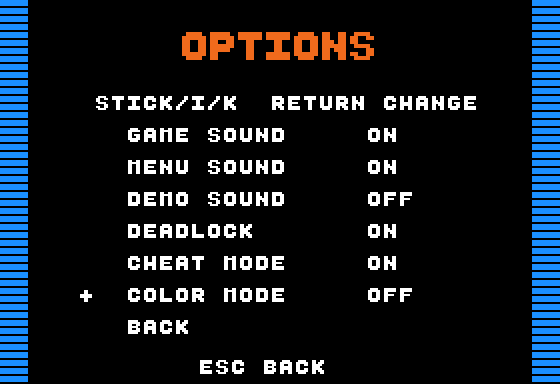
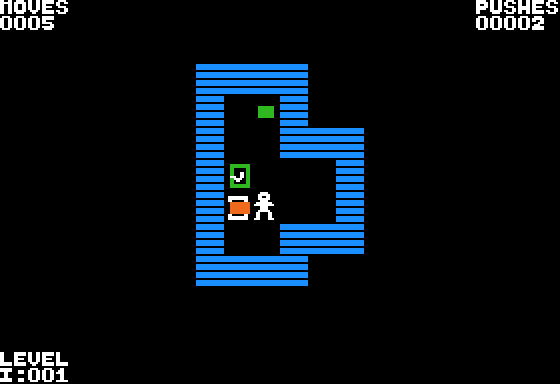
- COLOR MODE: a new switch in OPTIONS gives crates on goals their filled green body back. It is off by default: on a monochrome display orange and green look the same, and the hollow frame with a check mark remains the readable choice there.
- Steadier title: the corridor animation now steps between two beats of the music instead of delaying a note.
Saved games, records, profiles and options from 1.1 disks keep working: the new switch uses a spare bit of the options byte.
Screenshots
| OPTIONS with COLOR MODE | A crate on its goal in COLOR MODE |
|---|---|
 |
 |
How the two voices work
The Apple II speaker has one bit. The player looks at the bass, then at the melody, 31,000 times a second: while both square waves are at the same level the speaker rests there, and while they differ it flips at every look. That carrier is too fast to hear; what remains is the sum of the two waves. Every path through the loop takes the same 33 cycles, so pitches are whole counts of turns, and the tune is written in the just scale of F, whose periods are whole.
Playing
Use I/J/K/L, W/A/S/D, the arrow keys, or a joystick to move. U undoes, Y redoes, R restarts the level, ESC opens the menu, and H opens help. The menu provides the tutorial, profiles, restart, level selection, options, the Hall of Fame, and exit to DOS; everything on screen is in English.
The game keeps ten independent player profiles, saved puzzle positions and records, and a 1,024-move Undo/Redo history during play. The collections are unchanged: 150, 122, 92 and 90 puzzles from David W. Skinner's Microban I–IV, with their original numbers.
Validation and credits
The release disk was rebuilt from a clean tree and compared byte-for-byte with the committed image. Automated emulator tests cover all 454 puzzles, the five tutorial lessons, solution playback, video-page restoration, menu navigation, saved positions, profiles, ranking, write-protected media, and return to BASIC. New in this version: the tests listen to the title music (both voices at their pitch and level, ten steady bars, a key cutting a note) and check the colour-mode tile on screen and its option across a reboot. These checks validate emulated Apple II execution; the two-voice music has not yet been heard on real hardware.
Puzzle collections: David W. Skinner, distributed with credit. Apple II adaptation: VERHILLE Arnaud. Source code is available under GPL-3.0. The full manual in the repository is in French.
ChromaBreak 1.0
ChromaBreak 1.0 — Apple //e and //c
ChromaBreak is a free, open-source brick-breaker in double hi-res for the enhanced Apple //e (128 KB) and the Apple //c. Download CHROMABREAK.po, mount it as a 5¼-inch disk and boot it: it starts ProDOS and the game. A 65C02 is required.
Features
- Double hi-res in 16 colours, 30 frames per second (25 on PAL machines)
- Sixty boards, with tiles that take one, two or three hits, and steel
- Six bonus capsules: Enlarge, Slow, Catch, Disrupt, Laser and Pierce
- Enemies, combos up to ×8, extra lives
- Mouse, keyboard, joystick or paddles; the paddle also moves up and down
- Two-voice music on the built-in speaker
- Three difficulty levels, high scores and progress saved on the disk
- A help page in the game: press
?on the title
Screenshots
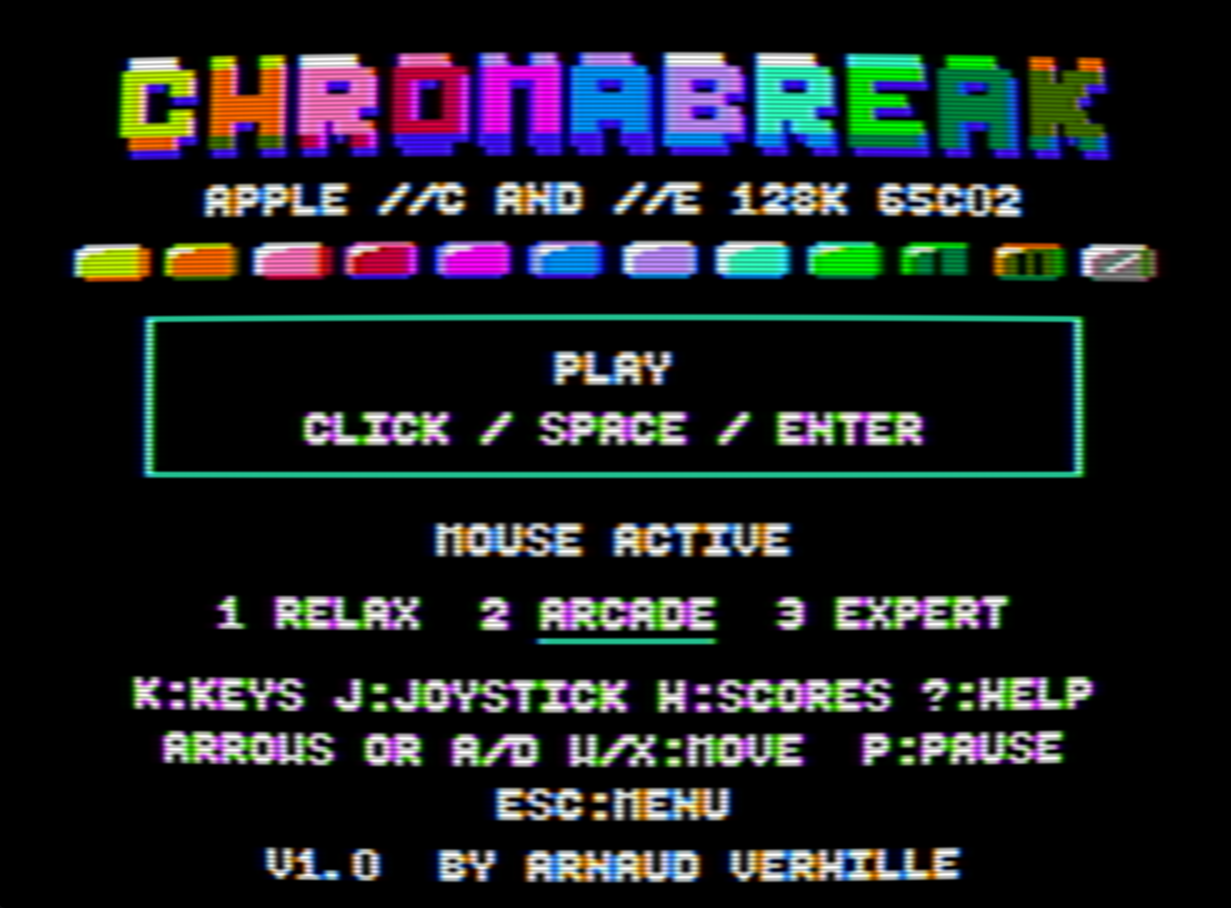
| Sector 1 | Sector 2 |
|---|---|
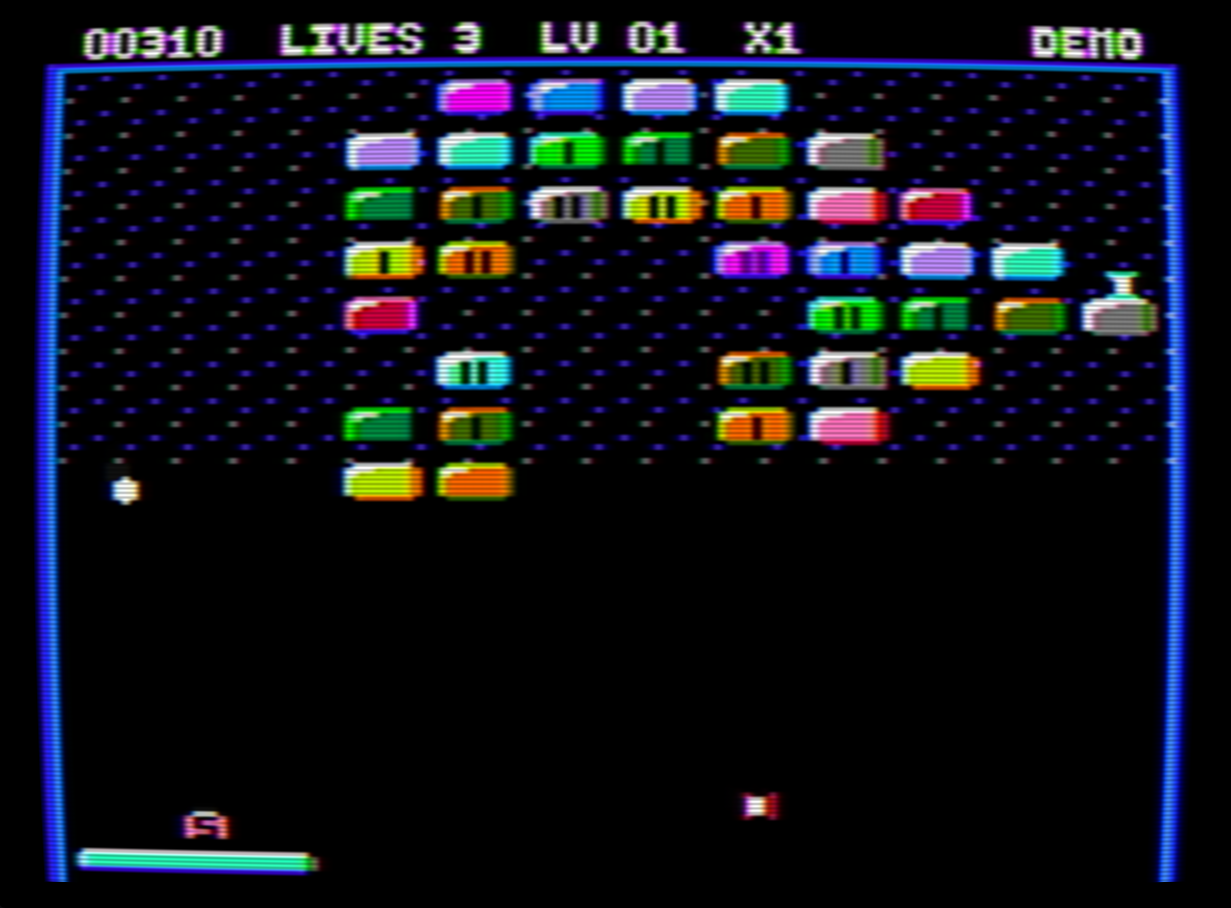 |
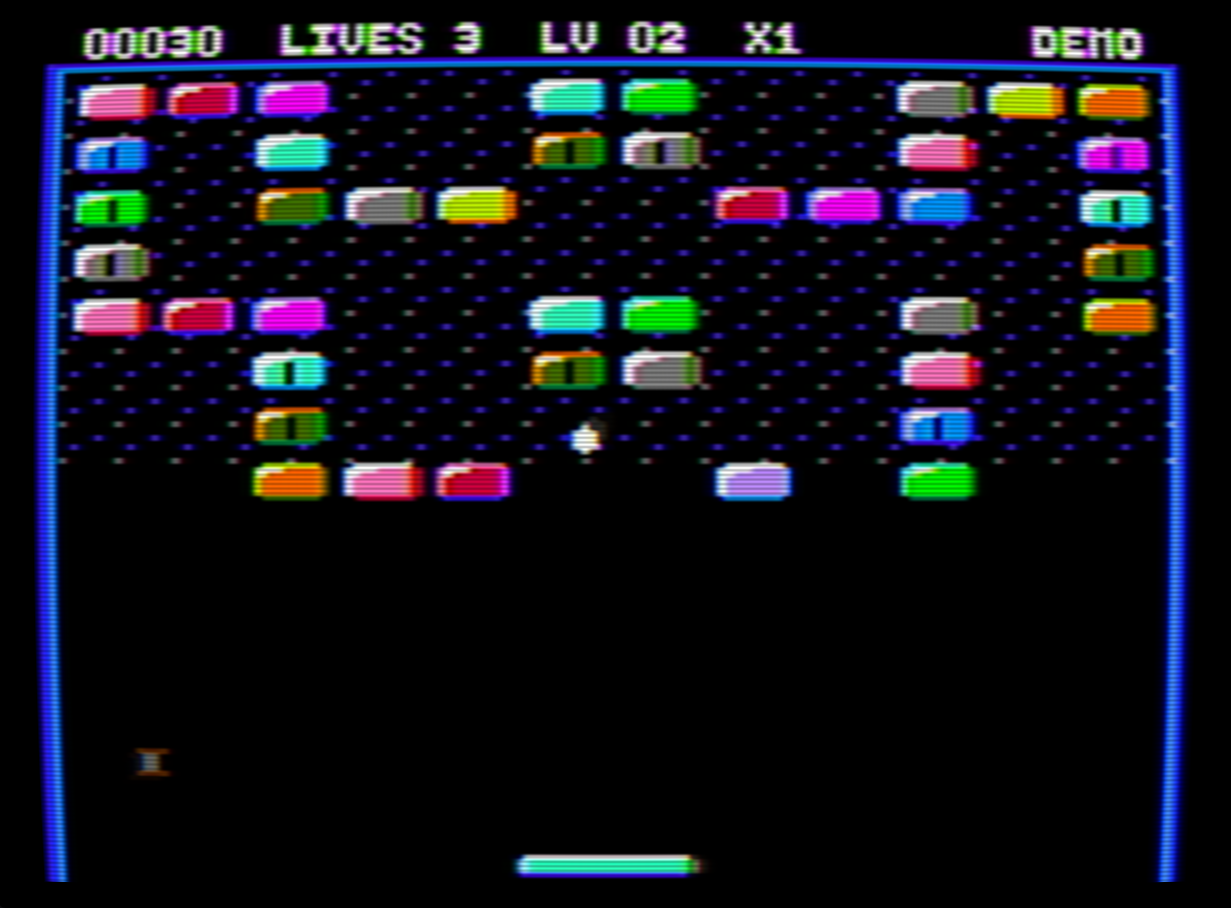 |
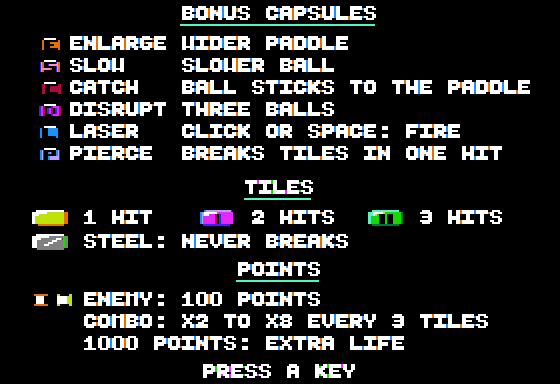
Status and credits
The game has been tested in emulation only, with the real //e and //c ROMs. Reports from real hardware are welcome.
Code and boards: VERHILLE Arnaud. Beautiful Boot font: Michael Pohoreski. Source code under GPL-3.0.
MICRO-SOKOBAN 1.1
MICRO-SOKOBAN 1.1 — Apple II+
MICRO-SOKOBAN 1.1 is a bootable DOS 3.3 disk image for the Apple II+ with 48 KB RAM and later Apple II models. Download MICRO-SOKOBAN.dsk, mount it as a 5¼-inch disk, and boot it. The disk contains all 454 Microban I–IV puzzles and the five introductory lessons; no installation is needed.
What's new since 1.0
- Title music: a quiet, swung melody played through the built-in speaker. MENU SOUND controls it; the automatic Hall of Fame and demonstration stay silent by default.
- Solution playback: enable CHEAT MODE in OPTIONS to reveal SOLUTION in the menu. It plays the current puzzle's solution, then restores your position without recording a result. Playback can be interrupted.
- Monochrome readability: crates on goals now have a hollow green frame and a white check mark. All seven gameplay tiles have different silhouettes even without colour.
- Title presentation: centred “APPLE II PORT BY” / “VERHILLE ARNAUD” credits, white profile and V1.1 labels on black panels, and a slower corridor animation. The animation finishes with the crate on its goal before the ten-second Hall of Fame presentation.
- Navigation and resume fixes: canceling level selection from the title returns to the title; RESUME retains the saved position; RESTART from the title starts the level with zero counters.
- Display and exit fixes: menus and solution playback restore the correct board and video page. QUIT TO DOS and Ctrl-RESET restore the BASIC launcher, so LIST and RUN work again.
Screenshots
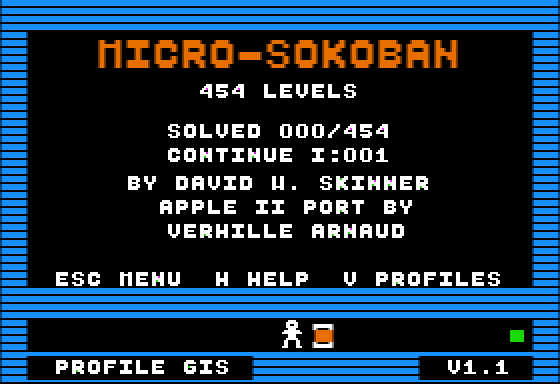
| Microban I, level 30 | Microban I, level 39 |
|---|---|
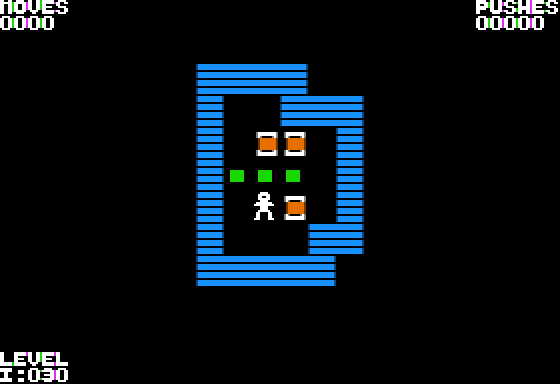 |
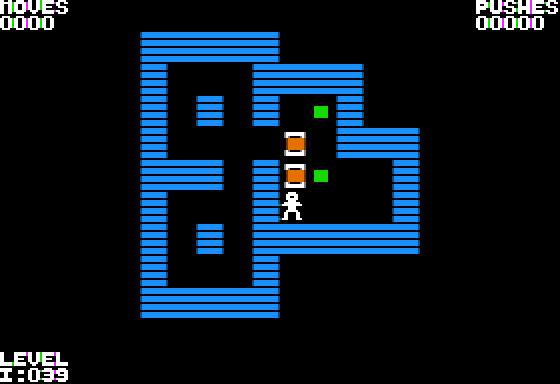 |
Playing
Use I/J/K/L, W/A/S/D, the arrow keys, or a joystick to move. U undoes, Y redoes, ESC opens the menu, and H opens help. The menu provides profiles, restart, level selection, options, the Hall of Fame, and exit to DOS.
The game retains ten independent player profiles, saved puzzle positions and records, and a 1,024-move Undo/Redo history during play. After reboot, the saved board and counters return with a fresh history. Puzzle collections remain unchanged: 150, 122, 92 and 90 puzzles from David W. Skinner's Microban I–IV, keeping their original collection and puzzle numbers.
Validation and credits
The release disk was rebuilt and compared byte-for-byte with the committed image. Automated emulator tests cover all 454 puzzles, the five tutorial lessons, solution playback, title music, video-page restoration, menu navigation, saved positions, profiles, ranking, write-protected media, and return to BASIC. These checks validate emulated Apple II execution; they do not replace testing on real hardware.
Puzzle collections: David W. Skinner, distributed with credit. Apple II adaptation: VERHILLE Arnaud. Source code is available under GPL-3.0. Full instructions.
MICRO-SOKOBAN 1.0
MICRO-SOKOBAN 1.0 — Apple II+
The first release of MICRO-SOKOBAN is a bootable DOS 3.3 disk image for the Apple II+ with 48 KB RAM and later Apple II models. Download MICRO-SOKOBAN.dsk from this release, mount it as a 5¼-inch disk, and boot it. The image includes the game and its level collections; no installation is needed.
Screenshots
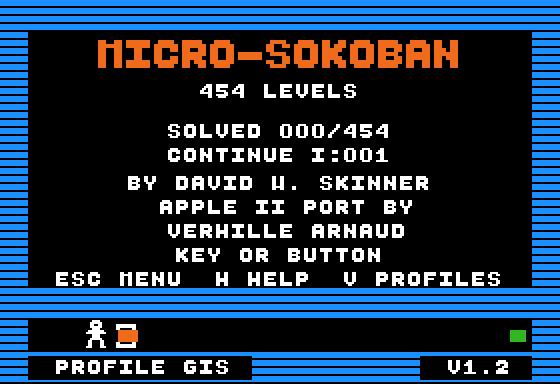
The title screen shows your progress and the level to resume. The two puzzles below show how the board, crates, goals, and move counters look in play.
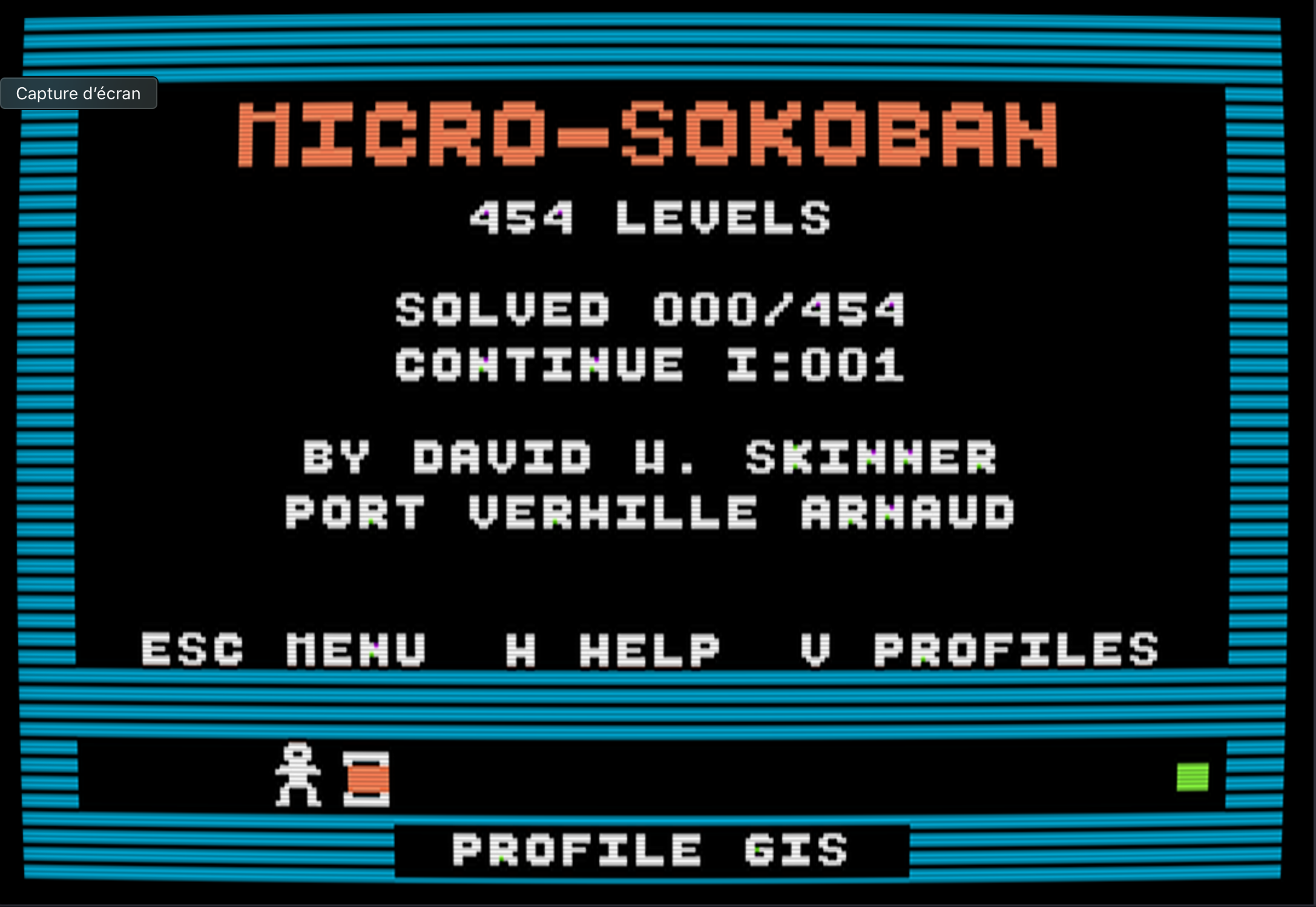
| Microban I, level 30 | Microban I, level 39 |
|---|---|
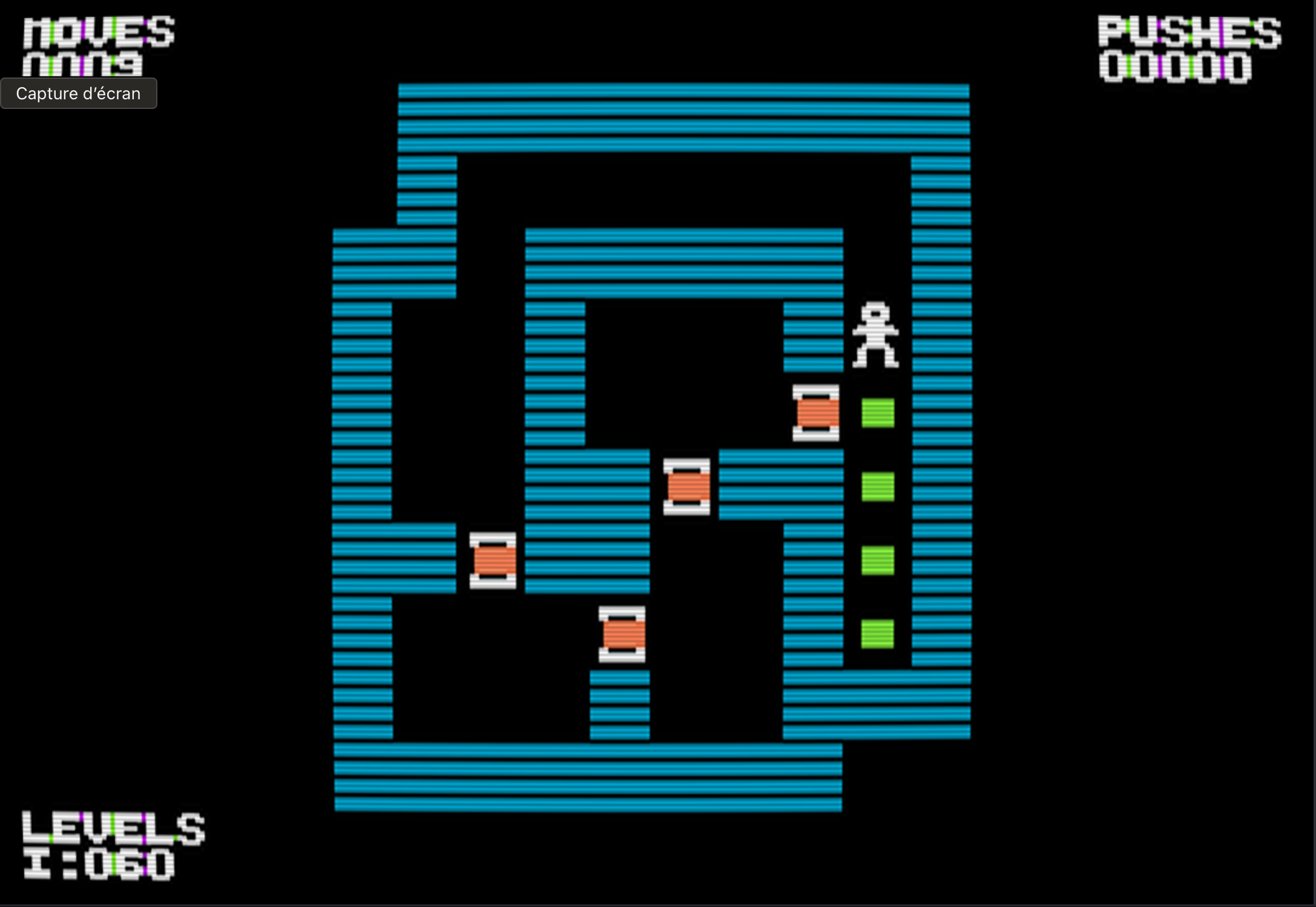 |
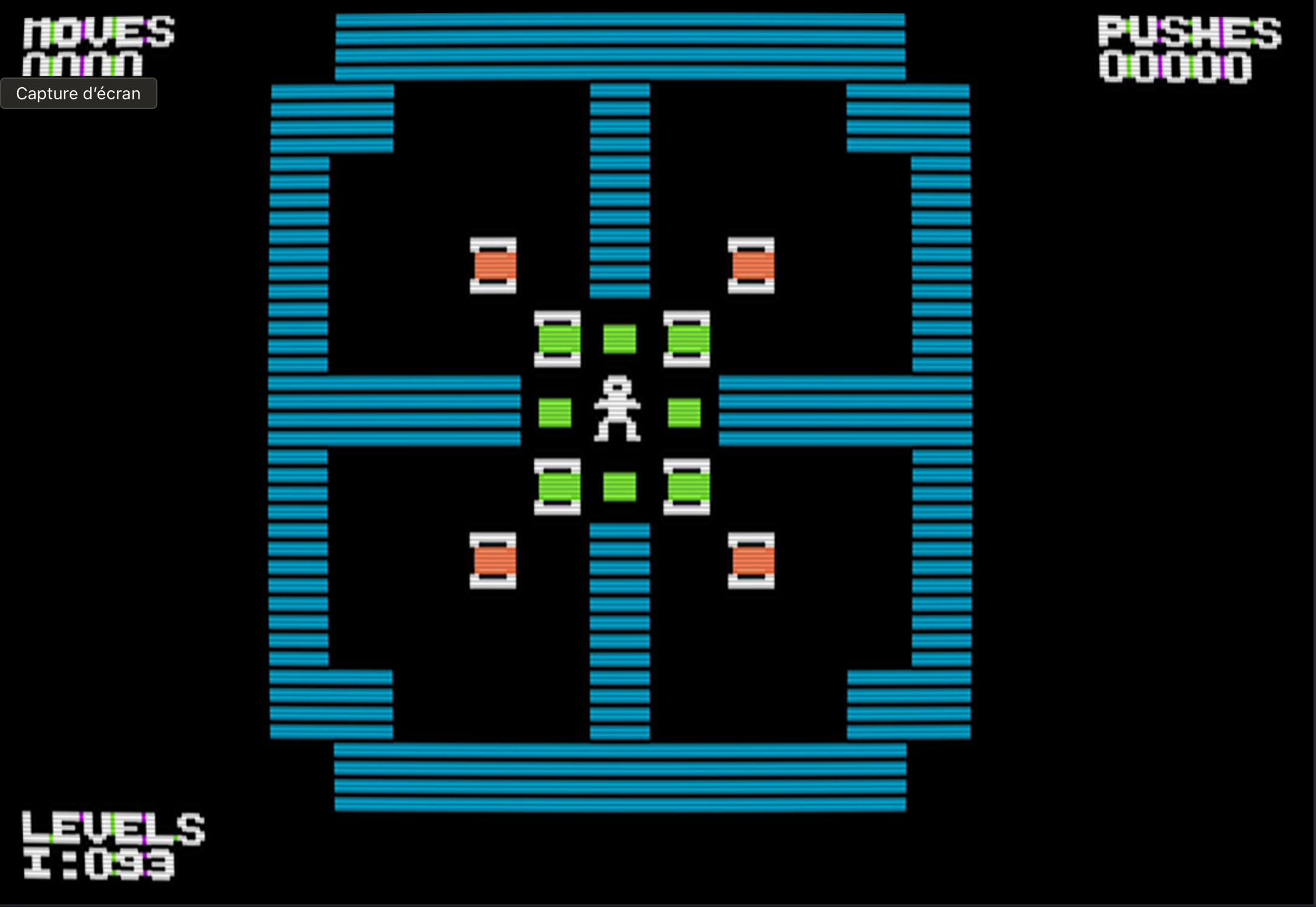 |
The game contains 454 puzzles from David W. Skinner's Microban I–IV collections: 150, 122, 92, and 90 puzzles respectively. Puzzles that fit when rotated are rotated; puzzles that cannot fit the 20 × 12 playfield or clear its HUD corners are omitted. Original collection and puzzle numbers remain visible in the game.
- Colour hi-res graphics, keyboard and joystick controls, and five introductory puzzles.
- Undo and redo with a 1,024-move history, restart, and direct level selection.
- Ten independent player profiles, saved records, and saved puzzle positions. A changed position is saved when opening the menu or after about six seconds without input.
- A Hall of Fame ranked by puzzles solved, then by the fewest moves in each player's best results. The HUD shows both moves and pushes.
- Optional sound and dead-square warnings, plus an automatic demonstration.
Use I/J/K/L, W/A/S/D, the arrow keys, or a joystick to move. Press U to undo, Y to redo, ESC or joystick button 1 to save the current position and open the menu, and H for help. An Undo/Redo history remains available during a session; after a reboot, the saved board and counters return with a fresh history.
All 454 included puzzles and the five tutorial puzzles were played through in automated tests on an Apple II emulator. Profile isolation, saving and rebooting, write-protected disks, and the menu were also checked. Real-hardware feedback is welcome.
Puzzle collections: David W. Skinner, distributed with credit. Apple II adaptation: Arnaud Verhille, based on the POM1 Apple-1/GEN2 Sokoban sketch. Source code is available under the repository's GPL-3.0 licence.