Datasheet-verified electronic component pinouts, specs, and ASCII diagrams in your terminal, offline.
partinfo is an offline command-line reference for electronic parts and connectors: pinouts, key specs, typical applications, and the gotchas that catch you in practice. Every entry is a hand-curated JSON file checked against a datasheet, indexed into SQLite with full-text search. 228 parts, 25 connectors, and a library of formula references ship in the package; no network needed.
Structured --json on every lookup, plus a bundled skill (below), so Claude Code or Codex query partinfo for a verified number instead of guessing a pinout (or a thermal resistance) from memory.
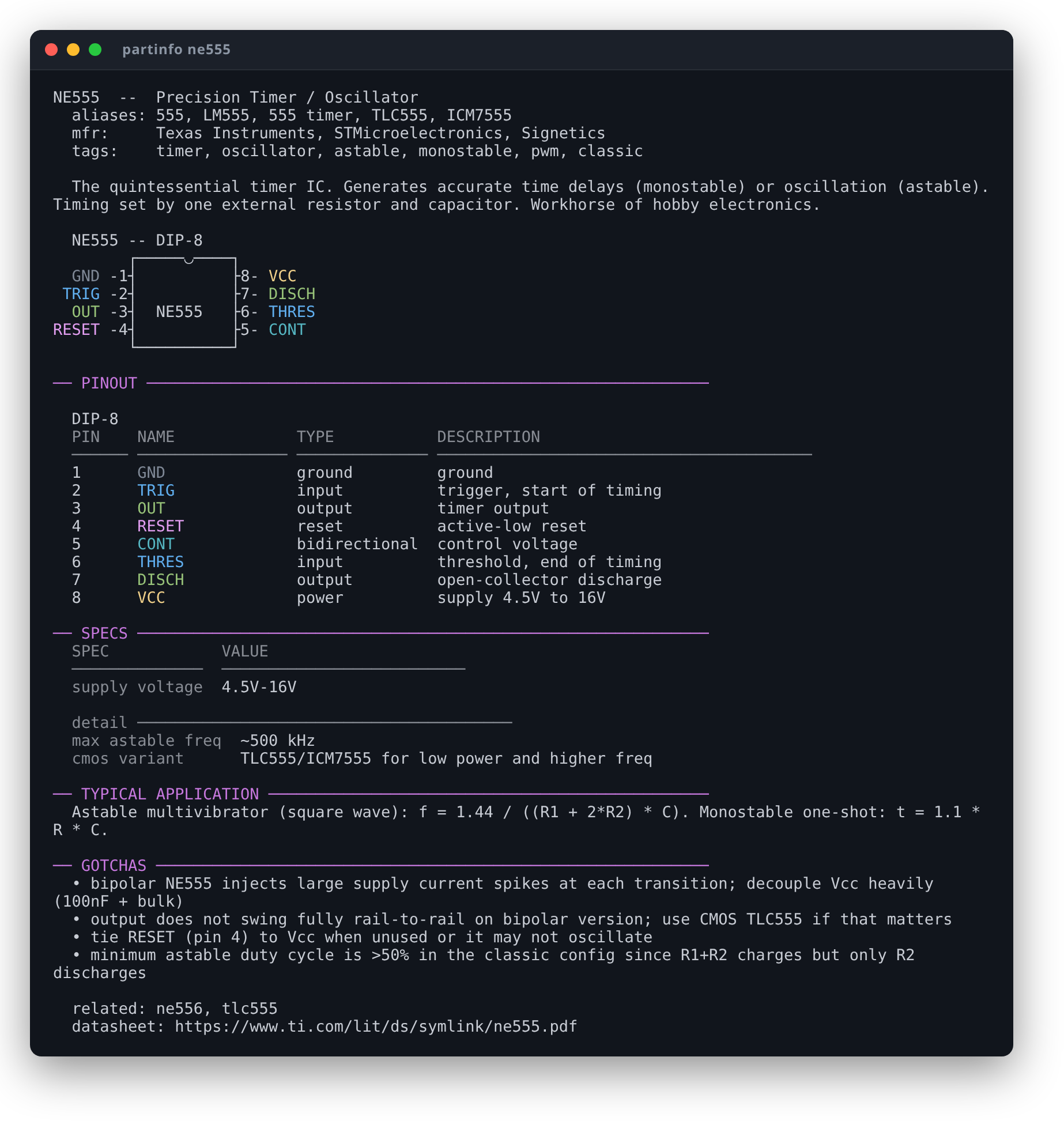
Datasheets are slow to open and pin-numbering traps are easy to forget: the BC547 is C-B-E, the 2N3904 is E-B-C; the LM317 tab is the output but the 7805 tab is ground. partinfo answers those in one command, with the package drawn in ASCII so you can wire it without opening a PDF.
pip install partinfopartinfo ne555 # full entry
partinfo irlz44n --ascii # ASCII package diagram
partinfo lm317 --specs # key specs only
partinfo search "can transceiver"
# connectors & cables
partinfo conn obd-ii # OBD-II / DB9 / USB-C / eurorack power / MIDI ...
partinfo conn gallery # every connector diagram
# formula references
partinfo ref list # ohms-law, rc-time-constant, mosfet-parameters, ne555-formulas ...
partinfo ref mosfet-parameters # formulas with a variable legend
partinfo gallery # every part diagram, to scroll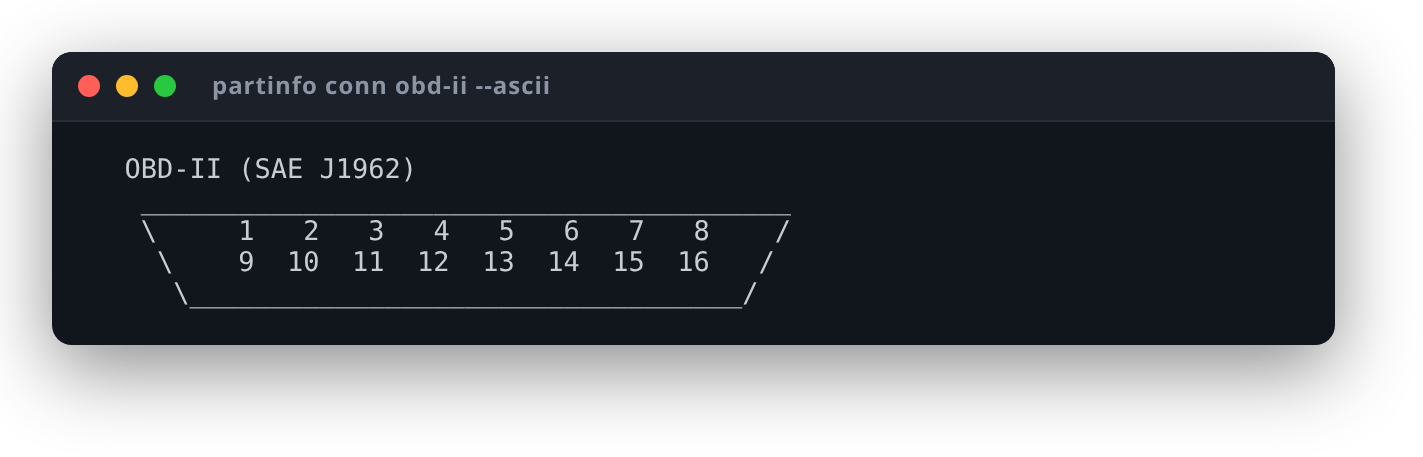
Pins are colored by function on a real terminal and drop to plain when piped or read by a script or model. Override with --color {auto,semantic,minimal,mixed,off} or NO_COLOR=1.
partinfo ships a skill so an agent reaches for its verified data instead of recalling a pinout from training. After installing:
partinfo skill install # copies the skill into ~/.claude/skills and/or ~/.codex/skills (asks first)A fresh session, asked "show me the IRF520 pinout and whether it survives 3 A in still air," then runs partinfo for the diagram and the real thermal numbers and does the math, instead of guessing.
The ASCII pinout is generated from the same pin table as the specs, so the picture and the data stay in sync. Supply a pre-rendered ascii string on a package only to override.
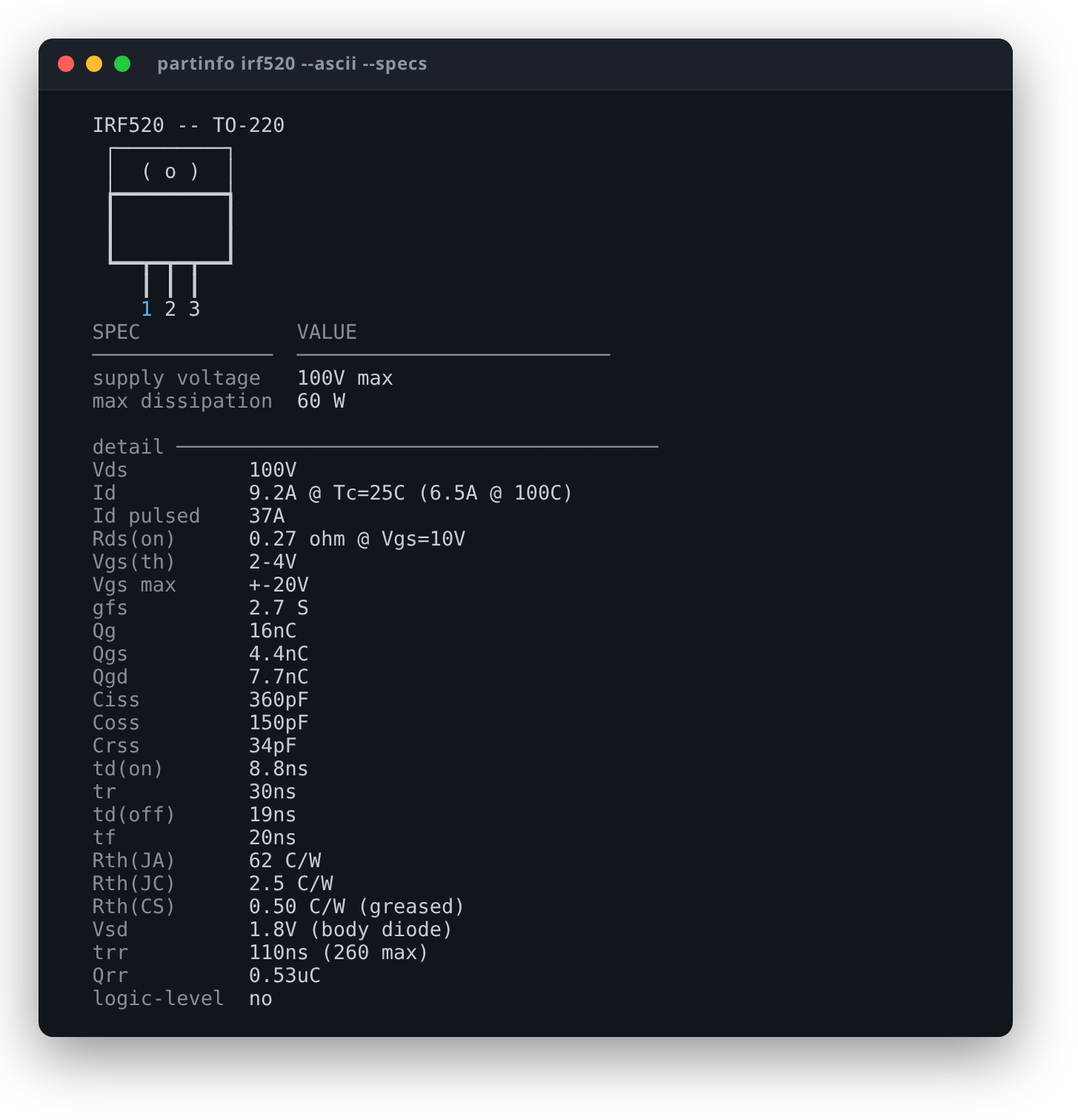
Each part stores its calculation inputs (rds_on_ohm, rth_ja_cw, ...) and the reference library stores the formulas, so a question gets answered from verified numbers. For "is an IRF520 safe switching 3 A in still air?", partinfo supplies Rds(on) = 0.27 Ω and Rth(JA) = 62 °C/W; applying P = I²·R and Tj = Ta + P·Rth(JA) gives Tj ≈ 176 °C, over the limit. The 9 A on the datasheet front page is a rating that needs a heatsink, and one formula shows it. --json hands the field names straight to a formula's variables.
Each part is one JSON file validated by a Pydantic schema: packages (pins with number, name, type, description), specs, gotchas, related, datasheet_url. Connectors and references use the same approach, so every entry is structurally identical and diagrams render from the pin data. Add a part by dropping a JSON file in its category folder and running partinfo ingest.
The JSON ships inside the package; the SQLite index is a derived cache at ~/.local/share/partinfo/parts.db, built on first use.
MIT