


TOON (Token-Oriented Object Notation) codec for Ruby, versioned by the spec it implements: the gem's MAJOR.MINOR is the TOON spec version it speaks.
TOON is a compact, readable encoding of the JSON data model for LLM prompts: indentation instead of braces, quotes only where needed, and tables for arrays of uniform objects. toon-fu is written from the specification and runs the spec's reference fixtures as its conformance suite — every encode and decode fixture of the spec version it implements passes.
Every Ruby TOON gem on RubyGems was published in late 2025 and stopped at spec 1.2, three major versions behind. They leave strings starting with # or + unquoted, which a current reader takes for a comment or a number, and shift dates by a day east of Greenwich. toon-fu tracks the spec: its version is the spec version, and a daily check flags a newer spec.
Yes, we know:
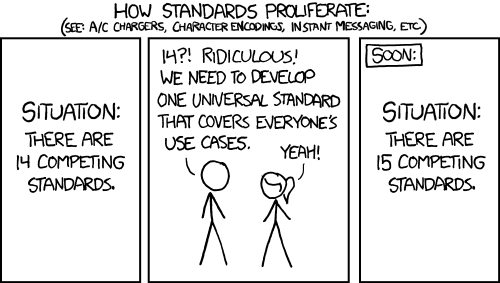
xkcd #927 "Standards" by Randall Munroe, CC BY-NC 2.5.
Add it to your Gemfile:
gem "toon-fu"In a plain script: gem install toon-fu and require "toon_fu". To pin the spec version, see Versioning.
ToonFu.encode({users: [{id: 1, name: "Ada", role: "admin"}, {id: 2, name: "Bob", role: "user"}]})users[2]{id,name,role}:
1,Ada,admin
2,Bob,user
Arrays of uniform objects become tables that declare their fields once. Everything else reads like YAML:
{order: {id: 7, tags: ["new", "paid"], customer: {name: "Ada"}}}.to_toonorder:
id: 7
tags[2]: new,paid
customer:
name: Ada
to_toon is available on Hash, Array, String, Symbol, Integer, Float, true, false, nil, Set, Time and Date once toon_fu is loaded.
delimiter:—","(default),"\t"or"|". Tab usually costs the fewest tokens.indent_size:— spaces per nesting level, default2.
ToonFu.encode(data, delimiter: "\t")
encoder = ToonFu::Encoder.new(delimiter: "|") # reuse for many documents
encoder.encode(data)Define as_toon to return plain data; it wins over every built-in mapping:
Money = Struct.new(:cents, :currency) do
  include ToonFu::Encodable # optional: adds #to_toon

  def as_toon = {amount: cents / 100.0, currency:}
end

ToonFu.encode({price: Money.new(1999, "EUR")})
# price:
#   amount: 19.99
#   currency: EUR
Any other value raises ToonFu::Error:
ToonFu.encode({at: Object.new})
# ToonFu::Error: cannot encode Object; convert it first or define #as_toon
For ActiveRecord models, pass record.as_json (or define as_toon).
| Ruby value | TOON |
|---|---|
Hash with String, Symbol or Integer keys |
object; keys become strings, keys that collide raise |
Array, Set |
array: inline, table, or list form |
String |
string, quoted only when needed; other encodings are transcoded to UTF-8, invalid UTF-8 raises |
Symbol |
its name |
Integer |
its exact digits, any size |
Float, BigDecimal |
canonical number; NaN and infinities become null |
true, false, nil |
true, false, null |
Date |
2026-05-31 |
Time, DateTime |
ISO 8601 with its offset: 2026-05-31T10:00:05.25Z |
objects with to_hash, to_ary, to_str |
the value they convert to |
objects with as_toon |
whatever as_toon returns, encoded in turn |
Everything else raises ToonFu::Error — including a Struct or Data without as_toon, circular references, and nesting too deep for the stack.
ToonFu.decode("users[2]{id,name}:\n  1,Ada\n  2,Bob")
# => {"users" => [{"id" => 1, "name" => "Ada"}, {"id" => 2, "name" => "Bob"}]}
You get back plain Ruby: Hash with String keys, Array, String, Integer, Float, true, false, nil.
Quoting decides the type, and an unquoted token is a number only if the spec says it is one:
ToonFu.decode("a: 42")      # => {"a" => 42}
ToonFu.decode('a: "42"')    # => {"a" => "42"}
ToonFu.decode("a: 05")      # => {"a" => "05"}
ToonFu.decode("a: +1")      # => {"a" => "+1"}
Malformed input raises ToonFu::Error:
ToonFu.decode("tags[3]: a,b")
# ToonFu::Error: cannot decode 2 values where the header declares 3strict:—true(default) checks what the spec requires: declared lengths, row widths, duplicate keys, indentation. Passfalseto read a document that bends those rules — a declared length is ignored, a duplicate key takes its last value.indent_size:— spaces per nesting level, default2.
ToonFu.decode(text, strict: false)
decoder = ToonFu::Decoder.new(indent_size: 4) # reuse for many documents
decoder.decode(text)The gem installs a toon executable that encodes JSON on stdin — handy for reading a command's output in fewer tokens:
$ gh api repos/ruby/ruby/pulls --jq '.[0] | {number, title}' | toon
number: 13579
title: Fix a typo
Input it cannot encode is passed through unchanged, so putting it at the end of a pipe never costs you the output:
$ git log --oneline -1 | toon
b08ea2d feat: ship a toon executableThe only one that passes every spec fixture: toon-fu passes all 179 encode and all 359 decode fixtures. The table compares encoding — the 154 encode fixtures that use default options, which every gem can run; none of the others reads TOON back.
| Gem | Spec fixtures passed | Speed vs toon-fu |
|---|---|---|
| toon-fu | 154 / 154 | 1.00× |
| sorbet-toon 0.1.0 | 119 / 154 | 0.59× |
| toon-ruby 0.1.1 | 117 / 154 | 0.62× |
| toon_my_json 0.1.0 | 57 / 154 | 1.68× |
| toon-format 0.1.2 | 45 / 154 | 1.18× |
The Ruby TOON encoders with more than 10,000 downloads, measured by benchmark/run.rb on Ruby 3.4.10 (2026-09-24). Spec fixtures are the spec's own encode fixtures that use default options. Speed is the geometric mean of encodes per second over five workloads — tables of 100 and 1000 rows, nested objects, a list of mixed objects, strings needing quotes — relative to toon-fu.
What falls through the gaps:
- sorbet-toon, toon-ruby —
#tagand+1go out unquoted, so a current reader sees a comment and a number; arrays of objects with nested columns lose their table form; no keyed tables. Unknown objects slip through instead of raising: toon-ruby writesnull, sorbet-toon"#<Foo:0x…>". toon-ruby also moves aDatea day back east of Greenwich. - toon_my_json, toon-format — output a TOON reader cannot read: the table header on its own line, a
[2,]length, rows at the wrong depth, nested objects in cells as broken text; toon_my_json also writesfalseasnull. They do less work, and it shows in both columns.
Rerun it:
BUNDLE_GEMFILE=benchmark/Gemfile bundle install
BUNDLE_GEMFILE=benchmark/Gemfile bundle exec ruby benchmark/run.rb
To see where toon-fu itself spends time and allocates, profile one workload (CPU by stackprof, allocation sites by memory_profiler):
BUNDLE_GEMFILE=benchmark/Gemfile bundle exec ruby benchmark/profile.rb "table, 1000 rows"The gem version tracks the TOON specification it implements:
MAJOR.MINORis the spec version:X.Y.Zspeaks TOONX.Y.PATCHis the gem's own: fixes and improvements within the same dialect.
This release speaks toon-spec: 4.1.
Pin the spec line with gem "toon-fu", "~> X.Y.0": it takes our fixes and keeps you on the dialect you speak. The gem badge above shows the current release; the spec-drift badge turns red when a newer spec is released and toon-fu has not caught up yet.
Release notes: GitHub releases.
git clone --recurse-submodules git@github.com:hoblin/toon-fu.git
cd toon-fu
bundle install
bundle exec rspec        # unit specs + the spec's conformance fixtures
bundle exec standardrb   # lint
The TOON spec is a git submodule at spec/toon-spec, pinned to its release tag; the fixtures run from there.
- Bump
lib/toon_fu/version.rbin a pull request and merge it. git tag vX.Y.Z && git push origin vX.Y.Zonmain.- Approve the
releasedeployment in Actions.
The release workflow checks the tag matches the version, runs CI, and publishes to RubyGems via trusted publishing.
MIT