A full-stack autonomous vehicle perception pipeline: LiDAR + camera sensor fusion, 3D Kalman filter tracking, quantitative evaluation (HOTA / CLEAR-MOT), and interactive dual-modality visualization — built from first principles on the KITTI tracking benchmark, with a nuScenes adapter.
KITTI / nuScenes Sequence (dataset adapter → Frame)
      │
      ├─ LiDAR point cloud   ──►  Detection Source  ──►  Canonical boxes [x,y,z,l,w,h,yaw]
      │                           (live PV-RCNN /                    │
      ├─ Camera image              pre-computed / GT)                │
      └─ Calibration + Ego pose                                      ▼
                                                          3D SORT Tracker
                                            (Kalman + Hungarian, class-gated)
                                                                     │
                                ┌──────────────────┬─────────────────┤
                                │                  │                 │
                                ▼                  ▼                 ▼
                       Rerun Visualization   MP4 Video Export    Evaluation
                     (camera + LiDAR 3D)   (camera + LiDAR)   (HOTA + CLEAR-MOT)
Key numbers on KITTI sequence 0008 (390 frames):
- HOTA 0.633 / MOTA 0.553 with pre-computed PV-RCNN detections (see Evaluation)
- Tracker runs at ~1,500 fps (Kalman + Hungarian step only)
- PV-RCNN live inference: ~8 fps on RTX 5080
- Pre-computed detections: full sequence processes in < 1 second
The pipeline produces two outputs:
showcase.mp4 — Stacked dual-panel video: camera RGB with 3D bounding box overlays (top) and LiDAR returns projected through the identical camera matrix, coloured by depth (bottom).
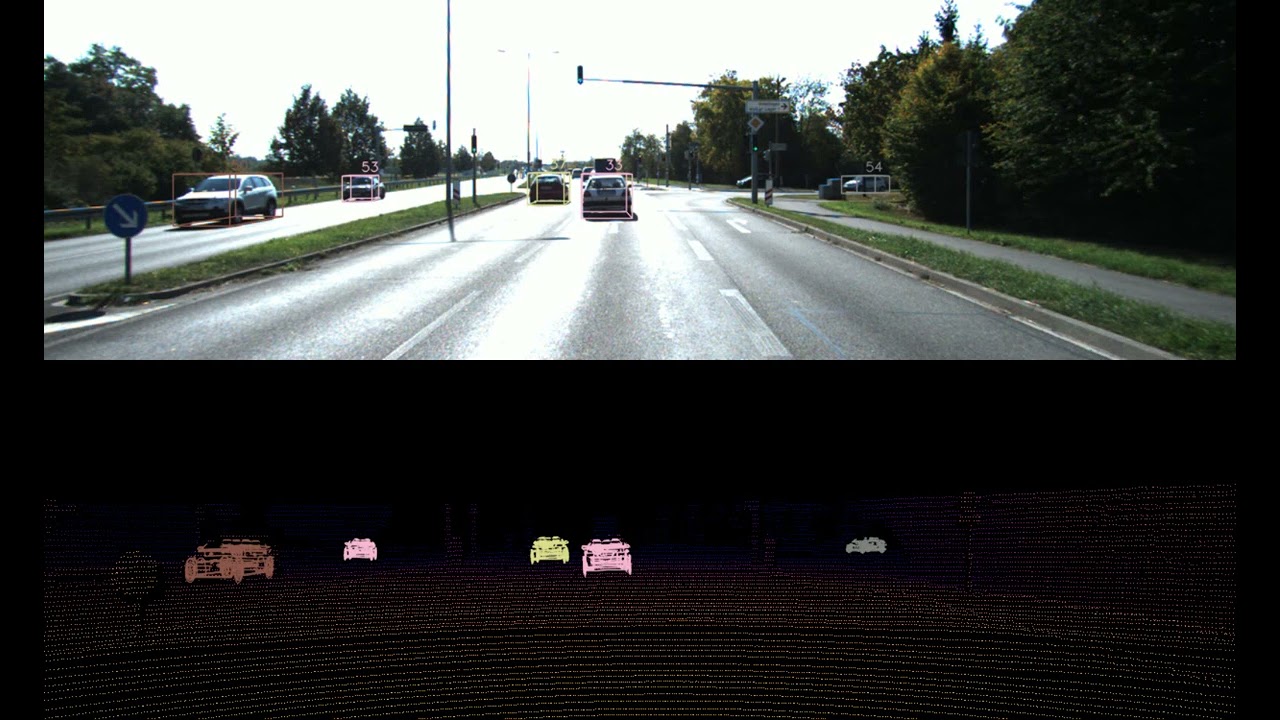
tracking.rrd — Interactive Rerun viewer: scrub through frames, orbit the 3D scene, inspect individual tracks.
Both outputs colour tracks by ID (tab20 colourmap) and keep IDs stable across frame gaps.
A 3D extension of the SORT algorithm operating in LiDAR space.
Kalman filter state (10-D):
[x, y, z, l, w, h, yaw, vx, vy, vz]
Constant-velocity motion model; box dimensions and yaw modelled as constant between frames.
Association:
- Cost matrix uses Mahalanobis distance (not 3D IoU) — naturally gates uncertain tracks more loosely and confident tracks more tightly via the per-track innovation covariance
S = H P Hᵀ + R - Hungarian algorithm (
scipy.optimize.linear_sum_assignment) solves the assignment problem optimally in O(n³) - Yaw differences wrapped to
[−π, π]before computing distance to handle the 180° ambiguity
Track lifecycle:
min_hits = 2consecutive detections to confirm a trackmax_missed = 3consecutive misses before pruning- Persistent confirmation (
_confirmed_idsset): once confirmed, a track stays visible through missed frames — critical for large vehicles that intermittently fall below detection threshold - Class-gated association: detections only match tracks from the same class group ({Car, Van, Truck} / {Pedestrian} / {Cyclist}) — vehicles share a group because detectors flip labels on the same object
Camera frame:  x = right,   y = down,  z = forward  (RIGHT_HAND_Y_DOWN)
LiDAR frame:   x = forward, y = left,  z = up        (RIGHT_HAND_Z_UP)
World frame:   ego-vehicle pose applied to LiDAR frame
- One canonical box format —
[x, y, z_center, l, w, h, yaw]in the LiDAR frame (perception/boxes.py) — used everywhere; dataset adapters convert at the boundary - KITTI calibration chain:
Velodyne → R0_rect → P2; label boxes lifted from the bottom-face convention (z_centre = z_bottom + h/2,yaw = −ry − π/2) - nuScenes chain:
LiDAR → ego(t_lidar) → global → ego(t_cam) → camera, honouring the timestamp offset between sensors; global-frame annotations converted to LiDAR-frame canonical boxes - Ego-vehicle pose integrated every frame so box centres are tracked in a consistent world frame, eliminating drift from vehicle motion
Rerun: Per-track 3D car mesh (.obj) scaled per-axis to match detector output — car.obj native size 8.95 × 3.71 × 2.97 m mapped to each detected box. Points inside confirmed track volumes masked out so meshes are not buried by their own returns.
MP4: LiDAR depth panel computed by projecting every point through V2C → P2 (the same matrices used for the camera), so detections align pixel-for-pixel across both panels. OBJ wireframes rendered using crease-edge filtering (dihedral > 50°, retaining ~1,236 of 8,174 edges) for clean car outlines without triangle noise. Playback runs in real time regardless of capture rate: low-rate captures (nuScenes 2 Hz keyframes) duplicate the camera/LiDAR pixels across subframes while box and mesh poses are interpolated per track — ego-motion compensated, shortest-arc yaw — so track motion stays smooth.
Four pre-computed detector outputs are included for sequence 0008 (tracked in git, so plain python main.py works after the KITTI download — no GPU needed). Scores are raw logits — scale varies per model; adjust score_threshold when switching. export_detections.py regenerates files like these via live inference (GPU; note it emits sigmoid scores, not logits).
| Detector | KITTI Car AP (moderate) | Avg dets/frame at threshold | Empty frames | Notes |
|---|---|---|---|---|
CasA (casa/) |
~86% | 3.1 @ threshold −1.0 | 33 | Best accuracy; requires lower threshold due to score scale |
PV-RCNN (pvrcnn/) |
~84% | 2.5 @ threshold 0.5 | 46 | Current default — strong balance of precision and recall |
SECOND-IoU (second_iou/) |
~80% | 1.8 @ threshold 0.5 | 96 | Fewest detections; worst frame coverage |
PointRCNN (point_rcnn/) |
~76% | 3.4 @ threshold 0.5 | 21 | Densest pre-computed coverage but lowest accuracy |
Why PointRCNN is not used for live inference: PointRCNN generates proposals from foreground-point segmentation (PointNet++). When segmentation is uncertain — sparse returns from distant vehicles, partial occlusions — no foreground points means no proposals. PV-RCNN voxelizes first, giving spatially uniform feature coverage regardless of local point density.
- Python 3.10, Conda
- A GPU is only needed for live inference (
--live,export_detections.py): any CUDA 11.8+ card from Pascal (GTX 10-series) up — tested on an RTX 5080 (sm_120). The default pre-computed-detection path, the nuScenes demo, evaluation, and the visualizations all run on CPU.
conda create -n 4D python=3.10 -y
conda activate 4DCPU-only (pre-computed detections, nuScenes, evaluation, tests):
pip install -r requirements.txtWith live inference — install.sh detects your CUDA toolkit and GPU, installs
matching PyTorch/spconv builds, clones OpenPCDet at the tested commit, applies the
compatibility patch, and builds the CUDA extensions:
bash install.shGPU compatibility: PyTorch's cu128 wheels only ship kernels for Turing (sm_75) and newer —
install.shdetects pre-Turing cards (e.g. GTX 1080, sm_61) and falls back to cu126 wheels automatically. Avoid CUDA 13 toolkits on Pascal; support was removed entirely. RTX 5080 / Blackwell: sm_120 needs nvcc + cicc 12.8 on PATH (see the note ininstall.shfor the conda symlinks).
PV-RCNN checkpoint from the OpenPCDet model zoo:
mkdir -p models/PVRCNN
# Download pv_rcnn_8369.pth to models/PVRCNN/From the KITTI tracking benchmark, download:
- Left color images
- Velodyne point clouds
- Camera calibration files
- Ego vehicle poses
- Training labels (ground truth, for evaluation)
Place under multi_object_tracking/data/ with the structure:
multi_object_tracking/data/
  velodyne/0008/000000.bin ...
  image_02/0008/000000.png ...
  calib/0008.txt
  pose/0008/pose.txt
  label_02/0008.txt
python main.pyProduces tracking.rrd (open with rerun tracking.rrd) and showcase.mp4.
The same pipeline runs on nuScenes scenes. Download the free mini split (~4 GB, no devkit needed — the adapter reads the JSON tables directly):
mkdir -p data/nuscenes && cd data/nuscenes
wget https://www.nuscenes.org/data/v1.0-mini.tgz && tar -xzf v1.0-mini.tgz && cd ../..
python main.py --dataset nuscenes --scene 0
Ground-truth annotations are served as detections (there is no nuScenes-trained
detector wired up yet), so this demonstrates the adapter, tracker, and
visualization — not detection quality. The tracker's dt switches to 0.5 s
automatically (nuScenes keyframes are 2 Hz).
Measure tracking quality against KITTI ground truth (CLEAR-MOT metrics via motmetrics):
python evaluate.py                                    # pvrcnn, seq 0008
python evaluate.py --detector casa --score-threshold -1.0
Confirmed tracks are matched to ground-truth vehicles (Car/Van/Truck) on bird's-eye-view centre distance (2 m gate, nuScenes-style) in the world frame.
Two metric families are reported: CLEAR-MOT (via motmetrics) and HOTA
(implemented in perception/evaluation.py following Luiten et al., IJCV 2021,
validated with analytic unit tests). HOTA decomposes into detection accuracy (DetA)
and association accuracy (AssA), so detection and identity quality carry equal weight.
Results on sequence 0008 (pre-computed detections, tuned tracker defaults —
min_hits=2, max_missed=3, gate=4.5, selected by parameter sweep with this harness):
| Detector | HOTA | DetA | AssA | MOTA | IDF1 | ID sw. | FP | FN |
|---|---|---|---|---|---|---|---|---|
casa @ −1.0 |
0.641 | 0.548 | 0.750 | 0.533 | 0.724 | 4 | 141 | 495 |
pvrcnn @ 0.5 |
0.633 | 0.544 | 0.737 | 0.553 | 0.731 | 1 | 82 | 529 |
Note the metric families disagree on the winner: casa finds more objects with
better identity continuity (higher HOTA), while pvrcnn makes fewer false
positives (higher MOTA) — exactly the trade-off HOTA's DetA/AssA split makes
visible. The split also confirms detection coverage, not association, is the
bottleneck: distant/occluded vehicles the detector misses account for most of
the lost score. Longer track coasting (max_missed 5/8/12) was re-tested
under HOTA and loses on both DetA and AssA — the tuned defaults hold.
(Pre-tuning defaults min_hits=3, max_missed=5, gate=6.0 scored MOTA 0.520 / 0.468.
A tighter --gate 3.0 reaches MOTA 0.560 on this sequence but was left off the
defaults — tuned on a single sequence, the χ²-principled 4.5 gate is safer.)
Everything is a command-line option (python main.py --help for the full list):
python main.py                              # pre-computed pvrcnn (fast, no GPU)
python main.py --live                       # live PV-RCNN inference
python main.py --detector casa --score-threshold -1.0
python main.py --frames 50 --no-video       # quick look at the first 50 frames
Tracker hyperparameters (shared by main.py and evaluate.py):
| Parameter | Default | Effect |
|---|---|---|
score_threshold |
0.5 | Detections below this are ignored (adjust per detector — see table above) |
min_hits |
2 | Consecutive detections to confirm a track |
max_missed |
3 | Missed frames before a track is pruned |
dist_threshold |
4.5 | Mahalanobis gate — increase for faster-moving or noisier scenes |
velocity_process_noise |
1.0 | Higher = tracker adapts faster to acceleration |
dt |
0.1 | Seconds between frames (10 Hz KITTI; set 0.5 for nuScenes keyframes) |
class_groups |
vehicles / peds / cyclists | Classes allowed to associate with each other |
perception/                   Core library
  boxes.py                    Canonical box format [x,y,z,l,w,h,yaw] + conversions
  frame.py                    Frame / Camera / Detections — dataset-agnostic data model
  detections.py               DetectionSource interface + live OpenPCDetSource
  assets/car.obj              3D car mesh for visualization
  datasets/
    base.py                   SequenceDataset interface
    kitti.py                  KittiSequence adapter + KittiLabelSource (pre-computed files)
    kitti_io.py               Low-level KITTI I/O (calibration, LiDAR, images, poses)
    nuscenes.py               NuScenesSequence adapter + GT detection source (no devkit)
  tracker/
    track.py                  Obstacle3D — per-track Kalman filter
    mot.py                    Tracker3D — Hungarian assignment + track lifecycle
  visualization/
    common.py                 Shared constants/helpers (car mesh path, track colours)
    geometry.py               project_box_to_image
    rerun_vis.py              Rerun SDK visualization
    video.py                  MP4 export with dual camera/LiDAR panels
  evaluation.py               HOTA + CLEAR-MOT metrics against tracking ground truth
  cli.py                      Shared command-line options for the entry points

tests/                        Unit tests (pytest)
main.py                       Entry point (argparse CLI)
evaluate.py                   Tracking evaluation entry point (HOTA + CLEAR-MOT)
evaluate_nuscenes.py          nuScenes evaluation entry point (GT-as-detections)
export_detections.py          Regenerate pre-computed detection files (live inference, GPU)
detector.py                   OpenPCDet live inference wrapper (model-agnostic)
requirements.txt

multi_object_tracking/        Data
  detectors/                  Pre-computed detections (tracked in git): pvrcnn/, casa/, second_iou/, point_rcnn/
  data/                       Raw KITTI sequences (gitignored — download per Setup)

models/
  PointRCNN/pointrcnn_7870.pth
  PVRCNN/pv_rcnn_8369.pth

OpenPCDet/                    Detection backbone (cloned, locally modified for sm_120)
| Dataset | Status | Notes |
|---|---|---|
| KITTI Tracking | ✅ Done | 21 sequences, 64-beam Velodyne HDL-64E |
| nuScenes | ✅ Done | Adapter reads the JSON tables directly (no devkit); GT served as detections — a nuScenes-trained detector and multi-sweep accumulation are the remaining pieces |
| Waymo Open Dataset | Planned | 1,150 segments, 5-beam top LiDAR + 4 side LiDAR; different coordinate system; richer ego-motion |
| Model | Status | Notes |
|---|---|---|
| PV-RCNN | ✅ Live inference | Current live detector |
| CasA | ✅ Pre-computed | Best KITTI accuracy (~86% mAP) |
| CenterPoint | Planned | Anchor-free, heatmap-based; dominant on Waymo and nuScenes leaderboards |
| BEVFusion | Planned | Camera + LiDAR fusion in BEV space; addresses LiDAR sparsity at range |
| DSVT | Planned | Dynamic sparse voxel transformer; strong across all three benchmarks |
| Feature | Status | Notes |
|---|---|---|
| 3D SORT (CV Kalman + Hungarian) | ✅ Done | |
| CTRA motion model | Planned | Constant turn-rate and acceleration — better for turning vehicles |
| Appearance features | Planned | Re-ID embedding to recover tracks after long occlusion |
| Multi-class tracking | Planned | Separate lifecycle params per class (pedestrian vs. vehicle) |
| HOTA / CLEAR-MOT evaluation | ✅ Done | HOTA implemented per Luiten et al.; CLEAR-MOT via motmetrics — see Evaluation above |
| Feature | Status | Notes |
|---|---|---|
| Per-sequence config files | Planned | YAML-driven scene configuration rather than hardcoded constants |
| Official nuScenes tracking metrics | Planned | Match the official tracking evaluation without the devkit (it pins numpy < 2; rerun needs ≥ 2) |
| ROS 2 node | Planned | Wrap the tracker as a ROS 2 node for real-time sensor input |
| Area | Tools |
|---|---|
| Core language | Python 3.10 |
| Deep learning | PyTorch 2.7, OpenPCDet |
| Detection models | PV-RCNN, CasA, SECOND-IoU, PointRCNN |
| State estimation | FilterPy — Kalman filter |
| Data association | SciPy — Hungarian algorithm |
| Sensor math | NumPy ≥ 2, SciPy Rotation |
| 3D visualization | Rerun SDK 0.33.1 |
| Video export | OpenCV |
| Datasets | KITTI Tracking Benchmark, nuScenes |
- SORT: Simple, Online and Realtime Tracking — Bewley et al., 2016
- PV-RCNN: Point-Voxel Feature Set Abstraction for 3D Object Detection — Shi et al., CVPR 2020
- CasA: A Cascade Attention Network for 3D Object Detection — Wu et al., 2022
- CenterPoint: Center-based 3D Object Detection and Tracking — Yin et al., CVPR 2021
- OpenPCDet — Open-source toolbox for 3D object detection
- KITTI Tracking Benchmark — Geiger et al., CVPR 2012