Your AI tools waste tokens on rules you don't need right now. ZeroContext serves only the rules that match the code you're working on.
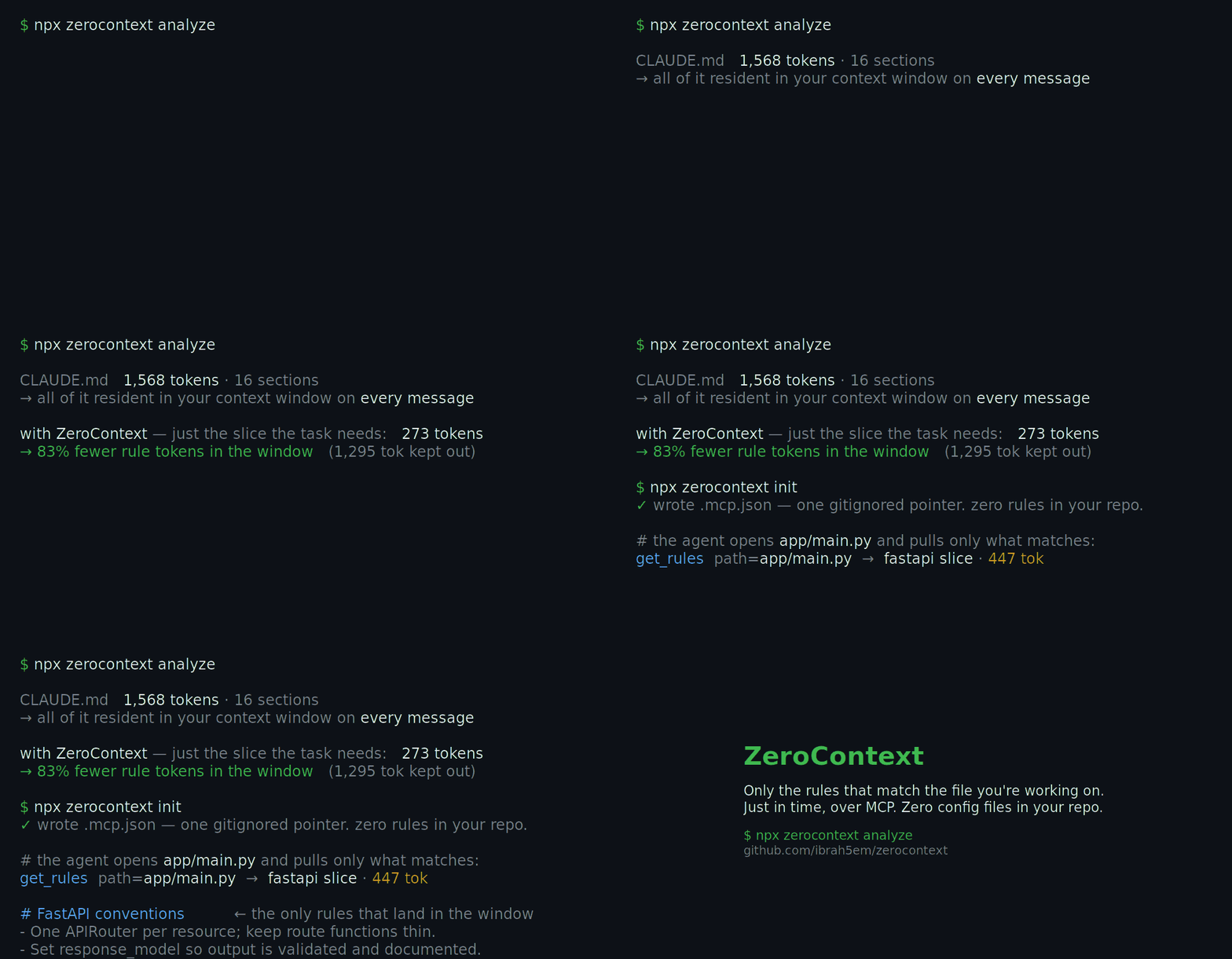
A real run on the bundled demo/fixture project — your numbers will differ. Regenerate the GIF with node demo/render.mjs.
CLAUDE.md and .cursorrules load everything you've ever written into every message —
keeping rules in the window that have nothing to do with the code in front of you.
ZeroContext is a local MCP server that inspects your project and hands the agent only
the rules it asks for, when it asks — just-in-time, per file and stack. A smaller,
sharper window, better-targeted answers, and zero config files cluttering your repo.
npx zerocontext init      # writes MCP config pointing at the local server
npx zerocontext serve     # stdio MCP server: serves matching rules on request
npx zerocontext analyze   # see how many rule tokens your CLAUDE.md / .cursorrules costs per message
📊 This repo's own
CLAUDE.mdkeeps 1,913 rule tokens in every message's window — ZeroContext keeps ~80% of them out, serving only the slice the task needs.
One honesty note, up front: this is a window-scoping number, not a cheaper bill. A
preloaded CLAUDE.md is prompt-cached, and our Phase 0 A/B found just-in-time ran
cost-neutral-to-higher end to end. So the win is relevance and a leaner window — never
dollar savings.
Run analyze on any repo with a CLAUDE.md or .cursorrules — no install required:
$ npx zerocontext analyze
ZeroContext analyze — rule tokens resident in every message
Tokenizer: o200k_base (gpt-tokenizer) — proxy for Claude, ~±10–15% vs. Claude's exact count

CLAUDE.md
  1,913 tokens  ·  7,533 chars  ·  9 sections (avg 213 tok/section)
  → resident in your context window on every message, relevant or not.

  With ZeroContext (just-in-time, 1 slice/task) — rule tokens resident in the window:
    fixed overhead     135 tok   (MCP instructions + get_rules schema, measured)
    + tool call(s)      40 tok   (assumption: agent writes 1 call)
    + rule slice(s)    213 tok   (your avg section size)
    = 388 tok resident   vs   1,913 tok preloaded (every message)

  → 80% fewer rule tokens in the window  (1,525 tok)
  Break-even: ZeroContext keeps fewer resident once rules exceed ~388 tok. Yours: 1,913 ✓
Your numbers will differ — bigger or polyglot rule files keep more out of the window. The
percentage is the headline (tokenizer-robust); the absolute count is a labeled o200k
estimate. If your rules fall below break-even, analyze says so instead of inflating the
number.
CLAUDE.md / .cursorrules |
ZeroContext | |
|---|---|---|
| When rules load | Front-loaded into every message | Pulled by the agent, only when it needs them |
| What loads | Everything you've ever written | Only the slice matching the active file / stack |
| Irrelevant rule tokens in the window | ~2–8k per message | ~0 |
| Rule files in your repo | One per AI tool | Zero (rules live in the server, served on demand) |
| Config footprint | The rule file itself | One gitignored .mcp.json pointer — no rules |
ZeroContext runs as a local MCP server that your AI tool spawns per session. It inspects
the working directory, detects the stack from project signals, and exposes a get_rules
tool. When the agent starts working on a file or task it calls that tool and gets back
only the matching rule slice — nothing else lands in the window.
It's agent-pulled, not a reactive editor hook. Claude Code is a terminal agent with no "current file" event for a server to chase, so ZeroContext serves rules just-in-time when the agent asks — the honest mechanism that works today, no IDE extension required.
Detection is by project signal, and additive: a Next.js app is also React + TypeScript, so both sets activate and each file gets only the slices whose globs match it.
| Signal | Rule set served |
|---|---|
next.config.* or a next dependency |
Next.js (also activates React + TypeScript) |
tsconfig.json + a react/react-dom dependency |
React + TypeScript |
drizzle.config.* or drizzle-orm + pg/postgres |
Node + Postgres + Drizzle |
pyproject.toml with a fastapi dependency |
FastAPI |
Cargo.toml |
Rust |
More stacks land as PRs come in — they aren't curated up front.
Not wired yet. The intended shape: a single repo-root .zerocontext.yaml maps a path
prefix to a bundled rule-set name, so each workspace gets the right slice. Pointers only,
never inline rules — the one allowed footprint in your repo.
# .zerocontext.yaml — planned, not yet read by the server
version: 1
routes:
  apps/web: nextjs
services/api: fastapi- vs.
awesome-cursorrules— that's a rules library; this is a runtime that picks the right slice and serves it to the agent on demand. - vs. native Cursor / Claude rules — those are static and front-loaded; ZeroContext is just-in-time, so the tokens only land when a rule is actually relevant.
Pre-launch, solo OSS. Phase 0 is resolved: in a live headless session the agent called
get_rules on its own and got back the correct stack-matching slice, so agent-pulled
just-in-time injection works end to end. Reactive file-switch is not promised — it isn't
available to a terminal agent without an IDE extension. Nothing in this README claims
behavior that isn't built.
MIT — see LICENSE. An open-source tool that scratches a real itch.