Give your AI a memory that actually sticks. One install, and your assistant remembers across sessions — not just what you said, but how the pieces fit together.

You know how AI assistants forget everything between chats? This fixes that.
Plug it in, and your assistant gets a brain that:
- 📌 Remembers what you tell it — preferences, decisions, fixes, the path of that file you mentioned three weeks ago.
- 🧠 Connects related ideas — like a real notebook with cross-references, not a search box.
- 😴 Reflects while you sleep — overnight, it strengthens what matters and notices new connections.
- ✏️ Updates itself when you change your mind — old facts get superseded, not duplicated.
That's it. The rest of this README goes deeper the further you scroll.
🌀 Don't want to install anything? A managed hosted version is in the works: mazemaker.online / mazemaker.dev — Build the maze. Your agent finds the way. Sign up, point your agent at an MCP endpoint, done. (SANDBOX/PREVIEW until launch.)
cd ~/projects/mazemaker-adapter
bash install.sh          # auto-detect hermes-agent
bash install.sh /path    # explicit path
The installer figures out:
- Python deps (FastEmbed, torch, numpy)
- Whether you have a GPU
- Where to deploy the plugin
- Database init (SQLite at
~/.neural_memory/memory.db) - Config setup
Restart hermes after install: hermes gateway restart
That's the beginner path. If anything goes wrong, the Production Lessons section near the bottom has every gotcha I've seen on a clean VM.
Live Dashboard — Knowledge Graph
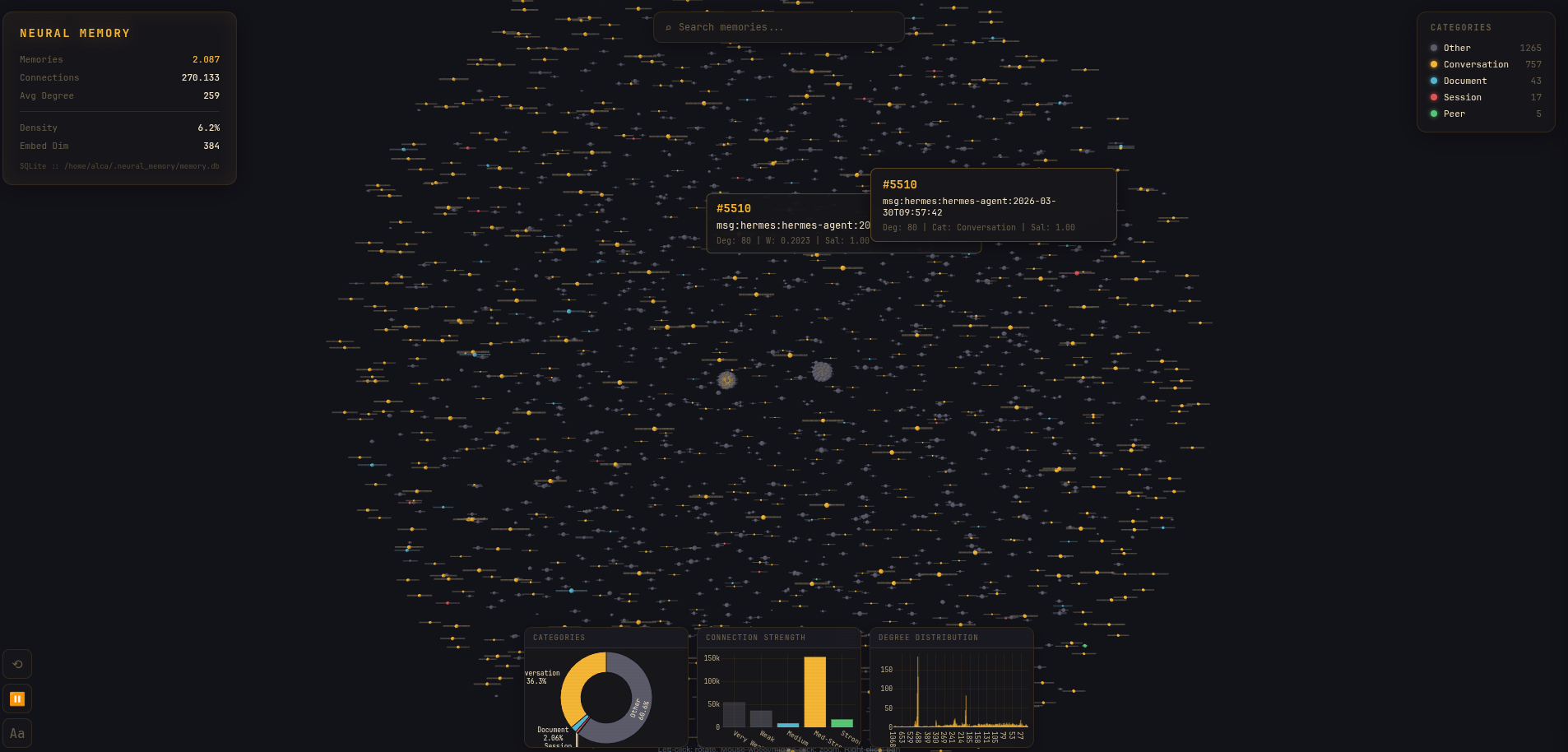
Most AI memory systems are search engines: type a query, get back the few documents that contain the same words. That works for simple recall. It falls apart for everything else an agent actually needs.
| Need | Search-engine memory | This system |
|---|---|---|
| Find a fact you told it once | ✅ | ✅ |
| Follow a chain of reasoning across multiple memories | ❌ | ✅ |
| Notice that two related facts should be connected | ❌ | ✅ |
| Replace a stale fact when you tell it the new one | ❌ | ✅ |
| Hold its ground when irrelevant noise piles up | ❌ | ✅ |
| Tell you why it surfaced a particular memory | ❌ | ✅ |
The right mental model isn't "vector database." It's a small brain that lives next to your agent.
If you want the numbers behind those check marks, keep scrolling. If you don't, the install above is enough — defaults are good.
A vector database with cosine similarity will do the first row of that table well and fail every other row. We measured that explicitly.
| Capability | Vanilla cosine | Neural-Memory | Lift |
|---|---|---|---|
| Hop-2 graph reasoning (answer reachable only via A→B→C edges) | 0.00 R@10 | 1.00 R@10 | +1.00 |
| Real edges vs shuffled control (proves traversal, not embedding) | n/a | 1.00 → 0.27 | +0.73 collapse |
| Post-dream synthesis (facts inferable only after consolidation) | structurally 0.00 | 0.43 at scale | +0.43 lift |
Conflict supersession (winner@1 with detect_conflicts=False) |
0.03 control | 0.33 | +0.30 |
| Cross-session continuity under concept-mode distractors | 0.06 | 0.62 | +0.56 |
| Lean retrieval mode (real prose, n=200) vs default skynet | n/a | 0.60 vs 0.42 | +0.18 R@5 |
R@10 = "the right answer is in the top-10 results", scored 0..1. Higher is better. Every cell measured by a suite that cannot be solved by token overlap, with negative controls (shuffled edges, supersession off, pre-dream zero) that must fail when the relevant mechanism is disabled.
Full numbers, the JSON dumps, and the suite catalog: benchmarks/README.md.
A peer-review-grade benchmark for this kind of system didn't exist. Existing semantic-memory evaluations measure either retrieval (BEIR, MS MARCO) or QA (NaturalQuestions) — none of them test graph traversal, dream consolidation, or supersession.
So we built one, and had it independently audited by GPT-5.5 (via codex CLI). It pushed back hard. Eight rounds:
| Round | Verdict | Headline reason |
|---|---|---|
| v2 | no | Lexical leakage in queries; broken dream suite; no baseline |
| v3 | no | Topic-word leakage; cross-instance anchor collisions; wrong-class import |
| v4 | qualified-y | Source-level fixes pending verification |
| v5 | YES + 4 caveats | Every condition empirically satisfied |
| v6 | qualified-y w/ 4 caveats | Real-text mode + lean preset shipped; 4 follow-ups |
| v7 | qualified-y w/ 1 caveat | n=200 real-prose: lean beats default skynet by +0.18 R@5 |
| v8 | UNCONDITIONAL YES — no residual caveat | Dream lift +0.43 at scale; the +0.04 at v7 was a sample-size artifact |
Every prompt and every verdict, from "no, this is just lexical retrieval" to "unconditional yes — accept it as evidence", is committed verbatim under benchmarks/audit/. Open codex-v2-audit-2026-04-28.md and codex-v8-verdict-2026-04-28.md side by side to see the journey end-to-end.
Running the benchmark wasn't just measurement. It surfaced real engineering wins. Each one is now a documented, opt-in option in ~/.hermes/config.yaml:
retrieval_mode: lean— channel ablation proved that on real prose, BM25 / temporal / salience are dead-weight (or actively harmful). Lean drops them. Result: 4× faster than skynet on synthetic; +0.18 R@5 better than skynet on real prose. The benchmark told the production code which channels to remove.recall_score_percentile— the legacyscore_flooroperates on a badly-scaled internal score (~0..0.05); a sensible-looking value like 0.2 silently nukes everything. The new percentile knob is calibrated [0,1] by rank, so0.5keeps top half regardless of corpus or model.- PPR is the load-bearing channel for ranking (-0.13 MRR if removed); semantic is the load-bearing channel for recall (-0.26 if removed). Surface this in your config tuning.
Run the benchmark yourself:
# Full v8 run on real-text corpus (200 chunks from the project's own docs):
python -m benchmarks.neural_memory_benchmark.runner \
  --realistic --suite baseline --suite lean_skynet \
  --suite graph_reasoning --suite dream_derived_fact \
  --suite conflict_quality --suite continuity_controls \
  --suite channel_ablation \
  --output-dir benchmarks/results/my-run --seed 42

# Single-suite quick check (graph reasoning is the headline):
python -m benchmarks.neural_memory_benchmark.runner \
  --paraphrase --suite graph_reasoning
A full run takes ~12 minutes on a workstation. Every suite produces a JSON file under benchmarks/results/<your-dir>/results/.
If the install + the cheat sheet above is enough for you, you can stop reading here. Below this line everything gets progressively more technical.
- Semantic memory storage — auto-embed via FastEmbed ONNX (intfloat/multilingual-e5-large, 1024d). Falls back to sentence-transformers, then TF-IDF, then hash.
- Knowledge graph — auto-connect related memories by cosine threshold, plus explicit
add_connection()for typed edges. Canonical (source<target) orientation enforced everywhere. - Spreading activation — BFS or Personalized PageRank for
think(start_id). The only path that solves hop-2 retrieval; vanilla cosine literally cannot. - Dream Engine — three-phase autonomous consolidation: NREM (strengthen activated edges + prune weak), REM (bridge isolated memories), Insight (Louvain communities + materialise
derived:clustersummary memories). - Conflict detection + supersession — fuse-or-mark with revision history.
detect_conflicts=Falsecontrol arm proves the algorithm is doing real work, not just relying on recency. - Multi-channel retrieval — semantic + BM25 + entity + temporal + PPR, fused via Reciprocal Rank Fusion. Six presets (
semantic,hybrid,advanced,skynet,lean,trim). - GPU recall — CUDA-accelerated cosine over an in-memory matrix (~100ms for 10k memories). CPU fallback automatic.
- SQLite-first — always works, no external DB needed. WAL mode + bg checkpointing. MSSQL optional for shared multi-agent deployments.
- Hermes plugin / MCP server / standalone library — one core, three integration shapes.
| Priority | Backend | Model | Speed | Requirements |
|---|---|---|---|---|
| 1st | FastEmbed | intfloat/multilingual-e5-large | ~50ms | pip install fastembed |
| 2nd | sentence-transformers | BAAI/bge-m3 1024d | ~200ms | GPU recommended |
| 3rd | tfidf | — | varies | numpy only |
| 4th | hash | — | instant | nothing |
FastEmbed uses ONNX runtime — no PyTorch conflict, works on CPU. Falls back automatically.
# gpu_recall.py — CUDA cosine similarity
# Loads all embeddings into GPU, does torch.matmul for batch similarity
# ~100ms for 10K memories vs ~500ms CPU

from gpu_recall import GPURecall
engine = GPURecall()
results = engine.recall(query_embedding, all_embeddings, top_k=10)
Auto-detects CUDA. Falls back to Python/numpy if no GPU.
flowchart TD
    subgraph Store["mazemaker_remember"]
        A[User content] --> B[FastEmbed encode]
        B --> C[1024d vector]
        C --> D[SQLite INSERT]
        C --> E[Cosine similarity search]
        E --> F[Create connections]
    end

    subgraph Recall["mazemaker_recall"]
        G[User query] --> H[FastEmbed encode]
        H --> I{CUDA available?}
        I -->|Yes| J[GPU torch.matmul]
        I -->|No| K[CPU numpy dot]
        J --> L[Top-k results]
        K --> L
    end

    subgraph Think["mazemaker_think"]
        M[Source memory] --> N[BFS on connections]
        N --> O[Apply decay factor]
        O --> P[Ranked activation]
    end

    subgraph Dream["mazemaker_dream"]
        Q[Idle trigger] --> R[NREM replay]
        R --> S[REM bridge discovery]
        S --> T[Insight communities]
        T --> U[Consolidated graph]
    end
- SQLite (always):
~/.neural_memory/memory.db— source of truth - Embeddings cache:
~/.neural_memory/models/(auto-downloaded, ~2.2 GB) - GPU cache:
~/.neural_memory/gpu_cache/(embeddings.npy + metadata.pkl) - Access logs:
~/.neural_memory/access_logs/(JSON Lines) - MSSQL (optional): 127.0.0.1/Mazemaker — multi-agent mirror
-- Core tables
memories (id, content, embedding, category, salience, ...)
connections (source_id, target_id, weight, edge_type)
connection_history (source_id, target_id, last_weight, last_updated)

-- Dream engine
dream_sessions (id, phase, started_at, completed_at, stats)
dream_insights (id, session_id, type, data)

-- Indexes
idx_memories_category ON memories(category)
idx_connections_source ON connections(source_id)
idx_connections_target ON connections(target_id)All settings in ~/.hermes/config.yaml. The defaults below are the recommended preset based on the v8 benchmark.
memory:
  provider: neural
  neural:
    db_path: ~/.neural_memory/memory.db
    embedding_backend: fastembed       # auto | fastembed | sentence-transformers | tfidf | hash

    # 2026-04-28 benchmark recommended preset.
    # `lean` beat `skynet` by +0.18 R@5 / +0.16 MRR on real prose at n=200,
    # and is 4× faster on synthetic at -0.02 recall. Drops the channels
    # (BM25, temporal, salience) that channel_ablation proved actively
    # hurt recall on real text.
    retrieval_mode: lean               # semantic | hybrid | advanced | skynet | lean | trim
    retrieval_candidates: 128
    use_hnsw: auto                     # ANN index above ~1k memories
    think_engine: ppr                  # bfs | ppr — PPR is the load-bearing channel for ranking

    # Calibrated [0,1] noise floor — drops the bottom X fraction of
    # ranked candidates by RANK. Calibrated alternative to the legacy
    # recall_score_floor (which lived on the badly-scaled raw RRF
    # score ~0..0.05; values >= 0.2 silently nuke everything).
    recall_score_percentile: 0.3

    # Optional: MMR diversity in result set (0.0=pure relevance,
    # 0.7=balanced). Off by default.
    mmr_lambda: 0.0

    # Hermes session knobs
    prefetch_limit: 10
    search_limit: 50
    consolidation_interval: 0
    session_extract_facts: true
    session_fact_limit: 5

    dream:
      enabled: true
      idle_threshold: 600              # seconds before dream cycle
      memory_threshold: 50             # dream after N new memories
      mssql:                           # optional — only if using MSSQL
        server: 127.0.0.1
        database: Mazemaker
        username: SA
        password: 'your_password'
driver: '{ODBC Driver 18 for SQL Server}'| Mode | Channels active | Use when |
|---|---|---|
semantic |
semantic only | Lowest latency, no hybrid fusion needed |
hybrid |
semantic + BM25 | Add lexical recall |
advanced |
semantic + BM25 + entity | + named-entity grounding |
skynet |
all six channels | Default; over-channeled per benchmark |
lean |
semantic + entity + PPR | Recommended — drops dead-weight channels |
trim |
semantic + BM25 + entity + temporal + PPR | Conservative middle-ground (drops only salience) |
When the plugin is active, these tools appear in Hermes:
| Tool | Description |
|---|---|
neural_remember |
Store a memory (with conflict detection) |
neural_recall |
Search memories by semantic similarity |
neural_think |
Spreading activation from a memory |
neural_graph |
View knowledge graph statistics |
neural_dream |
Force a dream cycle (all/nrem/rem/insight) |
neural_dream_stats |
Dream engine statistics |
Autonomous background memory consolidation, biological-sleep inspired:
flowchart LR
    subgraph Trigger
        T1[Idle 600s] --> D
        T2[50 new memories] --> D
        T3[Manual / Cron] --> D
    end

    D[Dream Cycle] --> NREM
    D --> REM
    D --> INSIGHT

    subgraph NREM["Phase 1 — NREM"]
        direction TB
        N1[Replay 100 recent memories] --> N2[Spreading activation]
        N2 --> N3{Connection active?}
        N3 -->|Yes| N4[Strengthen +0.05]
        N3 -->|No| N5[Weaken -0.01]
        N3 -->|Dead <0.05| N6[Prune]
    end

    subgraph REM["Phase 2 — REM"]
        direction TB
        R1[Find 50 isolated memories] --> R2[Search similar unconnected]
        R2 --> R3[Create bridge connections]
        R3 --> R4[weight = similarity × 0.3]
    end

    subgraph INSIGHT["Phase 3 — Insight"]
        direction TB
        I1[BFS connected components] --> I2[Identify communities]
        I2 --> I3[Find bridge nodes]
        I3 --> I4[Store dream_insights]
    end
- Automatic: after 600s idle (configurable)
- Automatic: every 50 new memories (configurable)
- Manual:
neural_dreamtool - Standalone:
python python/dream_worker.py --daemon
cd ~/projects/mazemaker-adapter/python
python3 demo.py# Plugin test suite
cd ~/.hermes/hermes-agent/plugins/memory/neural
python3 test_suite.py
# Upside-Down Test Suite — edge cases, corruption, concurrency, SQL injection
cd ~/projects/mazemaker-adapter
python3 tests/test_upside_down.pycd ~/projects/mazemaker-adapter
python3 -c "
import sys; sys.path.insert(0, 'python')
from mazemaker import Mazemaker
nm = Mazemaker(db_path='/tmp/test.db', embedding_backend='cpu', use_cpp=False)
mid = nm.remember('test memory', label='smoke')
results = nm.recall('test')
assert len(results) > 0, 'recall failed'
print(f'SMOKE TEST PASS: {len(results)} results')
"Tested on a fresh Debian 12 QEMU/KVM VM — hermes-agent + mazemaker only, no jack-in-a-box.
| Property | Value |
|---|---|
| VM | Debian 12, 4 GB RAM, KVM enabled |
| hermes-agent | git clone (itsXactlY fork) |
| mazemaker | git clone + FastEmbed ONNX |
| Embedding | intfloat/multilingual-e5-large (1024d) |
| C++ bridge | Not built (Python fallback) |
All 12 integration tests passed:
| # | Test | Result |
|---|---|---|
| 1 | Mazemaker standalone (remember/recall/graph) | PASS |
| 2 | Memory Provider (FastEmbed 1024d) | PASS |
| 3 | NeuralMemoryProvider.init | PASS |
| 4 | is_available() | PASS |
| 5 | initialize(session_id) | PASS |
| 6 | get_tool_schemas() → 4 tools | PASS |
| 7 | system_prompt_block() (250 chars) | PASS |
| 8 | handle_tool_call — neural_remember | PASS |
| 9 | handle_tool_call — neural_recall | PASS |
| 10 | handle_tool_call — neural_graph | PASS |
| 11 | prefetch() | PASS |
| 12 | shutdown() | PASS |
- 4 GB RAM minimum — FastEmbed model download (~500 MB). 2 GB = OOM killed.
- HashBackend works as fallback on low-RAM systems (1024d, instant, no deps).
- C++ bridge optional — Python fallback covers all functionality.
- FastEmbed >= 0.5.1 — earlier versions default to CLS embedding (deprecated).
python3-venvrequired on Debian —apt install python3.11-venvif missing.- PEP 668 (Debian) —
pip installneeds venv or--break-system-packages. - Cloud-init delay — 60–90 s on first boot. Don't assume SSH is ready immediately.
- prefetch() returns empty on fresh DB — expected, no prior memories to pre-load.
mazemaker-adapter/
├── install.sh                    # Installer
├── hermes-plugin/                # Plugin (deployed to hermes-agent)
│   ├── __init__.py               # MemoryProvider + tools
│   ├── config.py                 # Config loader
│   ├── plugin.yaml               # Plugin metadata
│   ├── neural_memory.py          # Unified Memory class
│   ├── memory_client.py          # Main client (Mazemaker, SQLiteStore)
│   ├── embed_provider.py         # Embedding backends (FastEmbed, st, tfidf, hash)
│   ├── gpu_recall.py             # CUDA cosine similarity engine
│   ├── dream_engine.py           # Dream engine (NREM/REM/Insight)
│   ├── dream_worker.py           # Standalone daemon
│   ├── access_logger.py          # Recall event logger
│   └── ...
├── python/                       # Python source (mirrors hermes-plugin)
│   └── ...
├── src/                          # C++ source (optional, legacy)
│   ├── memory/lstm.cpp           # LSTM predictor
│   ├── memory/knn.cpp            # kNN engine
│   └── memory/hopfield.cpp       # Hopfield network
├── benchmarks/                   # The eight-round audit story
│   ├── README.md                 # Suite catalog + headline numbers
│   ├── audit/                    # codex-v2..v8 prompts + verdicts (verbatim)
│   └── neural_memory_benchmark/  # Suites + dataset generators
└── README.md
- FastEmbed > sentence-transformers — ONNX runtime, no PyTorch conflict, fast on CPU.
- FastEmbed >= 0.5.1 — earlier versions default to CLS embedding. Pin version or set
add_custom_model. - GPU recall > C++ Bridge — C++ Hopfield had bias issues; GPU matmul is clean.
- numpy before FastEmbed — FastEmbed imports numpy at load time; install order matters.
- Don't force PyTorch — let FastEmbed handle CPU. torch only needed for GPU recall.
- SQLite = Source of Truth — MSSQL is optional. SQLite always works.
- Auto-detect everything — CUDA, backends, venv paths. Minimize config burden.
- 4 tool schemas exposed by NeuralMemoryProvider:
neural_remember,neural_recall,neural_think,neural_graph. (neural_dream/neural_dream_statsare standalone Memory class only.)
retrieval_mode: leanis the new recommended default — channel_ablation at n=200 on real prose proved BM25/temporal/salience are dead-weight or actively harmful. Lean drops them. +0.18 R@5 vs skynet.recall_score_percentileoverrecall_score_floor— the legacy floor lives on a 0..0.05 scale and is silently broken for any reasonable user input. Percentile is calibrated [0,1] by rank.think_engine: pproverbfsfor ranking-quality runs — channel_ablation proved PPR is the biggest MRR contributor (-0.13 if removed).
See LICENSE.