A deep-sky star atlas you print yourself. A4, black and white, 101 pages, and four languages in one book. Free to print, copy and adapt.
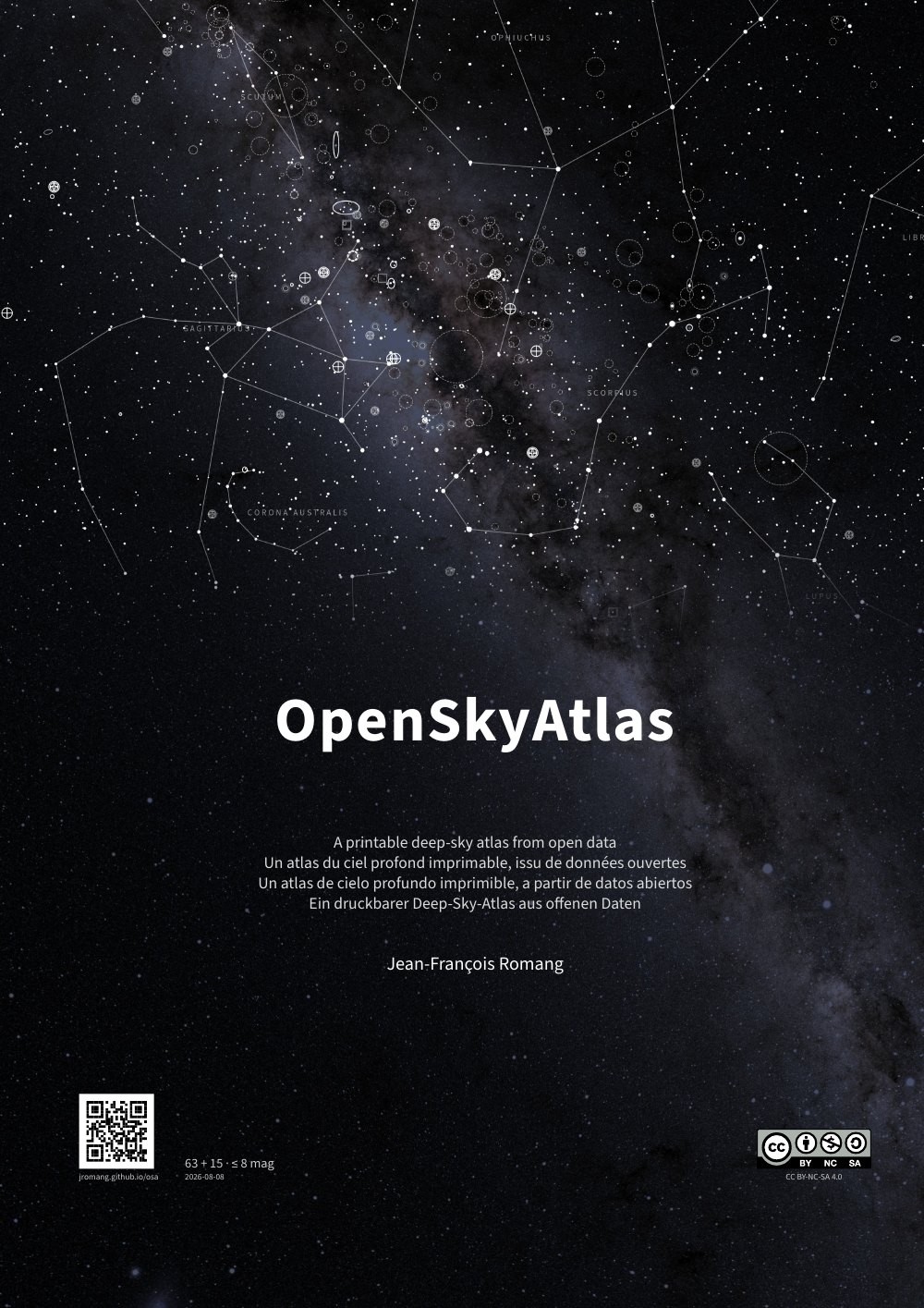
Download the book · Browse the charts online
Lire en français · Leer en español · Auf Deutsch lesen
An atlas made for the night rather than the shelf: you print it, take it outside, leave it open on a damp table beside the telescope, write in the margins, and when it wears out you print another one. The licence says you may, and the file does not wear out with the paper.
Everything on the pages comes from public astronomical catalogues — the work observatories and amateurs have gathered, measured and counted for generations. Nothing is traced from another atlas, and every source is credited in the book, one by one, with its licence.
| Format | A4 portrait, greyscale, made for a home printer |
| Main charts | 63, covering the whole sky, in seven declination bands and ordered so that a section is what is overhead tonight |
| Close-ups | 15 more, at up to eight times the scale — Virgo and Coma, the Sagittarius Milky Way, Cygnus, the tail of Scorpius, Orion's Sword, the Pleiades, the Magellanic Clouds, Crux and others |
| Scale | 6 mm to the degree, the same on every main chart: about 30° × 40° a page |
| Overlap | at least 8° between neighbouring charts, so an object stranded at one edge sits comfortably inside the next |
| Stars | to visual magnitude 8.0, roughly five times what the unaided eye shows from a dark site |
| Deep sky | around 1,500 objects: galaxies to 11.5, globular clusters to 10.5, planetary nebulae to 12, open clusters, and the bright and dark nebulae worth hunting — drawn at their true size and orientation |
| Always included | every Messier, Caldwell and Herschel 400 object, whatever its magnitude |
| Finding your way | a whole-sky map at the front with all 63 charts drawn on it, a constellation lookup table in large type, and a flat index of 952 entries |
| Languages | English, French, Spanish and German, side by side in the front matter |
The charts themselves need no translating — a Greek letter and an NGC number read the same everywhere — which is why there is one book instead of four.
Same charts, same numbers, same index in all three.
Standard is the one you print: black on white, for the desk and for the night.
Field is the same book with its ink reversed, white stars on a black ground. It is not for the printer — a full-black page empties a cartridge to no purpose. It is for the screen you take outside, a tablet or a phone beside the telescope, where a white page would cost you half an hour of dark adaptation and a black one costs nothing.
Mirror is for observers using a star diagonal, which flips the sky left to right. Its charts are reflected to match what the eyepiece shows, the text stays the right way round, and east sits on the right.
Print at 100%, with any "fit to page" or "shrink to fit" option turned off. Printers quietly shrink pages by a few per cent, and a chart printed at 96% will send you to the wrong star — which is why one page carries a 100 mm calibration bar to check with a ruler before you trust anything else.
Ordinary paper rather than laminate: this is a book to write on, and a clean copy is always one print away. That same page holds a Telrad template — copy it onto acetate, cut out the rings, and because every main chart shares one scale it is correct on all of them.
Nothing is encoded in colour. Object class is carried by symbol shape, line weight and grey level, each enough on its own. Under the red torch you should be using outside, red ink vanishes and yellow washes out to the colour of the paper — so a colour atlas loses exactly the information it meant to bring out, at night, in the field, at the one moment it is any use. Greyscale is not a compromise here; it also means a colour-blind observer reads what everyone else reads.
The legend is at the foot of every chart, so you never have to turn back to the front matter in the dark to remember what a symbol means.
The index is flat and in catalogue order — Messier, Caldwell, NGC, IC, then everything known by a name. You do not need to know that NGC 6543 is a planetary nebula in order to look it up.
The constellation lookup is at the front and set large, not hidden on the inside back cover in type you cannot read by red light.
A map of the whole sky opens the book, with all 63 charts drawn on it and their numbers inside them, so "which page do I want" is answered by looking. Under it, a scale of months for nine in the evening, midnight and three in the morning: what stands above a month is due south at that hour.
Every chart carries a QR code to its own web page, which takes the chart's deep-sky objects one by one with their magnitude and size, its finest double stars with their separation, and links on to the neighbouring charts. The address is printed in plain text under the code, because the book has to work with no phone and no signal.
The charts, the book and its text are CC BY-NC-SA 4.0. Print it, copy it, give it away, cut it up and build something else out of it, for any non-commercial purpose — credit OpenSkyAtlas and the catalogues named in the book, and pass on the same freedom. For commercial use, ask.
The catalogues themselves are openly licensed and credited page by page in the book's colophon: HYG and the IAU star names, OpenNGC, d3-celestial's constellation figures from IAU sources, the Barnard, Lynds, Sharpless, Dias, Harris, Acker, GCVS and Alksnis catalogues through NASA HEASARC and the CDS archive, the Washington Double Star Catalog, and the Milky Way, whose contours are derived here from NASA's Deep Star Maps 2020.