


A Python library for reinforced concrete section analysis and design checks to Eurocode 2 (EN 1992-1-1:2004). It combines a fibre-based strain-compatibility engine with fully validated Pydantic models, so the same code that drives an interactive design study can sit behind an API or post-process FEA results in batch.
 |
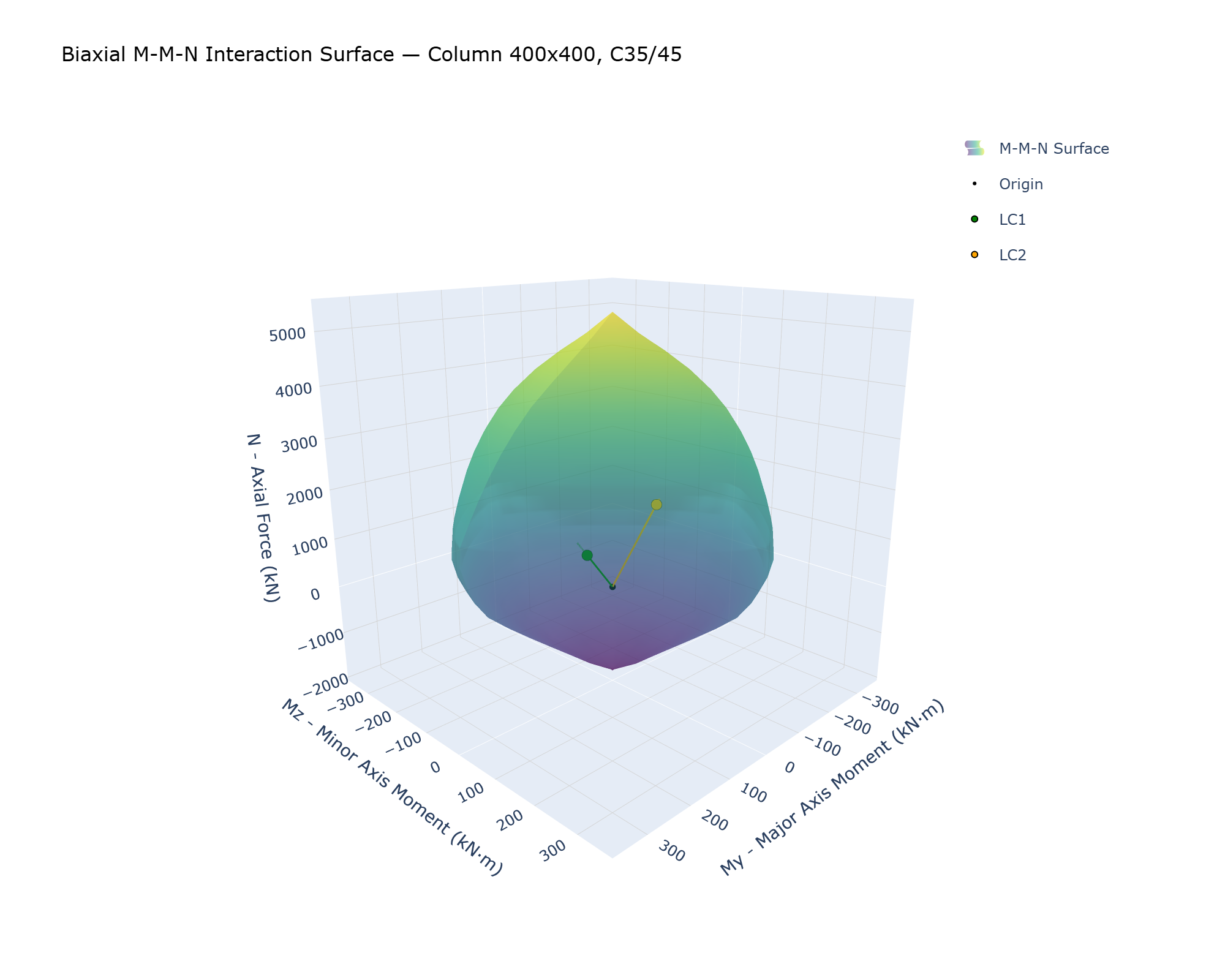 |
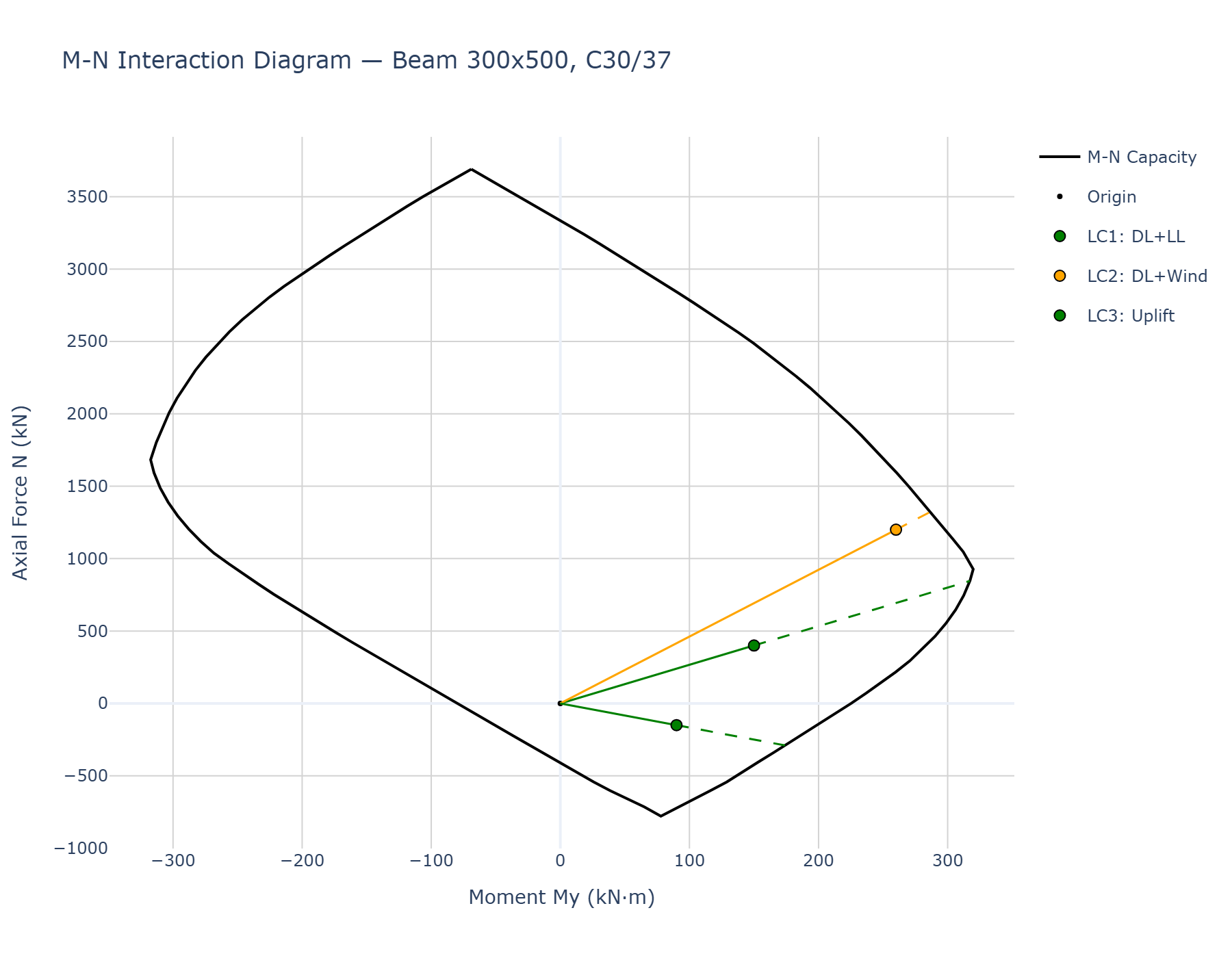
| Uniaxial M-N interaction diagram with load cases and capacity vectors | Biaxial M-M-N interaction surface (EC2 pivot method) |
 |
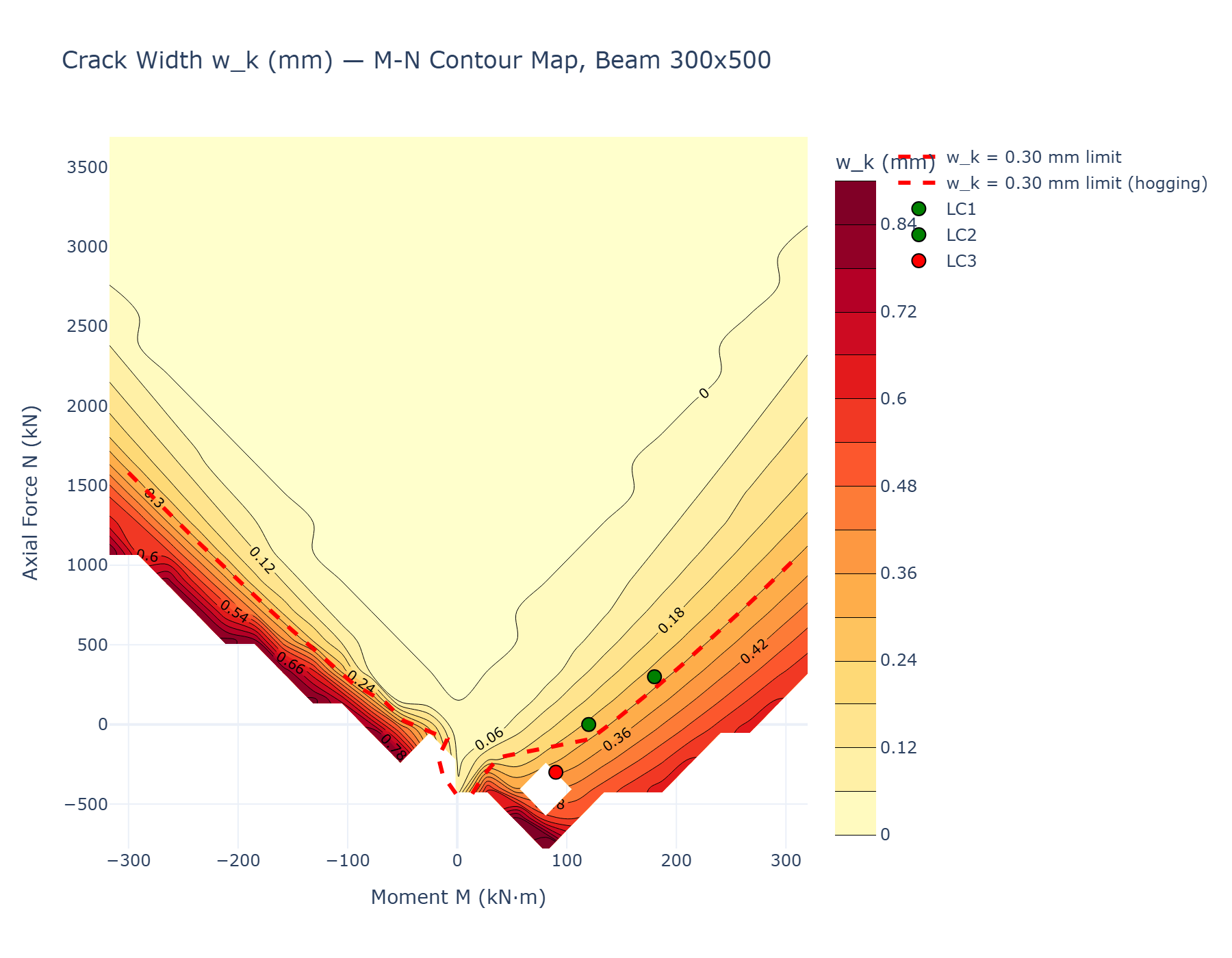 |
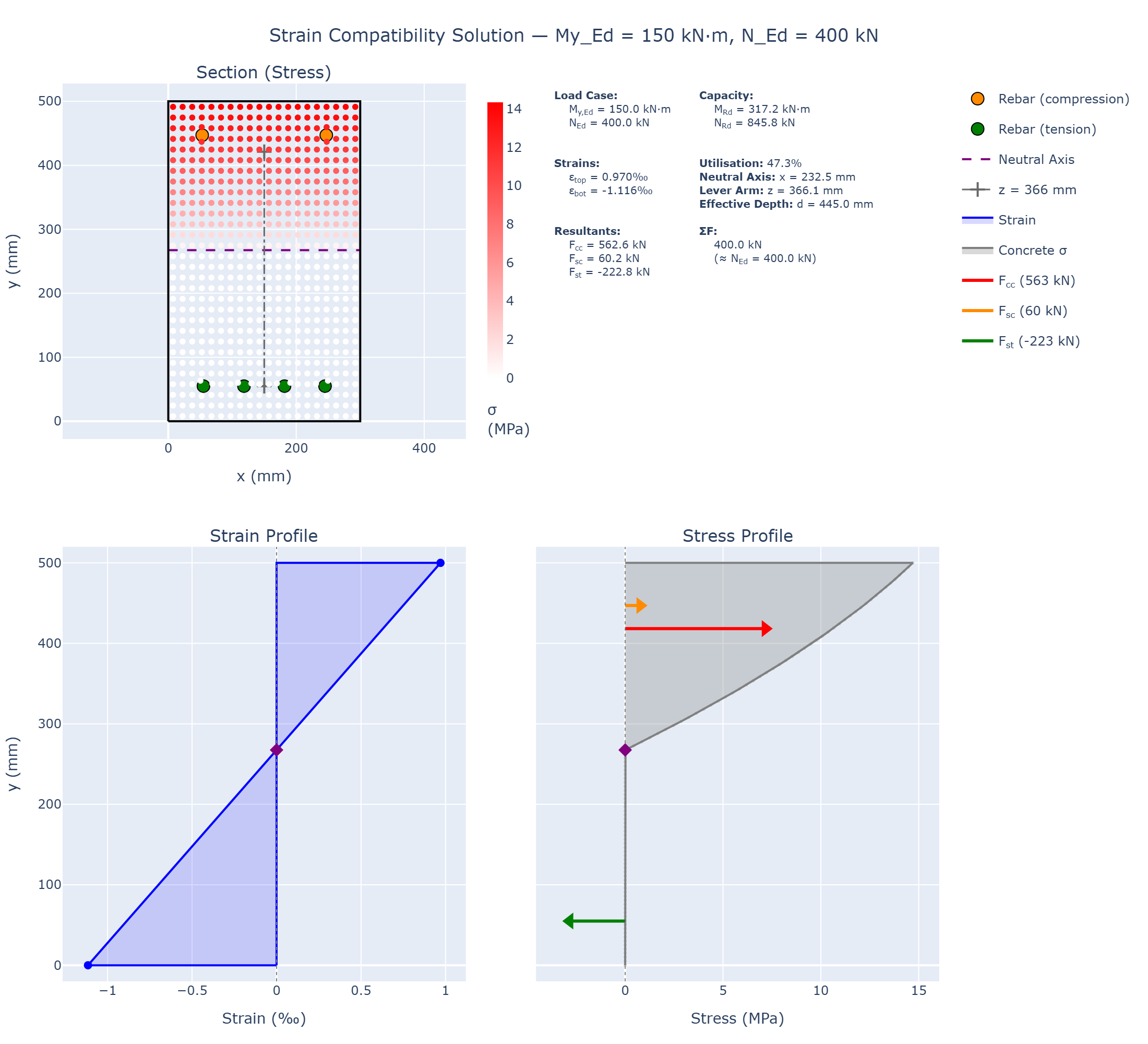
| Strain-compatibility solution for an applied (M, N) pair | SLS crack width contour map over the M-N domain |
 |
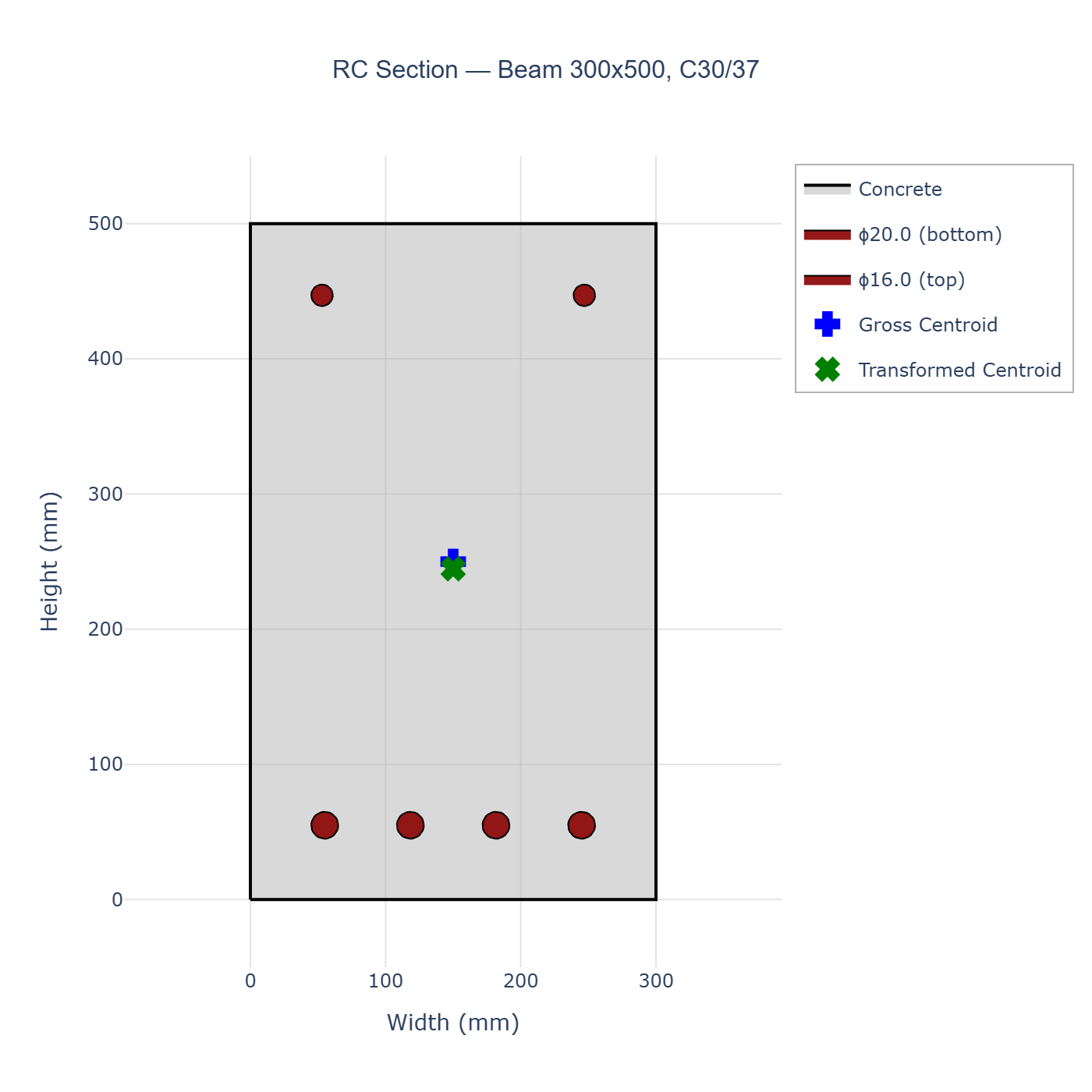 |
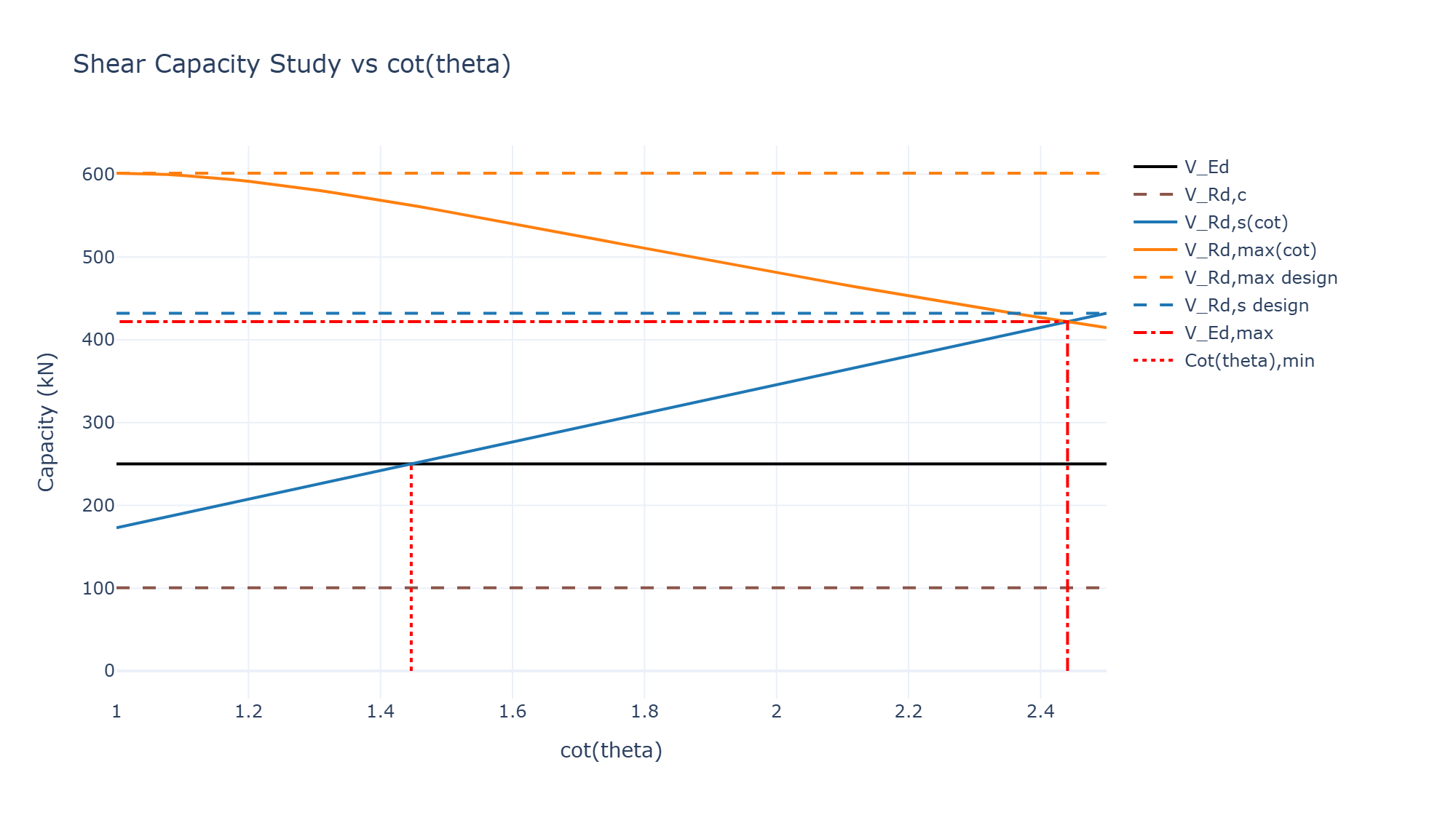
| Variable strut inclination study for the shear check | Section viewer with rebar hover data |
All plots are interactive Plotly figures; the PNGs above are regenerated with examples/generate_release_plots.py.
Materials and constitutive models
- EC2 concrete grades C12/15 to C90/105 and reinforcement B500A/B/C, with partial factors, long-term coefficients and derived properties computed and validated by Pydantic
- EC2 stress-strain models: parabola-rectangle, bilinear, schematic and linear-elastic (SLS), steel with horizontal or inclined post-yield branch, plus confined-concrete and user-defined constitutive models
- Concrete ageing (strength development with time) and early-age thermal models (adiabatic temperature rise to CIRIA C766)
Section geometry
- Arbitrary polygonal outlines (including holes) built on Shapely, with helpers for rectangular and circular sections, linear rebar layers and perimeter bar arrangements
- Fibre mesh generation for strain-compatibility analysis of any shape
- Save/load of complete reinforced sections to JSON
Section analysis
- Uniaxial M-N interaction diagrams from first principles (fibre integration with analytical Jacobians, cached inverse solver, parallel batch solving)
- Biaxial M-M-N interaction surfaces generated with the EC2 pivot method, so every point lies on the true failure surface
- Inverse strain solver: given (M, N) find the strain plane, then reuse it for effective depth, lever arm and stress extraction
- Free neutral-axis adapter for unsymmetric sections and biaxial SLS states, including an analytical fast path for uncracked linear-elastic states
Code checks (EN 1992-1-1:2004)
- Bending with axial force, via the interaction diagram (
BendingCheck) - Shear to section 6.2 with variable strut inclination, tension shift,
uncracked shear capacity and axial-force effects (
ShearCheck) - Crack width to section 7.3 (
CrackingCheck) and stress limits to section 7.2 (StressLimitsCheck) - Combined beam checks (
BeamCheck) orchestrating the above - Circular sections (piles, columns) following Orr (2012), with shear
efficiency factors, equivalent web width and the k_f factor for cast-in-place
piles (
CircularSectionCheck)
Nationally Determined Parameters
- NDP registry for EN 1992-1-1:2004 and EN 1992-2:2005 with the EU recommended values plus UK and German National Annexes, switchable at runtime and extensible with custom annexes
Visualisation
- Interactive Plotly viewers for sections, M-N diagrams (with load points and utilisation vectors), 3D biaxial surfaces, strain/stress states, shear design studies (cot θ, link angle, heatmaps, contour maps with sliders) and crack widths (3D stem plots and M-N contour maps)
From the first published release onwards, via PyPI:
pip install "section-design-checks[viz]" # viz extra adds PlotlyOr from source:
git clone https://github.com/jsb2505/section_design_checks.git
cd section_design_checks
pip install -e ".[viz]"
The distribution is named section-design-checks; the import package is
section_design_checks. Requires Python 3.11+. Core dependencies: Pydantic v2,
NumPy, SciPy, Shapely. For static image export of the Plotly figures,
additionally pip install kaleido.
from section_design_checks.reinforced_concrete.materials import ConcreteMaterial, Rebar, ShearRebar
from section_design_checks.reinforced_concrete.geometry import (
    create_rectangular_section,
    create_linear_rebar_layer,
)
from section_design_checks.reinforced_concrete.analysis import create_interaction_diagram
from section_design_checks.reinforced_concrete.code_checks.ec2_2004 import (
    CrackingCheck,
    LoadCase,
    ShearCheck,
)

# 300x500 beam, C30/37, 4H20 bottom + 2H16 top
concrete = ConcreteMaterial(grade="C30/37")
section = create_rectangular_section(width=300, height=500)
section.add_rebar_group(
    create_linear_rebar_layer(
        rebar=Rebar(diameter=20, grade="B500B"),
        n_bars=4,
        start_point=(60, 60),
        end_point=(240, 60),
    )
)
section.add_rebar_group(
    create_linear_rebar_layer(
        rebar=Rebar(diameter=16, grade="B500B"),
        n_bars=2,
        start_point=(60, 440),
        end_point=(240, 440),
    )
)

# ULS bending capacity from the M-N interaction diagram
diagram = create_interaction_diagram(section=section, concrete=concrete)
capacity = diagram.get_capacity_vector(N_Ed=400.0, M_Ed=150.0)
print(f"Utilisation: {capacity.utilization:.2f} (safe: {capacity.is_safe})")

# Shear check to EC2 6.2 (variable strut inclination)
shear = ShearCheck(
    section=section,
    concrete=concrete,
    shear_reinforcement=ShearRebar(diameter=10, link_spacing=150, n_legs=2, grade="B500B"),
)
result = shear.perform_check(load_case=LoadCase(V_Ed=250.0, M_Ed=100.0, N_Ed=150.0))
print(result)

# SLS crack width to EC2 7.3
cracking = CrackingCheck(section=section, concrete=concrete, w_k_limit=0.3)
crack = cracking.calculate_detailed(My_Ed=120.0, N_Ed=0.0)
print(f"w_k = {crack.w_k:.3f} mm (limit {crack.w_k_limit} mm)")from section_design_checks.reinforced_concrete.analysis.biaxial_interaction import (
BiaxialMNInteractionSurface,
)
surface = BiaxialMNInteractionSurface(section=section, concrete=concrete)
N_Rd, My_Rd, Mz_Rd, is_safe, utilisation = surface.get_capacity_vector(
N_Ed=1000.0, My_Ed=150.0, Mz_Ed=60.0
)
# Interactive 3D surface with load points and capacity vectors
surface.plot(
load_points=[{"N_Ed": 1000, "My_Ed": 150, "Mz_Ed": 60, "name": "LC1"}],
show_vectors=True,
)from section_design_checks.reinforced_concrete.ndp import CountryCode, set_ndp_context
set_ndp_context(country=CountryCode.EU_UK) # UK National Annex
set_ndp_context(country=CountryCode.EU_DE) # German National Annex
set_ndp_context(country=CountryCode.EU) # EC2 recommended values (default)- Dimensions in mm, forces in kN, moments in kN·m, stresses in MPa
- Axial force
N_Edis compression positive My_Edis the major-axis moment,Mz_Edthe minor-axis moment;Vz_Edis the major-axis (vertical) shear paired withMy_Ed, andVy_Edthe minor-axis (horizontal) shear paired withMz_EdV_EdandM_Edare accepted as direction-agnostic inputs that map to the major axis
The examples/ directory contains runnable scripts and Jupyter notebooks, including:
| Notebook | Topic |
|---|---|
| m_n_interaction_diagram_tutorial.ipynb | Uniaxial M-N diagrams end to end |
| biaxial_mn_interaction_tutorial.ipynb | Biaxial M-M-N surfaces and the pivot method |
| ec2_code_checks_demonstration.ipynb | Bending, shear, cracking and stress-limit checks |
| shear_viewer_demonstration.ipynb | Shear design study plots |
| crack_width_viewer_demonstration.ipynb | Crack width visualisation |
| circular_section_check_demonstration.ipynb | Circular pile/column checks (Orr 2012) |
| ndp_demonstration.ipynb | Nationally Determined Parameters |
- 1,300+ tests run in CI on every push (fast lane plus a slow biaxial regression lane)
rufflinting and a fully type-checked codebase undermypy(both blocking in CI)- Numerical results are validated against hand calculations and published references throughout the test suite
pip install -e ".[dev,viz]"
pytest                # fast lane
pytest -m slow # slow lane (biaxial surface regression)section_design_checks/
├── core/ # Base abstractions: materials, constitutive, units
└── reinforced_concrete/
├── materials/ # Concrete, rebar, ageing
├── constitutive/ # EC2 stress-strain models
├── geometry/ # Sections, rebar layers, fibre mesh, viewer
├── analysis/ # M-N diagrams, biaxial surfaces, viewers
├── code_checks/ec2_2004/ # Bending, shear, cracking, stress limits, circular
├── ndp/ # Nationally Determined Parameters (EU, UK, DE)
└── thermal/ # Early-age thermal models (CIRIA C766)
This library is provided for research and engineering workflow automation. It is not a substitute for professional engineering judgement: all results must be independently verified by a qualified engineer before being used in design. See the LICENSE for the full warranty disclaimer.
Issues and pull requests are welcome. Please run the test suite and the
ruff/mypy gates before submitting:
ruff check section_design_checks tests --extend-ignore E501
mypy section_design_checks --ignore-missing-imports
pytest- EN 1992-1-1:2004 — Eurocode 2: Design of concrete structures, Part 1-1
- EN 1992-2:2005 — Eurocode 2: Concrete bridges
- Orr, J. J. (2012). Shear design of circular concrete sections. University of Bath
- CIRIA C766 — Control of cracking caused by restrained deformation in concrete