csubst scan
csubst scan lists recurrent nonsynonymous-state substitutions shared by
foreground clades. It is a direct scan for repeated amino-acid or recoded-state
changes, separate from the omegaC branch-combination search used by
csubst search.
Use it when you want a candidate list such as "site 778 changed to S in many foreground clades", together with foreground support, control-branch rate enrichment, site evolutionary rate, and conservation summaries.
csubst scan \
  --alignment_file alignment.fa.gz \
  --rooted_tree_file tree.nwk \
  --foreground foreground.txt
The default scan writes outputs under csubst_scan/, uses
--scan_match any2spe, tests foreground branches against all non-foreground
branches, and calibrates rate-enrichment P values with full foreground-clade
permutations.
Use csubst scan when you want to:
- find recurrent substitutions shared by foreground clades without enumerating foreground branch combinations
- detect partial foreground sharing, such as a substitution present in 8 of 10 foreground lineages
- compare foreground event counts and branch-length exposure with non-foreground or sister branches
- prioritize candidates by site rate, rate quantile, amino-acid conservation, state conservation, and rate-enrichment P values
- generate a quick tree + detected-site summary plot for top scan hits
Run csubst doctor first when working with a new dataset.
csubst scan treats each foreground lineage ID as one foreground unit. Multiple
tips with the same lineage ID are analyzed as one clade-level unit. The lineage
IDs do not have to be consecutive, but consecutive IDs are easier to inspect in
csubst_scan_units.tsv.
With the default stem-only discovery, candidate support is called on each foreground stem. Rate event/exposure accounting uses the whole descendant foreground clade, so post-hit branches are reduced by state-aware opportunity instead of being placed in the non-foreground control.
For foreground file details, see: Foreground specification
Use --scan_match to choose which state-change pattern classes to scan:
-
any2any: any ancestor state to any derived state at the same site -
any2spe: any ancestor state to the same specific derived state -
any2dif: any ancestor state to at least two different derived states -
spe2any: the same specific ancestor state to any derived state -
spe2spe: the same specific ancestor state to the same specific derived state -
spe2dif: the same specific ancestor state to at least two different derived states -
dif2any: at least two different ancestor states to any derived state -
dif2spe: at least two different ancestor states to the same specific derived state -
dif2dif: at least two different ancestor states to at least two different derived states
--scan_match all scans all nine classes. The default is any2spe, which is
usually the most direct representation of convergent amino-acid substitutions.
-
--scan_min_event_pp: posterior probability threshold for candidate discovery and foreground-lineage support calls. With--scan_rate_event_mode posterior_sum, this threshold does not filter event mass used for rate P values. -
--scan_min_support: minimum number or fraction of foreground units that must support a candidate. Integer tokens, including1, are counts. Decimal or scientific-notation values<=1are fractions. -
--scan_rate_event_mode posterior_sum|called: event mass used for rate-enrichment tests.posterior_sumsums matching posterior event mass;calleduses only events passing--scan_min_event_pp. -
--scan_rate_length raw|sn_rescaled|n_rescaled: branch-length scale for rate-enrichment tests. The default,n_rescaled, uses CSUBST nonsynonymous-substitution branch lengths. -
--scan_rate_exposure q_weighted|state_aware|raw_branch_length: exposure model for rate-enrichment tests.q_weightedis the default and integrates the candidate transition weight over the parent codon posterior using the codon Q matrix. With3di20, it resolves tostate_awarebecause the fitted codon Q does not define 3Di-state transition rates. -
--scan_other_scope all|sister: control branch set for rate-enrichment tests.alluses all non-foreground branches;sisteruses sister branches of the foreground units. -
--scan_pvalue_calibration none|candidate_fixed|full_scan: empirical calibration for rate-enrichment P values.full_scanreruns candidate discovery for each size-binned, non-overlapping foreground-clade permutation. -
--scan_n_permutations: number of foreground-clade permutations. Permutations are parallelized over--threads; multiprocessing workers reopen large substitution and posterior-state arrays from shared read-only memmaps. -
--nonsyn_recode: scan standard amino-acid states or recoded nonsynonymous states, including 3Di structural-alphabet recoding. -
--scan_site_plot: write a tree + detected-site summary plot using thecsubst sitesplotter. The default format is PDF. If multiple candidate patterns share one site, the best-supported candidate represents that site.
For the full option list, run:
csubst scan -hBy default, outputs are written under csubst_scan/ with prefix csubst_.
Common files include:
-
csubst_scan.tsv: one row per detected candidate substitution and target class -
csubst_scan_units.tsv: foreground units, matched leaves, foreground branch IDs, whole-clade rate branch IDs, and sister branch IDs -
csubst_foreground_branch.txt: branch IDs assigned to the foreground -
csubst_scan.tree_site.pdf: tree + detected-site summary plot, when--scan_site_plot yes
csubst scan does not write csubst_scan.tree_site.tsv; the scan result table
itself is csubst_scan.tsv.
The example below was generated from the bundled PEPC sample data with an
independent foreground file, --scan_match any2spe, --scan_min_event_pp 0.5,
--scan_min_support 2, --scan_pvalue_calibration none, and
--tree_site_plot_format png. The run reported 78 candidate substitutions from
10 foreground units. The P and q values in the table are analytical
rate-enrichment values, not permutation-calibrated values.
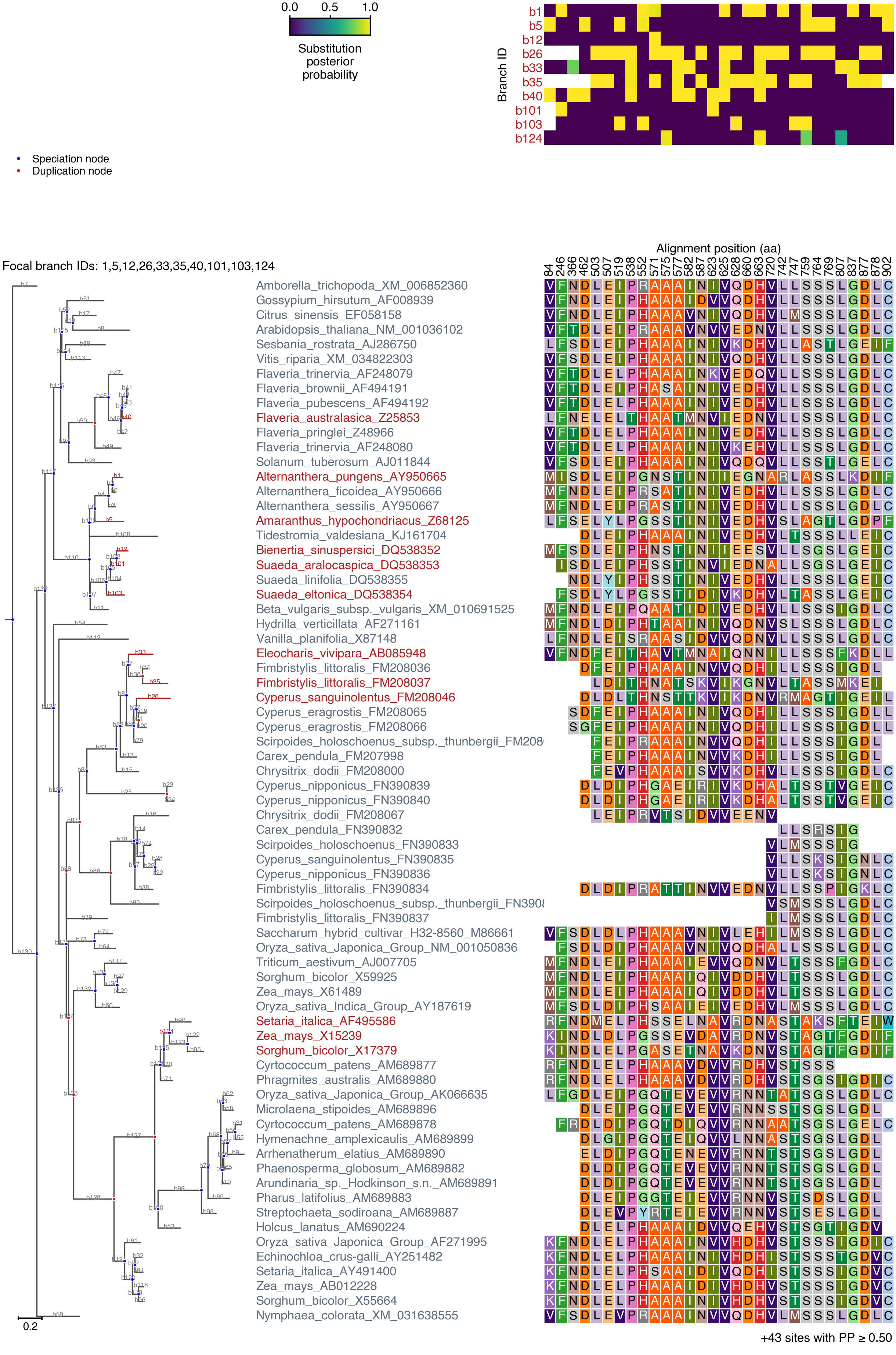
Top foreground candidates:
| state_change | codon_site_alignment | support_unit_count | support_fraction | target_event_count | other_event_count | p_rate_enrichment | q_rate_enrichment | site_rate_quantile | aa_bg_conservation |
|---|---|---|---|---|---|---|---|---|---|
| 778S | 778 | 8 | 0.80 | 7.2607 | 1.7296 | 2.18e-06 | 0.000170 | 0.935 | 1.000 |
| 759A | 759 | 6 | 0.60 | 6.2127 | 1.0093 | 1.51e-05 | 0.000588 | 0.820 | 0.983 |
| 538T | 538 | 4 | 0.40 | 3.9687 | 0.0311 | 0.000193 | 0.00502 | 0.752 | 0.981 |
| 625I | 625 | 5 | 0.50 | 4.9857 | 1.0228 | 0.000312 | 0.00528 | 0.590 | 1.000 |
| 571N | 571 | 4 | 0.40 | 3.9619 | 0.0383 | 0.000339 | 0.00528 | 0.935 | 0.679 |
| 749F | 749 | 3 | 0.30 | 2.9769 | 0.0232 | 0.00119 | 0.0103 | 0.451 | 0.983 |
| 837K | 837 | 3 | 0.30 | 2.9762 | 0.0237 | 0.000697 | 0.00777 | 0.820 | 0.982 |
| 577T | 577 | 4 | 0.40 | 3.9798 | 2.3767 | 0.00178 | 0.0139 | 0.935 | 0.660 |
-
state_change: compact candidate label, such as778SorA123T -
candidate_event_pp_sum: posterior probability sum over events used to build the candidate -
support_unit_count,support_fraction,support_pp_sum: foreground support across foreground units -
support_unit_ids,support_branch_ids: units and foreground branches supporting the candidate -
target_event_count,other_event_count: event mass in foreground and control branches. With--scan_rate_event_mode posterior_sum, these are posterior expected counts. -
target_exposure_branch_length,other_exposure_branch_length: exposure used in the foreground-vs-control rate test -
target_event_rate,other_event_rate,rate_ratio: rate summaries -
p_rate_enrichment: one-sided foreground enrichment P value from the Poisson rate test -
p_rate_enrichment_empirical,p_rate_enrichment_empirical_maxT: empirical permutation-calibrated P values, when enabled -
q_rate_enrichment,q_rate_enrichment_by_trait,q_rate_enrichment_by_trait_match: Benjamini-Hochberg corrected analytic Q values -
q_rate_enrichment_empirical,q_rate_enrichment_empirical_by_trait,q_rate_enrichment_empirical_by_trait_match: BH correction of candidate-wise empirical P values. The maxT P value is already scan-wide family-wise calibrated. -
site_rate,site_rate_categorized,site_rate_quantile: IQ-TREE posterior-mean site rate, category representative, and tie-aware mean-rate quantile -
aa_all_conservation,aa_bg_conservation,state_all_conservation,state_bg_conservation: amino-acid or recoded-state conservation summaries
csubst scan \
  --alignment_file alignment.fa.gz \
  --rooted_tree_file tree.nwk \
  --foreground foreground.txt \
  --scan_match any2spe \
  --scan_min_support 0.8 \
  --scan_rate_event_mode posterior_sum \
  --scan_rate_exposure q_weighted \
  --scan_rate_length n_rescaled \
  --scan_other_scope all \
  --scan_pvalue_calibration full_scan \
  --scan_n_permutations 1000 \
  --threads 8
This command reports substitutions shared by at least 80% of foreground units, uses posterior expected counts for rate tests, and calibrates scan-wide significance with parallel foreground-clade permutations.
P and Q columns are written in scientific notation independently of
--float_digit; posterior counts and other continuous measurements continue to
use the requested fixed precision.