




OpenccNetLib is a fast and efficient .NET library for converting Chinese text, offering support for Simplified ↔ Traditional, Taiwan, Hong Kong, and Japanese Kanji variants. Built with inspiration from OpenCC, this library is designed to integrate seamlessly into modern .NET projects with a focus on performance and minimal memory usage.
- Features
- Installation
- Usage
- Office Document & EPUB Conversion
- Performance
- API Reference
- Dictionary Data
- Add-On CLI Tools
- Usage Notes -
OpenccNet pdf - Project That Use OpenccNetLib
- License
-
Fast, multi-stage Chinese text conversion using prebuilt dictionary unions
(optimized with static caching and zero-allocation hot paths) -
Supports:
- Simplified ↔ Traditional Chinese
- Taiwan Traditional (T) ↔ Simplified / Traditional
- Hong Kong Traditional (HK) ↔ Simplified / Traditional
- Japanese Kanji Shinjitai ↔ Traditional Kyujitai
-
Accurate handling of Supplementary Plane CJK (U+20000+) characters
(correct surrogate-pair detection and matching) -
Optional punctuation conversion
-
Thread-safe conversion core with immutable shared dictionaries; suitable for high-throughput parallel processing when converters are not reconfigured concurrently.
-
Office document & EPUB conversion:
.docx(Word),.xlsx(Excel),.pptx(PowerPoint),.odt,.ods,.odp,.epub- Pure in-memory
byte[] → byte[]APIs for web, server, IPC, and memory-oriented workflows - Separate streaming file APIs for desktop, CLI, and large-document workflows
- Converts only targeted XML/XHTML content while streaming non-target assets entry by entry
- EPUB-compliant rebuild with
mimetypefirst and uncompressed - Optional punctuation conversion and font preservation
- Async wrappers plus validated, safe file-output publication
-
.NET Standard 2.0 compatible (.NET Core 2.0+, .NET 5/6/7/8/9/10 and later), with an optimized .NET 9.0+ implementation path
(cross-platform: Windows, Linux, macOS; usable from .NET implementations supporting .NET Standard 2.0)
- Add the library to your project via NuGet or reference the source code directly.
- Add required dependencies of dictionary files to library root.
dicts\dictionary_maxlength.zstdDefault dictionary file.dicts\*.*Others dictionary files for different configurations.
Install via NuGet:
dotnet add package OpenccNetLibOr, clone and include the source files in your project.
using OpenccNetLib;

// Recommended: use the enum-based constructor
var opencc = new Opencc(OpenccConfig.S2T); // Simplified → Traditional

string traditional = opencc.Convert("汉字转换测试");
Console.WriteLine(traditional);
// Output: 漢字轉換測試
Or, using the legacy string-based configuration:
using OpenccNetLib;
var opencc = new Opencc("s2t"); // Simplified to Traditional
string traditional = opencc.Convert("汉字转换测试");
Console.WriteLine(traditional);
// Output: 漢字轉換測試| Config | Description |
|---|---|
| s2t | Simplified → Traditional |
| t2s | Traditional → Simplified |
| s2tw | Simplified → Traditional (Taiwan) |
| tw2s | Traditional (Taiwan) → Simplified |
| s2twp | Simplified → Traditional (Taiwan, idioms) |
| tw2sp | Traditional (Taiwan, idioms) → Simplified |
| s2hkp | Simplified → Traditional (Hong Kong phrases) |
| hk2sp | Traditional (Hong Kong phrases) → Simplified |
| t2hkp | Traditional → Traditional (Hong Kong, phrases) |
| hk2tp | Traditional (Hong Kong, phrases) → Traditional |
| s2hk | Simplified → Traditional (Hong Kong) |
| hk2s | Traditional (Hong Kong) → Simplified |
| t2tw | Traditional → Traditional (Taiwan) |
| tw2t | Traditional (Taiwan) → Traditional |
| t2twp | Traditional → Traditional (Taiwan, idioms) |
| tw2tp | Traditional (Taiwan, idioms) → Traditional |
| t2hk | Traditional → Traditional (Hong Kong) |
| hk2t | Traditional (Hong Kong) → Traditional |
| t2jp | Traditional Kyujitai → Japanese Kanji Shinjitai |
| jp2t | Japanese Kanji Shinjitai → Traditional Kyujitai |
var opencc = new Opencc("s2t");
string result = opencc.Convert("“汉字”转换。", punctuation: true);
Console.WriteLine(result);
// Output: 「漢字」轉換。var cc = new Opencc(OpenccConfig.S2Hkp);
Console.WriteLine(cc.Convert("别随便录影侵犯个人隐私权"));
// 別隨便錄影侵犯個人私隱權using OpenccNetLib;
var opencc = new Opencc("s2t"); // Or: var opencc = new Opencc(OpenccConfig.S2T);
// Initial conversion
string result = opencc.Convert("动态切换转换方式");
Console.WriteLine(result); // Output: 動態切換轉換方式
// Switch config using string
opencc.Config = "t2s"; // Also valid: opencc.SetConfig("t2s")
result = opencc.Convert("動態切換轉換方式");
Console.WriteLine(result); // Output: 动态切换转换方式
// Switch config using enum (recommended for safety and autocomplete)
opencc.SetConfig(OpenccConfig.S2T);
result = opencc.Convert("动态切换转换方式");
Console.WriteLine(result); // Output: 動態切換轉換方式
// Invalid config falls back to "s2t"
opencc.Config = "invalid_config";
Console.WriteLine(opencc.GetLastError()); // Output: Invalid config provided: invalid_config. Using default 's2t'.Use a frozen converter when configuration must remain fixed and conversions must be independent of later process-wide dictionary changes:
var frozen = new Opencc(OpenccConfig.S2T, isFrozen: true);

Console.WriteLine(frozen.IsFrozen);        // True
Console.WriteLine(frozen.Convert("汉字")); // 漢字

// Both throw InvalidOperationException:
frozen.Config = "t2s";
frozen.SetPreserveIds(true);
Frozen converters own their conversion-plan cache and always use the built-in DictionaryLib.Provider as their base.
Frozen custom-spec converters apply their mappings to that built-in base and are likewise unaffected by later
UseCustomDictionary() or UseDefaultDictionary() calls.
Thread-safety note:
Openccinstances should not be reconfigured while they are being used by other threads. For parallel conversion, create one instance per configuration and treat it as immutable, or use direct conversion methods.GetLastError()is instance-level diagnostic state and should not be shared across threads.
- Use
OpenccConfigenum for compile-time safety and IntelliSense support. - Use
GetLastError()to check if fallback occurred due to an invalid config. - You can also validate config strings with
Opencc.IsValidConfig("t2tw").
You can also use direct methods for specific conversions:
using OpenccNetLib;
var opencc = new Opencc();
opencc.S2T("汉字");  // Simplified to Traditional
opencc.T2S("漢字");  // Traditional to Simplified
opencc.S2Tw("汉字"); // Simplified to Taiwan Traditional
opencc.T2Jp("漢字"); // Traditional to Japanese Kanji
// ...and moreIDS preservation is disabled by default. Enable it when working with Unicode Ideographic Description Sequences (IDS). Complete IDS chunks are preserved, while surrounding normal text is still converted.
using OpenccNetLib;

var cc = new Opencc(OpenccConfig.T2S);

Console.WriteLine(cc.Convert("⿰氵漢"));
// ⿰氵汉

cc.SetPreserveIds(true);

Console.WriteLine(cc.Convert("⿰氵漢"));
// ⿰氵漢

Console.WriteLine(cc.Convert("測試⿰氵漢文本"));
// 测试⿰氵漢文本
The same option can be set as a property:
var cc = new Opencc("t2s")
{
    IsPreserveIds = true
};OpenccNetLib provides two complementary Unicode normalization layers for Chinese/CJK text:
NormalizeCompat(...)/CompatIdeographsnormalizes CJK Compatibility Ideographs using the built-in Unicode decomposition mappings for the CJK Compatibility Ideograph ranges.NormalizeUnicodeCompat(...)applies the curated extended Chinese Unicode compatibility table. It targets additional Kangxi radicals, CJK radical variants, legacy Chinese glyph forms, compatibility punctuation, and known text-extraction artifacts outside the normal compatibility-ideograph pass.
The two tables serve different purposes. NormalizeUnicodeCompat(...) is not a replacement or superset of
NormalizeCompat(...). Use NormalizeCompat(...) when compatibility ideographs are the concern, and enable its
extended mode when both normalization layers should be applied together.
These operations are Unicode/text normalization, not OpenCC linguistic conversion. They do not modify OpenCC dictionaries, phrase matching, regional variant selection, script detection, or OpenCC punctuation conversion. They are also not intended to be a general-purpose Unicode NFKC implementation.
Both normalization tables intentionally use a strict one Unicode scalar → one Unicode scalar mapping contract. A normalization entry may substitute the scalar representation, but it never expands or contracts the scalar sequence. This keeps character positions stable for diffing, offsets, selections, diagnostics, and other position-sensitive text processing. Length-changing rewrites belong to a separate conversion or extraction-repair layer rather than these normalization tables.
For the curated extended table, source keys are additionally required to be non-ASCII. ASCII source mappings are
rejected when the table is loaded. This prevents compatibility normalization from accidentally rewriting structural
syntax such as <, >, &, ", ', /, or =, protecting HTML/XML, OpenXML-based Office documents, subtitle
formats, and other structured text from malformed output.
Targets may still be ASCII when that is the correct-normalized representation; the restriction applies only to source keys.
For converted text, the recommended order is:
- Normalize the input with
NormalizeCompat(...), optionally enabling extended normalization. - Run normal OpenCC conversion with
Convert(...). - Optionally run DeTofu on the converted result for display fallback.
The default NormalizeCompat(...) pass handles CJK Compatibility Ideographs only:
using OpenccNetLib;

var cc = new Opencc();

Console.WriteLine(cc.NormalizeCompat("天龍八部書裡的喬峰是契丹人"));
// Output: 天龍八部書裡的喬峰是契丹人

Console.WriteLine(cc.NormalizeCompat("abc天龍八部書裡的喬峰是契丹人123"));
// Output: abc天龍八部書裡的喬峰是契丹人123
This conservative pass is useful before OpenCC conversion because compatibility ideographs can otherwise prevent dictionary keys from matching their ordinary unified-ideograph forms.
For Chinese text that also needs the curated extended normalization table, enable the extended mode:
using OpenccNetLib;

var cc = new Opencc();

Console.WriteLine(
    cc.NormalizeCompat("⾣〸ム敻耈‧︰﹐﹑﹔﹕﹖﹗", extended: true));
// Output: 酉十厶夐耇·:,、;:?!
The extended table includes carefully selected forms useful for Chinese text processing and text extraction, including
compatibility punctuation such as ‧ → ·, ︰ → :, ﹐ → ,, ﹑ → 、, ﹔ → ;, ﹕ → :,
﹖ → ?, and ﹗ → !, plus conservative extraction-artifact repairs such as ⸺ → —. Normalizing these punctuation forms
can improve downstream CJK paragraph reflow and sentence splitting; normalizing the middle dot also helps preserve
translated Western personal names during splitting.
The extended table is scalar-preserving by design. For example, ⸺ → — is allowed, while a visually similar
length-changing rewrite such as ⸺ → —— is intentionally rejected. Built-in mapping data is validated when loaded, and
malformed rows fail fast instead of being silently skipped.
The extended table is intentionally curated rather than blindly applying every compatibility or historical glyph mapping. Mappings where both source and target remain valid Chinese unified ideographs are excluded when normalization would amount to choosing one legitimate Han form over another.
NormalizeUnicodeCompat(...) exposes the extended table directly when only that layer is wanted, for example when
cleaning text extracted from PDF or other document formats:
using OpenccNetLib;

Console.WriteLine(
    Opencc.NormalizeUnicodeCompat("⾣〸ム敻耈‧︰﹐"));
// Output: 酉十厶夐耇·:,
The extended normalization table is curated for Chinese/CJK-Chinese text. Japanese- and Korean-specific compatibility normalization is outside its scope. Characters not covered by the selected normalization table are preserved unchanged.
Normalize before OpenCC conversion:
using OpenccNetLib;

var cc = new Opencc(OpenccConfig.T2S);

string normalized =
    cc.NormalizeCompat("天龍八部書裡的喬峰是契丹人", extended: true);
string converted = cc.Convert(normalized);

Console.WriteLine(converted);
// Output: 天龙八部书里的乔峰是契丹人CompatIdeographs remains available for callers that need direct access to the reusable compatibility-ideograph
normalizer:
using OpenccNetLib;

var compat = CompatIdeographs.Builtin();

Console.WriteLine(
    compat.Normalize("天龍八部書裡的喬峰是契丹人"));
// Output: 天龍八部書裡的喬峰是契丹人
CompatIdeographs also supports custom mapping text for advanced callers:
using OpenccNetLib;

var compat = CompatIdeographs.FromText("金\\t金\\n");

Console.WriteLine(compat.Normalize("金"));
// Output: 金Opencc.NormalizeCompat(...)
Opencc.NormalizeUnicodeCompat(...)
CompatIdeographs.Builtin()
CompatIdeographs.FromText(...)
CompatIdeographs.Normalize(...)
CompatIdeographs.NormalizeScalar(...)
CompatIdeographs.NormalizeChar(...)
CompatIdeographs.NormalizeInPlace(...)
CompatIdeographs.NormalizeCompatIdeographs(...)
NormalizeCompat(...) is the normal entry point for CJK Compatibility Ideograph normalization. Its extended mode adds
the curated Chinese Unicode compatibility table in the same preprocessing operation. NormalizeUnicodeCompat(...)
exposes that extended table independently. Unmapped characters are preserved unchanged.
Advanced users:
dicts/Unicode_Compatibility.txtmay be customized to add project-specific extended Chinese Unicode normalization mappings used byNormalizeUnicodeCompat (...)andNormalizeCompat (..., extended: true). This customization applies only to the extended Unicode compatibility table. The built-in CJK Compatibility Ideograph mappings are separate and are not intended to be customized through this file.Dictionary Format:
# source<TAB>target
‧	·
︰	:
⸺	—
Both
sourceandtargetmust contain exactly one valid Unicode scalar value. Entries that are malformed or that expand/contract the scalar sequence are rejected when the table is loaded.
DeTofu is an optional display-compatibility pass for rare non-BMP CJK extension characters. Some systems, browsers, document viewers, e-book readers, and mobile platforms do not have complete font coverage for these characters, so they may render as tofu boxes or missing glyphs.
DeTofu is not OpenCC linguistic conversion. It does not modify OpenCC dictionaries, phrase matching, regional variant selection, script detection, or punctuation conversion. For converted text, the recommended order is:
- Optionally normalize CJK Compatibility Ideographs before conversion.
- Run normal OpenCC conversion with
Convert(...). - Run DeTofu on the converted result.
Normal OpenCC conversion:
using OpenccNetLib;

var cc = new Opencc(OpenccConfig.S2T);
string converted = cc.Convert("汉字转换测试");
Console.WriteLine(converted);
// Output: 漢字轉換測試
OpenCC conversion followed by DeTofu:
using OpenccNetLib;

var cc = new Opencc(OpenccConfig.T2S);
string converted = cc.Convert("驂𬴂");
string displaySafe = cc.DeTofu(converted, DeTofuLevel.ExtB);

Console.WriteLine(displaySafe);
Direct utility usage:
using OpenccNetLib;

string displaySafe = DeTofu.Convert("驂𬴂", DeTofuLevel.ExtB);
Console.WriteLine(displaySafe);
DeTofu APIs:
DeTofu.ParseLevel(...)
DeTofu.Convert(...)
DeTofuMap.Builtin(...)
DeTofuMap.WithCustomFile(...)
DeTofuMap.WithCustomPairs(...)
Opencc.DeTofu(...)
Opencc.DeTofuWithCustomFile(...)
Opencc.DeTofuWithCustomPairs(...)
Reusable map usage:
using System.Collections.Generic;
using OpenccNetLib;

var map = DeTofuMap
    .Builtin(DeTofuLevel.ExtB)
    .WithCustomPairs(new[]
    {
        new KeyValuePair<string, string>("𣭲", "氄")
    });

string displaySafe = map.Convert("𣭲");
Console.WriteLine(displaySafe);
Custom in-memory pairs usage:
using OpenccNetLib;

var cc = new Opencc();

var pairs = new Dictionary<string, string>
{
    ["𣭲"] = "氂",
    ["𬴂"] = "騑"
};

var output = cc.DeTofuWithCustomPairs(
    "𣭲毛 骖𬴂",
    DeTofuLevel.ExtB,
    pairs);

Console.WriteLine(output);
// 氂毛 骖騑
In-memory pairs are supplied as IEnumerable<KeyValuePair<string, string>>, where each key is a tofu-risk character and
each value is its display-compatible fallback character. Only the first Unicode scalar value from each key and value is
used, and null or empty keys and values are ignored. Pairs do not carry an extension column, so they are applied
directly to the selected map after the built-in mappings. Custom pairs override built-in mappings for the same tofu-risk
character. If duplicate keys are supplied, the later mapping wins according to enumeration order.
Custom fallback file usage:
using OpenccNetLib;

var cc = new Opencc(OpenccConfig.T2S);
string converted = cc.Convert("驂𬴂");
string displaySafe = cc.DeTofuWithCustomFile(
    converted,
    DeTofuLevel.ExtB,
    "dicts/custom-tofu.txt");

Console.WriteLine(displaySafe);
Fallback files are UTF-8 text files with one mapping per line:
# Format: tofu_char<TAB>fallback_char<TAB>extension
Example:
# Custom DeTofu fallbacks
𣭲	氂	B
𬴂	騑	ExtC
Blank lines and lines beginning with # are ignored. The extension column accepts compact B-I values and legacy
ExtB-ExtI values.
Built-in mappings are loaded from dicts/TSCharactersTofu.txt. Custom files and custom pairs are applied after the
built-in mappings. File mappings override built-in mappings for the same tofu-risk character, and custom pairs do the
same. Later mappings override earlier mappings when the same tofu-risk character is provided.
Characters without built-in or custom fallback mappings are preserved unchanged, even if they belong to an enabled CJK
extension block. DeTofu is non-destructive: it never replaces unknown characters with ?, □, �, or empty text.
DeTofuLevel is threshold-based:
| Level | Replacement threshold |
|---|---|
DeTofuLevel.ExtB |
ExtB and above |
DeTofuLevel.ExtC |
ExtC and above |
DeTofuLevel.ExtD |
ExtD and above |
DeTofuLevel.ExtE |
ExtE and above |
DeTofuLevel.ExtF |
ExtF and above |
DeTofuLevel.ExtG |
ExtG and above |
DeTofuLevel.ExtH |
ExtH and above |
DeTofuLevel.ExtI |
ExtI only |
If an error occurs (e.g., invalid config), use:
string error = opencc.GetLastError();
Console.WriteLine(error); // Output the last error messageDetect if a string is Simplified, Traditional, or neither:
using OpenccNetLib;
int result = Opencc.ZhoCheck("汉字"); // Returns 2 for Simplified, 1 for Traditional, 0 for neither
Console.WriteLine(result); // Output: 2 (for Simplified)By default, OpenccNetLib uses the built-in Zstandard-compressed lexicon. For advanced custom dictionary workflows, build
or customize a DictionaryMaxlength instance, then activate it before creating Opencc instances.
DictionaryMaxlength DictionaryLib.FromDicts(
    string relativeBaseDir = "dicts",
    IDictionary<DictSlot, string> overrides = null,
    IDictionary<DictSlot, string> appends = null)
OpenccNetLib follows the OpenCC lexicon structure. Custom dictionaries must attach to existing OpenCC dictionary slots
such as DictSlot.STPhrases or DictSlot.TSPhrases; dynamic generic slots such as user_dict are intentionally
rejected. Preserving the OpenCC dictionary topology keeps dictionary metadata, lookup acceleration structures, and
runtime plans deterministic and compatible.
Regional variant phrase slots are also customizable. DictSlot.TWVariantsPhrases is applied before
DictSlot.TWVariants, and DictSlot.HKVariantsPhrases is applied before DictSlot.HKVariants, so phrase exceptions
can protect a full term from later character-level regional variant mappings. These slots can be used with both append
and override custom dictionary APIs.
Direct Hong Kong phrase slots are customizable too. DictSlot.HKPhrases is used by s2hkp after
Simplified-to-Traditional conversion, and DictSlot.HKPhrasesRev is used by hk2sp before Traditional-to-Simplified
conversion.
OpenccNetLib 1.7.0 adds an isolated per-instance alternative to the existing process-wide custom dictionary API:
public Opencc(
    OpenccConfig configEnum,
    IEnumerable<CustomDictSpec> customDictSpecs,
    bool isPreserveIds = false,
    bool isFrozen = false)

public Opencc WithCustomDictionary(
    IEnumerable<CustomDictSpec> customDictSpecs)
Ordinary Opencc instances continue to use the shared process-wide conversion-plan cache. They do not allocate a
private plan cache or a private dictionary snapshot. In contrast, the custom-spec constructor snapshots the currently
active global dictionary provider, applies the CustomDictSpec entries to that snapshot in enumeration order, and gives
the new converter its own isolated internal cache. Instance customization never mutates the active global provider, and
later global-provider changes do not affect an already-created custom instance. When isFrozen is true, the custom
instance uses DictionaryLib.Provider instead of the active global provider as its base and rejects later changes to
Config and IsPreserveIds.
The isolated dictionary snapshot belongs to the instance rather than to one configuration. Calling SetConfig(...) or
assigning Config on the custom instance continues to use the same snapshot. Multiple custom instances can therefore
use different mappings safely and independently.
WithCustomDictionary(...) is a convenience method that returns a new Opencc with the source instance's current
configuration and IsPreserveIds value; it does not mutate the source. The supplied specs are the new instance's
complete custom spec set. They are not layered on top of any custom specs attached to the source instance. As with the
constructor, the base is a snapshot of the currently active global provider at the time the new instance is created.
Constructor-based customization can use in-memory pairs directly:
using System.Collections.Generic;
using OpenccNetLib;

var specs = new[]
{
    new CustomDictSpec
    {
        Slot = DictSlot.STCharacters,
        Mode = CustomDictMode.Append,
        Pairs = new Dictionary<string, string>
        {
            ["汉"] = "甲"
        }
    }
};

var cc = new Opencc(OpenccConfig.S2T, specs);
Console.WriteLine(cc.Convert("汉")); // 甲
Use WithCustomDictionary(...) when starting from an existing converter's configuration and IDS setting:
var source = new Opencc(OpenccConfig.S2T, isPreserveIds: true);
var customized = source.WithCustomDictionary(specs);

Console.WriteLine(source.Convert("汉"));     // 漢; source is unchanged
Console.WriteLine(customized.Convert("汉")); // 甲
Different instances may use different mappings for the same dictionary key:
var first = new Opencc(OpenccConfig.S2T, new[]
{
    new CustomDictSpec
    {
        Slot = DictSlot.STCharacters,
        Pairs = new Dictionary<string, string> { ["汉"] = "甲" }
    }
});

var second = new Opencc(OpenccConfig.S2T, new[]
{
    new CustomDictSpec
    {
        Slot = DictSlot.STCharacters,
        Pairs = new Dictionary<string, string> { ["汉"] = "乙" }
    }
});

Console.WriteLine(first.Convert("汉"));  // 甲
Console.WriteLine(second.Convert("汉")); // 乙
Instance specs are layered on the active global dictionary snapshot. For example, this instance sees both the global mapping and its own overlay, while the active global provider receives only the global mapping:
var globalDictionary = DictionaryLib.New();
DictionaryLib.WithCustomDicts(globalDictionary, new[]
{
    new CustomDictSpec
    {
        Slot = DictSlot.STCharacters,
        Pairs = new Dictionary<string, string> { ["汉"] = "全" }
    }
});
Opencc.UseCustomDictionary(globalDictionary);

var specs = new[]
{
    new CustomDictSpec
    {
        Slot = DictSlot.STCharacters,
        Pairs = new Dictionary<string, string> { ["字"] = "例" }
    }
};
var cc = new Opencc(OpenccConfig.S2T, specs);

Console.WriteLine(cc.Convert("汉字"));                           // 全例
Console.WriteLine(new Opencc(OpenccConfig.S2T).Convert("汉字")); // 全字
Config switching on a custom instance reuses its isolated dictionary snapshot:
var cc = new Opencc(OpenccConfig.S2T, new[]
{
    new CustomDictSpec
    {
        Slot = DictSlot.STCharacters,
        Pairs = new Dictionary<string, string> { ["汉"] = "甲" }
    },
    new CustomDictSpec
    {
        Slot = DictSlot.TSCharacters,
        Pairs = new Dictionary<string, string> { ["漢"] = "乙" }
    }
});

Console.WriteLine(cc.Convert("汉")); // 甲
cc.SetConfig(OpenccConfig.T2S);
Console.WriteLine(cc.Convert("漢")); // 乙
Choose the API according to the required scope:
| API | Behavior |
|---|---|
Opencc.UseCustomDictionary(DictionaryMaxlength) |
Process-wide/global; ordinary instances use the shared active provider |
new Opencc(config, specs) |
Isolated per-instance dictionary snapshot and internal cache |
cc.WithCustomDictionary(specs) |
New isolated instance; the source instance is unchanged |
new Opencc(config, specs) accepts either a configuration name or an OpenccConfig value:
var cc1 = new Opencc("s2t", specs);
var cc2 = new Opencc(OpenccConfig.S2T, specs);A portable custom-dictionary token has this grammar:
<slot>:<append|override>:<path>
Use CustomDictSpec.Parse(...) when a specification comes from configuration, a command line, or another portable
string source. Slot and mode matching is case-insensitive. Slot parsing is strict: numeric enum strings, unknown names,
and the obsolete JPVariants and JPVariantsRev slots are rejected. The parser splits the token into no more than
three fields, preserving Windows drive-letter paths and relative paths containing additional colons. It validates the
specification syntax but does not check whether the file exists; dictionary loading reports missing or unreadable files.
using OpenccNetLib;

var parsed = CustomDictSpec.Parse(
    @"hkphrasesrev:append:data\my_hk_dict.txt");

var parsedDict = DictionaryLib.WithCustomDicts(
    DictionaryLib.New(),
    new[] { parsed });
Use CustomDictSpec.FromFile(...) when the slot and mode are already strongly typed in C#:
var typed = CustomDictSpec.FromFile(
    DictSlot.HKPhrasesRev,
    @"data\my_hk_dict.txt",
    CustomDictMode.Append);

var typedDict = DictionaryLib.WithCustomDicts(
    DictionaryLib.New(),
    new[] { typed });
Parse(...) and FromFile(...) construct specifications; they do not load files or change the active dictionary. Apply
the resulting specifications with DictionaryLib.WithCustomDicts(...). For custom files applied while loading a
complete OpenCC text dictionary directory, use DictionaryLib.FromDicts(...) with its strongly typed appends or
overrides dictionaries.
Canonical names and supported slots are discoverable without maintaining a separate list:
foreach (var slot in DictSlotExtensions.ActiveSlots)
{
    Console.WriteLine(slot.ToCanonicalName());
}

var slotParsed = DictSlotExtensions.Parse("hkphrasesrev");
bool recognized = DictSlotExtensions.TryParse("HKPhrasesRev", out var slotTried);
The token representation is intentionally unified across the C#, Java, Rust, and Python OpenCC ecosystem. This release
provides the public C# CustomDictSpec.Parse(...) API and uses it for the C# CLI. A matching public library parser is
not claimed here for Java, Rust, or Python; those public API ports are separate work and should be treated as planned or
not yet ported unless the documentation for that language explicitly says otherwise. A CLI in another language may
already accept the shared token without exposing a public library parser.
Use DictionaryLib.FromDicts() when custom files should be applied while loading the OpenCC text dictionaries.
Use appends to load custom entries after the built-in dictionary in the selected slot. Appended entries use
"late-comer wins" behavior, so duplicate keys override earlier built-in mappings.
using System.Collections.Generic;
using OpenccNetLib;

var dict = DictionaryLib.FromDicts(
    appends: new Dictionary<DictSlot, string>
    {
        [DictSlot.STPhrases] = "custom_st_phrases.txt",
        [DictSlot.TWVariantsPhrases] = "custom_tw_variant_phrases.txt"
    });

Opencc.UseCustomDictionary(dict);

var opencc = new Opencc("s2t");
Console.WriteLine(opencc.Convert("帕兰蒂尔是一家公司"));
Hong Kong phrase slots can be customized with the same API:
var dict = DictionaryLib.FromDicts(
    appends: new Dictionary<DictSlot, string>
    {
        [DictSlot.HKPhrases] = "custom_hk_phrases.txt"
    });

Opencc.UseCustomDictionary(dict);

var cc = new Opencc(OpenccConfig.S2Hkp);
Console.WriteLine(cc.Convert("小女孩问:什么是个人隐私权?"));
// 妹丁問:什麽是個人私隱權?
For in-memory pairs, apply a post-load custom spec:
var dict = DictionaryLib.New();

DictionaryLib.WithCustomDicts(
    dict,
    new[]
    {
        new CustomDictSpec
        {
            Slot = DictSlot.HKPhrases,
            Mode = CustomDictMode.Append,
            Pairs = new Dictionary<string, string>
            {
                ["小女孩"] = "妹丁",
                ["動畫片"] = "卡通片"
            }
        }
    });

Opencc.UseCustomDictionary(dict);

var cc = new Opencc(OpenccConfig.S2Hkp);
Console.WriteLine(cc.Convert("小女孩喜欢看动画片"));
// 妹丁喜歡看卡通片Use overrides only when replacing the full content of an OpenCC dictionary slot with a complete custom dictionary.
using OpenccNetLib;

var dict = DictionaryLib.FromDicts(
    overrides: new Dictionary<DictSlot, string>
    {
        [DictSlot.STPhrases] = "./company/STPhrases.txt"
    });

Opencc.UseCustomDictionary(dict);Use DictionaryLib.WithCustomDicts() when you already have a loaded DictionaryMaxlength provider and want to apply
additional slot-level changes.
using System.Collections.Generic;
using OpenccNetLib;

var dict = DictionaryLib.New();

DictionaryLib.WithCustomDicts(
    dict,
    new CustomDictSpec[]
    {
        new CustomDictSpec
        {
            Slot = DictSlot.STPhrases,
            Mode = CustomDictMode.Append,
            Paths = new[] { "company_terms.txt", "product_terms.txt" },
            Pairs = new Dictionary<string, string>
            {
                ["帕兰蒂尔"] = "帕蘭蒂爾"
            }
        }
    });

Opencc.UseCustomDictionary(dict);
var opencc = new Opencc("s2t");
Post-load customization works with any already loaded provider, including DictionaryLib.New(), FromDicts(),
FromJson(), FromCbor(), or another customized DictionaryMaxlength instance.
Each CustomDictSpec targets one slot. Paths is optional and can contain multiple custom dictionary files. Pairs is
optional and contains in-memory entries. At least one of Paths or Pairs must be supplied. When both are supplied,
files are applied first in array order, then pairs are applied; later duplicate keys overwrite earlier entries, so pairs
win over file entries.
CustomDictMode.Append merges into the existing slot. CustomDictMode.Override replaces the whole target slot with the
merged result from that spec. Dictionary metadata and lookup acceleration structures are rebuilt automatically after
customization.
Use CustomDictSpec.Pairs for small, exact in-memory fallback pairs when an application needs project-local conversion
patches without restructuring the built-in OpenCC dictionary files.
This is especially useful for tofu-risk or CJK Extension Unicode cases where some target platforms may not render newer characters correctly. Applications can provide temporary alternate mappings while keeping the built-in dictionary topology unchanged.
using System.Collections.Generic;
using OpenccNetLib;

var dict = DictionaryLib.New();

DictionaryLib.WithCustomDicts(
    dict,
    new CustomDictSpec[]
    {
        new CustomDictSpec
        {
            Slot = DictSlot.STPhrases,
            Mode = CustomDictMode.Append,
            Pairs = new Dictionary<string, string>
            {
                // Project-local fallback pairs for tofu-risk / Extension Unicode cases.
                // Keep these patches small, explicit, and easy to remove later.
                ["骖𬴂"] = "驂騑",
                ["𫜩合"] = "齧合",
                ["𫜩蘗吞针"] = "齧蘗吞針",

                // Normal custom phrase pairs may be mixed in as well.
                ["帕兰蒂尔"] = "帕蘭蒂爾"
            }
        }
    });

Opencc.UseCustomDictionary(dict);

var opencc = new Opencc("s2t");

Console.WriteLine(opencc.Convert("骖𬴂"));
Console.WriteLine(opencc.Convert("𫜩合"));
Console.WriteLine(opencc.Convert("帕兰蒂尔"));
This keeps the core dictionary structure unchanged while still allowing applications to patch specific high-risk entries at load time.
| API | Description |
|---|---|
DictSlot |
Strongly typed OpenCC dictionary slot selector |
DictSlotExtensions.ActiveSlots |
Enumerate active supported slots |
DictSlotExtensions.Parse(...) / TryParse(...) |
Strictly parse a canonical slot name |
DictSlotExtensions.ToCanonicalName() |
Format an active slot canonically |
CustomDictSpec.Parse(...) |
Parse a portable custom-dictionary token |
CustomDictSpec.FromFile(...) |
Construct a strongly typed single-file spec |
CustomDictSpec.Slot |
Target slot |
CustomDictSpec.Paths |
Custom dictionary files |
CustomDictSpec.Pairs |
In-memory dictionary entries |
CustomDictSpec.Mode |
Append or Override |
CustomDictMode.Append |
Merge into the existing slot |
CustomDictMode.Override |
Replace the whole slot |
Custom dictionary files are UTF-8 text files. Each entry is written as phrase<TAB>translation; blank lines are
ignored, comments are supported, and duplicate keys use late-comer wins behavior.
# Company terminology
帕兰蒂尔	帕蘭蒂爾
人工智能	人工智慧
Short append example:
var dictionary = DictionaryLib.FromDicts(
    appends: new Dictionary<DictSlot, string>
    {
        [DictSlot.STPhrases] = "custom-st-phrases.txt"
    });

Opencc.UseCustomDictionary(dictionary);
var opencc = new Opencc("s2t");| DictSlot | Serialization Field | Default File |
|---|---|---|
DictSlot.STCharacters |
st_characters |
STCharacters.txt |
DictSlot.STPhrases |
st_phrases |
STPhrases.txt |
DictSlot.STPunctuations |
st_punctuations |
STPunctuations.txt |
DictSlot.TSCharacters |
ts_characters |
TSCharacters.txt |
DictSlot.TSPhrases |
ts_phrases |
TSPhrases.txt |
DictSlot.TSPunctuations |
ts_punctuations |
TSPunctuations.txt |
DictSlot.TWPhrases |
tw_phrases |
TWPhrases.txt |
DictSlot.TWPhrasesRev |
tw_phrases_rev |
TWPhrasesRev.txt |
DictSlot.TWVariants |
tw_variants |
TWVariants.txt |
DictSlot.TWVariantsPhrases |
tw_variants_phrases |
TWVariantsPhrases.txt |
DictSlot.TWVariantsRev |
tw_variants_rev |
TWVariantsRev.txt |
DictSlot.TWVariantsRevPhrases |
tw_variants_rev_phrases |
TWVariantsRevPhrases.txt |
DictSlot.HKVariants |
hk_variants |
HKVariants.txt |
DictSlot.HKPhrases |
hk_phrases |
HKPhrases.txt |
DictSlot.HKVariantsPhrases |
hk_variants_phrases |
HKVariantsPhrases.txt |
DictSlot.HKVariantsRev |
hk_variants_rev |
HKVariantsRev.txt |
DictSlot.HKPhrasesRev |
hk_phrases_rev |
HKPhrasesRev.txt |
DictSlot.HKVariantsRevPhrases |
hk_variants_rev_phrases |
HKVariantsRevPhrases.txt |
DictSlot.JPSCharacters |
jps_characters |
JPShinjitaiCharacters.txt |
DictSlot.JPSCharactersRev |
jps_characters_rev |
JPShinjitaiCharactersRev.txt |
DictSlot.JPSPhrases |
jps_phrases |
JPShinjitaiPhrases.txt |
Japanese Shinjitai dictionary layout follows upstream OpenCC commit 93ee7f7: JPShinjitaiCharacters.txt
is the authoritative character mapping source, and JPShinjitaiCharactersRev.txt is the generated reverse dictionary
used by t2jp. JPVariants.txt and JPVariantsRev.txt are no longer part of the active dictionary schema. Users who
provide custom dictionary bundles, JSON, CBOR, or Zstd packs must regenerate those bundles or include the new non-empty
JPShinjitaiCharactersRev.txt / jps_characters_rev slot. The retired DictSlot.JPVariants and
DictSlot.JPVariantsRev enum members remain defined as obsolete compatibility sentinels with their original numeric
values. Custom dictionary APIs reject these inactive slots rather than silently redirecting their values to a different
dictionary.
Use appends for company terms, product names, domain vocabulary, and temporary conversion fixes. Use overrides only
when maintaining a full proprietary replacement dictionary. Prefer following the upstream OpenCC lexicon structure
whenever possible.
Prefer activating a custom dictionary once during application startup, before conversions begin. The active provider is
process-wide and should be treated as the application's single source of truth. If it changes, conversions already in
progress may finish with the previous complete state; conversions started after the replacement is published use the new
provider, including calls made through existing Opencc instances. Avoid routine provider changes when concurrent calls
must all use the same dictionary snapshot.
This global provider design is intentional for performance: dictionary data, derived lookup metadata, and prepared
conversion state can be shared instead of duplicated per Opencc instance. Normal applications usually need only one
custom provider. Unit tests that mutate the global provider should not run in parallel with tests expecting the default
provider.
OpenccNetLib intentionally preserves the OpenCC dictionary topology. Generic dynamic slots complicate conversion ordering, derived dictionary metadata, and cached lookup state. Existing OpenCC slots already provide deterministic and extensible customization points.
OfficeDocConverter supports two intentionally different I/O models for ZIP-based Office and EPUB containers.
ConvertOfficeBytes(...) accepts the complete package as byte[]. It opens and rebuilds the package in memory, then
returns a new byte[]. This is the pure in-memory API.
ConvertOfficeFile(...) uses a separate streaming filesystem path. It opens the input package with FileStream and
writes the rebuilt package to a sibling temporary file. The temporary package is validated before it is published to the
requested output path.
| Format | Document type | Converted content |
|---|---|---|
docx |
Microsoft Word (Office Open XML) | word/document.xml |
xlsx |
Microsoft Excel (Office Open XML) | Shared strings and worksheet inline strings |
pptx |
Microsoft PowerPoint (Office Open XML) | Slides, notes, layouts, masters, and comments |
odt |
OpenDocument Text | content.xml |
ods |
OpenDocument Spreadsheet | content.xml |
odp |
OpenDocument Presentation | content.xml |
epub |
EPUB 2/3 e-book | XHTML, HTML, OPF, and NCX content |
Optional punctuation conversion and font-name preservation are supported through the same APIs.
| API | I/O and memory model | Best suited for |
|---|---|---|
ConvertOfficeBytes(...) |
Caller supplies all package bytes. Source and rebuilt packages remain in managed memory. No temporary file or extraction directory is used. | Web, server, IPC, database BLOB, and other in-memory pipelines |
ConvertOfficeFile(...) |
Opens the source with FileStream and writes to a temporary sibling package. The complete package is not intentionally loaded into a managed byte[]. |
Desktop, CLI, filesystem workflows, and large documents |
Large packages can require significantly more managed memory with the byte API. This is especially relevant when they
contain large embedded fonts, images, or media. Prefer ConvertOfficeFile(...) when filesystem access is available and
the document may be large.
using OpenccNetLib;

var opencc = new Opencc(OpenccConfig.S2T);

byte[] inputBytes = File.ReadAllBytes("sample.docx");

byte[] outputBytes = OfficeDocConverter.ConvertOfficeBytes(
    inputBytes,
    format: OfficeFormat.Docx,
    converter: opencc,
    punctuation: false,
    keepFont: true);

File.WriteAllBytes("output.docx", outputBytes);
ConvertOfficeBytes(...) itself is pure in-memory. The caller supplies the complete source package, and the method
returns a newly allocated rebuilt package. It does not create a temporary file or extraction directory.
File.ReadAllBytes(...) and File.WriteAllBytes(...) only demonstrate loading and saving. Callers may obtain or
consume the byte arrays from any source.
For example, the same API can be used with uploaded files, database blobs, network responses, embedded resources, or other byte-stream workflows without creating intermediate document files.
The original string-based format overload remains available:
byte[] outputBytes = OfficeDocConverter.ConvertOfficeBytes(
    inputBytes,
    format: "docx",
    converter: opencc);
For new code, OfficeFormat is recommended for compile-time safety:
byte[] outputBytes = OfficeDocConverter.ConvertOfficeBytes(
    inputBytes,
    OfficeFormat.Docx,
    opencc);
No public Office conversion API was removed when the byte-array pipeline became pure in-memory.
Async wrappers are available when synchronous conversion should not occupy the calling thread:
var outputBytes = await OfficeDocConverter.ConvertOfficeBytesAsync(
    inputBytes,
    format: OfficeFormat.Docx,
    converter: opencc,
    punctuation: false,
    keepFont: true);
ConvertOfficeBytesAsync(...) uses Task.Run(...) around the synchronous byte path.
ConvertOfficeFileAsync(...) similarly uses Task.Run(...) around the synchronous streaming file path. The async APIs
do not merge the two I/O models or turn package processing into native asynchronous ZIP I/O.
Cancellation is honored before the background conversion task begins. Once synchronous package conversion is running, it continues to completion.
String-format async overloads remain available for backward compatibility.
For file-to-file workflows, OfficeDocConverter provides a first-class streaming filesystem path:
OfficeDocConverter.ConvertOfficeFile(
    "input.docx",
    "output.docx",
    format: OfficeFormat.Docx,
    converter: opencc);
And:
await OfficeDocConverter.ConvertOfficeFileAsync(
    "input.docx",
    "output.docx",
    format: OfficeFormat.Docx,
    converter: opencc);
The file APIs are not wrappers around ConvertOfficeBytes(...). They:
- Open the input package directly with
FileStream. - Process ZIP entries sequentially.
- Materialize only selected text-bearing XML/XHTML entries as strings for OpenCC conversion.
- Stream non-target assets from each input ZIP entry to its output ZIP entry.
- Write the rebuilt package to a sibling temporary file.
- Validate the completed temporary package.
- Move or replace it into the requested output path only after validation succeeds.
The temporary file supports safe publication. It is not an extracted document tree, and no temporary extraction directory is used. The temporary file is cleaned up if conversion fails.
System.IO.Compression.ZipArchive may decompress and recompress unchanged entries internally. The file path's memory
benefit is that it does not intentionally materialize the complete input or output package as a managed byte[].
Both I/O models use the same entry-selection and text-conversion rules. Packages are processed entry by entry. Only a selected XML/XHTML entry is materialized as a string for conversion.
The pure in-memory ConvertOfficeBytes(...) pipeline is:
input byte[]
    ↓
MemoryStream
    ↓
ZipArchive (Read)
    ↓
process entries sequentially
    ├─ target XML/XHTML → read → OpenCC convert → write
    └─ other entries    → stream directly to output
    ↓
ZipArchive (Create)
    ↓
MemoryStream
    ↓
validate package
    ↓
output byte[]
The source package and rebuilt package are both memory-resident. The complete decompressed archive is not materialized as one document tree, and no temporary file or extraction directory is used.
The streaming ConvertOfficeFile(...) pipeline is:
input file → FileStream → ZipArchive (Read)
    ↓
process entries sequentially
    ├─ target XML/XHTML → read as string → OpenCC convert → write
    └─ other entries    → stream into rebuilt package
    ↓
sibling temporary ZIP → validate → move/replace output file
The complete input or output package is not intentionally held in a managed byte[]. Non-target assets include images,
embedded fonts, media, relationships, stylesheets, and metadata.
- DOCX — converts the main WordprocessingML document content.
- XLSX — converts shared strings and text inside worksheet
inlineStrcells. Formulas and other worksheet structural data are left untouched. - PPTX — converts text-bearing slide, notes, layout, master, and comment XML parts.
- ODT / ODS / ODP — converts the OpenDocument
content.xmlpayload. - EPUB — converts XHTML/HTML content together with OPF/NCX textual metadata.
When keepFont is enabled, relevant font declarations are temporarily protected with internal markers during text
conversion and restored before the XML/XHTML entry is written to the new package.
EPUB output follows the required ZIP packaging rule:
mimetypeis written as the first ZIP entry.mimetypeis stored without compression.- Remaining EPUB entries are written afterward using normal ZIP compression.
- Missing
mimetypecauses conversion to fail instead of producing a malformed EPUB.
These requirements are enforced by both the in-memory byte path and the streaming file path.
Generated Office/EPUB packages are reopened and validated as ZIP containers before conversion succeeds.
Invalid or corrupted input packages raise InvalidOperationException, preserving the underlying package/ZIP exception
as the inner exception where applicable.
For file APIs, output is written to a sibling temporary package. It is validated before being moved or replaced at the requested destination. The temporary file is cleaned up on failure, so an existing valid output is not overwritten.
The Office/EPUB conversion suite covers both real documents and synthetic package-level test cases, including:
- Real DOCX conversion and ZIP/package validation
- Strongly typed and legacy string format overloads
- XLSX shared-string conversion
- XLSX worksheet inline-string conversion
- Preservation of non-target binary ZIP entry payloads
- Pure
byte[] → byte[]DOCX conversion - EPUB XHTML conversion
- EPUB
mimetypefirst-entry requirement - EPUB uncompressed
mimetyperequirement - Missing EPUB
mimetyperejection - Corrupted ZIP error propagation
- Failed conversion without overwriting an existing output file
- Atomic file-output cleanup
- Pure in-memory byte APIs —
ConvertOfficeBytes(...)requires no temporary directory or intermediate package file. - Streaming file APIs —
ConvertOfficeFile(...)avoids loading the complete input or output package into a managedbyte[]. - Entry-by-entry processing — only selected XML/XHTML entries are materialized as strings for conversion.
- Preserves package assets — non-target binary and structural entry payloads are streamed into the rebuilt archive.
- Server and byte-stream friendly — documents can enter and leave the converter entirely as
byte[]. - EPUB compliant — required
mimetypeordering and storage rules are preserved. - Safe file publication — file conversion validates a sibling temporary package before moving or replacing output.
- Cross-platform — built on .NET
System.IO.Compressionrather than Office automation or native Office applications.
- Uses shared dictionary caching, precomputed candidate-length metadata, and thread-local buffers for high throughput.
- On .NET 9 and later, dictionary candidates are probed directly from
ReadOnlySpan<char>without allocating temporary string keys. The .NET Standard 2.0 asset retains the compatible string-key fallback. - Suitable for real-time, batch, and parallel processing.
Benchmarked under normal desktop usage (IDE and background apps running) to reflect realistic performance.
| Item | Value |
|---|---|
| BenchmarkDotNet | v0.15.8 |
| OS | Windows 11 (Build 26200.8875, 25H2) |
| CPU | Intel Core i5-13400 (10C/16T @ 2.50 GHz) |
| .NET SDK | 10.0.302 |
| Runtime | .NET 10.0.10 (X64 RyuJIT x86-64-v3) |
| Iterations | 10 (1 warm-up) |
| Method | Size | Mean | Error | StdDev | Min | Max | Rank | Gen0 | Gen1 | Gen2 | Allocated |
|---|---|---|---|---|---|---|---|---|---|---|---|
| BM_Convert_Sized | 100 | 1.776 µs | 0.0156 µs | 0.0093 µs | 1.769 µs | 1.793 µs | 1 | 0.0305 | – | – | 328 B |
| BM_Convert_Sized | 1,000 | 35.594 µs | 0.2929 µs | 0.1743 µs | 35.364 µs | 35.876 µs | 2 | 0.1831 | – | – | 2,128 B |
| BM_Convert_Sized | 10,000 | 199.543 µs | 13.7299 µs | 9.0815 µs | 192.796 µs | 214.343 µs | 3 | 14.6484 | 2.4414 | – | 146,651 B |
| BM_Convert_Sized | 100,000 | 1,383.007 µs | 36.8934 µs | 21.9547 µs | 1,352.110 µs | 1,422.130 µs | 4 | 156.2500 | 119.1406 | 109.3750 | 1,035,338 B |
| BM_Convert_Sized | 1,000,000 | 11,444.810 µs | 144.7586 µs | 86.1435 µs | 11,278.808 µs | 11,562.277 µs | 5 | 968.7500 | 859.3750 | 531.2500 | 10,274,191 B |
- 100 chars → ~1.8 µs, 328 B allocated
- 1,000 chars → ~35.6 µs, 2.1 KB allocated
- 10,000 chars → ~0.20 ms, 143.2 KB allocated
- 100,000 chars → ~1.38 ms, 0.99 MB allocated
- 1,000,000 chars (1M) → ~11.45 ms, 9.8 MB allocated
On this system, the 1M-character result corresponds to approximately 87 million characters per second.
| Size | v1.6.1 Mean | v1.6.2 Mean | Speedup | Allocation Reduction |
|---|---|---|---|---|
| 100 | 2.430 µs | 1.776 µs | 1.37× | ~93.8% |
| 1,000 | 62.305 µs | 35.594 µs | 1.75× | ~97.6% |
| 10,000 | 250.230 µs | 199.543 µs | 1.25× | ~81.1% |
| 100,000 | 3.807 ms | 1.383 ms | 2.75× | ~86.7% |
| 1,000,000 | 20.040 ms | 11.445 ms | 1.75× | ~87.1% |
The large improvement is primarily due to target-specific optimization introduced in v1.6.2. Version 1.6.1 did not
ship a .NET 9+ optimized asset, so modern applications used the .NET Standard 2.0 implementation and materialized a
temporary string for each candidate dictionary key. Version 1.6.2 adds a net9.0 asset that uses
Dictionary.TryGetAlternateLookup<ReadOnlySpan<char>>(), allowing the union conversion hot path to probe existing
Dictionary<string, string> data directly from input spans. This removes most temporary candidate-key allocations,
reduces GC pressure, and improves throughput without changing dictionaries or conversion results.
The package still includes its netstandard2.0 asset for broad compatibility. Applications running on runtimes that do
not select the .NET 9+ asset continue to use the string-allocation fallback, so the gains above should not be assumed
for those targets.
- Benchmarks include real-world system noise (IDE and background services), not isolated lab conditions.
- The benchmark measures warmed
S2Tconversion. Conversion prepares only the required dictionary groups. Precomputed starter metadata eliminates impossible candidate lengths, and prepared lookup structures are reused across conversions. - Managed allocation now comes mainly from conversion output and buffer growth rather than temporary lookup keys.
- Time and memory remain approximately linear with input size; expected GC activity is visible at larger sizes.
- BenchmarkDotNet removed one outlier from the 100-, 1,000-, 100,000-, and 1,000,000-character measurements. For the 1,000,000-character case, two outliers were detected and one was removed.
- Results are specific to the listed hardware, runtime, input distribution, and system load. Treat them as comparative measurements rather than universal latency guarantees.
OpenccNetLib 1.6.2 delivers a clear performance step forward on .NET 9 and later: the measured workload is 1.25×–2.75× faster than v1.6.1, while managed allocation falls by approximately 81%–98%. At one million characters, conversion improves from ~20.0 ms to ~11.45 ms and allocation drops from ~75.7 MB to ~9.8 MB, with the same deterministic conversion behavior and a preserved .NET Standard 2.0 compatibility path.
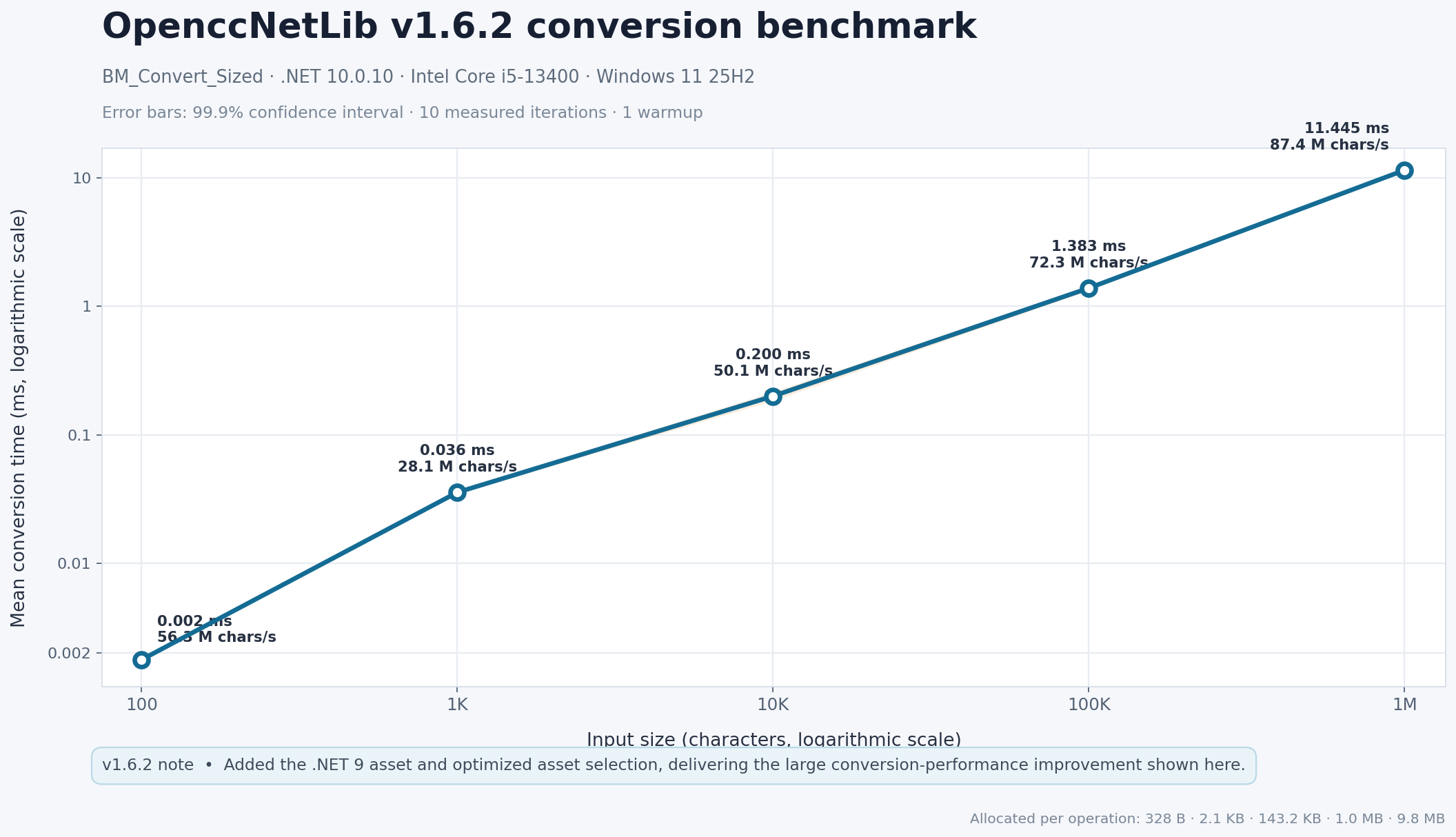
- 🚀 High throughput: processes 1M characters in ~11.45 ms, or roughly 87 million characters/second on the tested Intel i5-13400 system.
- 📉 Much lower allocation: uses about 9.8 MB for the 1M-character conversion, down from about 75.7 MB in v1.6.1.
- ⚙️ Modern-runtime fast path: .NET 9+ uses allocation-free span-key dictionary probes; .NET Standard 2.0 retains the compatible string-key fallback.
- 📌 Predictable scaling: both elapsed time and memory remain approximately linear as input size grows.
- 📚 Same conversion semantics: the optimization changes candidate lookup mechanics, not dictionary selection, longest-match behavior, or output.
-
Opencc(string config = null, bool isPreserveIds = false, bool isFrozen = false)Creates a new converter using a configuration name (e.g.,"s2t","t2s").
This overload is compatible with existing code but requires string-based config. -
Opencc(OpenccConfig configEnum, bool isPreserveIds = false, bool isFrozen = false)Creates a new converter using the strongly-typedOpenccConfigenum
(e.g.,OpenccConfig.S2T,OpenccConfig.T2S).
Recommended for all new code because it avoids magic strings.
-
string Convert(string inputText, bool punctuation = false)
Convert text according to the current config and punctuation mode. -
string S2T(string inputText, bool punctuation = false) -
string T2S(string inputText, bool punctuation = false) -
string S2Tw(string inputText, bool punctuation = false) -
string Tw2S(string inputText, bool punctuation = false) -
string S2Twp(string inputText, bool punctuation = false) -
string Tw2Sp(string inputText, bool punctuation = false) -
string S2Hkp(string inputText, bool punctuation = false) -
string Hk2Sp(string inputText, bool punctuation = false) -
string T2Hkp(string inputText, bool punctuation = false) -
string Hk2Tp(string inputText, bool punctuation = false) -
string S2Hk(string inputText, bool punctuation = false) -
string Hk2S(string inputText, bool punctuation = false) -
string T2Tw(string inputText, bool punctuation = false) -
string T2Twp(string inputText, bool punctuation = false) -
string Tw2T(string inputText, bool punctuation = false) -
string Tw2Tp(string inputText, bool punctuation = false) -
string T2Hk(string inputText, bool punctuation = false) -
string Hk2T(string inputText, bool punctuation = false) -
string T2Jp(string inputText) -
string Jp2T(string inputText)
Opencc supports both string-based and enum-based configuration APIs.
Internally, all configurations are stored as a strongly typed OpenccConfig identifier;
string APIs are provided for backward compatibility and convenience.
Recommended: Use the
OpenccConfigenum–based APIs whenever possible.
String-based APIs are fully supported but are considered legacy-style convenience helpers.
-
bool IsFrozen { get; }Reports whether configuration and IDS-preservation settings were frozen during construction. -
string Config { get; set; }
Gets or sets the current conversion configuration using a canonical string
(for example,"s2t","tw2sp").
Invalid values automatically fall back to"s2t"and update the internal error status. -
void SetConfig(string config)
Sets the conversion configuration using a string name.
Comparison is case-insensitive and ignores surrounding whitespace.
Falls back to"s2t"if the value is invalid. -
void SetConfig(OpenccConfig configEnum)
Sets the conversion configuration using a strongly typedOpenccConfigenum value.
This is the preferred and recommended approach for type safety, IDE support, and interop scenarios (P/Invoke, JNI, bindings). -
string GetConfig()
Returns the current configuration as a canonical lowercase string
(for example,"s2tw"). -
OpenccConfig GetConfigId()
Returns the current configuration as anOpenccConfigenum value.
This reflects the authoritative internal configuration state. -
string GetLastError()
Returns the most recent configuration-related error message, if any.
Anullvalue indicates that no configuration error is currently recorded.
The following static helpers are provided for validation, parsing, and discovery of supported configurations:
-
static bool TryParseConfig(string config, out OpenccConfig result)
Attempts to parse a configuration string into the correspondingOpenccConfigenum value.
Comparison is case-insensitive and ignores leading or trailing whitespace.
Returnsfalseif the input isnull, empty, or not a recognized configuration. -
static bool IsValidConfig(string config)
Determines whether the specified string represents a supported OpenCC configuration. -
static IReadOnlyCollection<string> GetSupportedConfigs()
Returns a read-only collection of all supported configuration names
(canonical lowercase strings).
The returned collection is stable and does not allocate on each call. -
static int ZhoCheck(string inputText)
Detects whether the input text is likely:2→ Simplified Chinese1→ Traditional Chinese0→ Neither / unknown
-
string NormalizeCompat(string text)Normalizes mapped CJK Compatibility Ideographs with the built-in Unicode compatibility table. Use this as an optional pre-processing step beforeConvert(...)when input may contain forms such as金. Unmapped text is preserved unchanged.
OpenccNetLib exposes dictionary provider APIs for advanced scenarios such as custom dictionaries, generated dictionary artifacts, test fixtures, and tooling. Most applications can use the built-in dictionary without calling these APIs.
-
static void UseCustomDictionary(DictionaryMaxlength customDictionary)Sets the process-wide provider to a customDictionaryMaxlengthinstance and atomically refreshes internal conversion state. Prefer calling this once during application startup, before conversions begin. Calls already in progress may finish with the previous complete state; subsequent calls, including calls through existingOpenccinstances, use the replacement provider. -
static void UseDefaultDictionary()Restores the active provider to the built-in dictionary and atomically refreshes internal conversion state. -
static void UseDictionaryFromPath(string dictionaryRelativePath)Loads OpenCC text dictionary files withDictionaryLib.FromDicts(dictionaryRelativePath)and activates the result. -
static void UseDictionaryFromJsonString(string jsonString)Deserializes aDictionaryMaxlengthJSON payload and activates it as the custom dictionary provider.
-
static DictionaryMaxlength Provider { get; }Returns the shared built-in dictionary instance. -
static DictionaryMaxlength GetActiveProvider()Returns the dictionary instance currently supplied by the active provider delegate. -
static DictionaryMaxlength New()Returns the built-in dictionary and resets the active provider to the built-in dictionary. -
static void SetDictionaryProvider(DictionaryMaxlength dictionary)Sets the active dictionary provider to a fixedDictionaryMaxlengthinstance and atomically refreshes derived conversion state. Conversions already in progress may finish with the previous complete state; subsequent conversions use the replacement state. -
static void ResetDictionaryProviderToDefault()Restores the active dictionary provider to the built-in dictionary and atomically refreshes derived conversion state.
static DictionaryMaxlength FromDicts(string relativeBaseDir = "dicts", IDictionary<DictSlot, string> overrides = null, IDictionary<DictSlot, string> appends = null)
Loads OpenCC text dictionary files, optionally replacing slots with overrides or extending slots with appends.
-
static DictionaryMaxlength WithCustomDicts(DictionaryMaxlength dict, IEnumerable<CustomDictSpec> specs)Applies post-load customization to an already loaded dictionary provider. Each spec targets oneDictSlot, reads optionalPathsand/orPairs, and applies them withCustomDictMode.AppendorCustomDictMode.Override. -
static DictionaryMaxlength FromJson(string relativePath = "dicts/dictionary_maxlength.json")Loads and normalizes a JSON dictionary payload. -
static DictionaryMaxlength DeserializedFromJson(string path)Compatibility wrapper aroundFromJson(path). -
static DictionaryMaxlength FromCbor(string relativePath = "dicts/dictionary_maxlength.cbor")Loads and normalizes a CBOR dictionary payload. -
static DictionaryMaxlength LoadJsonCompressed(string path)Loads and normalizes a Zstandard-compressed JSON dictionary payload.
The serialization helpers accept an optional DictionaryMaxlength dictionary = null parameter. When omitted, they load
from the default OpenCC text dictionary sources with FromDicts().
-
static void SerializeToJson(string path, DictionaryMaxlength dictionary = null)Writes a dictionary to indented JSON. -
static void SerializeToJsonUnescaped(string path, DictionaryMaxlength dictionary = null)Writes indented UTF-8 JSON without escaping non-ASCII characters. -
static void SaveCbor(string path, DictionaryMaxlength dictionary = null)Writes a dictionary as CBOR. -
static byte[] ToCborBytes(DictionaryMaxlength dictionary = null)Returns a CBOR-encoded dictionary payload. -
static void SaveJsonCompressed(string path, DictionaryMaxlength dictionary = null)Writes a dictionary as Zstandard-compressed JSON.
var dict = DictionaryLib.FromDicts(
    appends: new Dictionary<DictSlot, string>
    {
        [DictSlot.STPhrases] = "./UserDict.txt"
    });

DictionaryLib.SerializeToJson("./custom-dictionary.json", dict);
DictionaryLib.SaveCbor("./custom-dictionary.cbor", dict);
DictionaryLib.SaveJsonCompressed("./custom-dictionary.zstd", dict);- All configuration inputs ultimately resolve to a single internal
OpenccConfigidentifier. - Invalid configuration values never throw; they safely fall back to
"s2t". - Enum-based APIs are future-proof and align with the C API, Rust core, and other language bindings.
- Dictionaries are loaded and cached on first use.
- Data files are expected in the
dicts/directory (seeDictionaryLibfor details).
Description:
  Generate OpenccNetLib dictionary files.

  Examples:
    OpenccNet dictgen
      Generate default Zstd dictionary (dictionary_maxlength.zstd)

    OpenccNet dictgen -f cbor
      Generate CBOR dictionary for interop

    OpenccNet dictgen -f json --unescape
      Generate readable JSON dictionary without \uXXXX escapes


Usage:
  OpenccNet dictgen [options]

Options:
  -f, --format <format>            Dictionary format: zstd|cbor|json [default: zstd]
  -o, --output <output>            Output filename. Default: dictionary_maxlength.<ext>
  -b, --base-dir <base-dir>        Base directory containing OpenCC-style .txt dictionary sources (for dictgen) [default: dicts]
  -u, --unescape                   For JSON format only: write readable Unicode characters instead of \uXXXX escapes
  -D, --custom-dict <custom-dict>  Load custom dictionary: <slot>:<mode>:<path>.
                                   Example: HkPhrasesRev:append:my_hk_dict.txt
                                   Available slots: STCharacters, STPhrases, STPunctuations, TSCharacters, TSPhrases, TSPunctuations, TWPhrases, TWPhrasesRev,
                                   TWVariants, TWVariantsRev, TWVariantsRevPhrases, HKVariants, HKVariantsRev, HKVariantsRevPhrases, JPSCharacters, JPSPhrases,
                                   TWVariantsPhrases, HKVariantsPhrases, JPSCharactersRev, HKPhrases, HKPhrasesRev
  -?, -h, --help                   Show help and usage information
Description:
  Convert text using OpenccNetLib configurations.

Usage:
  OpenccNet convert [options]

Options:
  -i, --input <input>               Read original text from file <input>
  -o, --output <output>             Write original text to file <output>
  -c, --config <config> (REQUIRED)  Conversion configuration.
                                    Valid options: s2t, t2s, s2tw, tw2s, s2twp, tw2sp, s2hkp, hk2sp, t2hkp, hk2tp, s2hk, hk2s, t2tw, tw2t, t2twp, tw2tp, t2hk,
                                    hk2t, t2jp, jp2t
  -p, --punct                       Punctuation conversion.
  --detofu <detofu>                 Apply tofu-safe fallback after conversion: all, ext-b, ext-c, ext-d, ext-e, ext-f, ext-g, ext-h, ext-i
  --detofu-file <detofu-file>       Load additional DeTofu fallback mappings from a UTF-8 text file. Custom mappings override built-in mappings (requires
                                    --detofu)
  -I, --keep-ids                    Preserve Unicode IDS expressions during conversion.
  -n, --norm-compat                 Normalize CJK Compatibility Ideographs before conversion.
  -D, --custom-dict <custom-dict>   Load custom dictionary: <slot>:<mode>:<path>.
                                    Example: HkPhrasesRev:append:my_hk_dict.txt
                                    Available slots: STCharacters, STPhrases, STPunctuations, TSCharacters, TSPhrases, TSPunctuations, TWPhrases, TWPhrasesRev,
                                    TWVariants, TWVariantsRev, TWVariantsRevPhrases, HKVariants, HKVariantsRev, HKVariantsRevPhrases, JPSCharacters,
                                    JPSPhrases, TWVariantsPhrases, HKVariantsPhrases, JPSCharactersRev, HKPhrases, HKPhrasesRev
  --in-enc <in-enc>                 Encoding for input: UTF-8|UNICODE|GBK|GB2312|BIG5|Shift-JIS [default: UTF-8]
  --out-enc <out-enc>               Encoding for output: UTF-8|UNICODE|GBK|GB2312|BIG5|Shift-JIS [default: UTF-8]
  -?, -h, --help                    Show help and usage information
Example: append a custom Hong Kong phrase dictionary for hk2sp using the verified portable token.
data\my_hk_dict.txt:
# Custom Dictionary

細路哥	小男孩
"這個細路哥很靈活" | .\OpenccNet.exe convert -c hk2sp -D 'hkphrasesrev:append:data\my_hk_dict.txt'
这个小男孩很灵活
✅ Conversion (hk2sp): <stdin> → <stdout>
Repeat -D or --custom-dict to apply multiple specifications in command-line order:
.\OpenccNet.exe convert -c hk2sp -i input.txt -o output.txt `
  -D 'hkphrasesrev:append:data\my_hk_dict.txt' `
--custom-dict 'tsphrases:append:data\company_ts_phrases.txt'Description:
Convert Office documents or EPUB using OpenccNetLib.
Usage:
OpenccNet office [options]
Options:
-i, --input <input> Input Office document <input>
-o, --output <output> Output Office document <output>
-c, --config <config> (REQUIRED) Conversion configuration.
Valid options: s2t, t2s, s2tw, tw2s, s2twp, tw2sp, s2hkp, hk2sp, t2hkp, hk2tp, s2hk, hk2s, t2tw, tw2t, t2twp, tw2tp, t2hk,
hk2t, t2jp, jp2t
-p, --punct Enable punctuation conversion.
-f, --format <format> Force Office document format: docx | xlsx | pptx | odt | ods | odp | epub
-k, --keep-font Preserve font names in Office documents [default: true]. Use --keep-font:false to disable.
-q, --quiet Suppress status and progress output; only errors will be shown.
-D, --custom-dict <custom-dict> Load custom dictionary: <slot>:<mode>:<path>.
Example: HkPhrasesRev:append:my_hk_dict.txt
Available slots: STCharacters, STPhrases, STPunctuations, TSCharacters, TSPhrases, TSPunctuations, TWPhrases, TWPhrasesRev,
TWVariants, TWVariantsRev, TWVariantsRevPhrases, HKVariants, HKVariantsRev, HKVariantsRevPhrases, JPSCharacters,
JPSPhrases, TWVariantsPhrases, HKVariantsPhrases, JPSCharactersRev, HKPhrases, HKPhrasesRev
-?, -h, --help Show help and usage information
Description:
  Convert a PDF to UTF-8 text using PdfPig + OpenccNetLib, with optional CJK paragraph reflow.

Usage:
  OpenccNet pdf [options]

Options:
  -i, --input <input>              Input PDF file <input.pdf>
  -o, --output <output>            Output text file <output.txt>
  -c, --config <config>            Conversion configuration.
                                   Valid options: s2t, t2s, s2tw, tw2s, s2twp, tw2sp, s2hkp, hk2sp, t2hkp, hk2tp, s2hk, hk2s, t2tw, tw2t, t2twp, tw2tp, t2hk,
                                   hk2t, t2jp, jp2t
  -p, --punct                      Enable punctuation conversion.
  -H, --header                     Add [Page x/y] headers to the extracted text.
  -r, --reflow                     Reflow CJK paragraphs into continuous lines.
  -C, --compact                    Use compact reflow (fewer blank lines between paragraphs). Only meaningful with --reflow.
  -q, --quiet                      Suppress status and progress output; only errors will be shown.
  -e, --extract                    Extract text from PDF only (no OpenCC conversion).
  -n, --norm-compat                Normalize CJK Compatibility Ideographs before conversion.
  -D, --custom-dict <custom-dict>  Load custom dictionary: <slot>:<mode>:<path>.
                                   Example: HkPhrasesRev:append:my_hk_dict.txt
                                   Available slots: STCharacters, STPhrases, STPunctuations, TSCharacters, TSPhrases, TSPunctuations, TWPhrases, TWPhrasesRev,
                                   TWVariants, TWVariantsRev, TWVariantsRevPhrases, HKVariants, HKVariantsRev, HKVariantsRevPhrases, JPSCharacters, JPSPhrases,
                                   TWVariantsPhrases, HKVariantsPhrases, JPSCharactersRev, HKPhrases, HKPhrasesRev
  -?, -h, --help                   Show help and usage information
OpenccNet pdf uses a text-based PDF extraction engine (PdfPig) and is intended for digitally generated PDFs
(e-books, research papers, reports).
- ✅ Works best with selectable text
- ❌ Does not perform OCR on scanned/image-only PDFs
- ❌ Visual layout (columns, tables, figures) is not preserved
The --reflow option applies a CJK-aware paragraph reconstruction pipeline, designed for Chinese novels, essays,
and academic text.
Reflow attempts to:
- Join artificially wrapped lines
- Repair cross-line splits (e.g.
面+容→面容) - Preserve headings, short titles, dialog markers, and metadata-like lines
- Reflow is heuristic-based
- It is not suitable for:
- Poetry
- Comics / scripts
- Highly informal or experimental layouts
- Web novels often use inconsistent formatting and may require tuning
When used together with --reflow, --compact:
- Reduces excessive blank lines
- Produces denser, book-like paragraphs
- Is recommended for long-form reading or further text processing
--compacthas no effect unless--reflowis enabled.
Using --header inserts markers such as:
=== [Page 12/240] ===
This is useful for:
- Debugging extraction issues
- Locating original PDF pages
- Avoiding empty or ambiguous page boundaries
--quiet suppresses:
- Progress bars
- Status messages
- Informational logs
Only errors will be printed.
Recommended for batch processing or script integration.
- Output text is always written as UTF-8
- Line endings follow the host platform
If you need other encodings, convert the output text using standard tools after extraction.
Simple PDF → Traditional Chinese text
OpenccNet pdf -i input.pdf -o output.txt -c s2t -r
Compact novel conversion with page markers
OpenccNet pdf -i novel.pdf -o novel.txt -c s2tw -r --compact -H
Batch / automation use
OpenccNet pdf -i file.pdf -o out.txt -c t2s -r -q
- OpenccNetLibGui : A GUI application for
OpenccNetLib, providing a user-friendly interface for Traditional/Simplified Chinese text conversion.
- This project is licensed under the MIT License. See the LICENSE file for details.
See THIRD_PARTY_NOTICES.md for bundled OpenCC lexicons (Apache License 2.0).
OpenccNet is not affiliated with the original OpenCC project, but aims to provide a compatible and high-performance solution for .NET developers.