Kaiqi Liu · Haoxuan Zeng · Jingqi Liu · Jiacong Fang · Ziqi Cai · Yunyao Mao · Henglin Liu · Yu Sheng · Shuchen Weng · Boxin Shi





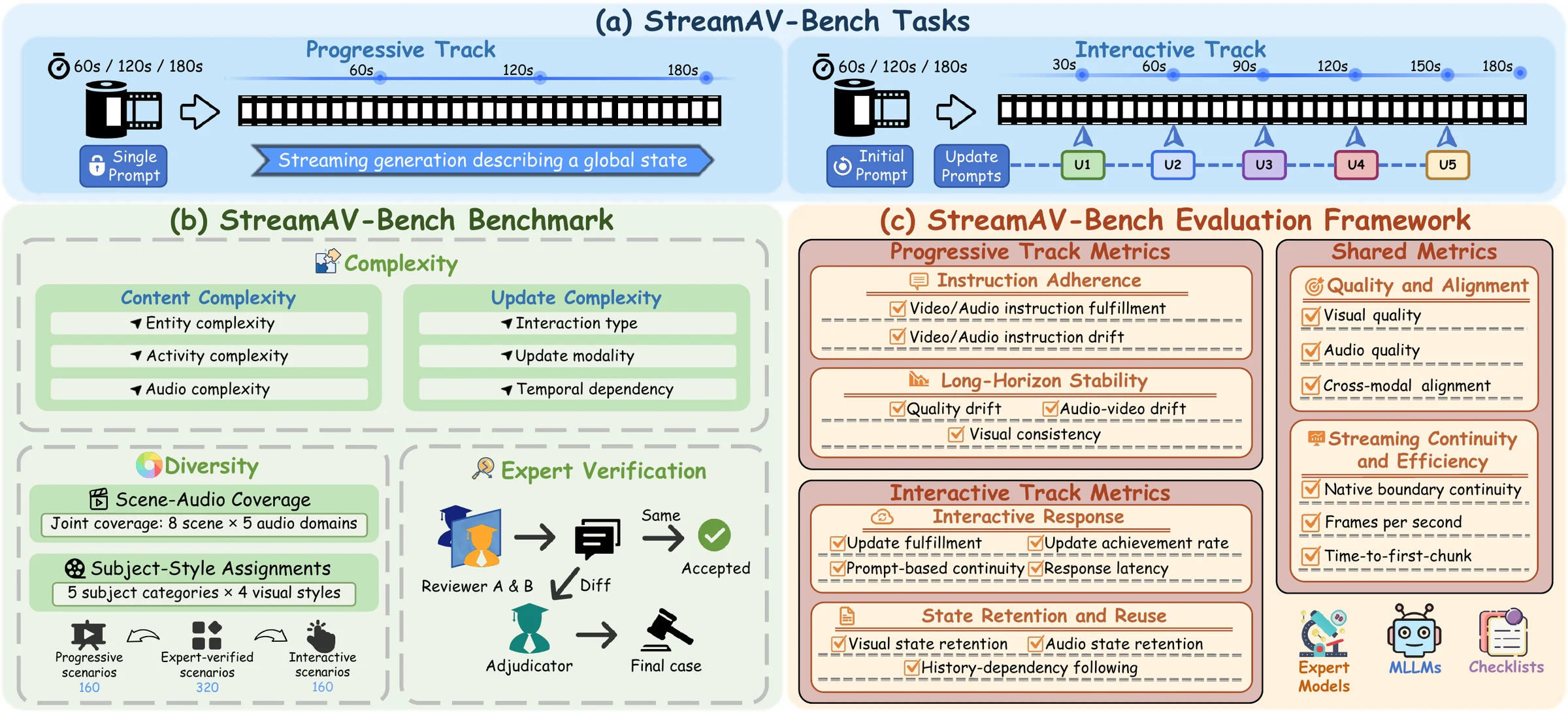
StreamAV-Bench evaluates streaming audio-video generation through a Progressive Track for instruction adherence and long-horizon stability and an Interactive Track for runtime-update response, state retention, and history-dependent reuse. It contains 160 scenarios per track, 800 interactive updates, and 32 evaluation dimensions.
This repository provides the evaluation code. Benchmark prompts and checklists are distributed through the StreamAV-Bench dataset.
.
├── configs/                 Worker template and NBC protocol
├── docs/                    External dependency guide
├── examples/                Minimal evaluation, run, and report configurations
├── scripts/                 Checkpoint, configuration, aggregation, and export helpers
├── src/streamav_eval/       Evaluation package and command-line implementation
├── third_party/             Minimal evaluator runtime dependencies
├── evaluate.py              Main evaluation command
├── run_evaluation.sh        End-to-end evaluation wrapper
├── setup.sh                 Conda environment setup
├── requirements.txt         Main evaluator environment
├── requirements_sync.txt    Synchronization evaluator environment
├── pyproject.toml           Package metadata and CLI entry point
├── LICENSE                  StreamAV-Bench MIT License
└── NOTICE                   External software and model attribution
Create the two evaluator environments and download the evaluator checkpoints:
bash setup.sh
conda activate streamav
export STREAMAV_DATASET_ROOT="/path/to/StreamAVBench-Dataset"
export STREAMAV_GEMINI_KEYS_PATH="/path/to/api_keys.txt"
bash scripts/download_assets.sh
Put one Gemini API key per line in the key file. See docs/dependencies.md for checkpoint sources.
Provide one JSON object per generated scenario:
{
  "model_id": "my-model",
  "case_id": "P-0001",
  "video_path": "outputs/my-model/P-0001.mp4",
  "runtime": {
    "generated_video_frames": 2880,
    "generation_time_seconds": 240.0,
    "time_to_first_chunk_seconds": 4.2
  }
}
Paths may be absolute or relative to the manifest. The track and expected
duration are read from the benchmark dataset. A full submission contains one
output for every scenario in both tracks.
Include runtime for every case of a model when generation timing can be
measured; otherwise omit it from every case. For cascaded systems, timing must
include the full audio-video pipeline.
Copy the example manifest, replace its media paths with your generated videos, and run:
bash run_evaluation.sh examples/evaluation.jsonResults are written to artifacts/report/report.json. The script validates the
inputs, builds metric jobs, runs evaluators, and aggregates the report.
Native-boundary continuity and efficiency require generation-time metadata and are added before public export. The corresponding helpers expose their options through:
python scripts/aggregate_efficiency.py --help
python scripts/evaluate_nbc.py --help
python scripts/aggregate_nbc.py --help
Export the 32 public dimensions to JSON and CSV with:
python scripts/export_public_results.py --helpStreamAV-Bench reports 32 dimensions and does not define an overall score:
- Shared: VA, VQ, PQ, AQ, AVAlign, AVSync, NBC, FPS, and TTFC.
- Progressive instruction following: VIF, AIF, VID, and AID.
- Progressive long-horizon stability: VA-D, VQ-D, PQ-D, AQ-D, SC, BC, AVAlign-D, and AVSync-D.
- Interactive response and state: VUF, AUF, PVC, PAC, PVUAR, PAUAR, PVRL, PARL, VSR, ASR, and HDF.
SC and BC uniformly sample the full 180-second rollout at 2 FPS before the VBench-Long slow-fast evaluation. AVSync averages the absolute offsets from the first and last 4.8-second windows of each 30-second interval. Results are first aggregated within each case and then averaged uniformly across cases. VSR and ASR are evaluated for every runtime update.
@misc{liu2026streamavbenchcomprehensivebenchmarkstreaming,
  title         = {StreamAV-Bench: A Comprehensive Benchmark for Streaming Audio-Video Generation},
  author        = {Kaiqi Liu and Haoxuan Zeng and Jingqi Liu and Jiacong Fang and Ziqi Cai and Yunyao Mao and Henglin Liu and Yu Sheng and Shuchen Weng and Boxin Shi},
  year          = {2026},
  eprint        = {2608.26336},
  archivePrefix = {arXiv},
  primaryClass  = {cs.SD},
  url           = {https://arxiv.org/abs/2608.26336}
}The StreamAV-Bench code, documentation, and evaluator prompts are released under the MIT License. The benchmark dataset is released separately under CC BY-NC 4.0. Third-party packages, models, and checkpoints retain their own terms; see NOTICE.