
Inspired by SKILL.state
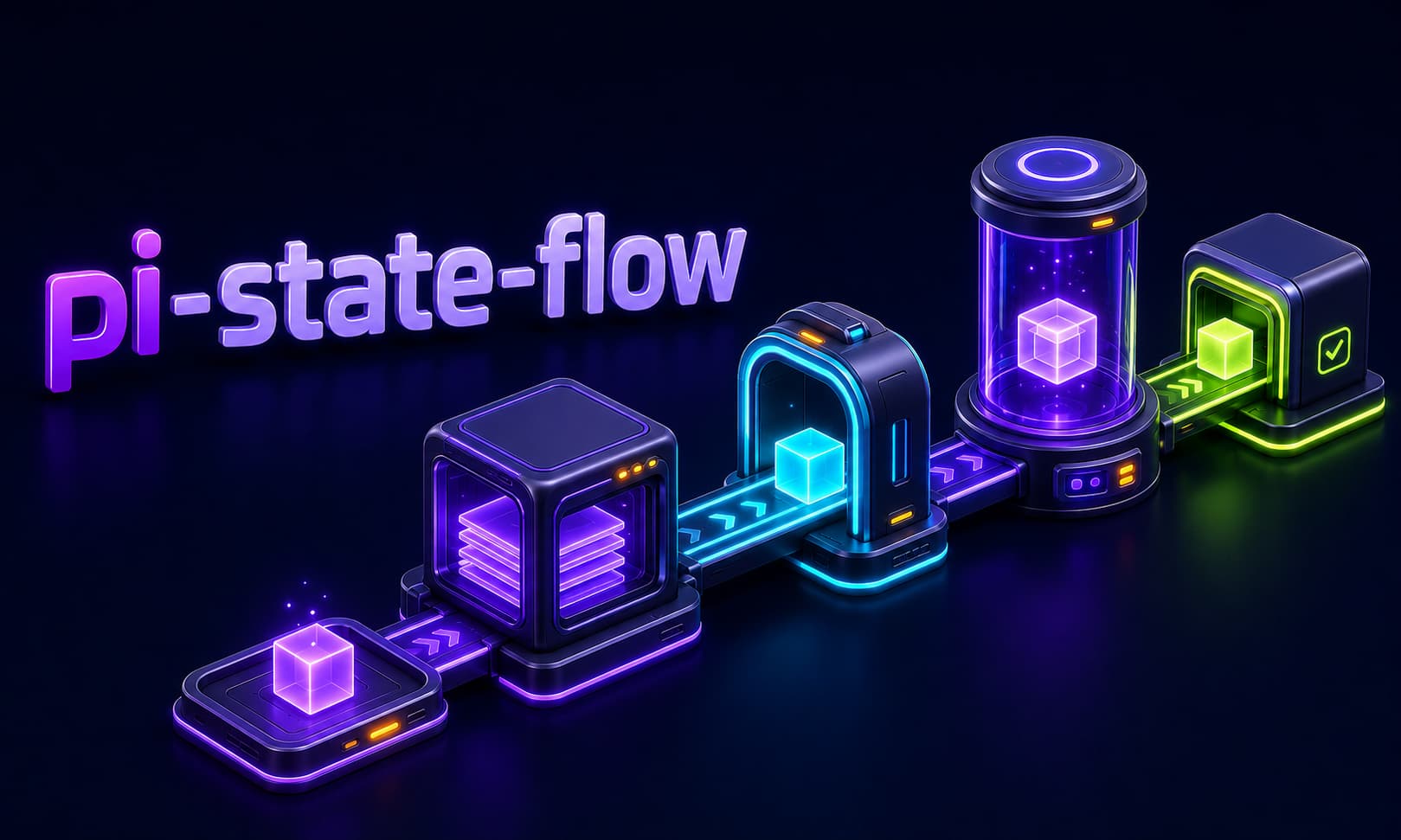
An opt-in Pi extension for explicit, validated state handoffs between complete agent runs.
State Flow preserves Pi's native tool loop inside each user request:
user request
  → model → tool → model → tool → model
  → one terminal answer (memory patch when needed)
  → committed state + displayed response
The current run keeps its user message, assistant tool calls, tool results, and persistent or current-run context-bearing custom messages from other Pi extensions model-visible. Only after the terminal handoff does the next run replace that trajectory with one materialized state. Pi's complete session trace remains inspectable.
Requirements: Pi 0.84.4–0.84.x and Node.js 22.19.0 or newer.
Install from npm:
pi install npm:@llblab/pi-state-flowOr install from GitHub:
pi install git:github.com/llblab/pi-state-flowPi packages execute with full user permissions; review the source before installing, as with any extension.
/state-flow-start
In a fresh session, the next prompt starts the first stateful run. Each later non-retry user prompt becomes the current turn-stable specification while committed state remains intact. When enabled inside an existing session, the first complete run retains the active pre-Flow context and must migrate every future-relevant fact into its terminal handoff.
The extension registers no model tools. Tool-bearing assistant responses use ordinary Pi tools and contain no State Flow patch. When memory changes, a terminal assistant response contains one transcript-private memory-patch comment, one separating blank line, and the user-facing answer exactly once. When memory is unchanged, an ordinary non-empty answer is sufficient: the runtime treats the missing comment as an empty memory patch, preserving contract and working while replacing response. Transcript-private means removed from the finalized message and later model context, not confidential during streaming:
<!-- state_flow {"contract":{...},"working":{...}} -->

Complete user-facing answer
At message_end, an explicit private comment must start the single terminal text block and be followed by exactly one blank line. Without a State Flow comment marker, ordinary text blocks are concatenated without inserted characters and preserved unchanged; no regeneration is triggered merely because the comment is absent. Malformed, incomplete, or embedded State Flow comment markers still fail explicit-envelope validation rather than silently becoming no-op patches. It removes only the comment and separator and stages all three state fields. At turn_end, it reconciles response with Pi's finalized assistant message after all chained message_end handlers, concatenating any text blocks without inserting characters, then commits. If a later handler removes all answer text or adds a tool call after terminal validation, the same hidden regeneration chain runs. Arbitrary response Markdown remains outside the HTML comment, so its own content cannot terminate the private frame. Invalid terminal commits are regenerated through hidden feedback up to three times. If all retries fail, State Flow remains enabled, preserves the last committed snapshot, abandons only the transient validation chain, and lets the next user request start cleanly from that state. Tool-bearing turns do not reset the attempt count. Aborting a regeneration has the same non-destructive behavior.
Commands:
/state-flow-start   # Start a fresh episode
/state-flow-status  # Inspect iteration metadata and the complete state JSON
/state-flow-stop    # Stop and clear the complete episode
The compact Pi status renders an accent state-flow label followed by the dimmed committed iteration number, for example state-flow #7. /state-flow-status reports iteration metadata, then separates the complete pretty-formatted materialized state JSON with a blank line for operator analysis.
/state-flow-stop clears the specification, materialized state, validation feedback, and committed-run counter. A later /state-flow-start always begins a fresh episode. State follows the active Pi session branch and is restored immediately after /tree navigation. If the newest checkpoint is malformed, restoration walks backward to the newest valid checkpoint instead of resetting an otherwise recoverable episode. Entering a branch with no State Flow snapshot leaves the mode disabled there.
The model sees one persistent state object before the current run trajectory:
{
  "contract": {},
  "working": {},
  "response": "Latest complete user-facing answer"
}
Materialized state has exactly three fields:
contractis a flexible object containing durable user requirements, stable decisions, rejected approaches, interface commitments, and compact operational knowledge compiled from relevant Skills or documents.workingis a flexible object containing verified facts, artifacts, validation, failures, unresolved work, current environment or domain state, and the exact continuation point.responseis the exact non-empty answer body captured by the runtime. It replaces the previous response on every commit.
The transcript-private wire patch contains only contract and working; the runtime derives response from Pi's finalized answer body. Memory patches merge recursively and materialize immediately. Empty objects preserve existing content; arrays and primitives replace. Nested object-key null deletes that key:
<!-- state_flow {"contract":{},"working":{"move":null,"result":"ok"}} -->

The operation completed.
This removes working.move, replaces working.result, preserves every other memory key, and stores The operation completed. as response. Materialized state cannot contain null, including inside arrays; represent semantic absence by omitting a key or using an explicit non-null domain value.
State and patch size have no byte, growth, pressure, or project-schema limit. Patch history remains only in the Pi trace, not in model context.
These three fields are the complete materialized State Flow state, but they are not the only state that can shape model behavior. A situational fourth, exogenous state lives outside the handoff: the current project, workspace, tools, processes, and runtime environment. It can change while work is in progress—including through the model's own tool effects—and later observations of those changes can alter subsequent behavior. State Flow neither snapshots nor rolls back this external state; working should retain only the decision-relevant facts needed to reconnect the next run to it.
Treat working as the last observation, not a live workspace. Before consequential actions, revalidate the volatile facts that action depends on: for example, the current revision and dirty files before editing, or the remote publication status before retrying a release. This is targeted inspection, not a requirement to reread stable knowledge or compiled Skills routinely.
After an interruption or session-branch navigation, inspect relevant external effects before repeating operations. A failed terminal commit does not undo file edits, running processes, or remote requests; restoring older memory does not restore the workspace. Missing memory is evidence of neither success nor absence of effects. If the effect cannot be verified, retain that uncertainty and the next discriminating check instead of blindly retrying or claiming completion.
These are protocol obligations, not runtime freshness checks, rollback, or exactly-once execution guarantees. No action ledger or new evidence-retrieval tool is introduced.
The terminal answer commits a handoff, not a progress phrase or transcript summary. A memory patch is required when future-relevant memory changes; omitting it is only shorthand for preserving existing memory, not a way to infer new memory from prose. The next run may see only this state plus its new user prompt. A fresh model should be able to continue without rereading, rediscovering, re-deriving decisions, or repeating failed approaches.
Useful handoffs capture:
- Stable requirements, constraints, decisions, rejected approaches, and compiled operational rules in
contract. - Verified facts, changed artifacts, validation evidence, failures, unresolved work, current domain state, and exact continuation in
working.
Before compressing, preserve active constraints, unresolved questions, consequential negative results, and the next check that would distinguish competing explanations. Keep observations, user requirements, assistant decisions, and hypotheses distinguishable; an assistant conclusion is not a user requirement. Retain decision-relevant hypotheses as uncertain rather than deleting them merely because they are unverified.
For consequential facts, include a compact source locator and validity condition when useful (for example, a test command and the revision it checked), not mandatory metadata on every value. Record why an approach was rejected and what would justify reconsidering it. When new information conflicts with an established constraint or observation, reconcile it using evidence or user clarification; neither an unsupported new claim nor fallible old memory wins automatically. If unresolved, preserve the conflict and the next discriminating check.
These are model obligations, not semantic validation gates. Protocol tests check that the instructions remain present; only continuation evaluations can establish whether a fresh agent makes the next correct decision.
Do not store raw source, logs, tool output, reasoning traces, or vague values such as "continue work" and "in progress".
A successful SKILL.md read is treated as episode-level acquisition. Before terminal commit, the model compiles its future-relevant operational rules, applicability conditions, constraints, syntax, routing decisions, and failure conditions under the exact source path. This compilation lives inside persistent contract memory at contract.compiled_skills; compiled_skills never becomes a fourth top-level state field. The nested representation remains fully flexible:
{
  "contract": {
    "compiled_skills": {
      "/exact/path/to/SKILL.md": {
        "routing": "...",
        "syntax": { "...": "..." },
        "constraints": ["..."],
        "reread_when": ["..."]
      }
    }
  }
}
No coverage/rules schema is imposed. The model chooses the smallest structure that faithfully preserves the Skill's useful behavior. Raw Skill text is not copied. The runtime checks only that the exact successfully executed source path has a non-empty compilation and rejects a terminal commit when it is missing. Attribution follows Pi's lifecycle order: it retains the mutable tool_call input reference so later interception rewrites resolve to the path actually executed, with tool_execution_start arguments as a compatibility fallback.
A complete matching compilation is authoritative episode memory and replaces routine rereading. Rereading is justified only by an explicitly uncovered detail, an incomplete compilation, concrete source-change evidence, a contradiction or execution failure requiring reconciliation, or an explicit user request. The mere possibility that a source changed is not sufficient. A justified reread refreshes the compilation and removes obsolete rules.
State is a minimal sufficient memory, not an append-only diary. At every handoff the model audits the complete state and may reorganize inefficient structure, merge fragments, replace verbose history with current conclusions, and delete stale, completed, redundant, or low-value keys with null. Active requirements, decisions, interfaces, verified evidence, and unresolved work must survive optimization.
The model must not invent bookkeeping merely to change contract or working. When a run creates no future-relevant information and existing memory is already efficient, both patch objects may remain empty, or the comment may be omitted entirely, while response still contains the actual answer. Successful Skill reads still require their compilations in materialized memory even when the comment is omitted. Bootstrap migration remains a model obligation: a plain answer cannot migrate pre-Flow context automatically. Structurally invalid handoffs are regenerated through hidden validation feedback; retry diagnostics are not user-facing output.
Within one run, State Flow projects:
persistent materialized state
+ current user prompt
+ current-run assistant tool calls
+ current-run tool results
+ persistent and current-run context-bearing custom messages from other extensions
+ optional terminal validation feedback
Earlier completed-run trajectories are removed from model context. During a bootstrap run, the active pre-Flow context remains available until the first successful terminal commit.
The normative protocol remains in the system prompt throughout a tool/retry chain. The turn-stable specification remains user-authority input: it stays in the initiating user message and is repeated, together with materialized state and private validation feedback, only in a synthetic user runtime-context message. The protocol explicitly treats persistent state as fallible assistant-produced data whose transport role does not elevate it into user instructions. Empty text specifications used by image-only prompts remain valid. State and the current-run trajectory are intentionally unbounded; State Flow does not claim a hard model-context bound.
- State commits exactly once per successful complete agent run, at terminal
message_end/turn_end. - Tool-bearing responses do not require or commit patches and retain ordinary Pi tool behavior, including multiple sequential calls. The runtime removes an accidental leading terminal envelope only when its JSON, fields, separator, and non-empty response are all structurally valid; malformed or quoted examples remain untouched.
- Terminal answers cannot contain another complete State Flow comment, even inside a fenced code block or inline code: duplicate detection scans the entire answer body, not Markdown structure. When explaining the protocol while State Flow is enabled, describe the fields or show plain JSON without the HTML comment delimiters. The literal envelope examples in this README are documentation, not valid content to copy into a terminal answer body.
- A failed tool remains in the current run trajectory for ordinary model reconciliation before terminal commit.
- If a run never reaches a valid terminal handoff, its external tool effects may exist while persistent State Flow state remains at the previous commit.
- The terminal envelope exists in ordinary assistant text until
message_end;message_update, RPC, JSON, or other streaming consumers can observe it. Never place secrets in State Flow state. - This mode remains a poor fit for auditing or outputs that require complete historical trajectories across user requests.
- Token, cache, latency, and success-rate advantages still require controlled Pi benchmarks.
index.ts is only the package composition and public-export boundary. Independent runtime domains live under lib/: json owns lossless JSON and patches, state owns the materialized state shape, episode owns explicit start/stop and user-run boundaries, snapshot owns persistence migration, session owns active-branch snapshot discovery and bootstrap detection, recovery falls back to the newest valid active-branch checkpoint, status owns deterministic operator-facing status rendering, context owns trajectory projection, private-feedback filtering, and synthetic runtime-context construction, skills owns Skill acquisition rules and mutable lifecycle correlation, terminal owns the handoff protocol, validation owns bounded retry decisions, transition owns atomic staging and compare-and-swap commits, and extension coordinates these domains with Pi. Every domain has a same-named test under tests/; lifecycle scenarios are colocated with the domain whose contract they exercise, tests/extension.test.ts remains focused on composition, shared setup lives in tests/harness.ts, and cross-domain constraints live in tests/invariants.test.ts.
npm install
npm run validate
Validation covers TypeScript checking, automated tests, and an extension import smoke check. Lifecycle tests use a mock Pi event harness; they do not establish behavior under the real Pi scheduler, queued prompts, abort/compaction interactions, or combinations of extensions. Those scenarios still need integration checks. Structural patch validation also cannot prove that a handoff preserved every important requirement or compiled a Skill faithfully.