Repository navigation
Releases: maosika-ai/reshot
Release list
0.5.0 — skeletons (pose) and lines (canny)

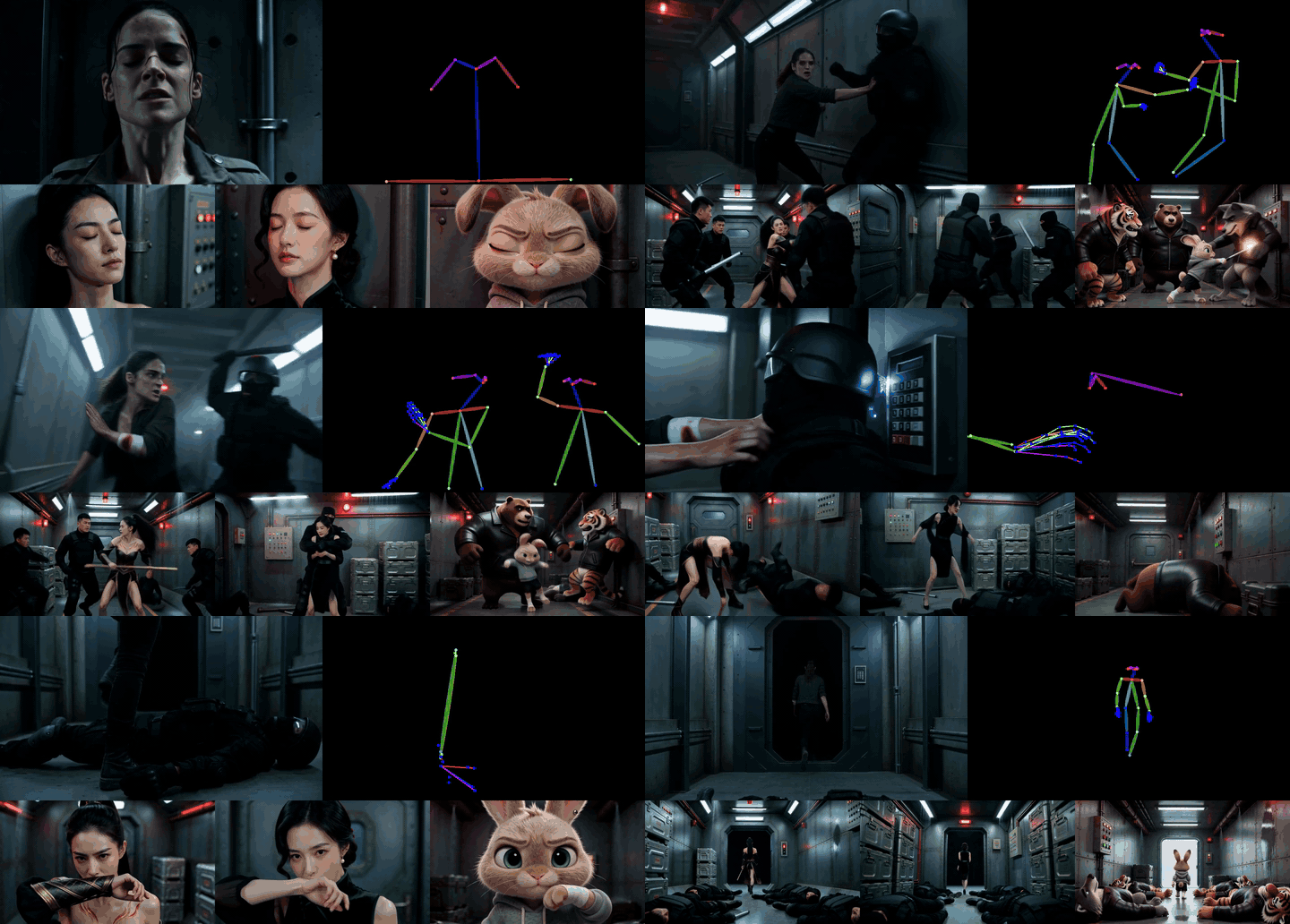
Top: the reference and its skeleton. Bottom: three takes generated on MiniMax H3 from that skeleton — same prompts and character sheets as the depth-map demo, only <Video 1> swapped. Prompts with seeds: docs/prompts/*_pose.txt.
--control pose — OpenPose-style skeleton video from DWPose (YOLOX-L + RTMPose whole-body, Apache-2.0 code and weights): 18 body joints + 21-point hands, faces off by default. Tracked across frames (identity by IoU, visibility hysteresis, One-Euro smoothing) so it does not flicker. --keypoints x.json dumps every skeleton. pip install "reshot[pose]"; weights (~340 MB) download once, or --checkpoint-dir. Measured 306 ms/frame on an M2 Max CPU; the 12 s demo in 90 s.
--pose-detect-every N (default 3): the detector runs every third frame, skeletons supply the boxes in between, cuts re-detect. vs every frame on the 289-frame demo: 280 frames identical people count, 80 % of joints within 2 px, 35 % faster.
--control canny — white edge lines, no model. --control depth,pose,canny writes all three in one go.
Web page: What to make — depth map / skeleton / lines — with the prompt line for your target × type and a keypoints download.
Verified on MiniMax H3: the three demo takes re-made with the skeleton as <Video 1> reproduce the six beats like the depth takes (GIF above). One take per condition, different seeds — read it as "pose works as a reference video too", not "pose is better".
ComfyUI: ComfyUI-ReShot 0.2.0 adds Pose Map / Pose Video / Canny Map / Canny Video nodes.
Closes #6. Full notes in CHANGELOG.md.