
An animation engine for explanatory math videos
Important
This is a fork of Manim Community Edition with a custom Streaming Web Renderer designed for mobile apps and web applications.
This fork adds a streaming web renderer that outputs animations as interactive HTML files instead of videos. Perfect for:
- React Native / Mobile Apps: Real-time animation rendering in WebViews
- Web Applications: Instant preview without video encoding
- Interactive Content: Animations that load progressively as they render
✅ Same Manim API - Use all standard Manim classes and animations ✅ Real-time Streaming - Frames are written to HTML as they're generated ✅ Full Feature Support - LaTeX, shapes, camera movements, all animations ✅ WebView Ready - Built-in React Native WebView integration ✅ Production Quality - Renders match Cairo output exactly
# Install this fork
pip install git+https://github.com/yourusername/ManimLive.git

# Or for local development
git clone https://github.com/yourusername/ManimLive.git
cd ManimLive
pip install -e .# Render any scene to streaming HTML
manim your_scene.py YourScene -ql --renderer stream
# Output: ./media/stream.htmlfrom manim import Scene, Circle, MathTex, Write, Create, config
# Configure streaming renderer
config.renderer = "stream"
class MyScene(Scene):
def construct(self):
circle = Circle()
formula = MathTex("E = mc^2")
self.play(Create(circle), Write(formula))
self.wait()
# Render
scene = MyScene()
scene.render()
# Read the generated HTML
with open('./media/stream.html', 'r') as f:
html_content = f.read()
# Send to mobile app, save to database, etc.The generated HTML includes WebView message handlers:
// In your React Native app
import { WebView } from 'react-native-webview';

<WebView
  source={{ html: animationHTML }}
  onMessage={(event) => {
    const data = JSON.parse(event.nativeEvent.data);
    // data.type === 'frame_added'
    // data.type === 'streaming_complete'
  }}
/>Manim is an animation engine for explanatory math videos. It's used to create precise animations programmatically, as demonstrated in the videos of 3Blue1Brown.
Note
This fork is based on Manim Community Edition (ManimCE), which is maintained and developed by the community. The original Manim was created by Grant Sanderson (3Blue1Brown). For the upstream version, visit ManimCommunity/manim.
Caution
These instructions are for the community version only. Trying to use these instructions to install 3b1b/manim or instructions there to install this version will cause problems. Read this and decide which version you wish to install, then only follow the instructions for your desired version.
Manim requires a few dependencies that must be installed prior to using it. If you want to try it out first before installing it locally, you can do so in our online Jupyter environment.
For local installation, please visit the Documentation and follow the appropriate instructions for your operating system.
Manim is an extremely versatile package. The following is an example Scene you can construct:
from manim import *


class SquareToCircle(Scene):
    def construct(self):
        circle = Circle()
        square = Square()
        square.flip(RIGHT)
        square.rotate(-3 * TAU / 8)
        circle.set_fill(PINK, opacity=0.5)

        self.play(Create(square))
        self.play(Transform(square, circle))
        self.play(FadeOut(square))
In order to view the output of this scene, save the code in a file called example.py. Then, run the following in a terminal window:
manim -p -ql example.py SquareToCircleYou should see your native video player program pop up and play a simple scene in which a square is transformed into a circle. You may find some more simple examples within this GitHub repository. You can also visit the official gallery for more advanced examples.
Manim also ships with a %%manim IPython magic which allows to use it conveniently in JupyterLab (as well as classic Jupyter) notebooks. See the
corresponding documentation for some guidance and
try it out online.
The general usage of Manim is as follows:
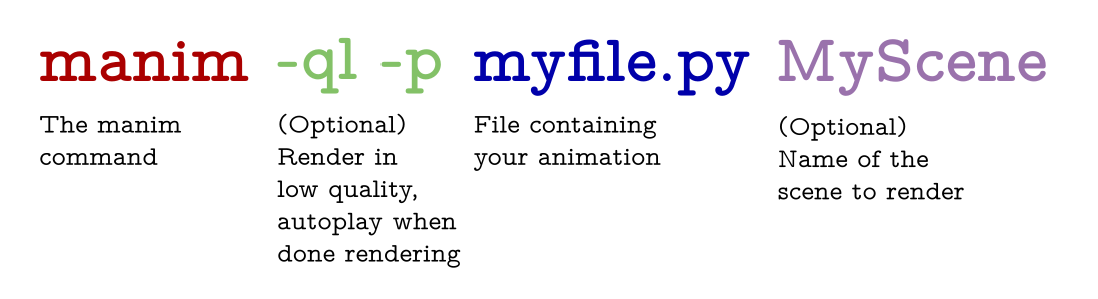
The -p flag in the command above is for previewing, meaning the video file will automatically open when it is done rendering. The -ql flag is for a faster rendering at a lower quality.
Some other useful flags include:
-sto skip to the end and just show the final frame.-n <number>to skip ahead to then'th animation of a scene.-fshow the file in the file browser.
For a thorough list of command line arguments, visit the documentation.
Documentation is in progress at ReadTheDocs.
The community also maintains a docker image (manimcommunity/manim), which can be found on DockerHub.
Instructions on how to install and use it can be found in our documentation.
If you need help installing or using Manim, feel free to reach out to our Discord Server or Reddit Community. If you would like to submit a bug report or feature request, please open an issue.
Contributions to Manim are always welcome. In particular, there is a dire need for tests and documentation. For contribution guidelines, please see the documentation.
However, please note that Manim is currently undergoing a major refactor. In general, contributions implementing new features will not be accepted in this period. The contribution guide may become outdated quickly; we highly recommend joining our Discord server to discuss any potential contributions and keep up to date with the latest developments.
Most developers on the project use uv for management. You'll want to have uv installed and available in your environment.
Learn more about uv at its documentation and find out how to install manim with uv at the manim dev-installation guide in the manim documentation.
We acknowledge the importance of good software to support research, and we note that research becomes more valuable when it is communicated effectively. To demonstrate the value of Manim, we ask that you cite Manim in your work. Currently, the best way to cite Manim is to go to our repository page (if you aren't already) and click the "cite this repository" button on the right sidebar. This will generate a citation in your preferred format, and will also integrate well with citation managers.
Our full code of conduct, and how we enforce it, can be read on our website.
The software is double-licensed under the MIT license, with copyright by 3blue1brown LLC (see LICENSE), and copyright by Manim Community Developers (see LICENSE.community).