Dungeons
Dungeons are procedurally generated structures inherent to dedicated dimensions and therefore detached from the normal worlds.
The bigger part of the gameplay loop takes place in dungeons, where you fight monsters and gather loot - mainly in form of equipment.
To enter dungeons you have to obtain a dungeon device which can be crafted using a nether star, four netherite ingots and four obsidian.
A placed dungeon device lets you open six portals to a newly generated dungeon by interacting with it and pressing the "Open" button.
Interact with those portals to get teleported into the dungeon.
Each portal can only be used once and will close afterwards.
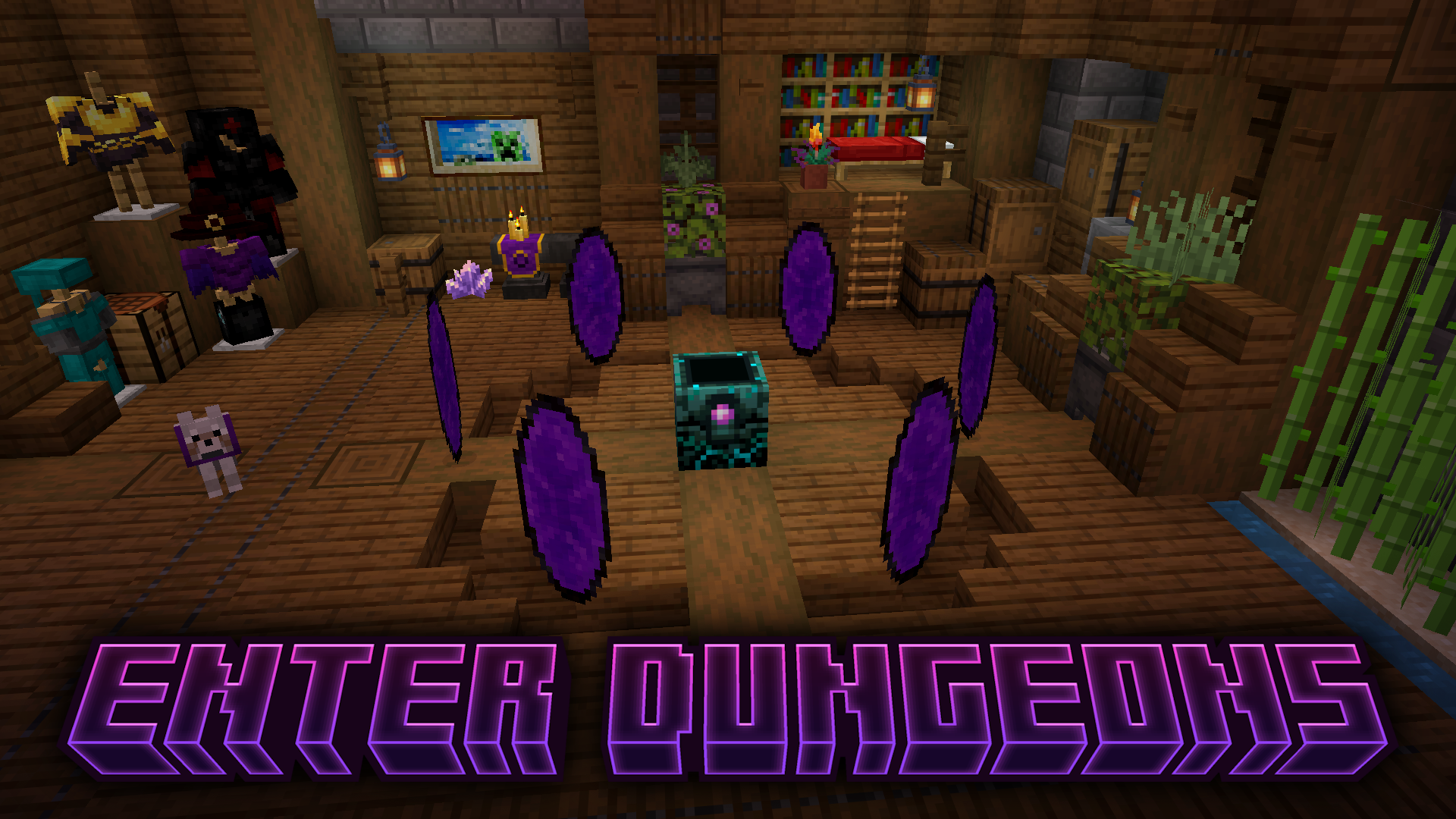
Dungeons can be exited via a portal at its entrance or portals that generate in boss rooms after defeating the boss.
Dying inside a dungeon will cause the player to respawn at the dungeon device.
Players that left while inside a dungeon will also spawn at the dungeon device when joining again.
A players dungeon level determines the difficulty and rewards of dungeons.
Enemies in higher level dungeons wear better armor, have more/better status effects and have additional modifiers affecting them.
The dungeon level is displayed inside the dungeon device aswell as in chat messages upon change.
Killing at least one boss inside a dungeon grants one progress to all players inside with a level lower or equal to the dungeon level.
Killing multiple bosses does not grant multiple progress points.
Upon reaching three progress a players level increases and the progress is set to zero.
Dying inside a dungeon will remove a level and set the progress to zero.
Some aspects can cause a dungeon to be higher level or grant increased progress on completion.
Operators can use the /dungeonlevel command to set a players dungeon level.
Dungeons contain a large amount of enemies wearing equipment scaled by the dungeon level.
By default each dungeon contains three bosses which are spread evenly across the dungeon.
"Loot Goblins" are normal enemies that are guaranteed to drop all equipment and spawn randomly.
They can be identified by their armor trims.
"Elites" are stronger enemies that drop aspect items.
They can be identified by their increased size and red skull particles.
Totems are encounters that can randomly be generated in dungeons.
Activating it will spawn a group of enemies and killing them will reward a totem item.
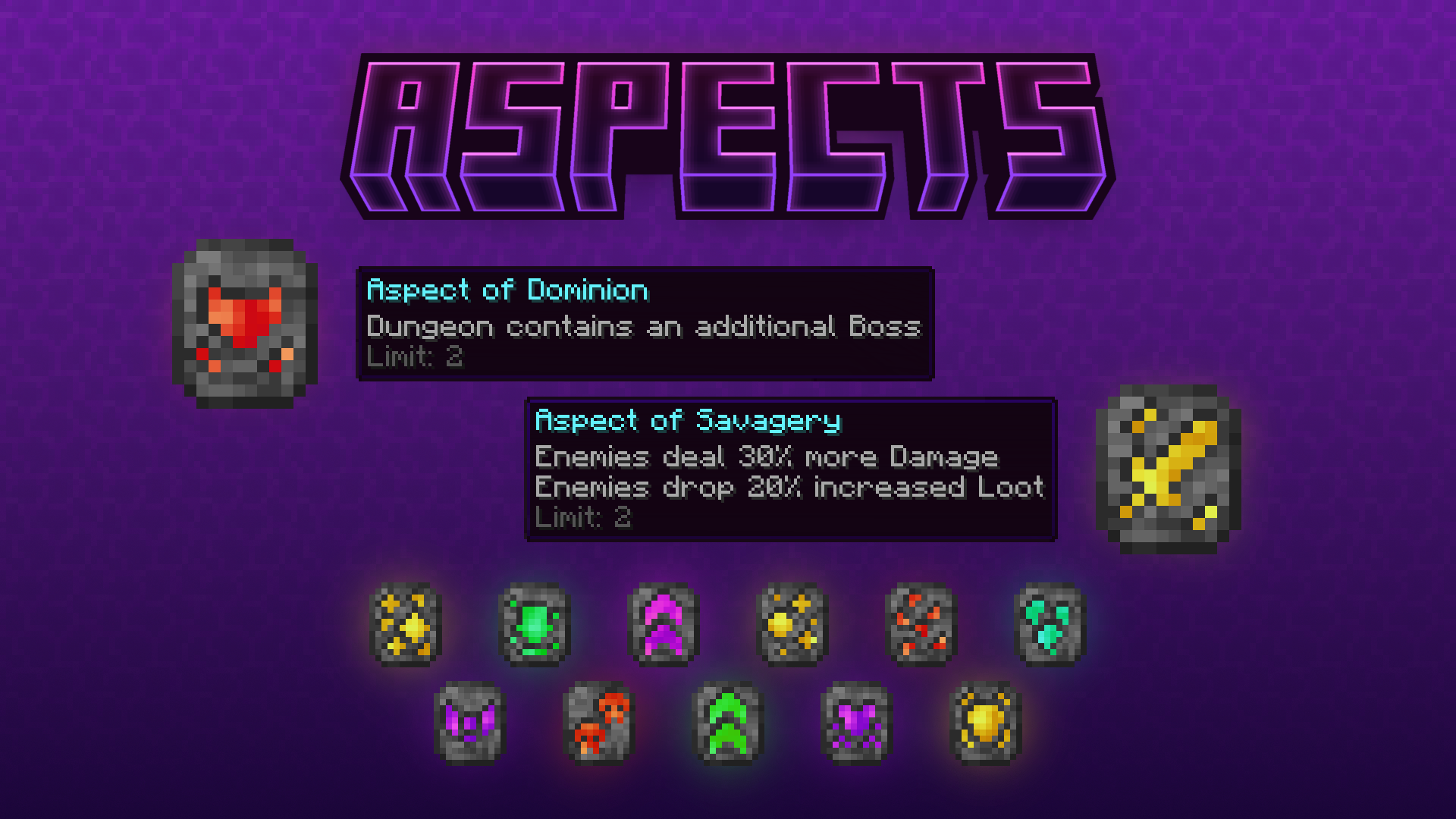
Aspects can be placed into the dungeon device before opening a dungeon to modify it.
They are a guaranteed drop from elite enemies in dungeons.
Up to four aspects can be used at a time.
When opening a dungeon one item from each stack will be removed.
Aspects that are not applicable due to being blocked by another aspect or exceeding its limit will not be consumed.
Aspects can, among other things, increase the amount of enemies, make enemies stronger in exchange for more loot, and force special encounters.
Dungeon types determine the dungeons structure (nether or stronghold) and define the monster variety.
Each player has a current dungeon type that is used for dungeons opened by it.
This dungeon type gets rerolled upon completing a dungeon.
Dungeons are genereated using prebuilt rooms that are chained after each other.
The layout is linear with at least two junctions.
At junctions a wither skull indicates the direction leading to a dead end containing a mini boss.