Home
[This wiki is under development]
Gridpp is post-processing tool for gridded weather forecasts. It consists of a library of commonly-used functions and a command-line tool that can apply a set of post-processing methods on forecast files in NetCDF. Gridpp is written in C++ but offers python and R bindings to the functions in the library. The tool is used at MET Norway to produce operational weather forecasts for Yr (https://www.yr.no).
The tool includes features such as:
- A variety of methods for downscaling a forecast from a coarse grid to a fine grid
- A variety of methods for calibrating the downscaled grid based on a set of parameters
- Computationally efficient neighbourhood methods to compute neighbourhood min, mean, max, and any quantile.
- Data assimilation using optimal interpolation (OI) to merge observations and gridded forecasts (deterministic or ensemble).
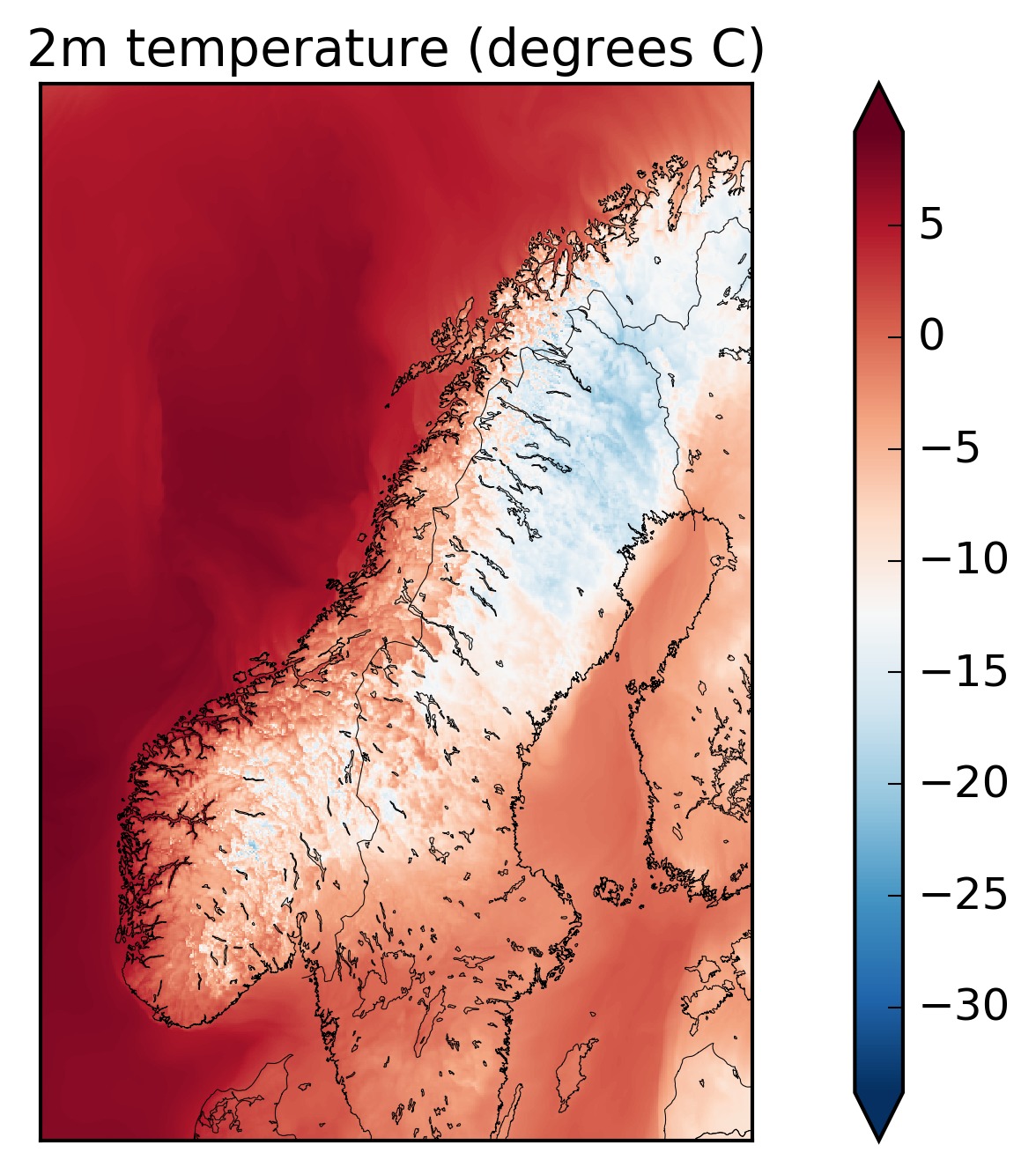
We have created a dataset that can be used for testing gridpp. The set includes two files that can be downloaded here: input file (315 MB) and output file (0.7 MB).
The output file contains a small domain covering south eastern Norway and is suitable for quick testing. Download the output_large file (58 MB) if you want to test gridpp on the whole Scandinavian peninsula (but computation is longer).
The input.nc file contains weather forecasts at 2.5 km resolution from the Metcoop-Arome model used operationally by the Norwegian Meteorological Institute and Swedish Meteorological and Hydrological Institute. The forecast was initialized 2016-01-24 at 00 UTC and gives forecasts for 66 hours forward. Temperature, wind speed, and precipitation is included. This will allow you to test most of the features of gridpp.
The output.nc file is a template file at 1.0 km resolution that you will create forecasts for.