examples_temperature
Using "further test only unflagged values" helps eliminate large errors before refining the test. This ensures that erroneous values do not affect the statistics, and it can also lead to faster computation times.
A typical workflow for the quality control of temperature might be: first flagging large errors using a buddy test, then flagging smaller errors with an SCT (Statistical Consistency Test), and finally identifying stations with too few neighboring stations, where spatial statistical quality control may be limited (isolation test).

When using "Apply test (no combination / first test)" with different tests or different parameters, it is possible to visually compare the results. Here is an example, where we see the effect of changing T2pos and T2neg (named pos and neg arguments in Titanlib) for the SCT test. When using stations that are not shielded it is likely that they will indicate warmer temperature when exposed in the sun. Thus one can wish a different criteria according to if the temperature deviate positively or negatively from the statistical values.

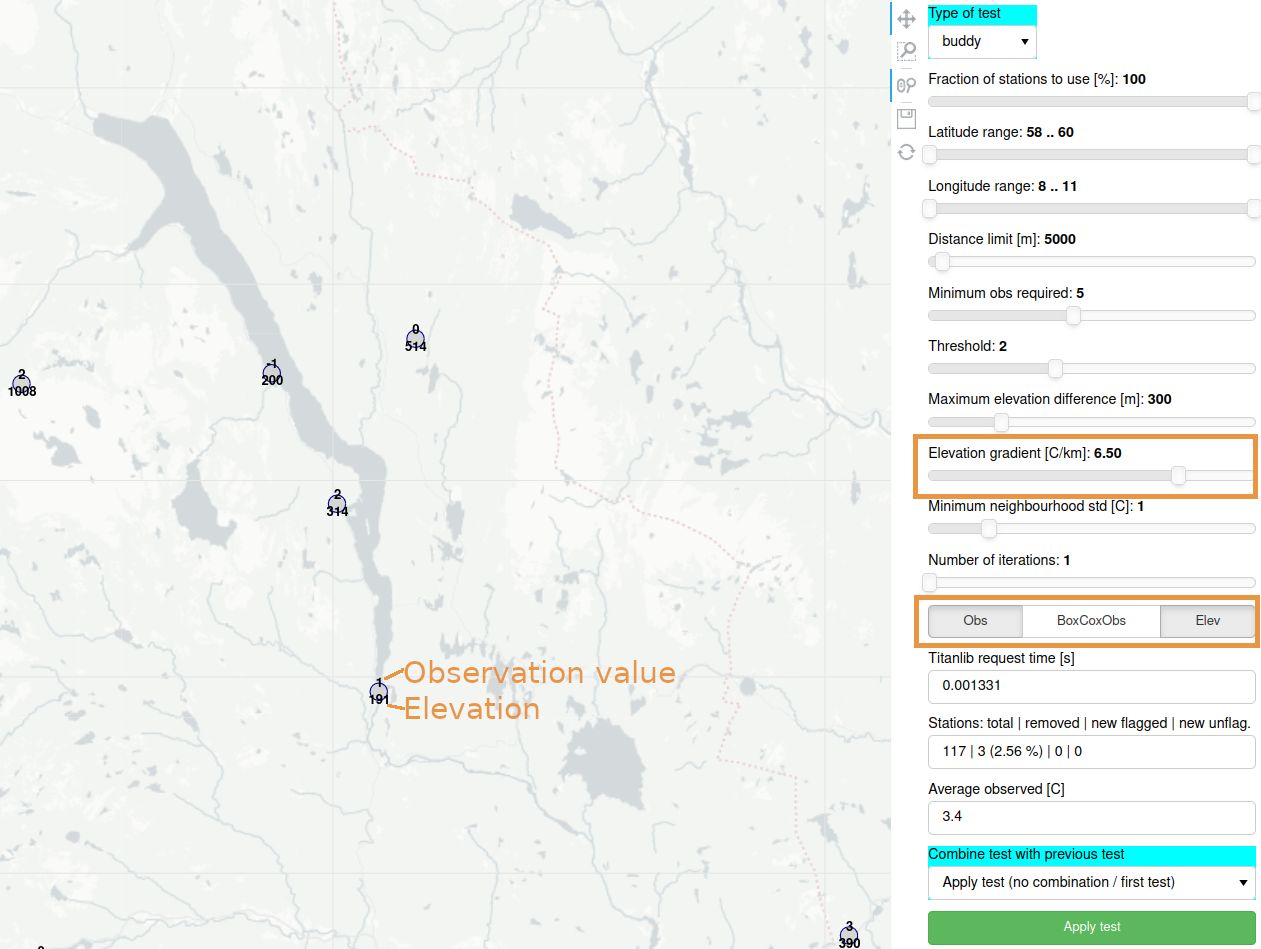
The temperatures can be corrected for elevation by setting a temperature gradient as shown below. Clicking the [Elev] button before running the test will also display the elevation values below the original observation values. Before running the spatial tests, one may check the elevation data by comparing them to a digital elevation model (DEM check) and, if necessary, fill in any missing elevation values and flag incoherent data.