Monte Carlo civilization simulator exploring systemic resilience, collapse dynamics, ecological overshoot, governance architectures, and Kardashev-scale energy progression.
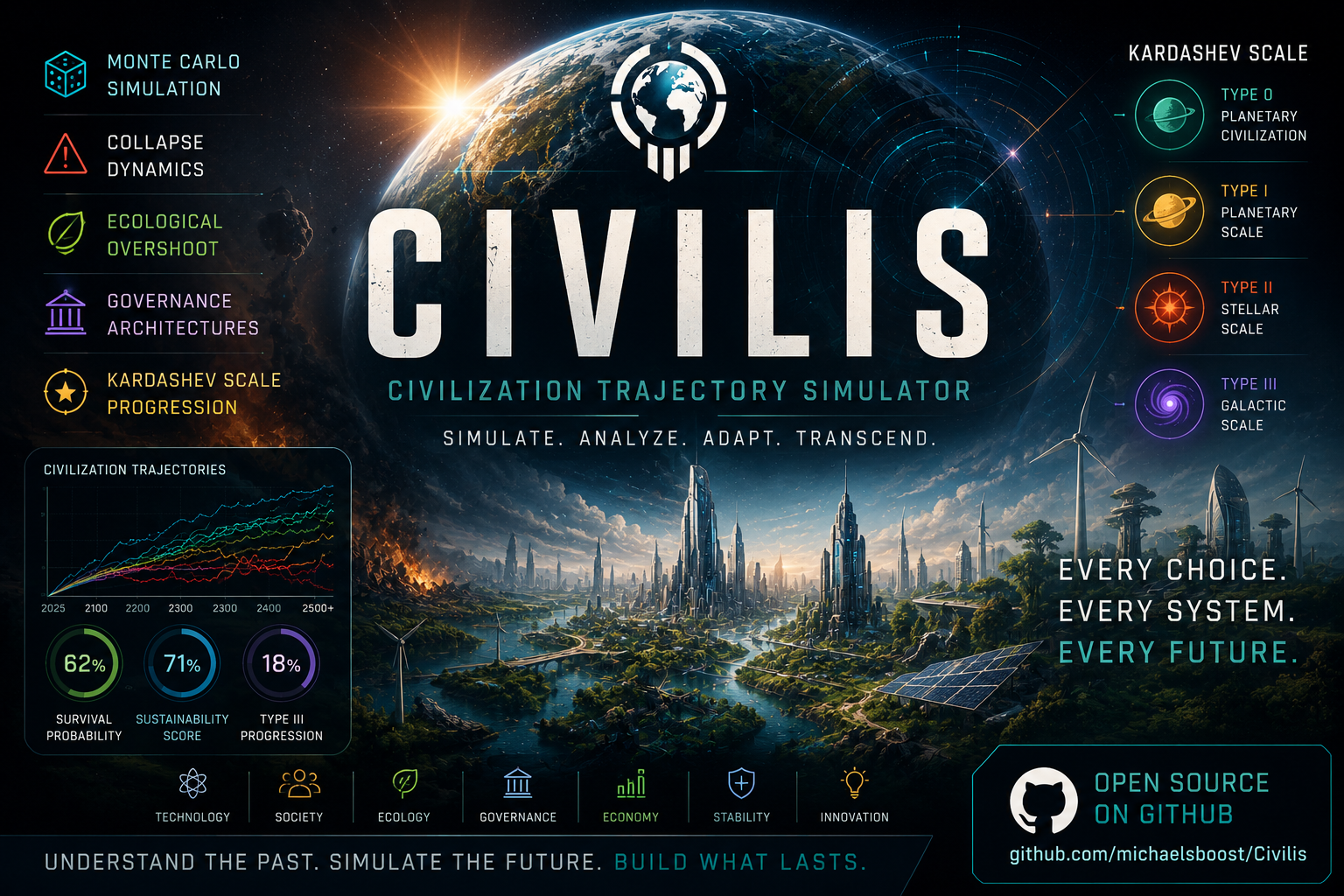
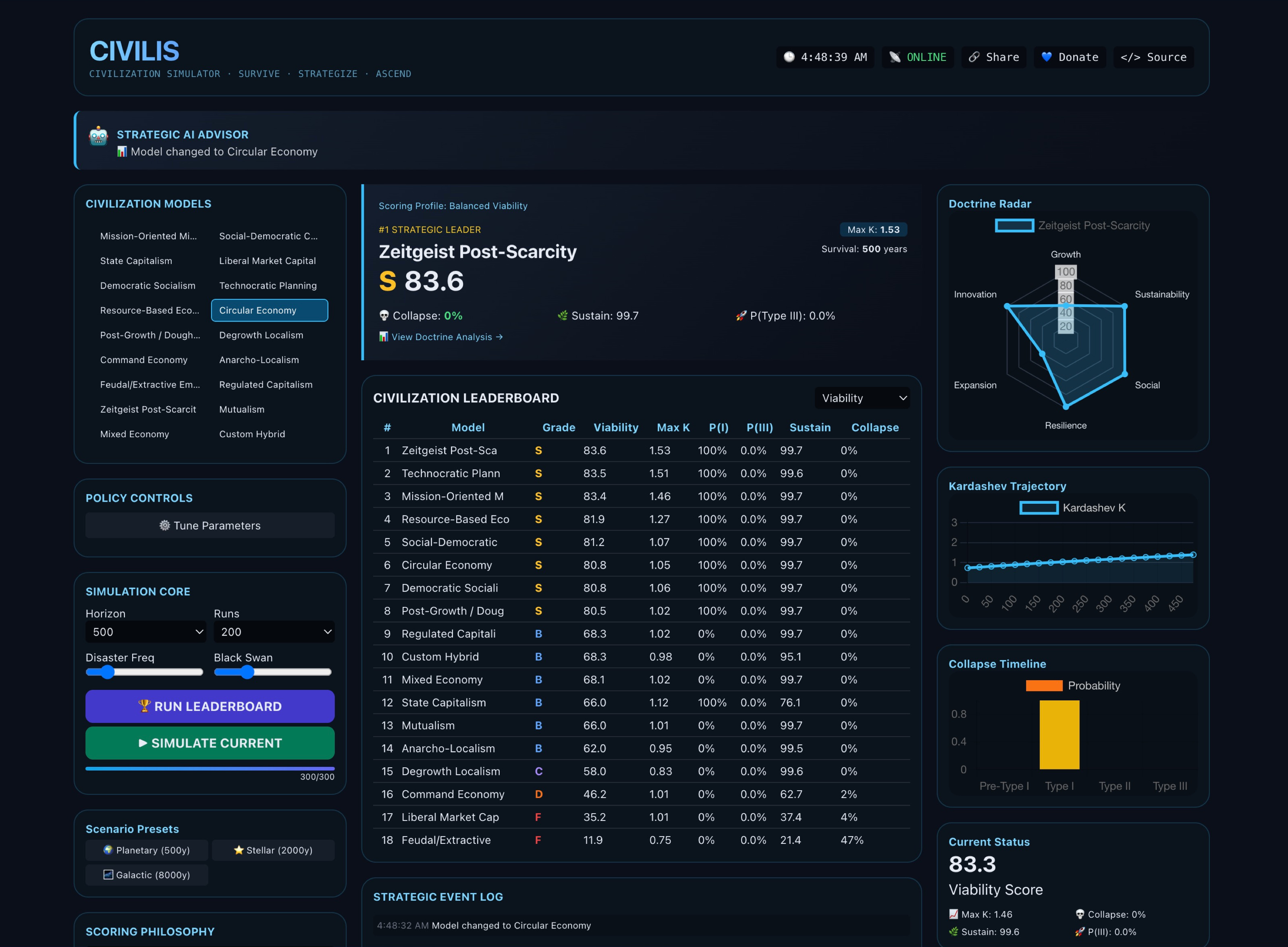


Civilis is an open-source civilization trajectory simulator built with modern web technologies.
It models how civilizations evolve over centuries and millennia under competing pressures such as:
- energy growth
- ecological stress
- inequality
- institutional strength
- innovation
- corruption
- automation
- war risk
- social trust
- resource depletion
- long-term planning
Rather than simulating individual people, Civilis simulates large-scale systemic behavior.
The project uses Monte Carlo simulation methods to explore probabilities of:
- collapse
- sustainability
- resilience
- technological progression
- planetary stability
- Kardashev-scale advancement
Civilis is designed as an educational systems-analysis sandbox for exploring long-term civilization tradeoffs.
Imagine taking an entire civilization — its economy, government, technology, environment, energy production, social stability, and resource consumption — and fast-forwarding it hundreds or thousands of years into the future.
That’s what Civilis does.
The simulator asks questions like:
- What happens if a civilization grows too fast?
- What happens if inequality becomes extreme?
- What happens if resources run low?
- What systems survive crises better?
- What systems become unstable over time?
- Can a civilization become highly advanced without collapsing ecologically?
Civilis does not try to predict the future.
Instead, it models probabilities.
For example:
- one simulation may experience war
- another may experience technological breakthroughs
- another may experience ecological collapse
- another may remain stable for thousands of years
By running hundreds or thousands of simulations, patterns begin to emerge.
The project is essentially a large systems experiment.
Not:
“Which ideology is correct?”
But:
“What kinds of systemic behaviors become more stable or unstable over very long periods of time?”
Additional technical notes are linked directly here for mobile and desktop GitHub users:
- 📘 Model Notes — explains the simulation math, Kardashev equation, viability scoring, collapse dynamics, and scenario logic
- ⚙️ Function Reference — explains what the main JavaScript functions do and how the simulation engine is organized
Monte Carlo simulation means the model runs hundreds or thousands of randomized simulations instead of assuming history follows one fixed path.
Each run introduces uncertainty:
- disasters
- breakthroughs
- wars
- resource crises
- instability
- environmental pressure
- black swan events
The simulator then compares outcomes statistically.
Instead of asking:
“What will happen?”
Civilis asks:
“What outcomes become more or less likely under different systemic conditions?”
Civilis models civilization advancement using the Kardashev Scale:
| Type | Description |
|---|---|
| Type 0 | Modern civilization |
| Type I | Planetary-scale energy civilization |
| Type II | Stellar-scale civilization |
| Type III | Galactic-scale civilization |
Energy usage is converted into Kardashev estimates using:
Where:
- (K) = Kardashev level
- (P) = total power consumption in watts
Civilis scores civilizations using a weighted viability model:
Where:
- (G) = growth potential
- (E) = ecological health
- (W) = societal wellbeing
- (S) = survival probability
- (R) = resilience
- (I) = innovation
Different scoring profiles adjust the weights depending on whether the user wants to prioritize survival, ecology, expansion, human wellbeing, or post-scarcity transition.
Collapse is modeled as an emergent systems risk:
Where:
- (E_d) = ecological degradation
- (I_n) = inequality
- (W_r) = war risk
- (T_s) = trust decay
- (R_d) = resource depletion
- (C_r) = corruption
Civilis treats collapse as something that emerges from interacting pressures, not from one single variable.
| Metric | Meaning |
|---|---|
| Viability Score | Overall long-term systemic stability |
| Max K | Highest Kardashev level reached |
| Collapse % | Probability of systemic collapse |
| Sustain | Ecological + societal sustainability score |
| P(Type I) | Probability of reaching planetary-scale civilization |
| P(Type III) | Probability of reaching galactic-scale civilization |
The simulator rewards civilizations that can sustain advancement without self-destruction.
- ✅ Monte Carlo civilization simulation
- ✅ Collapse probability modeling
- ✅ Kardashev-scale progression analysis
- ✅ Planetary / stellar / galactic scenarios
- ✅ Governance model comparisons
- ✅ Ecological overshoot modeling
- ✅ Black swan event simulation
- ✅ Resource depletion systems
- ✅ Institutional stability modeling
- ✅ Automation & post-scarcity analysis
- ✅ Sustainability scoring
- ✅ Civilization leaderboard
- ✅ Interactive radar charts
- ✅ Collapse timeline visualization
- ✅ Web Share API support
- ✅ Progressive Web App support
- ✅ Offline capable
- ✅ Open source
- Mission-Oriented Mixed Economy
- Social-Democratic Capitalism
- State Capitalism
- Liberal Market Capitalism
- Democratic Socialism
- Technocratic Planning
- Resource-Based Economy
- Circular Economy
- Post-Growth / Doughnut
- Degrowth Localism
- Command Economy
- Anarcho-Localism
- Feudal / Extractive Empire
- Regulated Capitalism
- Zeitgeist Post-Scarcity
- Mutualism
- Mixed Economy
- Custom Hybrid
Civilis is built entirely with lightweight modern web technologies.
- Alpine.js
- Tailwind CSS
- Chart.js
- JavaScript
- Monte Carlo probabilistic modeling
- Weighted systemic scoring
- Kardashev-scale energy calculations
- Collapse-risk modeling
- Scenario-based long-horizon simulation
- Canvas API
- LocalStorage API
- Web Share API
- Progressive Web App APIs
- lightweight
- browser-native
- offline capable
- no backend required
- fully client-side
- easy to fork
- open-source
➡️ https://michaelsboost.com/Civilis
Clone the repository:
git clone https://github.com/michaelsboost/Civilis.git
cd civilis
Start a local server:
python3 -m http.server 8000Then open:
http://localhost:8000Civilis is an experimental educational systems simulator.
The results are speculative and heavily dependent on:
- assumptions
- parameter weighting
- probabilistic modeling
- simplifications of real-world complexity
The project is intended for exploration, systems thinking, and discussion — not prediction.
Pull requests, ideas, improvements, and bug fixes are welcome.
Areas for improvement include:
- simulation realism
- systems balancing
- visualization
- mobile optimization
- accessibility
- mathematical refinement
- additional civilization models
- AI-assisted analysis tools
Civilis is an independent open-source research project built and maintained by one person.
If you find the simulator interesting, useful, or worth supporting:
- ⭐ Star the repository
- 📢 Share the project
- 🧠 Contribute ideas or improvements
- 💸 Support development: https://michaelsboost.com/donate
Support helps fund continued development, research, testing, infrastructure, and future simulation systems.
Civilis is open-source software licensed under the MIT License.
See: LICENSE
Michael Schwartz
https://michaelsboost.com