A minimal implementation of DINO self-supervised learning with a ViT-S/16 backbone. Trained from scratch and evaluated on the Food-101 dataset.
Weighted k-NN evaluation on Food-101 validation features:
| k | Top-1 accuracy | Top-5 accuracy |
|---|---|---|
| 5 | 64.09% | 79.93% |
| 10 | 66.38% | 83.47% |
| 20 | 67.59% | 86.17% |
| 100 | 67.81% | 88.72% |
The exported ViT backbone is published at here.
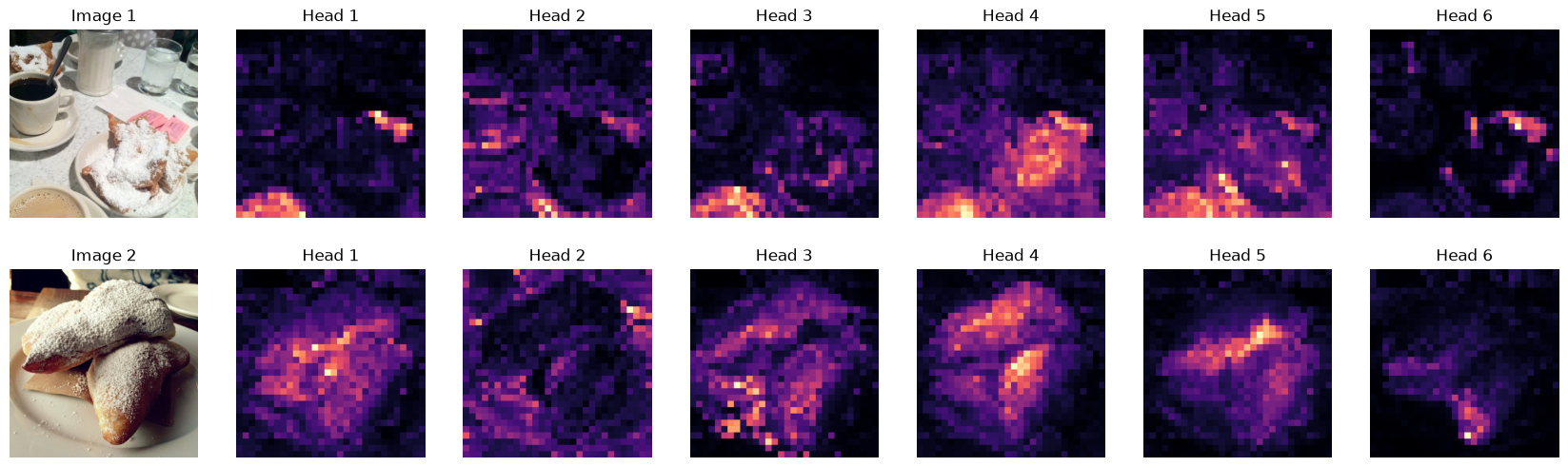
- DINO model, projection head, loss, and ViT implementation in
dino/ - Food-101 data pipeline and DINO multi-crop augmentation in
data.py - Training entrypoint in
train.py - Weighted k-NN evaluation in
eval_knn.py - Hugging Face ViT exporter in
hf_exporter.py - Default and ViT-S/16 model configs in
config/
Requirements:
- Python 3.12+
uv
Install dependencies:
uv syncThe default dataset is ethz/food101 from the Hugging Face Hub. It is downloaded automatically on the first training or evaluation run and cached under ./dataset/ethz/food101.
DINO training uses the train split without its labels. k-NN evaluation indexes train features and reports accuracy on the validation split.
Run the default config:
uv run python train.pyDefaults are ViT-S/16, Food-101, CUDA, 300 epochs, bf16, torch.compile, and batch size 32. Outputs, configurations, and checkpoints are written under logs/<run-name>/.
Common Hydra overrides:
uv run python train.py device=auto dataloader.batch_size=16 n_epochs=100 torch_compile=falseSee config/default.yaml and config/model/vit-s-16.yaml for all settings. device=auto selects MPS, XLA, or CPU when CUDA is unavailable.
To log to Weights & Biases, add the following to .env and enable it:
WANDB_API_KEY=...uv run python train.py wandb=trueEvaluate the teacher backbone in a training checkpoint with similarity-weighted k-NN:
uv run python eval_knn.py ./logs/<run-name>/ViT-S-16.pthThe evaluator L2-normalizes CLS features, finds nearest training examples with FAISS inner-product search, and weights each class vote by exp(similarity / temperature). It evaluates k = 5, 10, 20, 100 by default and writes the index, labels, and validation embeddings to ./eval_embeddings.
Useful overrides:
uv run python eval_knn.py ./logs/<run-name>/ViT-S-16.pth \
  --model-key student_model --nb-knn 10 20 100 --temperature 0.07
Reuse cached evaluation inputs:
uv run python eval_knn.py --load --nb-knn 5 10 20 100Export the teacher ViT backbone from a training checkpoint in Transformers format:
uv run python hf_exporter.py \
  ./logs/<run-name>/ViT-S-16.pth \
  ./DINOv1-ViT-S-16-food101
Load the published model:
from transformers import AutoImageProcessor, ViTModel

processor = AutoImageProcessor.from_pretrained("mnjm/DINOv1-ViT-S-16-food101")
model = ViTModel.from_pretrained("mnjm/DINOv1-ViT-S-16-food101")
inputs = processor(images=image, return_tensors="pt")
image_features = model(**inputs).last_hidden_state[:, 0]@article{caron2021emerging,
title={Emerging Properties in Self-Supervised Vision Transformers},
author={Caron, Mathilde and Touvron, Hugo and Misra, Ishan and J{\'e}gou, Herv{\'e} and Mairal, Julien and Bojanowski, Piotr and Joulin, Armand},
journal={Proceedings of the IEEE/CVF International Conference on Computer Vision},
year={2021}
}