Repository navigation
Gameplay And Iteration
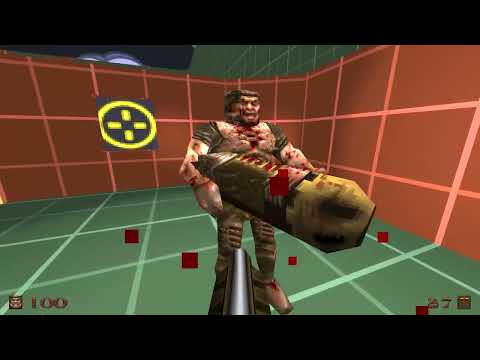
My process for iteration involved prioritizing both the most game-breaking issues, and secondly the quickest to solve issues. Then, addressing any remaining issues that play testers had noted. Feedback from play test one as well as my own experience watching play testers charged the motivation behind changes made.
An example of something that changed through this was that a loop back around to the beginning area, for a final boss fight, was added. An issue brought up during feedback was that the level felt like it ended on a low note and too quickly. By adding this in, it was a cost effective method (in terms of not creating a completely new area) of providing a final boss fight.
 This screenshot shows one highlight of the level, which is the carnival-ride themed area. The goal of this was to create combat that would occur while the player was on a moving platform. When the player enters the area, they step onto the middle platform, and the yellow door in the middle closes behind them. On either side is a low-tier enemy. Stepping on to the platform also triggers the platform to move downward towards the end goal.
This was one of the more challenging parts. One issue was getting the enemies to remain stationary, while also allowing the player to trigger a secret button that would open both their yellow doors (thus, allowing them to shoot the enemies before getting on to the platform where it would be harder.) The work around for this was iterative play testing while changing the sizing on the walls of the platform so that they would be just high enough that they wouldn't escape, but low enough that the player could still shoot.
 Another highlight of this map is the loop back around to the beginning. The bars depicted in this photo can be seen from the first area of the game. This allows players to gain curiosity about the area before they're able to access it.
Once the player is inside the area, it gives them a moment of rest before they continue. Once the player leaves this area, the final boss spawns. While they aren't inherently aware of this, players still will take a moment, heal and grab the gun, then press the button. Having this section, instead of teleporting them directly into the boss area, allows highs and lows in intensity throughout the map.
One major point that was iterated on was the final encounter. Originally the game ended at the teleport shown below.

However, after Playtest 1 players found that the map ended too early and never hit high difficulty peaks. Therefore, the choice was made to have the player loop back around to the starting area. This way, the space could be reused while also making use of the already large, more open area. This also made exploration in the area more engaging, because the player was able to see the button that triggers the final boss fight from the very beginning, but unable to reach it.
This is what the space looked like prior to the addition of the loop.

This is what it looked like after.
 The player goes through the portal that previously ended the game and teleports to the room pictured above. The player is then able to take a moment to orient themselves after teleporting. Once ready, they can push the button on the wall, which drops the wall pictured below, revealing the final enemy directly across.

Another aspect changed between iterations was the placement of buttons. During playtesting, it was made apparent certain buttons were too far from their corresponding target. Therefore, certain buttons were changed so that the player could see the target while triggering the button.
Example before

Example after
 '
As the level progressed, small architectural details were added in order to better convey the theme. For example, one area was intended to be the carnival games section. The blockout alone did not accurately convey this, because the stalls just seemed like typical hallways. So, posters and small games (such as bottle toss in the image below) were added as detail.

Textures also significantly helped in demonstrating the intention behind each space. In order to enhance the appearance of these, small changes to brushes were made, such as making posters stick slightly off the wall.
